
Beautiful Beards, Beautiful Merkins
This article, read aloud:
Share: X · Facebook · LinkedIn · Reddit · Bluesky · Threads · Email
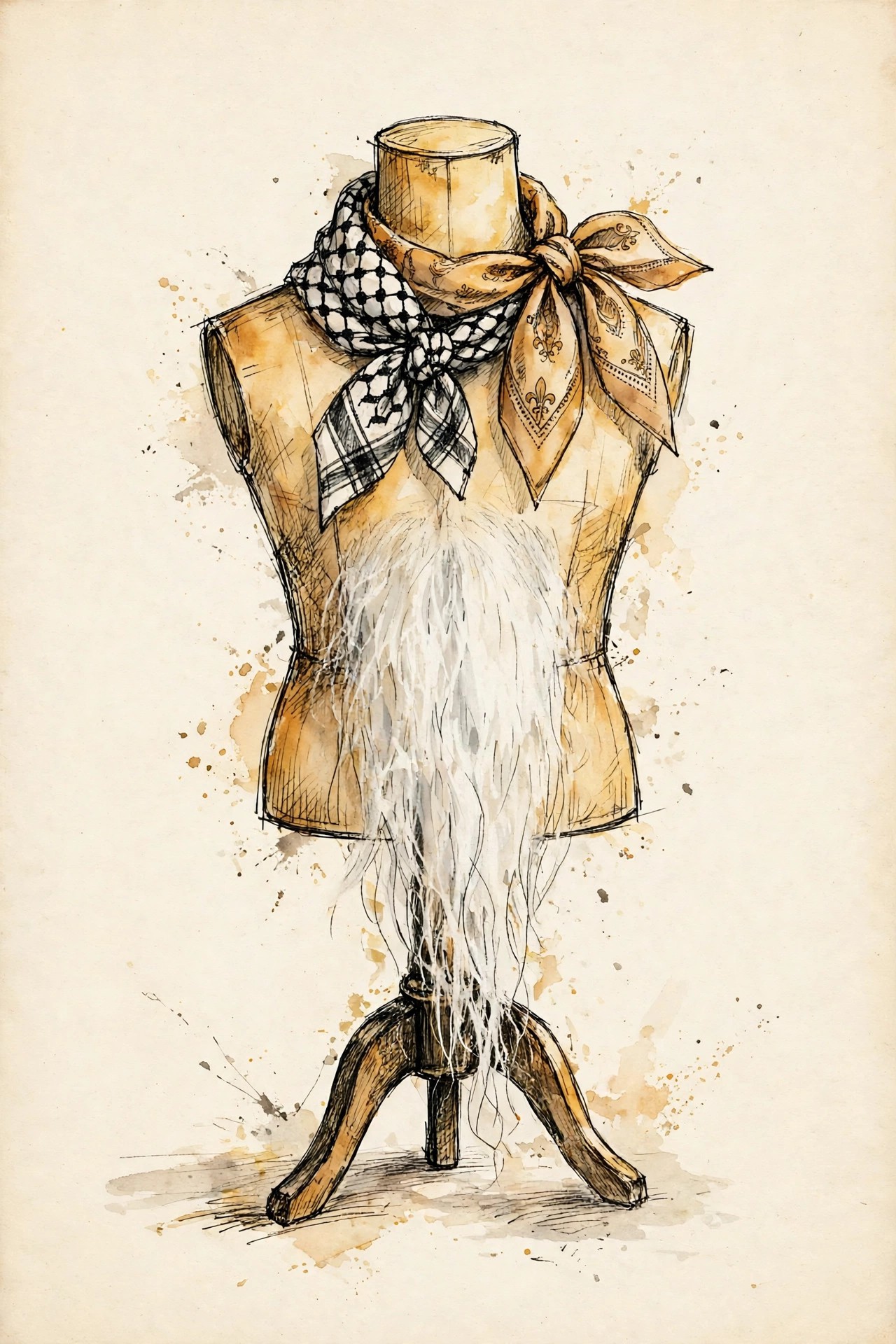
The keffiyeh is the revolutionary version of the Parisian French scarf, and the two garments do the same job for the same reason: the neck is the first honest ledger of age. A face can be maintained. It gets creams, budgets, filters, and eventually professionals. The neck testifies anyway, in double chins and triple chins and the wattle that arrives on schedule like a tax notice. French women solved this centuries ago with a square of silk worn high and a story about elegance. The revolutionary solved it with a square of checked cotton worn high and a story about solidarity. The stories differ. The curtain is the same curtain. And underneath both stories sits the mechanism nobody puts on the poster: most women cannot grow a large beard, and a beard is this same curtain grown at home for free, which makes the scarf a beautiful beard—a beautiful merkin—for the chin and the neck. I file this report from inside the vanity class it documents. My own scarves came home from Afghanistan as spoils of war, I wore them as a macho Hermès scarf, and my own white beard is Exhibit A. The rest of this field guide is the receipts. One procedural note before the evidence: the defendant in this courtroom is pretension—vanity, earnestness, and absurdity—and the indictments are drawn without respect of sex, because the author intends to be convicted under the same statute.
The neck keeps the books
Field observation, confirmed on every continent and at every income level: the face is the press release and the neck is the filing cabinet. A face can be lit, angled, painted, tightened, and photographed from above, which is the modern solution—an entire generation now holds its phone at the altitude of a ceiling fan, because geometry is the cheapest scarf ever sold. The neck declines all of it. The neck keeps the original books. It records the years in a hand nobody can forge and publishes them at throat height, in every photograph, at every dinner, forever.
The chin is where the ledger starts. One chin is youth's standard issue. The second chin arrives as the first entry in a longer account, and a third is compound interest. Skin that spent forty years winning its argument with gravity begins, politely and then less politely, to lose. Every portrait painter in history knew where the truth lived and shaded accordingly. The camera did not change the anatomy. It only raised the publication schedule from once an oil painting to four hundred times a day.
The field researcher learns to read a room by its curtains. Count them at any gathering of people past fifty: silk at the throat in Paris, cotton at the throat in Amman, wool at the throat in a Reykjavík winter, black knit at the throat of a California keynote. Different flags on identical fortifications. Nobody at the gathering mentions the fortifications. Everybody at the gathering built one.
A civilization facing an unfixable publication problem has exactly one move available to it, and every civilization makes it. It invents a curtain, and then it invents a noble reason for the curtain.
The Parisian original
The Frenchwoman of a certain age is the curtain's master engineer, and her instrument is the silk square—the Hermès carré and its thousand descendants—worn high, knotted with intent, riding exactly at the altitude where the ledger would otherwise open. The stated reason is elegance. The scarf finishes the outfit. The scarf pulls everything together. The scarf is chic, and chic is a word that ends conversations.
Notice what the instrument accomplishes while the stated reason does the talking. The silk is itself a testimony—it testifies to taste, to money, to a life correctly assembled—and while it testifies, the neck declines to. Two publications managed by one square of cloth: the wearer publishes what she chooses and seals what she does not. Paris refined this technology over centuries and exported it as fashion, which is the most successful cover story any technology ever had. The curtain crossed every border on earth by calling itself beautiful.
The revolutionary variant
The keffiyeh is the same instrument in checked cotton, worn at the same altitude, over the same ledger. The stated reason is solidarity: identity, resistance, a flag you can wear. Yasser Arafat, the garment's most famous modern wearer, arranged his with a care that forty years of hostile photography never caught slipping—draped, pinned by the agal, composed in every frame. Whatever else the man was doing in those photographs, his neck was not in them. The record of Arafat is a record of a headdress. Underneath it there was a man aging on the same schedule as every other man. The photographs decline to confirm this, which was rather the point.
The revolutionary variant improves on the Parisian original in one respect, and the improvement deserves its own line in the guide. The silk hides the wattle and displays the taste. The cotton hides the wattle and displays the virtue. Moral camouflage: the ledger stays sealed and a commitment is published in its place, so the wearer collects privacy and credit from a single garment. A woman posted a photograph this week, an old one, with a caption insisting that the advocacy in it is not a recent call, that the commitment predates the fashion. The caption is an audit, filed preemptively against no named auditor: not recent means early, early means senior, senior means hers by right of first wearing—and in the economy this guide is surveying, that audit is the real currency, because the scarf itself can be bought by anybody this afternoon. I take her at her word about the advocacy. Field guides are not in the business of doubting captions, and this guide is not about her. She is filed here as the opening specimen—not a target, an exemplar. She is also no stranger harvested from the internet: she is in Hawai'i, and the author has known her since she was fourteen and he was sixteen, which is precisely why she belongs in this guide—he is auditing his own world's plumage, beginning with the people he has known longest. There are a million of her, on every platform, in every cause, and the species is the subject here—the individual bird is just the one that flew across the notebook. The photograph she posted files a second report alongside her caption, and it is the older of the two: the scarf is riding high, at the classic altitude, doing the classic work. Both reports can be true. One of them is about the cause. The other is about the neck, and the neck has seniority over every cause ever photographed, hers included, mine included.
Radical chic and the signaling ledger
The Western chapter of this garment already has its scientific name, and it was coined in 1970 by Tom Wolfe: radical chic. Wolfe watched the privileged of New York adopt the symbols of revolutionary struggle as drawing-room fashion and named the maneuver exactly. The keffiyeh's Western career is radical chic's longest-running production—half a century now, outliving the Panthers' breakfast programs and every revolution it ever costumed, because the garment was never really about the struggle. It was about the signal the struggle sends across a room.
Underneath the signaling sits the reflection, which is the layer the wearer actually reads, and it is the true subject of this guide. Every garment in it is a mirror worn at the throat. The Parisian looks into her silk and sees the woman of taste she intends to be. The revolutionary looks into her checks and sees the ally, the witness, the self that history will approve of. The author looked into his shemagh and saw rakish—an intended self with better lighting. The scarf returns the intended self on demand, all day, in every shop window and every phone screen, and it never once returns the neck, because the neck is merely what is actually there. Radical chic is the name for this optical arrangement when the intended self happens to be a revolutionary: a mirror, framed as a flag, hung exactly where the ledger used to be.
Every scarf in this guide keeps two ledgers, and the signaling ledger is the one that pays. The Parisian silk signals capital and taste, and its taste is defined entirely by exclusion: the wearer is not cheap, not lower-class, not chasing a trend she found last week. The Western keffiyeh signals moral capital, subcultural capital, and it runs on the identical machinery pointed the other way: the wearer is not apolitical, not complacent, not aligned with power, not one of the comfortable dead. Same class-uniform function. Same border drawn through the same room. Opposite flag on the same fortification. A French sociologist built a career on this ledger, and the plain-language version fits on an index card: people wear their group's membership where it can be read at a glance, and the reading they want most is the one that says who they are not. The exchange-rate table for the whole taxonomy fits in one line, and this guide prints it like the equation it is: keffiyeh equals Hermès equals Gucci equals LV. Four currencies, one denomination—the legible sign, readable at twenty paces—differing only in which ledger the status is drawn on: money, taste, morality, war. Convert freely between them. The rate never changes, because the purchase is identical in every shop: a self, reflected back flattering, with the neck left out of the picture.
Temu Hermès and the relic audit
Every equation has a factory floor, and this one's is in the supply chain. The authentic article exists. In Hebron there is a factory—Hirbawi, the last keffiyeh looms in Palestine—weaving the genuine garment by hand, with waiting lists that form whenever the world remembers it exists. The Western mass of wearers never goes near it. They buy in bulk from Temu and Amazon, woven in China, delivered in days, priced like a sandwich. The garment of the Palestinian fellah is manufactured by Chinese factories, shipped by an e-commerce platform, and worn by the American bourgeoisie as a certificate of solidarity with the very people the supply chain bypassed. Temu Hermès—and barely that. The author's formula for the whole tier, printed at his strength: the signifier is the signification. If it quacks like a duck and walks like a duck, it's a duck. The pattern performs the entire politics. Provenance is a luxury tier, and most buyers decline the upgrade.
Americans should find the arrangement familiar, because patriotism was outsourced first. The Temu keffiyeh is the equivalent of buying your American flags from Alibaba. A large share of the flags waved at American parades are imported, overwhelmingly from China, which is why bills demanding origin labels on the flag keep getting introduced and keep going nowhere. The mechanism is identical and perfectly bipartisan: the symbol must be cheap, instant, and legible at distance, and its birthplace is an embarrassment nobody at the parade or the protest is checking. The flag taught the keffiyeh how.
Now run the authenticity inquisition, because this guide audits everything, and borrow the standard from the Church's oldest economy: the relic trade. The question for every Western wearer, asked in the inquisition's own Latin-hearted terms: is there the true dust and the true blood of the Palestinian people in your keffiyeh? Apply the standard honestly and it convicts the court. The author's own shemagh, by that standard, carries the true dust and the true blood of the brave mujahideen—spoils, carried home from Afghanistan in a soldier's luggage. He prints the claim as what it is: a joke he tells on himself. He never verified the dust. The buddy-story is his certificate of authenticity, and it is exactly as unverifiable as every other certificate in this market. That is the finding. The relic audit is the one audit no wearer in this guide can pass honestly, the author first in line—which is why the entire market, by silent treaty, agreed to grade on pattern alone and never ask about dust again.
And then the inquisition returns its darkest verdict, and this one is documentary, not decorative. If the mass-market keffiyeh carries any true dust and true blood at all, the likelier source is not the people on the label. Xinjiang produces the overwhelming majority of China's cotton, and the United States' Uyghur Forced Labor Prevention Act of 2022 writes it into law as a presumption: goods from Xinjiang are presumed to be products of forced labor unless proven otherwise. No individual scarf on any individual neck can be traced through that chain—untraceability is itself the finding, and this guide makes no claim about any specific garment. But the structure is documented, and the irony needs no assistance standing up: the one plausible relic inside the cheap solidarity keffiyeh is the suffering of a different Muslim people, unlisted on the label, unwoven into the pattern, and unread by the mirror. The fellah's scarf, woven at scale inside the other people's catastrophe, worn as a certificate of concern. The taxonomy has a bottom, and this is it.
The costume is older than the cause it currently serves, and literature keeps the receipt. In Les Misérables, Hugo puts his revolution on a barricade and staffs it with students and scholars—Enjolras and his Friends of the ABC, young men of the bourgeoisie to a boy, who had as much to do with the working man as a drama club does, or an undergraduate degree from the Royal Academy of Dramatic Art. They performed the revolution beautifully and died beautifully, and the actual people of Paris, in whose name the furniture was stacked in the street, mostly did not rise. The barricade was theatre with live ammunition. That is the keffiyeh's true ancestor: not the fellahin's headcloth but the student's costume, worn by the one class that can afford to die beautifully for the people—and, in the safer modern production, to pose beautifully for them. People ask whether I hear the people sing. No. I hear a bunch of drunken vanguard-of-the-proletariat rich kids from the university, getting everything they ever wanted off the power of the people, while the people in whose name the singing happens are at work and cannot attend the performance. The anthem is real. The choir is a drama society. The song is the scarf's soundtrack: sincere, stirring, and cast entirely from the class that can afford the production.
And then the snake completes itself, in public, on schedule. The Western women who wear the keffiyeh have acquired a nickname inside their own culture, and the nickname is bougie. Read that twice. The garment adopted to signal escape from the bourgeoisie has become a recognized uniform of the bourgeoisie—spotted at the brunch table and the gallery opening, priced into the outfit, filed by friend and foe alike under bourgeois. The revolution's scarf ends where every scarf in this guide ends: as a class badge on the class it was recruited to oppose. The tail is not hidden. The tail is the fashion.
The author will now file his suspicion at full strength, labeled as what it is. I think that the entire free Palestine movement, in its Western boutique edition, was just an opportunity for women to cover their awful necks. That is hyperbole, and the author knows it is hyperbole; movements are not founded as millinery, and no march in history was convened by a haberdasher. But hyperbole is a measuring instrument, and this one measures something true: it explains the speed. A cause that arrives carrying a flattering garment—one that seals the ledger, displays the virtue, and photographs like a portrait—does not have to recruit door to door. The mirror recruits. The men who adopted the same checked mirror by the thousand are standing in this guide's dock already, charged with the same vanity in a deeper voice, and the author, whose own awful neck has rotated through silk logic, war cotton, and a black cotton tube, files the suspicion against his own throat before he files it against anyone's. Believe the sentence at the strength it was offered: not as history, as a suspicion about why the fashion moved faster than the argument ever did.
Beautiful beards, beautiful merkins
Now the mechanism, stated plainly, because the whole guide hangs on it. Most women cannot grow a large beard. Most men can. The beard is the man's endogenous scarf—the same curtain, grown rather than bought, issued by the body at puberty and available in full by the time the ledger needs covering. One season of not shaving and the chin count becomes a state secret. The neckline retires from public life. Everything the books would publish disappears under a fabulous beard, and the man walks around with his filing cabinet strapped shut in plain sight.
Then the stories arrive, because a curtain requires a noble reason the way a flag requires a pole. Men call their curtain wisdom. They call it ruggedness, the prophet, the philosopher, the sea captain, the lumberjack. Women, who must accessorize the identical curtain, call theirs elegance in Paris and revolution everywhere the checked cotton flies. Same ledger hidden. Same story told about the curtain. The only difference in the entire arrangement is the supply chain: his is grown, hers is purchased.
This is why the scarf is a beautiful merkin, and the beard is a beautiful merkin that manufactures its own thread. A merkin, for the reader who has lived a sheltered life, is a covering from an older and less sentimental trade: a wig for the equipment, made to be seen in place of what it covers. That is the exact job description of every garment in this guide. A covering whose whole purpose is to be looked at instead of the thing underneath it. The beard does it with follicles. The carré does it with silk. The keffiyeh does it with a flag woven in. The craftsmanship varies. The purpose does not.
The beard also gets audited differently, which is the final proof of the story's power. A purchased curtain invites a question—what is she hiding? A grown curtain is never audited at all. It is admired. The man is asked about his beard the way a general is asked about his medals, and he answers with the story, and the story is believed, because a curtain a man grew reads as character while a curtain a woman bought reads as vanity. The ledger underneath is the same age either way.
Exhibit A is on my own face. The white beard there is not a philosophy and it is not a personality. It is the homemade model, and the chins it retired from circulation are no longer a public record. I grew my curtain and I have bought my curtain, and I am fluent in both dialects of the same sentence. Vanity, the field guide concludes, is distributed evenly across the species. Only the manufacturing differs.
A practitioner's footnote, from the only laboratory the author fully controls: the beard is a tool with settings. Grown long and wild, it adds volume of its own and joins the problem it was hired to hide—a wattle with its own wattle. Kept trimmed, it sculpts. It draws the jawline where the jaw is supposed to be and lets the neck read slimmer than the neck's own testimony, and the author testifies from direct experiment that on the days he shaves it down, the whole apparatus reads less fat. The dose makes the camouflage. Only a man who has run the trial on his own face, at several lengths, over several years, knows where the setting belongs—and every bearded man over fifty has run that trial, whether or not he admits he was conducting one.
A short census of curtains
For completeness, the guide records the related species. The turtleneck: the tech variant, a black curtain that announces the future while sealing the same ledger, standard issue for founders presenting themselves as inevitable. The clerical collar: a small white fence that announces the office and retires the throat beneath it. The aging rock star's scarf, worn at sixty in photographs taken at twenty paces: a curtain that announces the tour continues. The ascot, the cravat, the bandana tied high—each one a curtain, each one with its story, the stories getting grander as the cloth gets smaller. Civilizations are not embarrassed by this census. They are decorated by it.
Specimen No. 1: the author
The guide's final specimen is its author, who belongs in the collection because he was caught by his own field work. My scarves are shemaghs, technically speaking, and their provenance is a supply chain of exactly one link: a buddy of mine served as an imperial soldier in Afghanistan and came home with scarves—beautiful ones, a bunch of them—and gave me several. Spoils of war. I wore them constantly.
My reasons were the honest kind, the kind nobody prints on a poster. They were cool. They were beautiful. And a man requires a license to wear a beautiful scarf, and war is the license: I considered them a macho Hermès scarf—Hermès, but for boys, because of War. I was a man wearing a proletarian Hermès, and the brand names write themselves: MujahiHermès. Talibermès. Luxury achieved by provenance instead of price, the silk square's status and drape reissued in cotton with a combat pedigree, so a man could have his elegance and deny it in the same breath. Reduce the whole file to one line and the line is this: I only ever wore it because it made me look rakish. No solidarity. No statement. Rakishness, full stop. During COVID the same scarves began a second career as the best masks I owned, which is how a curtain earns a promotion to equipment. At no point in either career did the scarves stand for a cause. They stood in front of a neck. Mine.
The shemaghs have since been retired, and the cause of the retirement is a matter of public reading, not of cloth. For years the scarf read one way: rakish—a handsome man in handsome plumage, silken and cotton both. Then the eyes around it changed what they were seeing. The same scarf, on the same neck, on the same man, began to read as a political statement about a place the author does not think about and does not care about. His standard, in his words: the moment it went from being rakish to being anti-Semitic is the moment that I retired it. He changed nothing. The cloth changed nothing. The reading changed, and the scarf had to go, because a garment's meaning belongs to its audience and never to its wearer. The exemplar at the other end of this guide wants the meaning her audience assigns her; it is her credential, her seniority, her proof. The author retired his garment the day an assigned meaning arrived uninvited. Same law, opposite prayers. A checked scarf at the throat now reads as enlistment, and strangers assign the wearer to the barricade before he has ordered his coffee. The terminal entry in his own taxonomy is a plain black buff—an extra-large tube of black cotton, no pattern, no knot, no provenance, no statement. Accuracy before color, because this guide audits its own exhibits first: the buff was not adopted as a retreat from anything. It is rider's gear. The author rode a motorcycle twelve months a year, and a buff is what a rider wears against wind, cold, and road grit. It was on his neck for years before it meant anything at all. Function first. The enlistment was accidental, and it was discovered, not chosen.
The buff then had the career everything in this decade had. Through COVID it stayed on, pulled up over the face, and performed the security theater—a tube of black cotton accepted at every door that was turning away bare faces, because the checkpoint was auditing coverage rather than filtration, and whatever designations the serious masks carried, the buff passed the only inspection actually being run. The author's testimony on that career is the most honest sentence in this guide, and he files it without decoration: he never wore it to protect anybody, himself included. It was security theater all the way down, worn so that nobody would yell at him and nobody would look at him at all. Set that beside the exemplar's photograph and the survey's two optics stand complete. She wears her covering to be seen—a billboard, with a caption, seniority claimed in public. He wore his to disappear—a blind, drawn against attention itself. Same garment family, opposite directions, and his is the only motive in this entire field guide confessed with no noble story attached to it. That confession is the author's license to operate the mockery: the man who admits his curtain was a hiding place has earned the right to laugh at the curtains calling themselves flags. Then the shemagh finished getting politicized, the plain black tube became the default by elimination, and the author noticed, the way a man notices weather, whose uniform he was suddenly wearing. Pull a black buff up over your face in the wrong photograph and you are officially an anti-fascist. The black bloc wears the identical tube. The attempt to exit signaling altogether had landed, feet first, in the one garment that signals hardest. At rest around the neck it hangs—in the author's own description of his own equipment—like an uncut foreskin, one more covering in a guide that has turned out to be about nothing else.
Three careers, then: rider's gear, theater mask, accidental uniform. Each more conscripted than the last, and not one of them chosen as a statement. That is the terminal finding of this field guide, and it covers every neck in it. Innocence is no longer available as a neckwear position. There is no outside anymore. There is only the question of which army your wattle-cover gets drafted into, and lately the draft board does the choosing.
Postscript on the specimen, current plumage. The author's winter hat is a boina—the heavy black wool beret of the Pampas gaucho, Argentinian by way of an Etsy listing in January 2020, sixty dollars, unisex, traditional. He loved wearing it, he may buy another for this winter, and his governing rule for the entire wardrobe fits in one sentence, his own: as long as I feel rakish and don't feel foolish, I'm totally going to rock it. The field guide adopts the sentence as its last law, because rakish and foolish are the same garment read at two distances. The wearer supplies the rakish. The room decides the foolish. A garment is retired on the day the room's reading wins; that is the shemagh's file, closed. A garment is kept for exactly as long as the wearer's reading holds; that is the boina, still flying. So the survey ends on the current self-portrait, offered without a caption: a boina above the beard, a black buff at the neck—the full winter uniform of a man dressing for one reading only, his own, and auditing the room every morning to confirm it still holds.
So the field guide closes where it opened, with the whole of it in one breath. The keffiyeh is the revolutionary French scarf and the French scarf is the keffiyeh with better tailoring, and both are beautiful merkins for the chin and the neck, and the beard is the same curtain grown at home by the sex that got the follicles for it. Faces get the maintenance and the money; necks testify; and every civilization, faith, revolution, and rock tour responds with the identical invention—a curtain, worn high, carrying a noble story about why it is there. Elegance says Paris. Solidarity says the barricade. Wisdom says the beard. The wattle, which is universal and undefeated, says nothing at all, because the curtain is doing its job. The author pleads guilty on two counts, grown and bought, and files this report as the only honest entry in the ledger: his neck is sealed, his beard is fabulous, and the rest is stories. His own road into this guide ran through a war's spoils and a macho Hermès, and it exempts him from nothing—it is the same road, walked in louder boots. All roads of intention and revolution lead to the bourgeoisie.
Share: X · Facebook · LinkedIn · Reddit · Bluesky · Threads · Email