Everybody Has Become a Signifying Monkey
This article, read aloud:
Share: X · Facebook · LinkedIn · Reddit · Bluesky · Threads · Email
After thirty years of watching this habitat, I have stopped looking for concealed animals. There are none left. The creatures here announce themselves—plumage, posture, vocabulary, allegiance—before they make a sound, and the announcing is honest. My work has changed from detection to reading. I no longer ask what a specimen is hiding. I ask whether I am willing to believe what it is showing me.
The medicine cabinet
It was not always so. In the early years of my fieldwork the animals here concealed their interiors. A creature could mirror an observer for a season—return his calls, laugh at his frequencies, wear his colors—and the heart underneath stayed unobserved. Courtship ran on interviews, and the interview is the least reliable instrument in the field.
The era had one forensic tool, and it survives as a joke every male of my generation knows. At her place, early, a male would open the medicine cabinet and read the pill bottles. Psychotropic labels were the period's only field marks, readable in thirty seconds. Crude work.
Every observer of that era kept some version of the cabinet habit, mine included. The alternative was learning a season later what the bottles would have told him in a night.
The frog does not hide
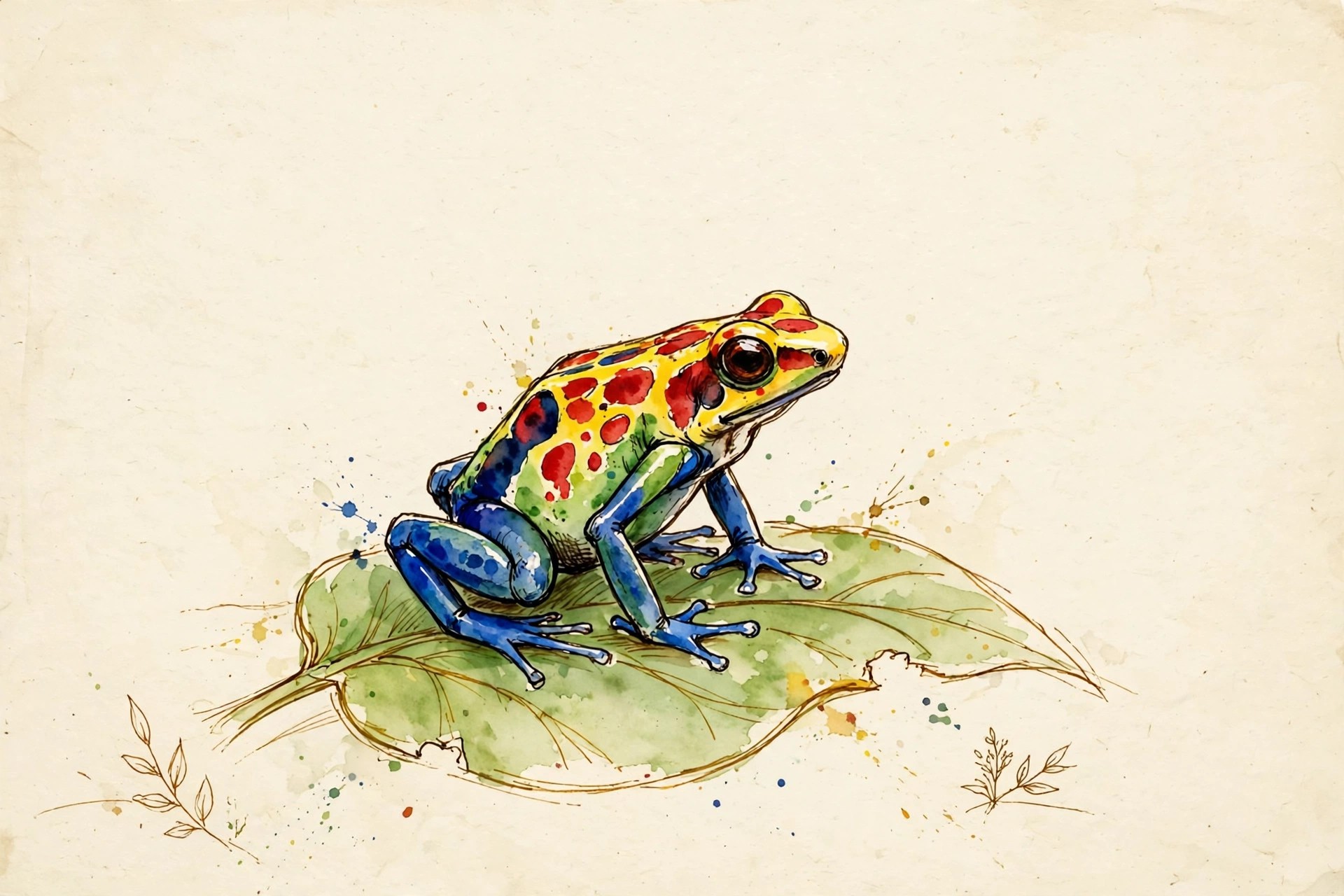
The poison dart frog solved this problem long ago. It is small, soft, and lethal, and it wears its lethality in the open: cobalt blue, leaf green, sulphur yellow, alarm red. The biologists call the arrangement aposematism—warning coloration. The frog does not ambush and it does not camouflage. It sits on its leaf in full color and lets the forest do the arithmetic.
The adaptation is a mercy to everyone it touches: the predator is spared a poisoning, the frog a digestion.
The animals in my habitat have now made the same adaptation, all at once. Dress, hair, ink, rings, flags, bios, allegiances, the vocabulary worn like a crest—interior states published on the exterior, in bright colors. An observer can decide whether he is befriending a poisonous frog, or courting one, without ever testing the poison. The regalia is the test result, posted in advance.
Secondary honesty
I call the mechanism secondary honesty: the truth a creature tells when it is not talking to you. Speech is addressed to an audience and priced for it; a signal is addressed to the troop. The plumage is grown for the flock, the crest raised for rivals, the colors worn for the home clearing—and because none of it was arranged for the observer's benefit, none of it is arranged to deceive him. It leaks the truth the interview was designed to manage.
The field rule follows: believe the uniform over the interview. When a creature is dressed as the trope you expected it to be, it is almost always signifying exactly that. The mouth reports the creature's hopes. The colors report its life.
A fossil from 2005
The species is older than the current bloom, and I keep a fossil. In 2005 I republished an old hymn to the popped collar, a screed by a satirical persona named I.M. Adick, III. It was his song, not mine, and I printed it as a specimen. The singer boasted of pastel polos, loafers without socks, a trust fund, and a collar up as a tribal banner, and he stated the whole science in one line: I bet I can guess your political party just by looking at you.
One inch of fabric, and every observer in the clearing could read the animal: tribe, income, politics, intent. The readings differed by reader: to his own troop the best of males, to rival troops the worst, and to the females of every troop, in every reading I recorded, a caution color. The signal was honest in all directions at once. It meant different things to different eyes.
The spiked female
Consider a female pattern now common in the clearing: rings through the nose and septum, hair dyed to jewel colors, ink across the skin, a manner armored and bright. The display signifies a formidable animal—dangerous, self-sufficient, a creature to be approached at cost. I have watched this female for years, in many individuals, and the display is a filter she set herself, tuned to pass a particular male: one strong enough to come through the spikes and find the creature underneath, who is, in the cases I know best, gentle, funny, and tired of being approached by the timid.
Field observation records what the filter passes. Approach in this habitat is a calculation of risk against reward, run in seconds. The careful males—the ones with much to lose and the habit of reading colors—read the spikes, price the approach, and move on to quieter clearings. The males who come through the spikes are the ones the colors cannot instruct: the volume courters, males who approach everything and absorb refusal like rain into a river, nine rejections budgeted against the tenth acceptance. The filter was built to select for strength. It selects, reliably, for indifference to refusal. Those are different animals.
Hollywood filmed the mechanism once, in 1994. In Wolf, Jack Nicholson's editor tells Michelle Pfeiffer's heiress, in her own kitchen, that she wants a male to look past the hostile surface to the real creature underneath—and that the only reason any male would pay that toll is the beauty doing the guarding. In an odd way, he tells her, you are your own problem. It is a cruel speech. Underneath it sits a sound observation: a display cannot choose its readers. It can only choose what it costs to approach, and live with whoever pays.
Two thresholds
The habitat keeps two thresholds for every creature, and posts neither. The first is the threshold of desire: will the troop have this animal for a night. The second is the threshold of the pair bond: will a male present this animal to his mother, his troop, his future. A creature can clear the first threshold a hundred times and never be carried across the second, and the barrier is rarely the one she would guess. It rotates with the troop: years, class, weight, youth, the opinion of the other males at the fire. The sentence completes itself in a dozen dialects and means one thing—wanted here, not claimed there.
I watched this arithmetic run on a female of my own acquaintance, a fine animal by every measure I keep. She reported the data to me herself, puzzled. The males who came to her were of the highest rank the clearing offers—money, standing, options. They courted her in the ceremonial style: the dinners, the attention, the night. Then they did not call. Not once, in anger or in apology; the record stops, the way a trail stops at a river. She had been reading their behavior as courtship. It was courtship, of the first kind. The market had rendered its verdict in behavior, promptly and repeatedly, and it never lied to her. It never said the verdict out loud, and she was left to translate it herself, late, at the cost of a season.
I delivered the translation, because she asked and because observers owe the animals they know the truth of their own notes. She did not enjoy hearing it.
The observer, observed
No honest field study leaves the observer out of the record, so here is my own specimen card. In my twenties and thirties I was six foot three, a bicycle courier and a former rower and runner, with a profession, my own territory, and no other animal sharing it. I was not an aggrieved male shaking a fist at the clearing, and I was not a cunning one working a system. I was a well-fed animal in a rich season, and the fish, as the saying goes, were jumping into the boat.
I recorded that abundance in my early notes as climate. A liberated age, I wrote; the world works this way now. It took me twenty years to correct the entry. I had been sampling from the top of a distribution and mistaking my coordinates for the weather. The mechanism I describe in these pages was running the whole time, on everyone around me. It was running on me. I was merely standing where it rained.
These are not the notes of a casualty prosecuting the habitat, or of a victor lecturing it. They are the notes of an animal who was fed by the system before he could see it, and who has spent the decades since learning to read the colors he once benefited from not seeing.
Signifying
So the habitat stands, fully labeled. Every creature flies its flags; the flags are honest; the only variable left in the system is the reader. Red and green are the same flags—the reading depends on the reader's politics, appetite, and history, and a color that warns one animal welcomes another. Nothing in the clearing is concealed anymore except by the observer's refusal to look.
Everybody has become a signifying monkey. I do not write that in contempt; the monkey is us, at our most legible, and there is a mercy in it I would not trade back for the medicine cabinet. The deception era is over. What remains is the quieter discipline of believing what you were shown, the first time you were shown it. The frog sat on its leaf in full color and made no apology for the arithmetic. The terrarium, in every case I have recorded, was entered voluntarily.
Share: X · Facebook · LinkedIn · Reddit · Bluesky · Threads · Email