
Ferraris Are Not Everyday Cars
This article, read aloud:
Share: X · Facebook · LinkedIn · Reddit · Bluesky · Threads · Email
Ferraris are not everyday cars. The sentence sounds like a remark about automobiles and it holds a whole mating market inside it. Access and commitment are separate markets, with separate prices, separate queues, and separate gatekeepers. A man can sit at the top of the first market and guard the second market with both hands. A woman can win the first market outright and lose the second one in an afternoon. The confusion in the modern habitat comes from treating the two markets as one market, one price, one verdict on a person's worth. The notebook says otherwise. Watch who gets approached, watch who gets kept, and the two ledgers separate on the page.
Two markets, two prices
Access is the first market. Access means a reply, a drink, an evening, a night, a season of evenings that never acquires a name. The currency in this market is immediate and visible: looks, height, bearing, money worn lightly, fame in any of its local forms, the easy confidence of an animal accustomed to being chosen. Prices clear fast. A specimen rich in that currency draws attention before he has spoken a full sentence, and the attention arrives from every direction in the clearing at once.
Commitment is the second market, and its currency is slower. Commitment means introduction to the family, a place in the future tense, a name spoken to friends in the grammar of plans. The man who receives access freely spends commitment rarely, because commitment costs him the whole field that access built. Every animal understands scarcity in its own stores. The top man's scarce good is commitment. Access arrives as weather. Commitment leaves as a decision, and he guards the door where decisions get made.
The shape of the first market
The distribution in the first market runs steep, and the field reports reflect the slope. Hinge data, as publicly summarized, has been reported this way: the top 1% of men receive about 16% of the likes. One number, reported and framed as reported, and the notebook uses it for shape alone. A thin sliver at the top of the clearing receives a share of attention wildly out of proportion to its numbers, and the rest of the population divides what remains among a very large number of ordinary evenings.
Goodall's troop had the same geometry in another currency. A few individuals sat at the center of grooming, of approach, of deference, and the center held because the troop kept choosing it. The parallel carries no insult in either direction. A steep distribution is a fact of grouped animals. The error enters when a participant reads the steepness as a promise. Attention concentrated at the top tells a woman that the top is reachable. The record of who stays at the top, season after season, tells a different story, and the second story governs the second market entirely.
What the top man guards
Spend time near the top of the first market and a pattern repeats with very little variation. The man there accepts invitations easily and makes promises slowly. He enjoys the clearing exactly as it is arranged. Each new commitment threatens the arrangement itself, because a public partner closes doors that his standing keeps open, and he feels that cost in advance, in full, every time a pleasant evening begins drifting toward a claim.
From the other side of the notebook, the same behavior reads as deception, and the reading deserves a careful entry. The women arriving at the top of the market generally know the market they entered. They have watched the same animal accept the same invitations from the same clearing for years. They can recite his history with accuracy when a friend repeats their own pattern back to them. Knowledge sits in one part of the mind and hope grazes in another, and the two pastures share a fence with a gate that hope opens at night. The denial at work here is self-administered, renewed by the person it governs, in full possession of the facts.
That entry matters because it changes the moral weather of the piece. A deceived person has a claim against a deceiver. A person bargaining with her own knowledge has a harder and more ordinary problem, the problem every animal in this habitat carries in some form: the wish that the general rule will make an exception in her case. The top man encourages the wish by enjoying her company. Enjoyment is real. It also costs him nothing in the second market, and the distance between real enjoyment and a commitment decision is the whole subject of the Ferrari sentence. A Ferrari can be admired, borrowed for a weekend, photographed, and returned. Everyday use is another contract entirely.
The second threshold
Behind the first threshold stands a second one, quieter and stricter. A woman can clear the desire bar completely and fail the introduction bar in the same week. Desire answers one question: does he want her in the evening in front of him. Introduction answers another: can he place her inside the life that watches him—his family, his friends, his standing, the version of himself those witnesses hold in their heads. The two questions use different evidence, different standards, and different juries.
The disqualifier at the second bar rotates, and the rotation is the telling detail. For one candidate the bar is age. For another it is class, the accent and schooling and table manners that a family reads in the first ten minutes. For another it is weight. For another it is her friends, the company she keeps and the company that would arrive with her at every gathering for years. Over all of them stands the mother test, the oldest jury in the habitat: the judgment, delivered or merely imagined, of the woman who raised him and whose picture of a suitable partner was formed decades before the candidate entered the clearing.
The taxonomy is the exhibit here. Any single case, examined closely, dissolves into biography, timing, and accident. The pattern across cases holds its shape. A man can desire a woman sincerely, enjoy her thoroughly, defend her warmly in private, and still decline to carry her across the introduction threshold, because the threshold guards his standing among the witnesses who will outlast any single attachment. He experiences the refusal as honesty about fit. She experiences it as a verdict on her value. The notebook records both experiences and notes that the second threshold, by design, is the one nobody discusses at the start, when discussing it would do the most good.
Rain in the parking lot
The observer is an animal in this habitat too, and the notebook applies to its keeper. Every person in the clearing has stood on both sides of a threshold somewhere: desired and unintroduced, introducing and declining, hoping the general rule would bend and learning the rule's actual flexibility at the standard price. The Ferrari sentence cuts in every direction. Each of us is an everyday car in most markets and, in one or two small clearings where our particular currency runs strong, something glossier. The markets keep sorting anyway, calmly, without malice, the way weather sorts a landscape.
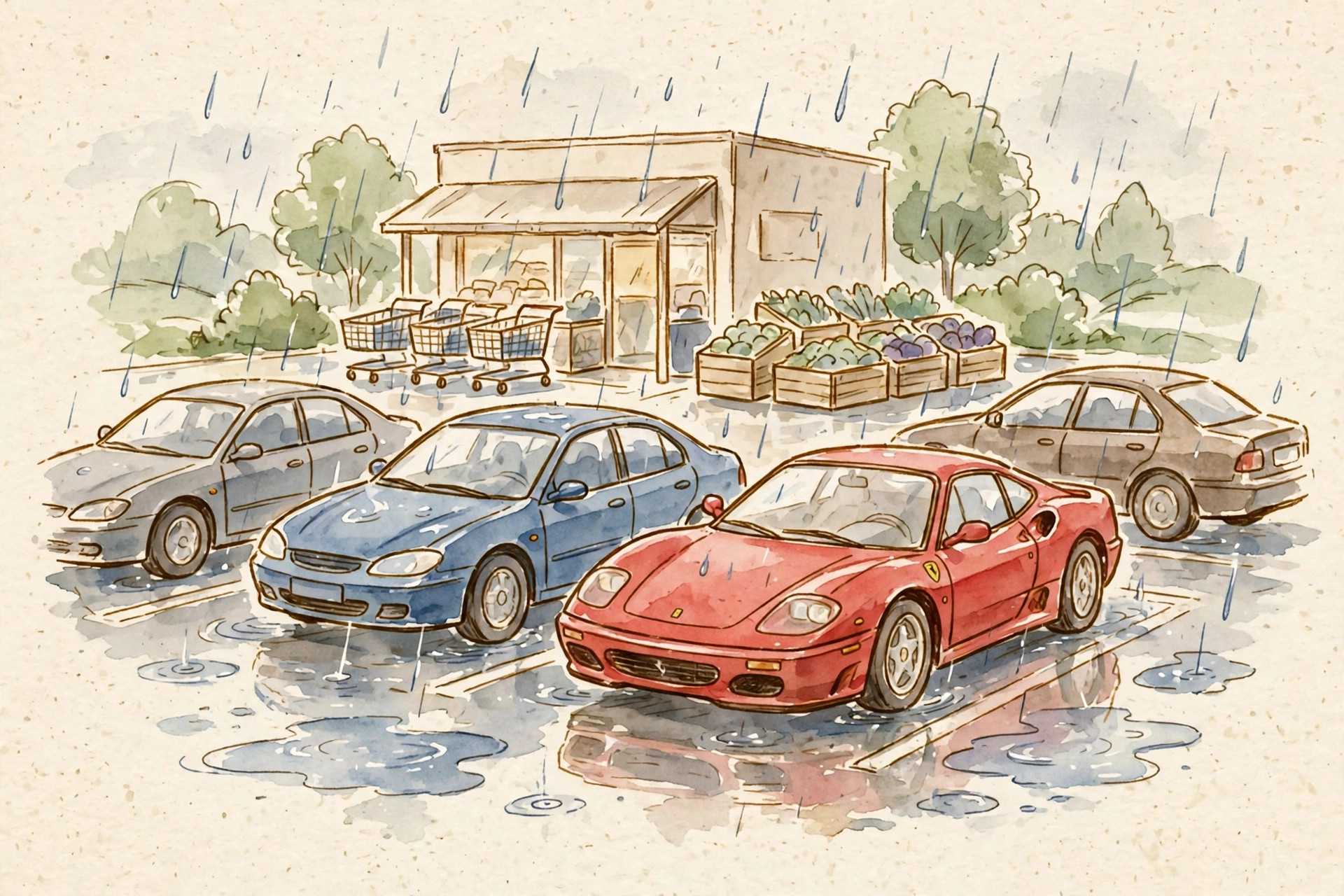
Picture the grocery lot in the rain. A red Ferrari sits among ordinary sedans, water beading on all of them alike, every windshield fogged, every owner inside buying milk and eggs under the same fluorescent light. The Ferrari driver runs the same errands. He parks in the same puddles. The difference lives entirely in what the car is for and what it costs to keep, and everyone in the lot understands the difference without a word of instruction. The mating market runs on the same understanding, spoken or unspoken. If you grab one and can't keep one I guess that's something you have to be willing to deal with even if you're always in denial of it.
Share: X · Facebook · LinkedIn · Reddit · Bluesky · Threads · Email