
Freaking Awesome at Math
This article, read aloud:
Share: X · Facebook · LinkedIn · Reddit · Bluesky · Threads · Email
The harvest does not have a diversity office. It has an appetite.
Everybody is always trying to harvest the meritocracy. Everybody always wants as many smart people as possible, no matter what color, no matter what gender. The universities want them. The corporations want them. The hospitals, the labs, the agencies, the teams. The wanting is universal, and the wanting has a property the speeches never mention: greed is the most reliable integrationist ever built.
A hungry institution cannot afford its prejudices. Prejudice is a luxury good, purchased with surplus. The moment the work is real and the deadline is a launch window, the appetite starts grading on capability and the captions fall off the candidates.
The computers
Run the experiment in the hardest laboratory available: Virginia, segregated, in the 1940s and 1950s.
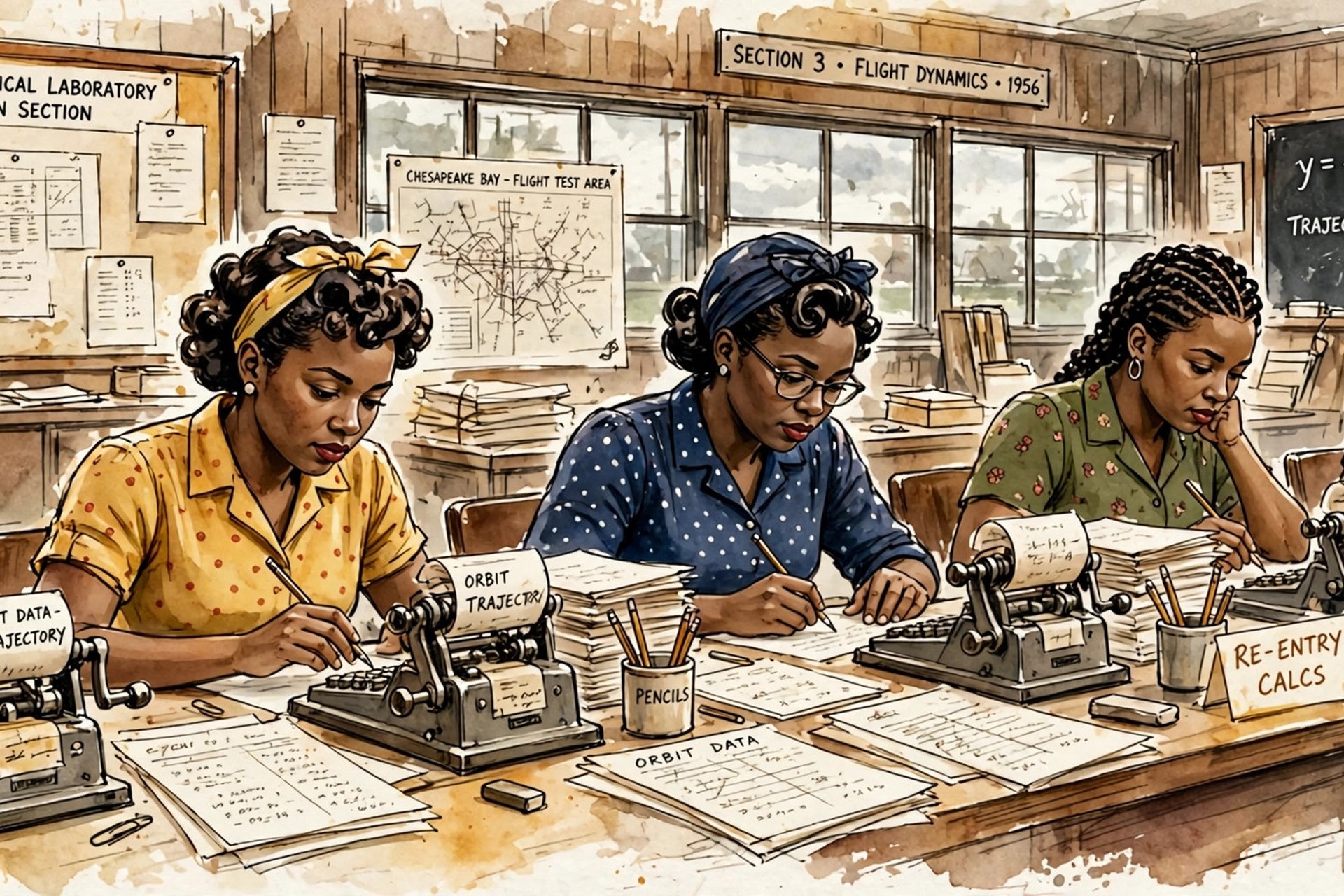
At Langley, the aeronautical laboratory that became NASA, the math had to get done. Flight research runs on figures—thousands of them, ground out by hand. The laboratory hired women to do the computing, and it hired Black women into a segregated unit, the West Area Computers, because the work was there and they could do it.
Understand what the record says about why. It did not matter that they were Black. It did not matter that they were ladies. They were freaking awesome at math. Awesome at logistics. Awesome at statistics. In a state that made them enter through the back, the numbers they produced went into the front of every flight report, because the alternative was airplanes falling out of the sky.
The work was not clerical in any soft sense. Wind-tunnel data, trajectory tables, the arithmetic under every test flight at the laboratory—an error propagated into metal. The computers were graded the way the harvest grades everyone: by whether the thing flew.
Katherine Johnson calculated trajectories for America's first spaceflights, and when John Glenn prepared to orbit the earth in 1962, he asked for her by role: get the girl, have her check the electronic computer's numbers, and if she says they're good, I'm ready to go. Dorothy Vaughan ran the West Computing unit as its first Black supervisor and then, when electronic computers arrived to erase her whole profession, taught herself FORTRAN and carried her women across into the new machine age. Mary Jackson petitioned a segregated city for permission to take engineering classes at a white school, took them, and became NASA's first Black female engineer.
Segregation built them a separate room. The appetite used the room, used the women, and eventually could not keep the fiction that the room was where the talent ended. Capability kept embarrassing the architecture.
Langley had to fight its own barred doors to place them; the modern corporation simply removed the doors, and the removal made the harvest frictionless—which is a triumph for the harvested and, as I argued in the leaders the drain took home with it, a quieter catastrophe for the places the frictionless machine now empties.
The short king clause
Generalize the computers and you get the standing rule of the harvest.
No matter how gay, Black, trans, queer, non-binary someone is—that short king, that short queen—if they have enough valuable skills, and they are charming and wonderful enough, and people really think they have capability, they can become a major part of a major American corporation or a major academic hub. They can become the face of it.
The door is narrow. The door is also real, and it opens on performance. The harvest certifies by output: the figures check, the rocket flies, the quarter closes. Nobody in the machine asks the capability to fill out a form about itself.
This is the same appetite that runs the harvest at both scales, the world's doctors and the hometown genius. It is one machine with one grading standard, and the standard is the whole explanation for its results across a century of American prejudice. The machine kept taking the best it could find, and the best it could find kept refusing to match the era's picture of what the best looked like.
The counterfeit
DEI enters here, as the harvest's large-scale corporate imitation.
The imitation copies the harvest's outcomes and skips its method. The outcome is visible: the faces at the table, the photograph of the leadership team. The method is invisible and expensive: the hunt, the test, the grading, the ascent. DEI says you just give the seat to people who look like that. The harvest says the seat belongs to whoever climbed, and the climbing is the only certification it has ever accepted.
The difference shows up in the product. The harvested person can do the job in the dark. The placed person needs the lighting maintained. An institution full of the harvested runs on its own power. An institution full of the placed runs on the program, and the program needs a budget, a staff, and a permanent defense against the question the computers answered every morning by sitting down and being right.
And the placed person pays a private price the program never lists. Every colleague runs the silent audit: harvested, or placed? The audit is unfair to exactly the people it claims to serve, including the ones who would have passed the harvest's test with room to spare. The computers never faced that audit. Their figures were the audit.
I wrote in the asymmetry of grace that one man gets a backstory and the other gets a caption. The computers refused the caption by main force of arithmetic. That option is available to every institution in America: grade on the work, publish the grade, and let the faces take care of themselves.
Hunger
The harvest is not kind. It is hungry. It takes people out of their places, pays them in money and distance, and calls the transaction a triumph for everybody except the place, which gets a poster.
Hunger is why it works. Hunger is why its results are real. A program that hands out the harvest's trophies without the hunger gets the faces and loses the math, and the math was the point all along.
The computers knew. Ask the girl. She ran the numbers.
Share: X · Facebook · LinkedIn · Reddit · Bluesky · Threads · Email