
Half the Game
This article, read aloud:
Share: X · Facebook · LinkedIn · Reddit · Bluesky · Threads · Email
People judge Christianity as a behavior code. You're not behaving Christian. You're not treating people right. You're not kind enough to the poor. The whole faith gets graded on conduct, and conduct is only half of it.
There are two commandments. Love God. Love your neighbor as yourself. The order carries weight: the first one is first.
Thou shalt love the Lord thy God with all thy heart, and with all thy soul, and with all thy mind. This is the first and great commandment. And the second is like unto it, Thou shalt love thy neighbour as thyself. On these two commandments hang all the law and the prophets.
Love God means worship. Prayer and worship, prayer and worship. Submission to your God. Obedience to your God. Loving on God above everything else in your life. That is half the game, and it is the half nobody talks about, because it happens at night, in private, where nobody can grade it.
A hospital, not a museum
The church is a hospital for sinners, not a museum for saints. AA is an emotional and spiritual hospital for drunks. NA is the same kind of hospital for addicts. Nobody walks into a hospital and gets graded on how healthy he looks. The qualification for admission is the sickness itself. A patient in the middle of treatment is not a fake patient and he is not half a patient—he is a patient, under care, and his chart does not close until it closes. The worshipful man whose behavior still limps is a Christian in exactly that way. He is in an ongoing relationship with his God, he keeps showing up for treatment, and the second commandment is the part of the cure he has not finished yet. Being a Christian is not performative. It is worshipful. The other patients do not get a vote on his standing, and neither does the neighborhood.
The entire Italian Mafia proves it. In 2014 Pope Francis stood in Calabria and said the mafiosi were not in communion with God—excommunicated, his word, at Mass, in their own country. It changed nothing at the door. They kept coming to Mass, kept marrying in the church, kept carrying the statue of Mary through the streets; one procession bowed her in front of a boss's house weeks after he spoke. And look at what the charge actually was: not that they had failed the behavior code, but that they had stopped adoring the Lord and adored money in his place. Even the condemnation was about worship.
A living God
And the God on the other end of it is alive now. That is the part outsiders miss entirely. They think Christians worship sequestered carbon from two thousand years ago, read about in a fictional history book—a man who may never have existed, an avatar borrowed from older virgin-birth stories. But the relationship is with a living God, in the present tense, and none of the principals are dead. Mary is the living Mother of God, hearing prayers now. Every Sunday at St James's the Mass is, very literally, time travel back to the Last Supper—the theologians call it anamnesis, the making-present of the event, not a re-enactment—and the bread and the wine become what they were there. True, not metaphor. People pray to this God and a great many of them hear back. My Mormon friend has two-way conversations with her God. Argue all you want about whether a Mormon is a Christian—I say she is one, because she has a relationship with her God. Mine does not run that way. I get no conversations. I feel heard, and I see reflections move in the world, and if I got neither, I would still be compelled to pray and worship and be in service. Muscle memory, being a mensch, cowardice—I could not tell you which. The compulsion does not check its credentials before it shows up.
The closest thing to a public record of my own prayer life is a passage I liked enough to copy out of the daily readings and pass around, or a Hallow notice that a streak is alive. That is the whole visible surface. Underneath it sit two or three hours most mornings before I get up: contemplation, prayer and worship, the red words of the Gospel, daily reflections, Jeff Cavins, a whole rosary prayed along with, half-asleep. Unstructured. I couldn't hand you a syllabus. I don't love writing even this much of it, because centering myself in it feels wrong—and that reluctance is the evidence. This half of the faith leaves almost no trace.
Worship doesn't wear a costume. It isn't dancing around an effigy going yabba yabba, and you don't have to be the Italian nana at church every single day of her life to be a prayerful person. The altar is wherever you are: on your knees praying, in contemplation, reading the Word, in relationship with other worshipers, exploring your relationship with God, in service of the Lord. Half the job is done in quiet, where you get no credit for it. Nobody awards brownie points for an interior life, for a rosary running inside your own head. That half earns nothing in public, and it is half.
And yes, the same Gospel that sends a man into his inner room and shuts the door also prays out loud in the assembly. Both. The command was never hide. The command was do not perform. Prayer said in public to God is worship. Prayer said in public to the room is theater, and the whole difference is who it is aimed at. A man can pray in the open as an exemplar, and there is an honesty in that which performance never has: not "do what I say, not what I do," but "do what I do, if you like." The hypocrisy lives in the gap between the saying and the doing. A life with no gap can be as public as it wants to be.
Love your neighbor as yourself
The second half is the neighbor. See God in the people around you and treat them as what they are: made in the image of God. Treat them as you would treat yourself. One quiet assumption rides inside that command: it presumes you love yourself. Love your neighbor as yourself fails in the hands of a man who loathes himself, because himself is the measuring stick. The intent of the law, not the letter of it.
And neighbor never meant your tribe. Jesus said it inside a Judaism where everybody outside the observant circle was unclean. Gentiles were unclean. Samaritans were unclean—the Samaritan is the hero of the parable precisely because he was the unclean one who stopped. Egyptians, Greeks, Romans, Caesar, tax collectors, prostitutes: unclean, all of them. Love your neighbor as yourself was never a command to be nice to the people on your left and right in the pews. It means humanity.
The halfway man
So take the man everybody calls a bad Christian, the one you can't stand. He might spend every night of his life worshiping his God. He might be a great dad. He might be golden inside his own walls, his country club, his garden. Then he leaves the garden and he is racist and sexist and he judges sinners and he would never be caught around lepers. That man is halfway there. He holds the first half. What he has not yet grown is the second: compassion, mercy. He is not a zero. And the kind, tolerant man who never prays is not a finished Christian either. Both men hold half of a two-part commandment.
Nor do the halves blend on their own. Temperaments lean. One man loves people; altruism costs him nothing, while prayer feels like a chore he has to talk himself into—so he doubles his helpings of outreach and charity and quietly starves the altar. Another man loves devotion and starves the neighbor. Doubling one half does not cover the other. The whole is the two halves, and you cannot replace the whole with anything.
Understand what half means here. Half describes the commandment, not the Christian. The worshipful man is not half a Christian waiting on his neighbors' verdict—the verdict on him is read once, at the end of days, by the God he worships, and until then his standing is whole because his commitment is whole. All a Christian has to do is commit himself to Christ, and he is a Christian, no matter how he behaves while the second half grows.
And do not presume on the behavioral expectations either. Turning the other cheek is a decision, made by the Christian, in the moment. It is not a policy the world gets to presume on. You cannot make war plans that assume Christians will not fight back. Walk up assuming a man will turn the cheek, and turn it again, infinitely, and you may meet the Christian who has decided otherwise—who draws his concealed-carry pistol and shoots you dead. The cheek was his to offer. It was never yours to schedule.
How the halves connect
The first half is receiving. God is merciful to us first. We get loved in a way we did not earn and do not deserve, because He is our Father. The second half is transmission. We become proxies for that mercy and we pass it on.
I bought orange juice for a woman at Giant once. She wanted my address so she could mail me the money. I told her: pass it on. That is the second commandment in three words. Learn to love God. Learn to be loved by God. Then learn to love, and learn to be loved, and carry it forward.
The rings
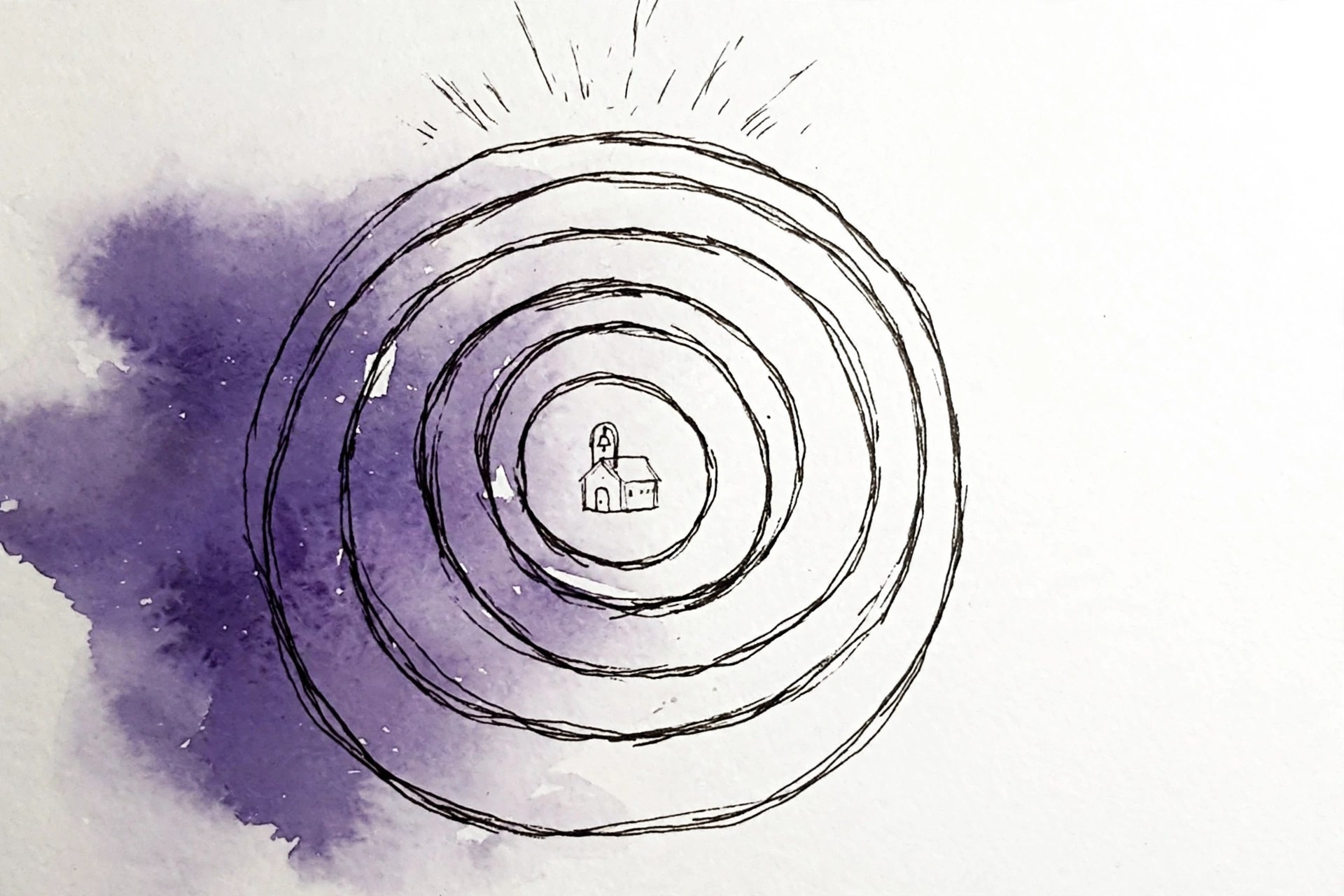
There is no rule that every Christian performs at the level of an apostle. The church itself is built in concentric rings. The priest at the center. Then the twelve—the vestry, the board of directors. Then the congregation. Then the Easter and Christmas members. Then the people out in the neighborhood who hear the bell when it rings and have never once come through the door. Nobody is required to stand in the same ring as the apostles. The rings are how the faith actually holds people.
Submission runs both ways
And submission is not weakness, whatever the sneer says. I know alpha men who love Jesus publicly and openly and are not diminished one inch by serving him. Submission in a marriage is not a man demanding a slave. It is two people deciding to submit their lives away from themselves and toward each other. What each one offers differs, but the submission runs in both directions or the marriage does not work—it cannot work otherwise. The only relationship meant to run one way is man's submission to God, and even that one doesn't. Jesus submitted himself to the cross on our behalf. At the very top of the thing, the submission is mutual too.
The Catholic courseload
Nobody gets this worse than Catholics, who get thrown out with the bathwater as the works-only Christians, as if Catholics believe good deeds buy a seat in heaven. Meanwhile every Catholic carries a courseload of worship the accusers never see: worshiping God and worshiping Jesus, prayer, prayers on behalf of other people, prayers for the dead—for souls in Purgatory, the in-between, being prayed out of it by the living. Today is All Souls' Day, and Catholics all over the world have photographs of their dead out and are praying for them, asking Mary, asking God. Intercession is a second job worked in silence, and it is aimed at neighbors the worker can no longer even see.
Invited
Because nobody deserves the Kingdom of Heaven. Nobody earns it and nobody is owed it. The word is invited. In Matthew 25 the King says: inherit the kingdom prepared for you from the foundation of the world. Prepared, not purchased. Good works do not buy a seat. At most, they show the first half landed—that a man was loved by God, and it started coming out of him toward his neighbor.
Two commandments. Love God, with everything. Love your neighbor, all of humanity, as yourself. Grade a Christian on one half alone and you have missed the faith by half.
Further reading, and the two apps I use
I am a practitioner, not a theologian, and I am not going to pretend this piece is the last word on any of it. It is one man's account of a two-part commandment he is still learning to keep. If you want it said better than I can say it, or you want to start living the invisible half yourself, here is what I actually use and where I would send you:
- Matthew 22:35–40—the two commandments in the text itself. Read it before you grade anybody, including me.
- Hallow—download it. Guided prayer, the daily readings, the rosary, sleep prayers. It is the sound in my ears overnight, and the closest thing I have to a structure.
- Evangelizo—download this one too. The free daily Gospel app; this morning's Matthew 25 came straight out of it, commentary and saint of the day included.
- Why Catholics pray for the dead—Purgatory and All Souls' Day explained properly, by people who can cite the councils.
- Jeff Cavins at Ascension—his Bible Timeline teaches the Bible as one story, which is how the red words finally got organized in my head.
Which leaves the good atheist, and there are many: I'm a good person. I do good things. What do I need with the rest of it? Doing good things is half the job—the visible half, the half the world grades. So the question stands. As an atheist, are you spending half your time in devotion to God—in prayer, and service, and submission?
Share: X · Facebook · LinkedIn · Reddit · Bluesky · Threads · Email