
How Much Hitler?
This article, read aloud:
Share: X · Facebook · LinkedIn · Reddit · Bluesky · Threads · Email
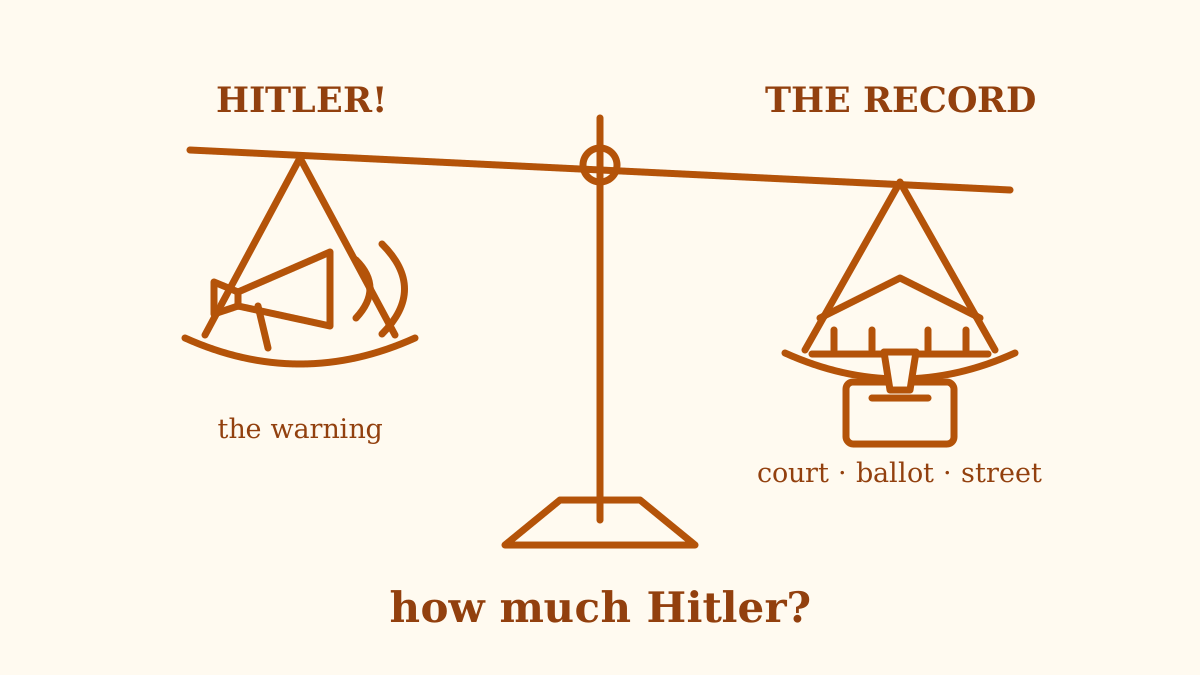
Donald Trump has been president again for nearly two years, and the country said to be living under Hitler keeps going to work, suing him in open court, voting against his party, mocking him on television, and arguing about him in public. Deportation officers still deport, as they deported under Barack Obama, George W. Bush, Bill Clinton, George H. W. Bush, and Ronald Reagan. Federal judges still issue orders, Congress still fights over money, opposition newspapers still publish, and grocery stores still open in the morning. Trump is no more Hitler than the modern presidents who built and ran the same machinery, and he remains fully answerable for his own uses of it. The pain in the argument has a precise name: cognitive dissonance. The told catastrophe and the lived country refuse to match, and millions of people wake up inside the gap.
Ten years, no election
I wrote under a TikTok video, “Dude is still President for another two years.” A woman answered, “You misspelled ten years. Yes watch him.” Down the thread, her timeline expanded. There would be no 2028 election. Trump would remain in power for a long time. Another commenter said, “Dream on.” Another said, “That’s not allowed.” I answered with the sentence that has followed me around since: “That would be awesome if it actually happened but nothing ever happens. Donald Trump follows every stupid order by every stupid judge and is the worst Hitler in the entire history of hitlers.”
The exchange contains the whole argument. One side speaks in constitutional permanence: ten years, no election, a ruler installed beyond the reach of the calendar. The other side looks at the calendar. Trump has a term. Elections remain on it. His opponents just won both chambers of Congress in the midterms. Judges keep ruling, lawyers keep filing, governors keep defying him, and the man himself keeps performing outrage at a system that keeps saying no to him in public and making the no stick often enough to govern the shape of his presidency.
That record can support anger, contempt, alarm, and electoral punishment. It strains under the word Hitler.
The word has a scale
Hitler names a regime with a party militia, a police state, destroyed opposition, subordinated courts, closed newspapers, smashed unions, racial law, aggressive war, and murder organized as an industry. The Brownshirts beat political enemies in the street as a method of rule. Kristallnacht put the method on display across Germany: synagogues burned, Jewish businesses wrecked, Jews beaten and murdered, and tens of thousands carried to camps while the state directed the violence or blessed it by standing in the doorway. The comparison imports all of that history every time it is spoken.
People who use the word owe the scale. If Brownshirts are beating citizens in American streets as state policy, show me the Brownshirts. Show me the orders, the units, the target lists, the nights of coordinated violence, the police participating as a corps, and the victims counted in the thousands. I want the evidence at the size of the accusation. A claim of Kristallnacht requires a Kristallnacht.
The names offered as proof are Alex Pretti and Renée Good, both killed in Minneapolis in January 2026 during the same enforcement operation. Good, a 37-year-old citizen, was shot by an ICE officer while she sat in her SUV; the Secretary of Homeland Security called her a domestic terrorist who had weaponized her vehicle, and a family-commissioned autopsy counted three gunshot wounds and a graze. Pretti, a 37-year-old ICU nurse and citizen, was shot by Border Patrol personnel after he had been subdued on the ground; the county medical examiner ruled his death a homicide. The full documented list of fatal shootings by federal immigration agents across 2025 and 2026 runs to seven names on Reuters’ count, and other trackers count more. Every one of those deaths deserves investigation, judgment, and consequences on its own facts, and several of the official accounts stand disputed by witnesses and video. Seven fatal shootings by agents describe a real and recurring enforcement danger, with names, dates, and case files. A nationwide pogrom describes a regime. The distance between those descriptions is the whole subject.
The street record runs the same way. ACLED, which codes political violence and demonstrations from press and partner reporting, counted 122 riot events in the United States in all of 2025, the fewest since it began national tracking in 2020, with one fatality across every one of them; 97 percent of the year’s demonstrations involved no violence at all. Blood in the streets is a measurable claim. The measurement comes back nearly empty.
I have already graded the larger comparison in “The Worst Hitler Ever.” Trump talks like a strongman, casts himself as a strongman, and enjoys the costume more than any president in the television age. The machinery of Hitlerism keeps failing to materialize around the performance. Objective Daily News printed the cold companion file in “The Word and the Record”: scholars divided over the label, courts fighting the administration in the open, deaths in custody on the government’s own list (at least 36 in fiscal 2026, the highest total ICE has recorded), and deportation totals running back across administrations. The record gives Trump plenty to answer for. It gives Hitler a different address.
The deportation machine had many drivers
Immigration enforcement supplies the clearest continuity. Ronald Reagan signed the 1986 amnesty and presided over the enforcement state that came with the bargain. George H. W. Bush ran the same federal machinery through the drug war and the border politics of his term. Bill Clinton signed the 1996 laws that widened deportability and sped removal. George W. Bush, after September 11, built the Department of Homeland Security and Immigration and Customs Enforcement, joining immigration enforcement to the permanent emergency state.
Barack Obama then operated the machine at a scale that earned him the name Deporter-in-Chief from the president of the National Council of La Raza. The Homeland Security Yearbook counts 3,060,440 formal removals across his eight years, the largest removal total of any administration in the table, and 5,246,510 removals and returns combined. Donald Trump’s first term produced 1,195,780 removals and about two million departures on the broadest count, returns and the first Title 42 expulsions included; his second administration’s first eighteen months produced roughly 980,000 removals and returns on the Migration Policy Institute’s estimate, built from the government’s own records. Joe Biden’s years also produced millions of enforcement events, most of them Title 42 expulsions. Trump inherited a staffed, funded, legally armed deportation system from presidents now offered as the sane alternative. He made its public face harsher, louder, and more theatrical. Presidents before him had already made it real.
The series you choose decides the ranking, which is itself the measurement lesson. Bill Clinton’s name carries twelve million “deportations” in popular claims because the claim adds his 11,421,260 returns to his 869,630 removals. Count removals alone and Clinton falls behind Obama, George W. Bush, and Trump’s first term. The machine’s output changes with the ruler you measure it by; the machine stays the same machine.
If deportation itself makes the president Hitler, American Hitlerism has a bipartisan production line: Reagan, Bush, Clinton, Bush, Obama, Biden, Trump. The line destroys the insult by distributing it evenly. If the machine is ordinary American governance, Trump’s operation of it can be judged by law, proportionality, error, cruelty, and result. Either standard can be applied. Switching standards when the driver changes is casting, and casting is the weakness running through the entire comparison.
George W. Bush after September 11 makes the problem unavoidable. His administration created a vast security department, normalized mass surveillance, claimed detention powers beyond ordinary criminal process, authorized coercive interrogation under legal memos, operated secret prisons, and launched the Iraq War. A person grading presidents by emergency power, foreign violence, and executive reach has abundant material there. Bush still left office after an election, under criticism from a free press, with courts and Congress intact enough to investigate his record. The label failed him too, because the American system surrounding his abuses remained visibly alive. Trump belongs in that American argument, with his own facts charged against him. Europe’s catastrophe adds volume and removes measurement.
Told terror, lived country
The psychological gulf explains why the argument feels impossible to settle at the level of evidence. A threat delivered in language arrives as a story: coherent, repeatable, future-facing, and easy to refresh with every headline and phone alert. Trauma suffered in the body arrives through the senses and stays there as fragments, reflexes, and physical alarm. Most Americans who believe they live under a fascist terror regime receive that regime through narration. They hear the warning at breakfast, watch a clip at lunch, read the emergency language at night, and move through streets where buses run, shops open, courts sit, and neighbors argue about ordinary life.
Leon Festinger named the resulting strain in 1957. Cognitive dissonance is the discomfort produced when a belief and a direct experience collide. “We live under Hitler” collides every morning with “I bought coffee, went to work, watched the opposition win an election, and read three newspapers attacking the president.” A mind has to discharge that pressure. It can reject the warning as rhetoric. It can distrust its own eyes and search daily life for the hidden terror required by the warning. It can put politics in a theater box, sealed away from the evidence of the senses.
I choose my eyes, with the record beside them. Elections happen. Courts rule. Newspapers publish. Congress changes hands. Deportation proceeds through a machine built over forty years by both parties. People suffer under that machine, and individual abuses deserve names, cases, and remedies. The national picture remains a noisy constitutional republic fighting over the limits of presidential power in public.
The sophisticated reply moves the terror indoors. Democratic erosion, on this account, happens through memos, appointments, prosecutions, regulations, and pressure campaigns before it reaches the street. Some of that warning deserves attention; institutional damage can be real long before a boot touches a neck. Precision still matters. A memo can be unlawful. An appointment can be corrupt. A prosecution can be abusive. A deportation can be cruel, mistaken, or illegal. Each charge carries its own evidence and its own remedy. Hitler supplies a costume large enough to cover them all and a fog thick enough to hide the differences among them.
The president in the courtroom
Trump’s relationship with judges tells the same story from the other side. He insults them, questions their legitimacy, campaigns against their rulings, and treats every injunction as a personal affront. His administration litigates aggressively, appeals, delays, tests boundaries, and has drawn findings from lower courts that it violated particular orders; an Associated Press investigation counted at least 31 lawsuits with such findings, and in January 2026 the chief judge in Minnesota, Patrick Schiltz, documented 96 orders ICE had violated in his district in that single month and wrote that ICE had likely violated more court orders in January 2026 than some federal agencies have violated in their entire existence. Those findings belong in the record and in the judgment against him. The courtroom remains open throughout the fight. Rulings issue. Agencies answer. Elections proceed while the appeals climb. Opposition politicians promise investigations from positions they won at the ballot box.
A Hitler regime settles the judicial question by ending judicial independence. Trump’s America argues the question every week, at high volume, before judges he appointed and judges he despises. His rage at the system is real. So is the system’s continued ability to frustrate him. Both facts can stand without rescuing his conduct. A president can abuse power inside a republic and still fall miles short of the man who destroyed one and built a racial empire on its ruins.
How much?
Ask the title as an honest measurement. How much Hitler is Donald Trump? Measure by party militia: none. Measure by abolished opposition: none. Measure by elections ended: none. Measure by newspapers closed by the state: none. Measure by industrial murder: none. Measure by deportation, detention, surveillance, emergency power, and executive violence, and Trump enters a crowded American field, shoulder to shoulder with presidents whose admirers would faint at the comparison. The scale either condemns the modern presidency as a class or returns Trump to judgment as a particular president with particular offenses.
I prefer the second court. Judge Donald Trump for Donald Trump: his words, his orders, his corruption, his cruelty, his lies, his deportations, his treatment of courts, and his conduct when voters reject him. That indictment has evidence, proportion, and a country capable of acting on it. The Hitler indictment has a woman on TikTok promising ten years and no election while the president she fears obeys the calendar, loses Congress, fights judges in their own courtrooms, and waits for the next vote. Trump is the worst Hitler ever because the American record keeps refusing to give him the regime the label requires.
Share: X · Facebook · LinkedIn · Reddit · Bluesky · Threads · Email