I Want to Be Jane Goodall
This article, read aloud:
Share: X · Facebook · LinkedIn · Reddit · Bluesky · Threads · Email
I want to be Jane Goodall. She died on October 1, 2025, at ninety-one, on tour, still working, still carrying the notebook from one hall to the next. Rest in peace. For sixty-five years she sat in one forest in Tanzania and watched one community of chimpanzees live their whole lives in front of her, and she changed what science knows about animals by refusing to leave, refusing to hurry, and refusing to hate anything she recorded.
That is the whole method. Sit still. Watch for years. Name the individuals. Write down what they do, including the parts that ruin your theories and your mood. Let the behavior explain itself. I have spent my writing life doing fieldwork on a different troop in a different clearing, and Goodall is the observer I measure the work against.
The other road
Dian Fossey took the other road, and for years I named her when I meant this discipline. I said Gorillas in the Mist, and the name was wrong about my own allegiance. Fossey went to war for her animals. At Karisoke, in the Virunga mountains of Rwanda, she ran anti-poaching patrols, burned poachers' camps, paid informants, and made herself a combatant in the habitat she had come to study. Her favorite gorilla, Digit, was killed by poachers on the last day of 1977, and the war escalated from there. She was murdered in her cabin in December 1985. The case was never solved.
Fossey's courage stands in my notes beyond question. Her gorillas needed a defender and she defended them with her life. War still changes the observer's data. A combatant sees raids, enemies, and losses. The notebook fills with the war because the war is what is happening around the desk. Fossey's record is magnificent and it is also a war diary, and the two kinds of writing keep interrupting each other on every page.
Gombe
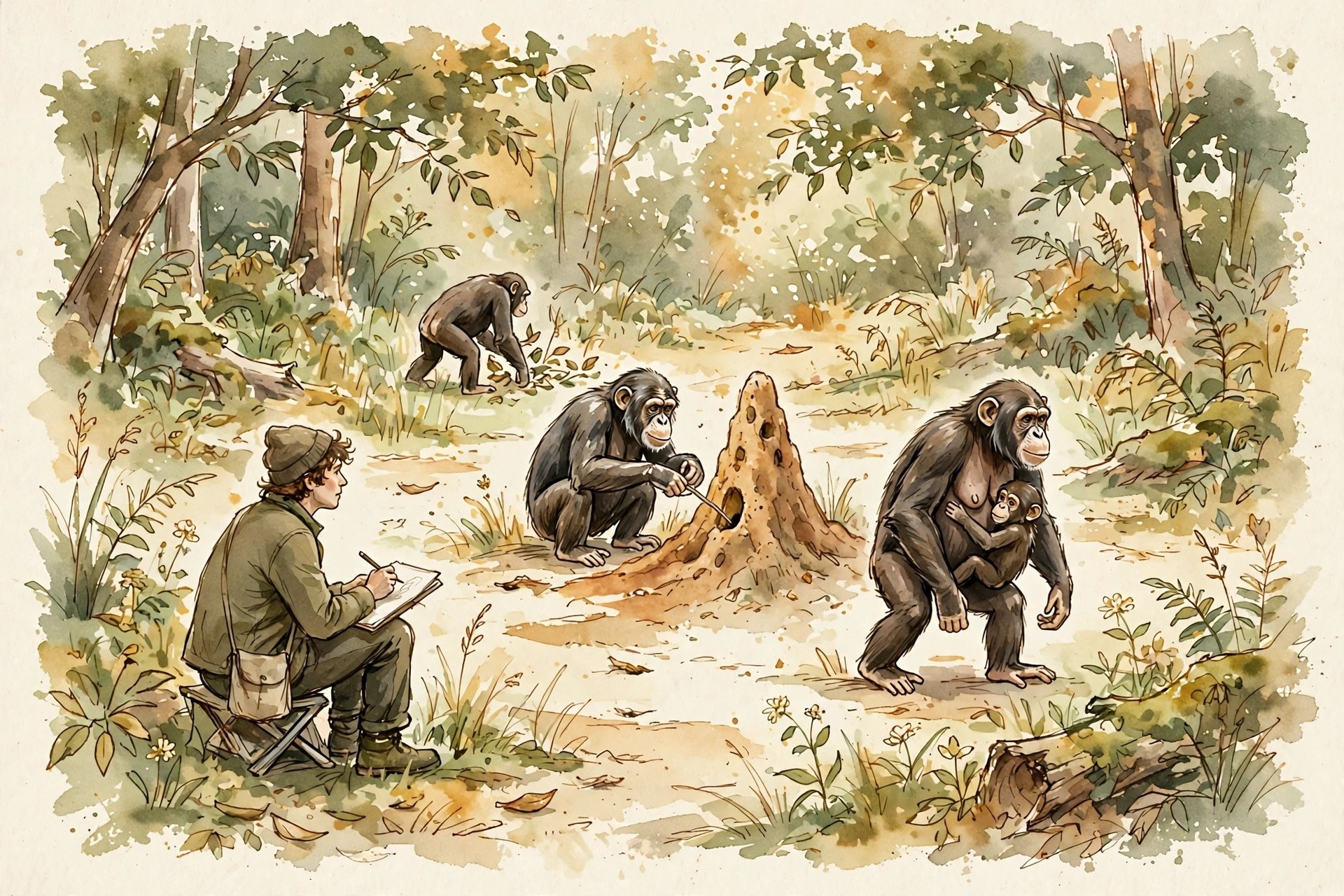
Goodall arrived at Gombe in July 1960. She was twenty-six, she had no degree, and Louis Leakey had sent her because he wanted eyes unclouded by the theories of the day. The park rules required a companion, so her mother came for the first months. Goodall sat on a peak with binoculars and waited for the chimpanzees to accept her presence, and for a long season they ran from her. She kept sitting. Acceptance, when it came, came on the animals' schedule, and it has stayed the central fact of her science ever since: the observer earns proximity by patience, and the price is time.
Within months she watched an old male she had named David Greybeard strip leaves from a twig and fish termites from a mound with it. He was making a tool. Leakey's answer by telegram is the famous line of the whole field: now we must redefine tool, redefine man, or accept chimpanzees as human. The discovery came from a woman sitting still long enough for an animal to behave naturally in front of her, and from her habit of treating the animal in front of her as somebody.
Individuals
The establishment wanted the chimpanzees numbered. Goodall named them—David Greybeard, Flo, Fifi, Figan, Faben, Flint—and she described personalities, moods, friendships, and grief, and the journals of her day treated the method as a young woman's sentimentality. She held her ground for sixty-five years and the ground moved to her. A troop average describes an animal that never lived. The named individual, followed across a lifetime, is where the actual data lives: who rises, who falls, who mothers well, who starts fights, who ends them.
Flo was the old matriarch of the early years, high-ranking, enormously productive, mother of Faben, Figan, Flame, and Fifi, and grandmother of a dynasty that still runs at Gombe. When Flo died in 1972 her youngest son Flint, who had never separated from her, stayed by the body, pulled at her hand, and wasted. He died within weeks, at eight and a half, and Goodall recorded the sequence in plain order, day by day, until the young animal stopped doing anything at all. The record has carried its own meaning for fifty years.
The dark record
The test of the method came when the clearing turned violent, and it is the part of her work I return to most. Between 1974 and 1978 the Kasakela community Goodall followed destroyed the neighboring Kahama community in a war of ambushes, one male at a time, until Kahama ceased to exist. In the same years the female Passion and her daughter Pom killed and ate infants of their own community, one after another, while Goodall's team watched and recorded. The woman the journals had mocked for loving her animals too much published all of it, in detail, with names.
She recorded the war and the infanticide the way she had recorded the grooming and the toolmaking: behavior first, judgment withheld, the notebook open. Empathy, in her hands, was a discipline. It meant the animals stayed individuals to her even when their behavior horrified her, and it meant the record and her feelings about the record lived in separate columns. The feelings went in the margin. The behavior went in the text. I know no harder discipline in any kind of writing, and I include every newsroom and every pulpit I have ever watched.
My clearing
My habitat is smaller and louder: South Arlington, the coffee shops and library tables, the clients, the feeds, the long human weather of the internet. The specimens are people, and they run the same repertoire Goodall's troop ran—alliances, displays, status games, tenderness, sudden violence of the verbal kind, mothers carrying dynasties, old males defending a shrinking range. I watch individuals across whole seasons, because a single afternoon of any animal is a rumor about that animal.
The record includes the observer. Goodall appears in her own notes as an animal the troop had to assess, tolerate, and eventually use, and my notes do the same work: I am a large, loud, aging male of my own clearing, with my own displays and my own blind seasons, and the troop reads me while I read it. A field study that leaves the observer out is a rigged study. Mine stays honest on that point or it is worth nothing.
No war
Every clearing now recruits. The feeds run a permanent enlistment drive: go to war for women, go to war against men, go to war for the tribe, the party, the faith, the flag of the week. Fossey's road stands open at all hours, with better weapons than hers and none of her excuses—she, at least, was defending animals who were actually being killed in front of her. The recruits get a war diary instead of a notebook, and within a season they can no longer see the animals at all. They see only the enemy's movements and their own side's losses, and they call the blindness commitment.
I am not going to war for anybody. I am going to watch, carefully, for as long as it takes. That is the whole posture, stated once and plainly, and it is Goodall's before it is mine. She out-watched every critic who called her soft. The softness was stamina. Sixty-five years of mornings on the same trails produced a record no raid and no theory could match, and the record is still teaching the field how its animals actually live.
For as long as it takes
Goodall founded her institute in 1977 and Roots & Shoots in 1991, and she spent her last decades on the road, three hundred days a year by her own count, carrying Gombe to halls full of people who would never see Tanzania. She died on that road at ninety-one. The work had become the life, and the life stayed pointed at the same clearing to the end. There are worse ways to spend a life. There are not many better ones.
So the notebook stays open on my table, in my clearing, among my troop. Watch the individuals. Learn their names and their histories. Record the grooming and the war in the same hand. Believe the behavior, accumulated over seasons, over the story any single afternoon tells. Jane Goodall sat still for sixty-five years and the forest explained itself to her. I intend to sit still in mine.
Share: X · Facebook · LinkedIn · Reddit · Bluesky · Threads · Email