
My Mojo Left With My Picnic Basket
This article, read aloud:
Share: X · Facebook · LinkedIn · Reddit · Bluesky · Threads · Email
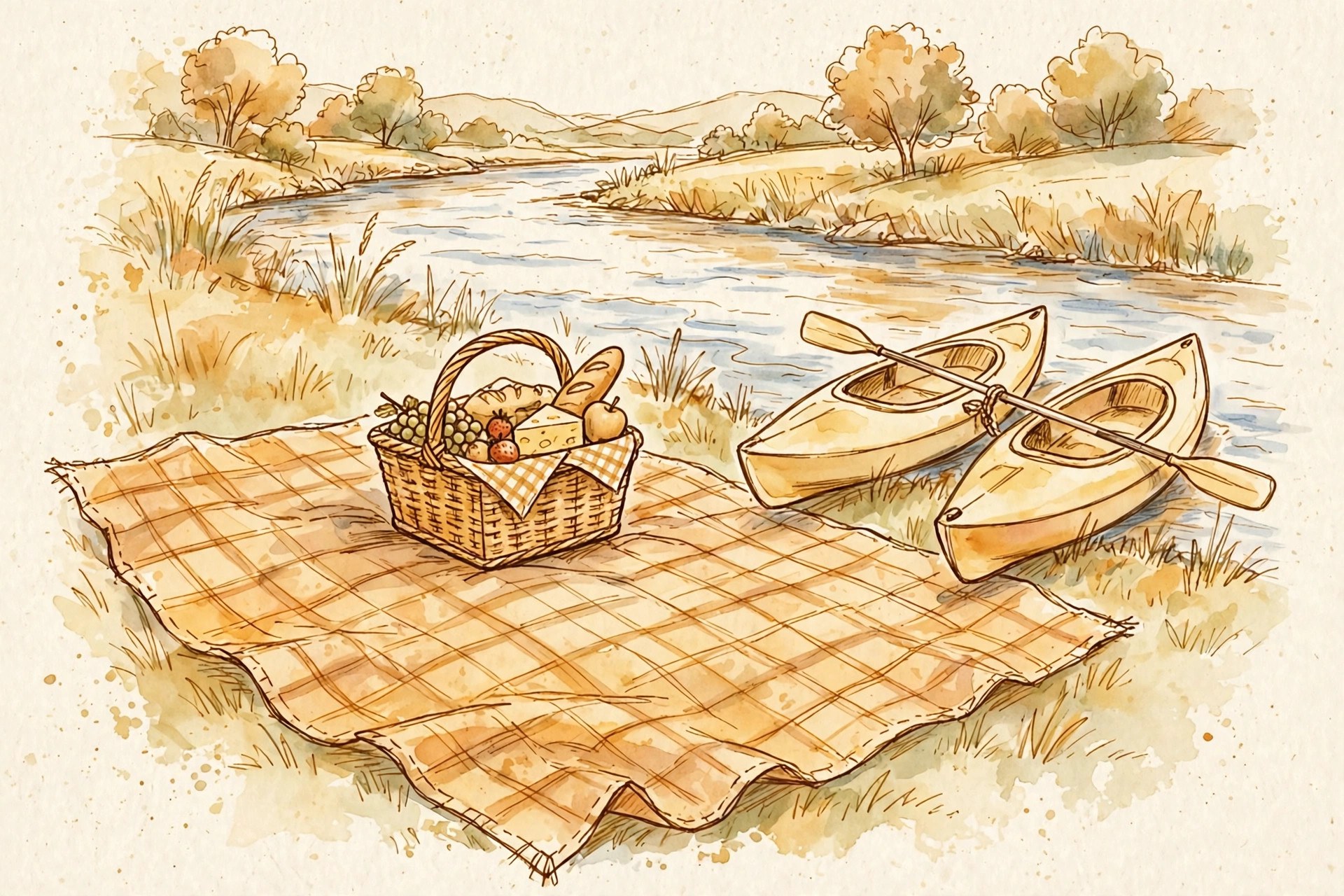
My mojo left with my picnic basket. The basket was the whole apparatus of my twenties and thirties: a wicker hamper loaded in Georgetown, a giant blanket, two kayaks waiting at the river, and a long walk built around food most people in Washington had never tasted. When the basket retired, the dates retired with it. The record stands in my own published archive, in titles I wrote in the season itself, and the record is plain about what the magic cost and where it lived.
I have aphantasia. My mind carries no pictures. I cannot pre-live a date in my head, cannot run the evening in advance, cannot watch the blanket spread itself on the grass while I sit at a desk deciding whether the plan will work. The scene arrives when I build it, in front of her, with my hands, or the scene never arrives at all. That single fact organized my whole courtship. Other men in my clearing carried a cinema. I carried a basket.
The basket
The basket was wicker, large, and loaded with intent. A picnic basket is a promise you can hold by the handle. It says the afternoon has a center, the food has been chosen, the ground has been claimed, and the man carrying it did the work before the woman arrived. I understood that signal early and I used it for years, across the Mall, along the river, on grass all over this city.
The loading mattered as much as the carrying. I shopped a fancy food boutique in Georgetown and the Whole Foods of that era, and I bought goat cheese and rare things nobody had tasted who had never been to Europe or counted themselves a foodie. In the Washington of that season, a soft goat cheese and an unfamiliar jar opened a small ceremony. The woman tasted something new. The afternoon acquired a flavor she associated with the man who had found it. I had no inner screen to project charm onto, so I put the charm in the basket and opened the lid.
The river
The water half of the apparatus lives in a piece I titled Blue Kayaks. Mark and I kept kayaks at Jack's Boats, and in that post I wrote that I had been writing too much about girls and about psychobabble, and I thought it prudent to allow my inner naturalist to surface. The sentence tells the truth about the era in both directions. The girls were the subject. The naturalist was the method. I watched, I noted habitat, I learned which clearings stayed quiet at which hours.
The kayaks turned a date into a shared physical task. Two people in two boats, or side by side on the Potomac, have work to do with their arms and a current to read together. Conversation rides on exertion and holds up better there. A woman could see how a man handled a paddle, a landing, a sudden chop off Roosevelt Island. I could see the same things in her. The river graded everybody honestly and the grades arrived without an interview.
My own training on that river was solitary and daily. In September 2002 I published a piece titled 11 Miles-a-Day on the River, about rowing a rented single eleven miles a day. A man who rows eleven miles before a picnic has a calm that needs no acting. The body had spent its restlessness on the water in the morning. The afternoon got the settled version of the animal, fed, tired in the good way, and ready to sit on a blanket and talk for hours.
The walks
The third element was distance on foot. Long walks across the Mall gave a date its long middle. Monuments supplied the scenery, the paths supplied the rhythm, and the walking itself supplied the talk. Side by side, facing forward, two people say things they withhold across a table. Every field observer learns that pattern in any species: the direct stare hardens an animal, the shared direction softens it.
The blanket closed the walk. It was a giant blanket, large enough to define a room outdoors, large enough for the basket, the food, two people, and a margin of grass kept at bay. Spread on the ground, it marked territory in the gentlest way available. Inside the blanket's border, the afternoon belonged to the two animals on it. Outside, the city kept its noise and its hurry and left the clearing alone.
The care package
The same producer ran in winter and in sickness. In September 2002 I published Chez Michelle, the record of an over-bought sick-day care package. The title stands in the archive and the habit stands behind it: when a woman was ill, I arrived with too much of everything, food and comfort bought past any reasonable measure. The over-buying was the message. A reasonable parcel says a man remembered. An excessive parcel says a man cleared the store's shelf thinking about one person.
I recognize the pattern across the whole archive of that season. The poems sit there too. The Lit page of my site carries dry elbows, described there as a love poem written from DC for Hawaii, and Easter, described there as a love poem. I wrote a great deal of love poetry in my twenties, and the poems and the picnics came from the same animal: a man with no pictures in his head, making the feeling into an object in the world—a poem on a page, a basket on a blanket, a parcel at a door—because an object was the only form in which he could hold the feeling up and look at it.
The producer
The young man in these notes was a producer, and under that name the record reads clean. A producer books the location, loads the props, feeds the company, and keeps the day moving. My locations were the river, the Mall, the grass, the boats at Jack's. My props were wicker, wool, cheese, and bread. My company arrived to a day already built, and the building was the courtship. The women in that clearing responded to production because production is legible. Effort leaves evidence. A basket is evidence.
The aphant's discipline explains the scale. A man who can picture an evening can coast on the picture and improvise the reality. I had no picture, so preparation replaced improvisation, every time. I over-bought, over-walked, over-rowed. The excess was compensation for a missing faculty, and the compensation worked so well that the missing faculty stayed invisible for decades, to the women and to me. The diagnosis arrived in middle age. The behavior had been in the field notes since my twenties.
The empty clearing
The habitat changed and the animal changed with it. The boats, the boutique runs, the eleven-mile mornings belong to a younger male in a younger city, and the archive holds that season the way a field station holds old notebooks: completely, and without any power to summon the season back. I read Blue Kayaks and Chez Michelle now the way an older observer reads his early logs. The handwriting is mine. The animal in the notes moves faster, carries more, and expects the river to cooperate.
Age edits every troop. Friends pair off, clearings empty, the long walks shorten, and a man who once produced afternoons for sport settles into a smaller range: a library table, a coffee shop, a notebook, the daily work of watching his own species at close quarters. The picnic basket left the kit at some unmarked point in that long edit. I kept no log of its last outing. Apparatuses retire that way, one unrecorded afternoon at a time, and the mojo follows the apparatus because the mojo was the apparatus, all along.
What the record shows
The verdict of the archive is kind to the young producer. He lacked the commonest tool in his clearing—the moving picture in the head that lets a man rehearse desire—and he built a working substitute out of wicker, water, food, and distance. The substitute fed people, floated them down a river, walked them across a monumental city, and wrote them poems. A whole courtship ran on objects because objects were what its author could see.
I sit in the clearing still, an older animal with the same blank screen and a better notebook. The basket is gone. The watching remains, and the watching was always the deeper habit—the inner naturalist I let surface in Blue Kayaks, still at his post on the bank of the Potomac, recording what the animals do, his own past self included, with the same patience he asks for everybody else in the troop.
Share: X · Facebook · LinkedIn · Reddit · Bluesky · Threads · Email