Neither Ant nor Grasshopper
This article, read aloud:
Share: X · Facebook · LinkedIn · Reddit · Bluesky · Threads · Email
America runs on a fable. Aesop told it twenty-six centuries ago and the country never replaced it. Work like the ant and winter cannot touch you. Sing like the grasshopper and winter collects its bill. Every life gets filed under one animal or the other. The saver is an ant. The drifter is a grasshopper. School teaches the filing system before it teaches long division.
I have been telling a friend of mine that the filing system is missing an animal. I am neither a romantic grasshopper nor an industrious ant. I am a roach.
The ant
The ant is real, and I know him personally. I have friends who worked like ants and retired at forty-five and fifty. They earned, they stored, they declined the shiny thing in front of them and bought the dull thing behind it. Their winters arrived, their stores held, and they deserve every quiet year the fable pays out.
Watch the ant closely, though, and watch what his arrangement requires. The ant needs winter to arrive on schedule. He needs the colony standing, the tunnel dry, the storehouse unraided. His whole genius is preparation for a specific future, and his genius pays only if that future shows up in the form he prepared for. The ant is a bet on continuity. Most years, continuity wins. The ant is not wrong. He is simply leveraged.
I watch my ants now in their retirement. They are calm men, and nothing in this notebook begrudges them one hour of it. The ant's way is a good way. It is one way, and the fable's fraud is pretending it is the only way with a door that opens.
The grasshopper
The grasshopper gets the fable's punishment and the culture's forgiveness in the same breath. He sings through the summer. When the cold arrives he has nothing, and the story closes the door in his face. Then the culture reopens the door, because the grasshopper is the one everybody secretly envies. He had the summer. The ant had the ledger.
The grasshopper's arrangement has its own requirement, and it is stricter than the ant's. The grasshopper needs an audience. The song is the point. His whole life runs on being witnessed: take away the watchers and the grasshopper is a cold insect with good memories. The ant needs the future to behave. The grasshopper needs the present to applaud.
The animal the fable left out
The roach files under neither. The roach stores nothing for winter and sings nothing for anybody. The roach eats what the season offers, including the leavings of both other animals, and the roach is still in the room when the season changes.
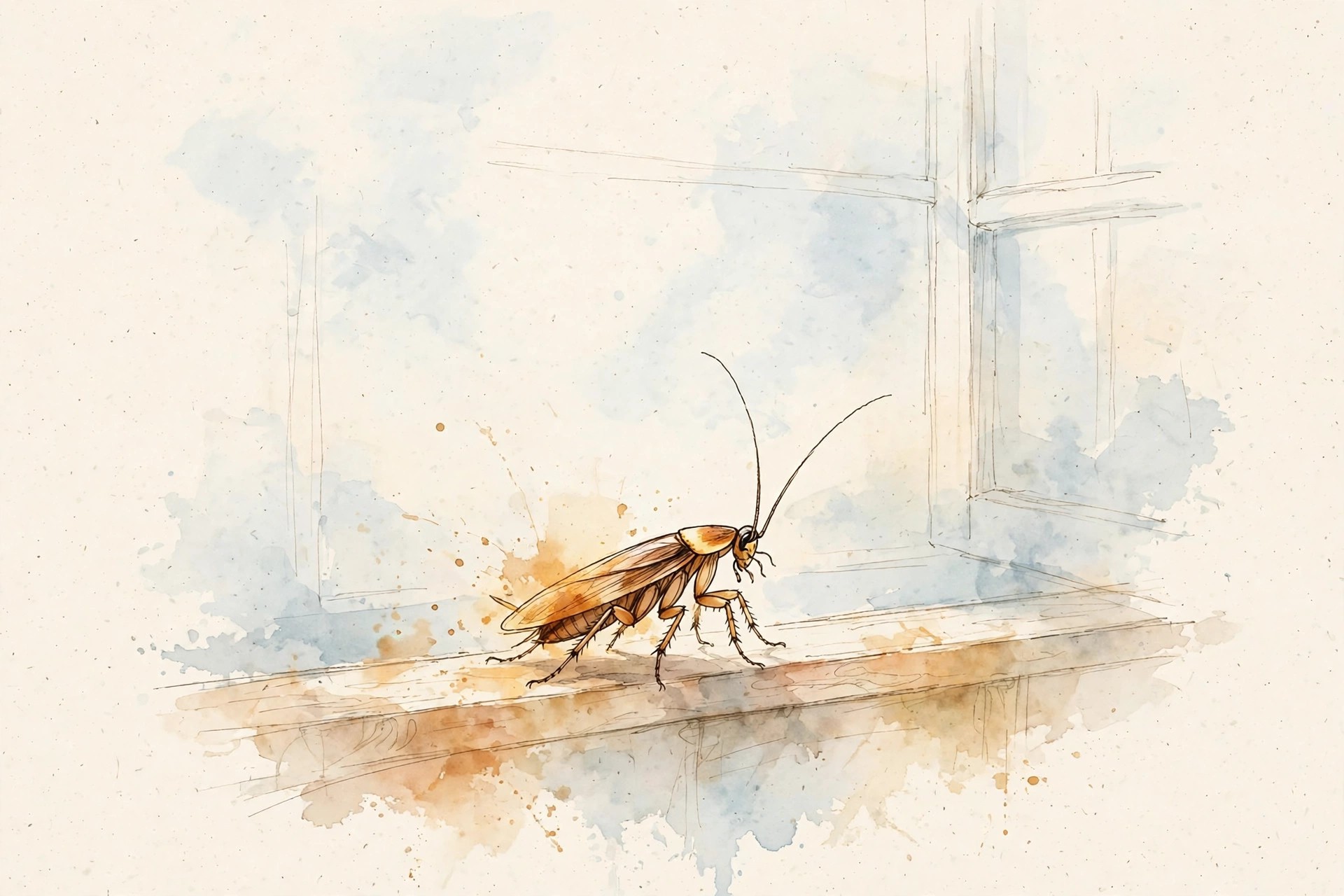
The field record on this animal is not close. The roach's line was running before the dinosaurs were new. It has crossed every extinction the planet has served up since. It lives in the walls of the rich man's house and the poor man's house on the same terms. Spray it and the survivors' grandchildren are immune to the spray. Seal the building and it finds the one seam the contractor missed. The roach does not defeat its enemies. The roach outlasts the category of enemy. Every exterminator who ever lived is dead. The roach is at the windowsill this morning, antennae up, unhurried.
The roach is also the animal of the house itself. It moved in when human beings built walls, and it has paid no rent and signed no lease in all the centuries since. Every house has two populations: the one on the deed and the one in the walls. Only one of them has never once been evicted.
Notice what the roach does not need. No storehouse. No audience. No winter arriving on schedule, no summer worth singing about. The roach needs one crack and one crumb, and the world has never once failed to provide both. It is the oldest strategy on the premises, with the longest record of the three.
The compliment hidden in the insult
The tell arrived on television. On Georgie & Mandy's First Marriage, Mandy is covering a police raid on a warehouse of bootleg movies when a cockroach crawls down her blouse on live television, and her screaming gives the raid away. The clip goes everywhere. Her own station piles on: cartoon cockroaches across her weather segment, "La Cucaracha" when she walks in. The world hands her the roach as a mockery, and she goes home and hides from it. Her mother, Audrey, sits her down and hands the animal back as a title. Own being the cockroach lady, she tells her, because the cockroach is the ultimate survivor, the animal that outlives everything. Then she reads the record as proof: the lost jobs, the baby by a teenager, the move back into her parents' house—every ending survived, every morning after it Mandy still standing in the room. The insult belonged to the station and the crowd. The mother never swung it. She picked it up, wiped it clean, and pinned it on her daughter as the highest grade one animal can give another in a hard country.
People say "like a roach" when they want to say a thing is beneath them. They have the animal exactly backward. Beneath notice is the whole design. The roach carries no flag and keeps no schedule the world can disrupt. It cannot be embarrassed out of the room. It cannot be sprayed out of the century. The animals we admire get statues. The animal we insult gets the future.
The coward's genealogy
The record on this animal's character is plain. The roach is a coward. It runs from the light. It hides in cracks, feeds at night, freezes under a shadow, and flees at the first tremor of a footstep. It carries no sting and no armor worth the name. Observed without sentiment, it is a small, furtive, faintly pathetic creature, and every compliment in this notebook is paid to that animal, to no nobler insect.
Here is the genealogy nobody carves on a crest. The heroes die early and beautifully, in everybody else's service, and the hero's line ends at the wall he held. The line that continues belongs to the one who ran: the soldier who slipped away from the doomed position, the family that fled the village the night before the army came, the clerk who kept his head down through the regime and sat at his desk when it fell. Every living person descends from somebody who ran, hid, ducked, or waited. The brave are the ancestors of statues. The cowards are the ancestors of everyone.
The roach is that arithmetic in animal form. It prevails by fleeing. It survives the boot by being elsewhere when the boot lands, and the poison by eating too little of anything for the dose to finish it. Cowardice, practiced faithfully across enough generations, becomes indistinguishable from immortality.
The people who were called roaches
Human beings have made the fable's filing error. Again and again the powerful have looked at a people marked for crushing and reached for this animal's name, and the named have picked the name up and kept it.
In Rwanda the word was inyenzi, cockroaches, hung on the Tutsi for decades before it became the vocabulary of the genocide broadcasts. Scholastique Mukasonga survived in exile; thirty-seven members of her family were murdered. She titled her memoir with the slur itself, Inyenzi, ou les cafards, Cockroaches in English: a paper grave for people the killers meant to erase from memory. The word meant to delete them stands on the cover of the book that refuses the deletion.
The shelf beside it is crowded. Rawi Hage's novel Cockroach, from 2008, follows an immigrant out of a war-torn country into Montreal's winter slums, a man who believes himself part cockroach and moves through the city underneath it, uninvited and alive. Oscar Zeta Acosta titled the Chicano movement's novel The Revolt of the Cockroach People in 1973, the brown and the poor of Los Angeles wearing the label as a banner. Hong Kong police called the protesters cockroaches in 2019, in a city where the animal's street name is Little Tough. This year in India, the chief justice used the word from the bench for activists and unemployed youth; within weeks the young had built the Cockroach Janta Party on the insult and marched under it, and by summer their protests had forced an education minister out. And the song Mandy's station played at her as a joke, "La Cucaracha," marched with Villa's armies through the Mexican Revolution, a people's anthem with the roach in the chorus. The station reached for an old mockery and grabbed a battle standard.
The proportion belongs on the record, stated plainly. Their stakes were blood: purges, camps, genocide, exile. Mine are decades at a desk. The claim here is kinship of kind at a vastly smaller scale, the same species of animal in far milder weather. The winters do not compare, and nothing here borrows theirs.
The barricade, refiled
Victor Hugo built the fable a second time, in Paris, and the cast sorts itself under the filing system. The vanguard of the proletariat, Hugo's beautiful young men of the barricade, are the grasshoppers: they sing the republic at the top of their lungs, gloriously, in public, and winter arrives in a single June night and collects every one of them. The ant is the establishment: the stores, the ledgers, the police files. The roaches are the people who never show up to the barricade, the millions who keep their heads down through monarchy, republic, and empire in turn and are still in the city when each regime that taxed them has become a chapter heading.
The novel keeps its own arithmetic. Its survivor comes out of the barricade underground, carrying a wounded boy through the sewers of Paris, while the beautiful die beautifully on a heap of furniture in the sun. Valjean is the book's roach: furtive, nocturnal, unfinishable, carrying the future through the one passage no army guards.
America ran the same scene in 2016 with the music playing. The contempt word arrived from a podium, deplorables, and the supporters performed the Audrey move at national scale: within days the word was on shirts and hats, worn as a title. At one rally the candidate walked onstage to the barricade anthem from Les Misérables itself, "Do You Hear the People Sing?," beneath a banner reading Les Déplorables. The insult, the musical, and the reclamation in a single frame.
The vocabulary of the spray can
The contempt at the top of the house runs in one vocabulary, and the vocabulary never changes species. The poors. The despicables. The deplorables. Each of those is a thing said about roaches: a population named as a pest problem, filed for spraying. I have spent fifty years at the tables of the elite, the poets, and the rich, and the contempt at those tables runs one way, downward, at the folk.
Populist America is the folk, and it keeps none of the addresses the counters use. The party machinery is an ant structure, stores and schedules. The country club is a storehouse with a dress code. The Harvard poets sing and the Princeton money stores, and the folk underneath go on without song or storehouse. The animal's oldest rule governs the count: one roach in the open means a thousand behind the wall. Every tally of them is an undercount, and every obituary written for them has been premature.
Field notes on one specimen
I keep the notebook on my own habitat, and the record reads the same across thirty years. Industries I worked in have been declared dead so many times I stopped attending the funerals. Print was going to kill me, then the web, then social, then search, then the machines that answer questions directly. Each wave arrived with its own spray can. Each wave left, and I was still at the desk.
I never built the ant's storehouse, and I will not pretend otherwise. I never sang the grasshopper's summer either; the work was always the work. What I built was harder to name and harder to kill: the ability to eat what the season offers and be standing in the room when it turns. Employers folded. Clients vanished. Whole trades were carried out of the building. The specimen remained, antennae up, finding the cracks and the crumbs.
That is the boast, and I mean it as one. The ant's stores can be eaten by inflation, illness, and time. The grasshopper's song ends with the summer and he knows it. The roach's arrangement has no single point of failure: it never bet everything on the future behaving or the present applauding. Surviving is the power itself, and the roach holds more of it than the other two combined.
So file me where the fable forgot to look, and file me honestly. The hat I wear says FERAL. It is kin to the deplorable shirts: a word handed over as an insult and kept as a flag. When I say I am a roach, the same claim is being made in the older language, and both times the claim is freedom: freedom from the storehouse schedule and the audience's applause, freedom to eat what the season offers and be standing in the room when it turns. Roaches wrote "power to the people." No party drafted that sentence and no poet did; it rose off the floor, from the population that gets stomped on and stays. The ants have their winters covered, and good for them. The grasshoppers have their summers, and the songs were lovely. I will be in the walls and at the windowsill, in the early light, unhurried, long after the storehouse and the stage have gone quiet. Neither a romantic grasshopper nor an industrious ant. A roach, and still here.
Correction, November 21, 2026: An earlier version of this article described Audrey McAllister's cockroach speech as a mother's jab that became a compliment. In the episode, the mockery came from Mandy's station and the viral clip; Audrey's speech was a defense, urging her daughter to own the label as a survivor's title.
Added November 21, 2026: the sections "The coward's genealogy," "The people who were called roaches," "The barricade, refiled," and "The vocabulary of the spray can" were written after publication, expanding the piece at Chris's direction the same day.
As an Amazon Associate I earn from qualifying purchases.
Share: X · Facebook · LinkedIn · Reddit · Bluesky · Threads · Email