
Nobody Believes That Story
Share: X · Facebook · LinkedIn · Reddit · Bluesky · Threads · Email
A meme went around Facebook this morning. The question at the top of it asked for the dumbest thing a large number of people believe, and the answer printed underneath, in the big confident letters memes use, was this: that rich people are trying to help the working class. Twenty-nine reactions, thirty-nine comments, two shares. A small room, and everybody in it nodding along at the foolishness of the imaginary believers. I commented, and the comment ran away with the morning:
That's not even a narrative. Nobody believes the rich people are trying to help the working class. Every single rich person wants cheap poor people to exploit for profit. The incentive is to stop being a poor person and scratch and crawl to being a middle-class or a wealthy or a rich person. There's supposed to be an extreme amount of disincentive to be poor. That's the American way. America is obsessed with its upward mobility and it likes to blame other countries for their class systems and say look, it's nothing but blue sky, you have an opportunity to become whatever you want. That's literally America's copyright. That's literally America's slogan. That's literally the promise America makes to migrants and immigrants.
Nobody in that thread believed the meme's premise, and nobody outside it does either. I have lived fifty-six years in this country, poor years and paying years, and I have never once met a working man who thought the rich were trying to help him. I have met men who thought the rich were cheating them, men who thought the rich were laughing at them, and men who intended to become rich and do a little of both. The helper-rich, the billionaire as social worker, exists in foundation press releases and nowhere else. The meme was dunking on a crowd that never showed up.
The help was never on offer
Read an earnings call sometime; the rich file their intentions in public. Labor is a cost line, and a cost line exists to be managed down. A rich man wants your work cheap, your rent paid on time, your truck financed at his rate, and your attention sold to his advertisers. He says all of this out loud, quarterly, to analysts, and the stock goes up when he says it well. Exploitation is too dramatic a word for the daily version of it; the daily version is a schedule, a rate card, and a shrug. And here is the part the meme misses entirely: the working class knows. The knowledge is the water. A man does not need a narrative to tell him the boss wants him cheap. He needs a narrative to tell him what to do about it, and America hands him exactly one.
Poverty is supposed to hurt
The disincentive is the design, and the design is admitted. America builds its floor low on purpose, because a floor a man can live on in comfort is a floor a man lives on. So the bottom rung comes with splinters: the rent eats the check, the check eats the month, the month eats the man, and every bit of that misery is load-bearing. It pushes. Scratch and crawl is the American system's transmission, the mechanism that converts pain into motion. Other countries cushion the bottom and call it decency. America sharpens the bottom and calls it opportunity, and the sharpening is the sales pitch: the worse it is down there, the harder everybody runs. You can hate the engineering. You cannot call it a secret. The blue sky at the top of the ladder and the broken glass at the bottom of it are the same invention, sold as one product.
America's copyright
The phrase itself is barely a century old, and it was coined in a collapse. James Truslow Adams put "the American Dream" into print in The Epic of America in 1931, in the middle of the Great Depression, when the country handing out the promise could not hand out bread. Adams was careful about what he meant: "It is not a dream of motor cars and high wages merely, but a dream of social order in which each man and woman shall be able to attain to the fullest stature of which they are innately capable, and be recognized by others for what they are, regardless of the fortuitous circumstances of birth or position." Read the history of the phrase at JSTOR Daily and you find the publisher wanted a different title, because a book called The American Dream sounded like a hard sell in 1931. The phrase outsold the doubt. It became the national slogan because it told every arrival at every dock the one thing the old countries would not: your birth is not your sentence here. America points at Europe's class systems, at castes and titles and the correct school tie, and says: we do not do that. Blue sky. No ceiling with your grandfather's name carved into it. That is the promise made to migrants and immigrants, and millions crossed oceans on the strength of it, and the crossing itself is the proof of concept: nobody risks the Atlantic for a country that promises to help. They risk it for a country that promises to let them.
Temporarily embarrassed
The most famous sentence about all of this may not belong to the man it is pinned on. "Socialism never took root in America because the poor see themselves not as an exploited proletariat but as temporarily embarrassed millionaires." The line is credited to John Steinbeck everywhere; it reaches print through Ronald Wright's A Short History of Progress, the 2004 Massey lectures, and nobody has produced the sentence from Steinbeck's own pages. The attribution stays open, and the sentence survives its paperwork, because it describes the machine exactly. A man who believes he is a millionaire in temporary embarrassment does not organize against millionaires. He organizes against anything that might tax, regulate, or delay the man he plans to become. His politics are a down payment on his future self. Kurt Vonnegut built the same observation into Slaughterhouse-Five as a fake scholarly monograph about Americans: money is hard to come by, Americans refuse to admit it, "those who have no money blame and blame and blame themselves," and the self-blame, Vonnegut wrote, "has been a treasure for the rich and powerful." A novelist's joke and a historian's borrowed quotation land in the same place. The American poor man is not waiting for rescue. He is waiting for his turn, and a man waiting for his turn keeps the line orderly.
The numbers
Now the audit. Raj Chetty and his co-authors measured the dream the plain way: did the children out-earn their parents at the same age? For children born in 1940, about ninety percent did. For children born in the 1980s, about fifty percent did. "It's basically a coin flip as to whether you'll do better than your parents," Chetty said when the study came out. Run the comparison across borders and it gets ruder: measured by how tightly a father's earnings predict a son's, the United States sits near the bottom of the rich countries, an elasticity around 0.47 against Denmark's 0.15 or so, with Canada, Norway, and Finland all offering a looser grip of birth on outcome; the Economic Policy Institute keeps the chart under the plain title "U.S. lags behind peer countries in mobility." The country that copyrighted upward mobility now posts some of the developed world's worst numbers at it. And the slogan did not even flinch. That flinchlessness is the story. A coin flip is still a bet a desperate man takes every day of his life, and the disincentive underneath the bet does not consult the table before it bites: the rent is due at fifty percent odds exactly as it was due at ninety. The dream is a story a man tells himself at five in the morning, in the cold, on the way to the job he is scratching and crawling out of, and a story does not need good odds. It needs a door that is not locked. America sells the unlocked door. The odds board hangs inside, where nobody reads it until they are already running.
Crabs in a basket
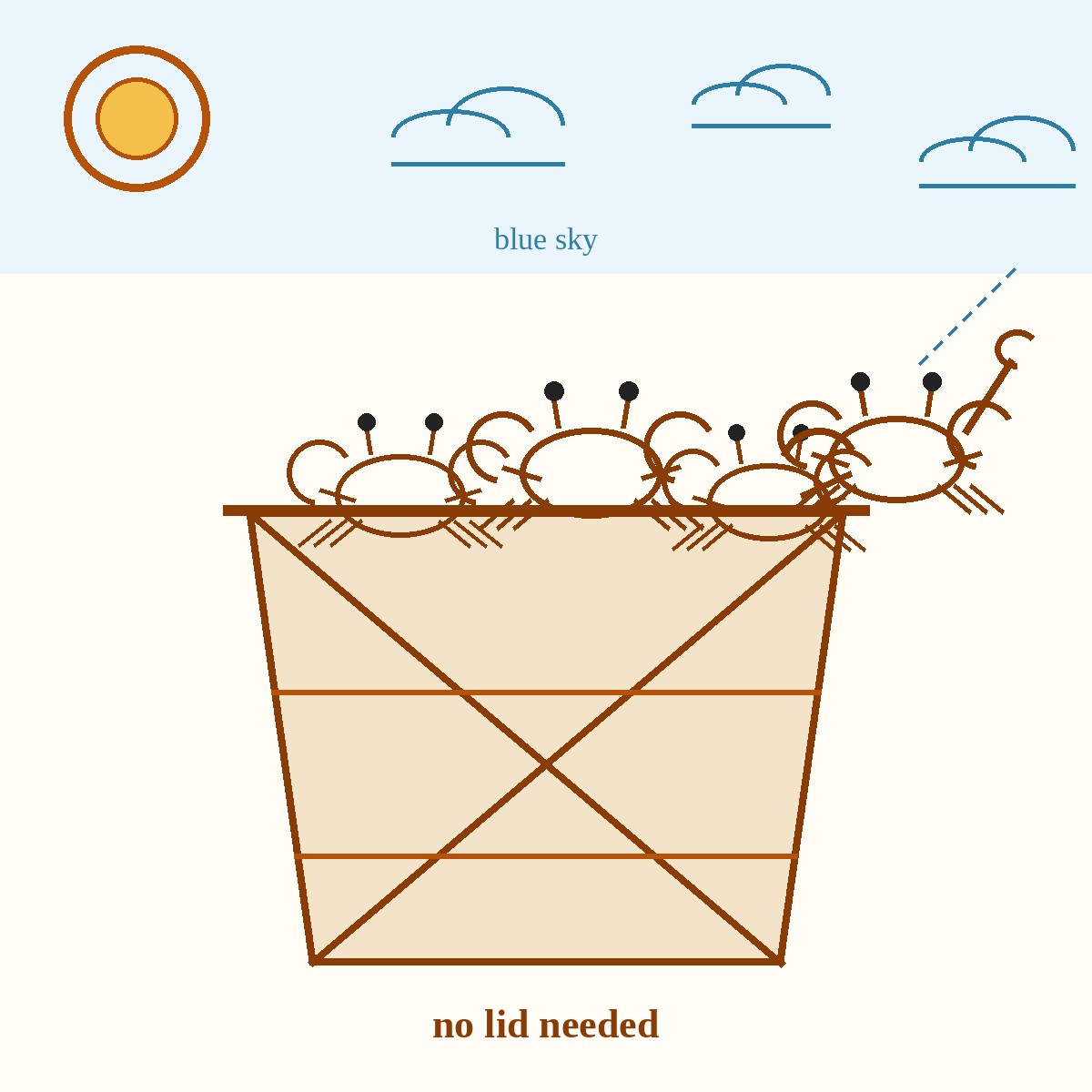
And then there is the guard nobody hired. I said it on TikTok this week, under somebody else's video, in the plainest words I had: Hawaii has "hammering down the protruding nail" syndrome, AKA Tall Poppy Syndrome. That's where I grew up. I have lived in enough places since—enough neighborhoods, enough shop floors, enough group chats—to learn that Hawaii holds no patent. Black people, brown people, Hawaiian people, working people of every description tell their own friends and family the same sentence in the local dialect: do not act white, do not behave white, do not get above yourself, do not leave us. The world has named the mechanism so many times it has a passport full of stamps. Australia and New Zealand call it tall poppy syndrome: the flower that grows taller than the field gets its head cut off. Japan says the nail that sticks out gets hammered down. The Philippines calls it crab mentality, and the image is the whole theory in one bucket: put live crabs in a bucket and you need no lid, because the moment one crab climbs toward the rim, the others reach up and drag it back down. The basket polices itself. The lid is a redundancy.
A man answered one of my comments this week with his whole childhood in a few sentences. Raised in a Hawaiian family in Louisiana, beaten down and called names I will not reprint, put to work like an animal, and mocked—laughed at, demeaned—for dreaming of being a writer. He does not speak to them now. He will never go to Hawaii. I answered him the only way the story deserves: that's rough, and I would read that book and watch that movie. Hold his account next to the theory and the theory stops being sociology. Somewhere in Louisiana a boy wanted to write, and the people closest to him treated the wanting as a betrayal to be beaten out of him, and they succeeded at everything except making him stop wanting. The basket lost the crab and kept the principle.
The burden of acting white
The academy gave the basket a citation in 1986. Signithia Fordham and John Ogbu published "Black Students' School Success: Coping with the 'Burden of Acting White'" out of fieldwork at a Washington, D.C. high school, and their finding, summarized at Penn's journal of urban education, was that students who did the things school rewards—studying, standard English, visible effort—risked being charged by their own peers with acting white, and some paid the charge in ostracism. The idea has been argued about ever since; later researchers narrowed it, finding the penalty concentrated among the highest achievers. The mechanism is the one that matters here: the accusation converts the exit tools into treason. Homework becomes collaboration. A library card becomes a costume. A kid who might have climbed gets a choice no kid should be handed—your people or your future—and the people doing the handing are not rich, and they are not white, and they are not anybody's employees. They are the basket, enforcing a ceiling the top of the ladder never had to build.
The cleanest trick ever pulled
Run the machine forward and admire the engineering. Convince a population that the instruments of power—literacy, credentials, the law, the ledger, the polished sentence—are the oppressor's property, contaminated at the source, and that touching them makes you a traitor to your own. The population then declines the instruments, proudly, loudly, as resistance. And the seats empty out. The seats at the universities, the partnerships, the bench, the board—seats do not stay empty; they fill, quietly, with the children of the people who never taught their children to despise the seats. Pierre Bourdieu spent a career showing how class power copies itself through culture, how the children of the dominant class arrive at school already holding the cultural capital the school pretends to hand out. His bleakest implication is the one this essay keeps circling: the copying rarely requires a guard. A class that can get its competition to police itself—to experience surrender as pride and withdrawal as loyalty—has outsourced the entire cost of domination to the dominated, and the invoice never arrives. The rich do not have to bar the door. They have to keep the door famous as the place traitors go.
Du Bois answered this in 1903
The counter-order was issued a hundred and twenty-three years ago, by a man who saw the basket forming. W.E.B. Du Bois, in "The Talented Tenth," wrote it flat: "The Negro race, like all races, is going to be saved by its exceptional men." His program was mastery, full stop: colleges, books, law, medicine, the whole arsenal of the dominant system's own instruments, seized and aimed. Develop the best, he argued, and let the best guide the mass; education must teach life and not merely work. The Black Panthers, two generations later, ran political education classes for the same reason: a people that intends to fight a system studies the system, in the system's own documents, down to the Constitution it claims to honor. Every serious movement in American history has made the same discovery. The amateur hour version—refuse the tools, call the refusal pride—has a perfect record. It has never taken a single seat.
Blue sky
So the meme this morning had the whole thing upside down, in the gentle way memes do. It imagined a country of believers waiting for rich men to help them, and invited us to laugh at the believers. The country I live in is harder and clearer-eyed than that. Nobody is waiting to be helped. Everybody is running the same race in the same weather: the disincentive below, pushing; the blue sky above, pulling; the basket beside, grabbing at ankles. The promise America makes to migrants and immigrants is permission, and permission only. Nobody is allowed to stop you. Nobody is assigned to save you. The rest—the scratching, the crawling, the climbing over the rim while the other crabs reach up—is yours.
That's literally America's copyright. That's literally America's slogan. That's literally the promise.
Disclosure: the Amazon links in this piece carry my affiliate tag (gerris-20), and as an Amazon Associate I earn from qualifying purchases. The dream pays me a few cents a book, which is more help than it ever promised anybody.
Share: X · Facebook · LinkedIn · Reddit · Bluesky · Threads · Email