
Probably Not Voting
This article, read aloud:
Share: X · Facebook · LinkedIn · Reddit · Bluesky · Threads · Email
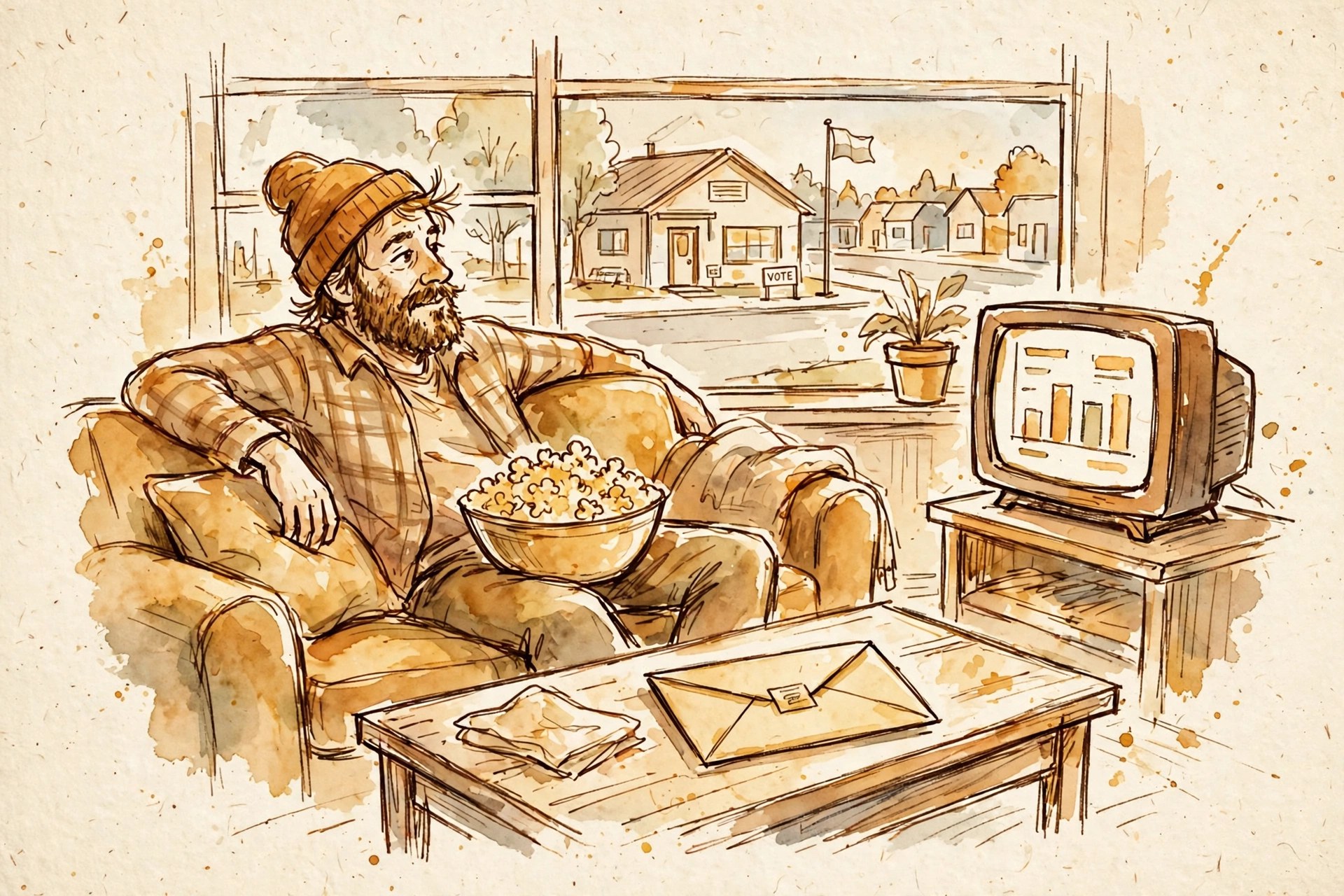
Today is midterm Election Day, November 3, 2026. I recently moved apartments here in Arlington, Virginia, and my mail ballot did not follow me. Virginia has my name on a list that is supposed to put a ballot in my mailbox: easy to fill out, a couple of check marks, back in the mail. At the new address there is no ballot. There is a polling place five blocks away, at the community center. I could walk over this morning. I probably will not.
I am ambivalent, and ambivalent is probably the wrong word, because I do not feel two ways about it. I feel no way about it. Probably not voting. Probably do not care. Midterms are stupid. I do not care if it is a Blue Wave or not. I am here for the popcorn and to see what happens next. I live in a completely blue part of Virginia. My vote would cancel out one person's blue vote, and that would be the entire consequence of my citizenship today. I do not feel seriously self-empowered by any of it.
This morning my friend Sean posted the story everyone is arguing about. American citizens in California are afraid to vote today because they think the government might come for their families. Reuters went to the Central Valley and reported it. Arrests in Bakersfield went from about one a day for much of 2026 to nearly ten a day in mid-October, in California's 22nd Congressional District, a closely watched House race that is 73 percent Latino, weeks before the election. A woman was arrested with her brother while unloading groceries; her 11-year-old came home from a school camping trip and learned his mother had been detained. Sean's verdict: this is fear as public policy.
I commented: "The only thing to fear is fear itself."
Sean answered: "Sure. But it hits a little differently when the fear is being created by your own government."
So I wrote the whole thing out. Here it is, cleaned up from voice-to-text, which is how I write everything now:
Every country works on a certain level of intimidation. All civilization works on a certain level of intimidation. Voting isn't supposed to be easy and simple; it's supposed to be brave and powerful. If I were undocumented or if I had a warrant out for my arrest, I would definitely be afraid. I think to be an American you should be brave and courageous and say I belong here, gosh darn it, and I deserve to vote. If being asked for your license and registration stops you from driving, then you shouldn't be driving, and if being stopped to ask for your license prevents you from voting, then you should have requested a mail-in ballot or found a different way to vote without having to expose yourself to an experience that intimidates you and makes you afraid. In 2026 there are many ways that you can avoid direct engagement with ICE agents or law enforcement and also vote as an American. In Virginia you automatically get a ballot to vote. The intimidation of perfectly legal people is a theoretical in the same way that the fact that there are all kinds of stolen votes and there's all kinds of fraud in voting is a theoretical too. But you can't prove a negative. You can't say that there would have been 10x more people if those people didn't feel afraid to go to the voting booths. Obviously when people hear that immigrants would be intimidated to go vote, they automatically think, well, what are they trying to hide? Are they really American citizens in the first place? And if they were, then all they have to do is prove that they are at the voting booths and it's all good. As an American it's worth going through a little bit of trouble in order to represent yourself on Election Day. But what do I know? I'm just talking about perceptions and reality. Lots of people respond to this kind of messaging as "if you had nothing to hide then you'd be just fine, and if you were a citizen in the first place then why are you so afraid." Getting pulled over in a car is scary, but it doesn't stop people from driving. A lot of people hate cops, but cops are in the community and are a necessary evil. I guess there are people who hide at home because they're afraid of cops and who don't drive because they're afraid of pullovers. That's why I'm talking about fear. You can be afraid of whatever. My mom was afraid of escalators. And actually exacerbating the fear of there being ICE by the left does as much work as the ICE agents being there in the first place. Also, if there's a lot of counter-protesters, a lot of voters won't even go out to the polls, because 100% of people don't like protests. And they're afraid of antifa and they're afraid of violence and they're afraid of gunfire and they're afraid of being hurt, and it's just not worth the trouble, so all roads lead to voting being a pain in the butt if it's not as simple as getting a letter in the mail, doing a couple check marks, and then putting it in the mailbox.
Human beings are grown-ass adults with agency, not little scurrying rats that need to be enabled or empowered. The citizens in the Reuters story never speak. A farmworker speaks for them. A wire service frames them. Sean amplifies them. At no point does a grown man or woman stand up in that story and say what they did and why. They are material. People who write about the poor that way do not realize how condescending and anthropological they are about the poor pagan babies. The babies have to stay babies. If a citizen of the United States, holding everything citizenship actually protects, weighs ICE against the ballot box and goes and votes anyway, there is no story, and a whole profession of concern is out of work.
The same country was arguing about the war this morning, in another thread, under a Libertarian meme about a soldier shipping out to Iran. A man informed me that one of our first acts of that war was bombing a school: two Tomahawks, about $5 million, 120 schoolchildren and 26 female teachers. The school stood directly adjacent to an IRGC Navy complex, and investigators concluded the targeting ran on outdated intelligence that still classified the whole parcel as an active military facility. He calls that criminal negligence, war crimes, treason. He also told me that his choices lose consistently because they are Libertarians, so if I am MAGA the blood is on my hands, not his. I told him what I tell anyone: that is war. War sucks. War kills children and babies and pregnant women 100 percent of the time. Studies published through PMC estimate that more than 10 million children younger than five were killed or affected by the direct and indirect consequences of conflict globally in just the twenty years from 1995 to 2015, driven by famine, disease, and the collapse of infrastructure alongside direct violence. 146 dead is a tragedy. Ten million is a statistic. The line is attributed to Stalin, which does not make it less true. And when my man in the thread tried to leave the ledger through the losing-ballot exit, I closed the door: as Americans, all the blood is in our hands. Mine too. You do not get innocence by ballot. You do not get it by staying home, either.
Sean answered in about seven minutes. "Chris, I think you just made the point of the post better than I did." Then he made his own point better than his post did: the people Reuters described were not undocumented people afraid to vote; they were American citizens afraid that showing up to vote could expose undocumented members of their families, and that is a very different thing. And he quoted my own sentence back at me. "Voting isn't supposed to be easy and simple. It's supposed to be brave." Why? Voting is a right. It should be boring.
Voting is a right. It is not an entitlement. A right is a thing you exercise, and exercising it has never come with a guarantee of zero friction. An entitlement is a thing delivered to you, on schedule, to your mailbox, with the friction removed by somebody else. Sean's whole post is a demand that the right be administered as an entitlement, and that any friction in the delivery is an outrage against the republic. I am not even innocent of the preference: I would like mine delivered too. I said so at the top. The difference is I do not dress the preference up as a principle.
What Sean never prices in is that a reader can accept every fact in his story and refuse his conclusion. We agreed on everything. I believe the Reuters reporting he believes. I just interpreted it completely differently. Read straight, his story asks the opposite question: why are we making it easy for people who are hiding their undocumented relatives? Make it as challenging as possible, and eventually the pressure does its work, until the person doing the hiding decides it is not worth it anymore: I am turning you in, abuela. There are terms for that. It is the logic of pressure and interrogation run as a nationwide deportation program, and nobody running it is hiding the intimidation; the intimidation is announced. If you have to bring your undocumented brothers and sisters into the polling area in order to vote, then there is a real possibility those people will be engaged and deported, and that risk is not an accident of the program. It is the program. The alternative is a place with no policing and no oversight, and a place with no policing is a lawless territory. If you want to be left alone entirely, you can live rural. Cities get law and order. That is the deal on offer, and it has always been the deal on offer.
And hear Sean's argument precisely, because it deserves to be answered in its strongest form. He is not saying the van gets stopped at the polling place. He is saying nobody gets in the van. The citizen cannot go and vote at all, because everybody who would drive him is undocumented, everybody he works beside is undocumented, everybody he comes home with is undocumented, and moving through public space toward a polling place puts his entire greater family at risk. So the American citizen stays home from his own election. No raid required. No stop required. No ICE agent ever has to see his face. The possibility does all the work, in advance, forever. And it is complete fabulism. Sean needs citizens who are hostages inside their own families, woven so deeply into illegality that a drive to the community center is an act of betrayal, because without them his story has no victims. It has only adults who heard a frightening story, weighed a small risk, and stayed home, which is not a scandal. It is Tuesday.
I will trade Sean his imagined population for one real person. Two days ago at Starbucks I turned to say hello to the woman sitting next to me and she came up out of her seat like I had grabbed her. She is Saudi Arabian, in a master's program in criminology since January, and she told me, a little embarrassed, that she reads about five murders a day for her coursework. She used to be a confident woman. She grew up where men and women live separated and covered, and she was not afraid of men or of rooms. Eleven months of murders changed her. Now her head stays on a swivel. Every man is a potential rapist, every stranger a potential murderer, and it is not the world that did it to her. Arlington did not get more dangerous. Her imagination got a syllabus.
We are friends now because I told her the truth, which was that her perfume was amazing, and I thank God it landed the way I meant it. Yesterday she came to me first and shook my hand, a little hand and a strong handshake, and I did not compliment it, because a grown woman does not need a man marveling that she can grip. She is a flinch person now. That is what a steady diet of imagined catastrophe does to a real nervous system, and Sean's readers are on the same diet, except their coursework is the news. Five murders a day, five raids a day, five families a day, until a trip to the polling place plays in the head like a crime scene. The fear is real. The danger is coursework.
So I said the rest of it out loud. So they are aiding and abetting their undocumented relatives. That is basically the takeaway anyone gets from reading that story: it is not that they are afraid for themselves, it is that they are afraid of revealing all the undocumented people who live around them. And that is the whole takeaway from the entire exchange, so let me not bury it: the undocumented people living around them are the people who should be deported, which means ICE is doing a good job. If you want to find people who are here without documentation, you go where the people shielding them have to step into public, and a polling place is one of those places. And the friction is the point. Aiding and abetting people living in this country without documentation is supposed to make your life highly frictional. Living here undocumented is not a crime, but it makes your life shittier, and that is intentional, and some of the shit lands on the people helping you stay. That is not the system failing. That is the system working as designed. And that is the actual distance between Sean and me, underneath everything else we said to each other this morning: everything he thinks is beyond the pale, I think is just normal law and order, normal policing, normal everyday American stuff. He is apoplectic over what I think is a Tuesday. It is, very literally, a Tuesday. And no, remember the purple-fingered, purple-thumb voters? Iraqis voted in 2005 with assassination priced in and walked out holding the ink up for the cameras. Voting is a revolutionary act that requires bravery and courage, not to be taken lightly. Zero friction is the belief system a lot of people are selling, and I am into it, because I am probably not voting today. I live in Arlington and everybody here is going to vote the same whether I show up or not, and I do not even feel like it. I am a total hypocrite. An honest hypocrite, for what it's worth.
And none of this is abstract for me. I am not arguing it from a gated distance. Most of my friends are undocumented, or recent immigrants, or refugees. In my neighborhood in South Arlington the day starts in four or five languages: ¿Qué tal? Todo bien. As-salamu alaykum. Ça va? ¿Hace frío? I live inside the world Sean writes about. I just refuse to describe the people in it as helpless.
That is the argument. Now the man I had it with.
Sean posts every day, at length, and every post is the perfectly toned liberal thing to say. No controversy, ever. Just the right thing for a perfectly lovely person to say, whether or not it is practical or probable or real or honest. It is what is in his heart, and I know his heart is beautiful, so I am not going to call him a fool. I am going to call him a beautiful child of God who has not allowed the world to create so much as a single flaw upon his alabaster flesh. Sean is not a naïf, either. He has spent twenty-five years in public relations; saying the perfectly toned thing is his profession. I push hard on anybody I feel is virtue signaling or white knighting, and when the earnestness comes that unblemished from a man whose whole career is knowing exactly what to say, I assume craft. His heart may be exactly as beautiful as the posts. Twenty-five years of professional persuasion is a strange place for artlessness to survive untouched.
He is not writing to say what he thinks, either. He is writing to model what should be thought. Sean believes he is an important part of role modeling the correct behavior to the people around him, a teacher handing out moral tales, and that is patriarchal and paternalistic to its bones. The post is the lesson and his readers are the class. It never occurs to the teacher that the class can read the same story and reach the opposite conclusion, or that the citizens in the story are grown adults who never enrolled in his classroom.
Patricianship is the word for it. Sean on the Mount, modeling the beatitudes of his class for the people below. Whether it is done to teach or done for clout I cannot tell, and I suspect he cannot either; the two coexist comfortably when the lesson and the applause arrive together. But parents who raise their children on a performance of perfection, no struggles shown, no flaws admitted, make terrible adults. The performance shows neither the grit nor the doubt. Even the Gospels would suck without Judas, and without Thomas, who doubted out loud and had to put his hand in the wounds. Thank God for the Pharisees and the scribes in that record, the valuable checksum, needling every claim while everybody else was glazing. A faith with the doubters and the betrayers edited out produces believers who shatter on first contact. So does a politics.
That is why every system needs a heckler, and why the heckler is always the first one the patricians want gone. Every system needs a Charlie Kirk: the man who walks into the classroom uninvited and argues with the lesson in front of the class. And that is why Charlie Kirk was murdered. He was a dissonant note in a country that has started treating dissonance as harm, and a note that will not resolve gets silenced. The people who celebrated his death were not celebrating a victory in an argument. They were celebrating the sound of the chord finally resolving. You cannot run a patricianship with somebody heckling your aloof interpretation. Do you know who I am? How dare you talk to me? How dare you challenge these children? Well, why are you college-educating those children if they are so vulnerable? College was never supposed to be a safe space. College is supposed to be hard and challenging, and people break there because it is hard. The voting booth is not supposed to be a safe space either. Somewhere along the way the college, the voting booth, and the police station all got rezoned as safe spaces, places where the citizen is promised in advance that nothing will frighten him. A republic that makes that promise is not protecting its citizens. It is keeping them children.
What Sean performs every morning is not patriotism. It is patricianship. And patricianship is worse than the nanny state, because the nanny state at least admits somebody is holding your hand. This is a man spending his whole life certain he is a master parachutist, HALO jump after HALO jump, all daring and all his, when every jump he ever made was tandem. Somebody has been strapped to his back the whole time, making every decision, doing the actual skydiving. He has never once descended on his own. His class pulled the cord for him, every time, and he calls the ride courage.
The polls close tonight at 1900. The community center is five blocks away. I still might walk over. Probably not. The popcorn does not care either way.
Share: X · Facebook · LinkedIn · Reddit · Bluesky · Threads · Email