
Rights Are Not Allowances
This article, read aloud:
Share: X · Facebook · LinkedIn · Reddit · Bluesky · Threads · Email
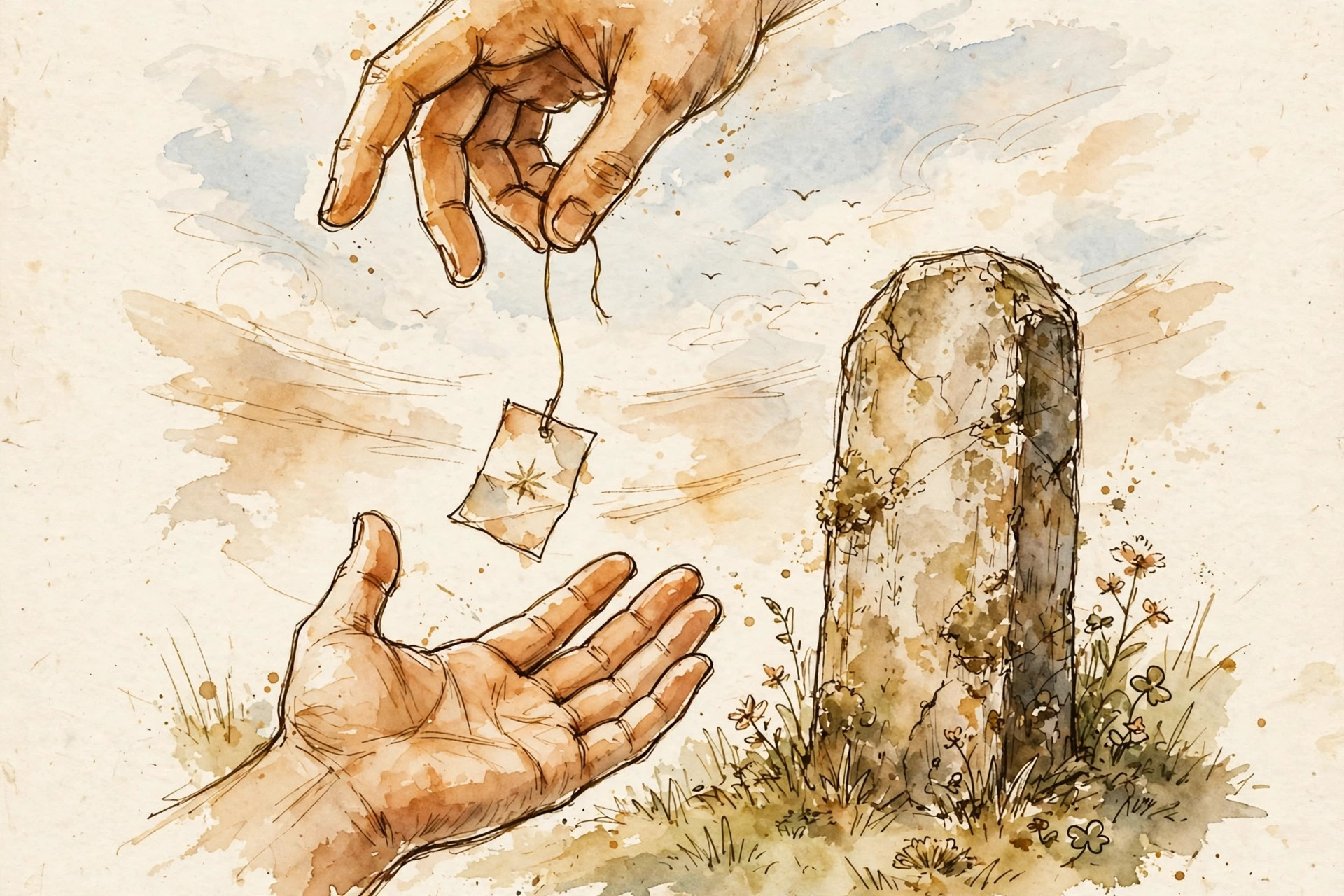
A right that can be taken away was never a right. It was a permission slip, and permission slips expire.
This morning a man told me human rights are defined by the people. Take it straight and it is a warning. A thing that gets defined can get undefined. The hand that writes the definition keeps hold of the eraser.
The allowance
An allowance is what a parent hands a child for doing his chores. It arrives on conditions. It is tested against behavior. It stops the week the behavior stops pleasing the hand that pays it. The child owns nothing. He holds a sum at somebody else's pleasure, and the arrangement is honest about what it is: a leash made of money.
Call a right an allowance and the whole structure follows it down. It lasts exactly as long as the holder stays in favor with whoever issues it. The citizen becomes the child. The state becomes the parent. The chores become compliance, and the allowance becomes speech, worship, assembly, and the gun in the closet—each one handed down, each one recallable when the behavior displeases.
Wardship is the allowance system applied to persons, and in America and Britain alike it is assigned by category. The immigrant, the foreigner, the woman, the man of the wrong color, the man of the wrong desire—each one is issued a childhood on arrival, to be protected and monitored like an eight-year-old. The assignment never asks about capacity. A grown man can be enormous, capable, and self-governing—a freaking bear of a man—and the classification still renders him an infant in the eyes of the state. Citizens hold rights. Wards hold permissions, under supervision.
Wardship's logical end is a Massachusetts courtroom. Lindsay Clancy admitted strangling her three children; the defense was postpartum psychosis, a real and documented disease, and the September trial deadlocked eleven to one toward insanity. Supporters in pink rallied for the mother as the victim, and the three dead children became the backdrop. Concede the diagnosis: explanation is not exoneration, illness is not innocence, and a disease that ends in three corpses settles a disposition—a secure institution, possibly for good—not a celebration.
Endowed, not issued
The Declaration says men are endowed by their Creator with certain unalienable rights, and it says governments are instituted among men to secure those rights. The rights arrive first. The government arrives second, hired for one job: guard what already exists. A guard issues nothing. A guard who starts issuing the thing he was hired to protect has changed jobs, and the new job is owner.
The humanist lands in the same place. Strip out the Creator and the claim survives: rights inhere in human dignity, in the bare fact of being a person. They precede every legislature, every court, every vote. Rights are found, not made. A legislature can acknowledge them or violate them. Creation is beyond its powers: a thing the legislature creates belongs to the legislature, and what belongs to it can be recalled by it.
The grammar of the Bill of Rights
The Bill of Rights, read as grammar, ends the argument early. The document grants nothing. It is a list of orders addressed to the government, every one a prohibition. Congress shall make no law. The right of the people to keep and bear arms shall not be infringed. The rights are assumed to be standing there already, and each amendment stands in front of them facing the state, telling it where it may not step.
Speech. Expression. Religion. The press. Assembly. The right to keep and bear arms and to defend your own life with them.
The Ninth Amendment gives the game away. The enumeration of certain rights, it says, shall not be construed to deny or disparage others retained by the people. Retained. You retain what was yours before anybody wrote anything down.
Fair weather
The granted model works in fair weather. While the holder agrees with the grantor, while his speech flatters the majority and his worship offends nobody, the allowance arrives and feels like a right. The week the holder says the unpopular thing, worships the unapproved god, or reaches for the disfavored arm, the grantor reaches for the eraser. Fair weather is when a man cannot tell which instrument he holds.
The enforcement ledger
Securing a natural right costs nobody anything. My free speech leaves your free speech whole. My worship takes no bread off your table. Nobody has to be taxed, fined, or licensed to manufacture my liberty. The state secures it by standing back, and by stopping anyone who tries to stand in the way. The ledger balances at zero.
An entitlement runs the opposite ledger. A granted right to a thing—housing, care, an outcome—has to be produced by somebody. The state that promises it must compel the production: tax the earner, regulate the builder, fine the refuser, penalize the man who will not say the words. One person's entitlement is invoiced to another person's labor, and the man judged unrightful has his portion taken so the portion of the approved can be given. The arithmetic is zero-sum by construction, and the collection machinery is fines, penalties, and force. Liberation administered by compulsion is still compulsion.
Fascism, stripped to the frame, is the imposition of will on other people, and by that measure both camps now practice it. The people wearing the fascist label these days are imposing nothing at all. They are speaking. They are publishing. They are defending their own rights in public. The doctrine that covers the gap says words are violence and words are harm, so speech that leaves somebody uncomfortable, afraid, or traumatized counts as force. England runs the exhibit, and it is no longer hypothetical. Russell Brand was convicted on November 9 and sentenced to 10.5 years for rape and sexual assault. On November 15 his wife Laura read a statement from him on their YouTube podcast: he maintains he is not guilty. The government's ground is distress. Prison rules ban statements that cause distress to victims, allow media contact only in exceptional circumstances, and bar bypass through somebody else publishing his words. Downing Street and the Ministry of Justice are investigating. The Justice Secretary called it completely unacceptable; No 10 called it appalling. The government asked Google to remove the video; Google reviewed it and declined. A minister allowed that lawmakers could look at legislation if needed. Brand is not niche. He is global—spiritual, Christian, evangelical, followed on every continent—and the state's trap completes itself. Whatever they do to him, his people will remember a martyr, sacrificed, not a criminal. The prison can hold the conviction on the record; it cannot control what the punishment certifies him as to the millions who follow him. The altar is one the authorities built themselves. Making people feel uncomfortable is enough to be classed as the fascist.
The moment discomfort counts as force, speech stops being non-zero-sum. Every right gets weighed against somebody else's feelings, by whoever holds power that season. A right that must be weighed before it may be exercised is an allowance awaiting its audit.
The ladder the other side climbs has three rungs, and each rung is a potential. Guns can kill, even though they rarely do, so the right that shall not be infringed gets restricted anyway. Words can hurt and words can kill—a person can be talked into killing himself—so speech needs curtailing in advance. The more vulnerable the listener, the easier the persuasion, so the curtailment widens to cover everyone in earshot. At the top of the ladder, speech that risks the outcome is treated as tantamount to the outcome: a killing by syllable.
Answer the ladder as a structure and it collapses under its own exchange rate. Every right carries a harmful potential in somebody's narration. A right that survives only until someone imagines its worst use is an allowance with a risk assessment attached. The rate gets set by the most vulnerable hypothetical person, and under that rate no right survives, because every liberty ever held can be narrated, step by plausible step, to a corpse.
The demand arrives early, before any harm. In the same conversation this week, the sickness was to be recognized and stopped before it starts killing people. I asked the only question a free country gets to ask: what can you do about it prophylactically, in a free country with freedom of choice? Totalitarianism? Despotism? How does one? Prevention administered in advance means machinery aimed at people who have done nothing yet: watchlists for the pre-guilty, treatment for the pre-sick, silence prescribed like medicine to men whose only symptom is an opinion. A right that survives only until somebody forecasts its abuse is an allowance with a weather report.
Who holds the pen
The people never sat down and defined anything. No crowd in history ever drafted a right. Definitions issue from small rooms—committees, courts, ministries—and the crowd learns it afterward and recites it as its own work. A right that needs a definer has a puppeteer, and the strings run from the small room to the page.
Permission slips
So the two instruments sit on the table. One is a birthright: endowed, unalienable, older than the government, guarded by prohibitions written against the state. The other is an allowance: defined, granted, conditioned on behavior, revocable at the grantor's pleasure, and enforced by taking from the unrightful to give to the approved.
A right that can be taken away was never a right. It was a permission slip, and the weather always turns.
Share: X · Facebook · LinkedIn · Reddit · Bluesky · Threads · Email