
Saving Pagan Babies
This article, read aloud:
Share: X · Facebook · LinkedIn · Reddit · Bluesky · Threads · Email
Every age has a creed it carries into other people's countries at the point of a weapon, and every age calls the carrying a rescue. The creed changes. The sentence never does: we are saving you from yourselves.
The modern creed is secular. Democracy, social justice, human rights, feminism, LGBTQIA rights, secularism itself—exported at the end of a bunker bomb by people who would be offended to be called missionaries. It is the same enterprise the Catholic Church ran across Europe and into Central and South America, and Islam ran in its own centuries: a universal truth, a duty to deliver it to people who did not ask, and force as the delivery van. The only thing missing from the modern version is God.
It runs in three acts, and the acts never change. Conquest takes the ground. Conversion makes the taking righteous. Collapse does the real killing. Only the costumes rotate.
Act 1: Conquest for treasure
The tip of the spear was never about saving anyone. The conquistadors went in for gold, for conquest, for adventure, for the king and for the queen. Cortés was not running a charity. The spear's work was to take ground and hold it, for the oldest reasons on the record: treasure, land, glory, position.
The modern spear works the same way. It goes in for strategic interest—bases, sea lanes, resources, position—and its work is seizure. Whatever brings the spear to the beach, the beach is taken the same way.
Then the ground is held, and the holding needs an explanation the people back home can live with. That is when the second wave sails.
Act 2: Conversion as moral cover
The friars followed the soldiers. Their work was to justify the taking and make it stick: convert the taken, teach them the creed, and turn a seizure into an order. Spain wrote the job description down.
In 1513 the Spanish Crown produced the Requerimiento, a royal demand read aloud to Indigenous peoples before the fighting started. It was read in Spanish, to people who could not understand a word of it, and sometimes it was read to empty villages and to trees. It announced that the pope had given their lands to the kings of Spain. It demanded that they accept the Church and the Crown. And it declared, in advance, in writing, that if they refused, the war, the enslavement, and the deaths that followed would be their own fault.
Read that last part again, because it is the whole second act in one clause: the violence pre-forgiven, the blame pre-assigned to the people about to receive it. Bartolomé de las Casas, a friar inside the enterprise, read the document and objected on the record. The objection is not hindsight. A man standing in the middle of it could see what it was.
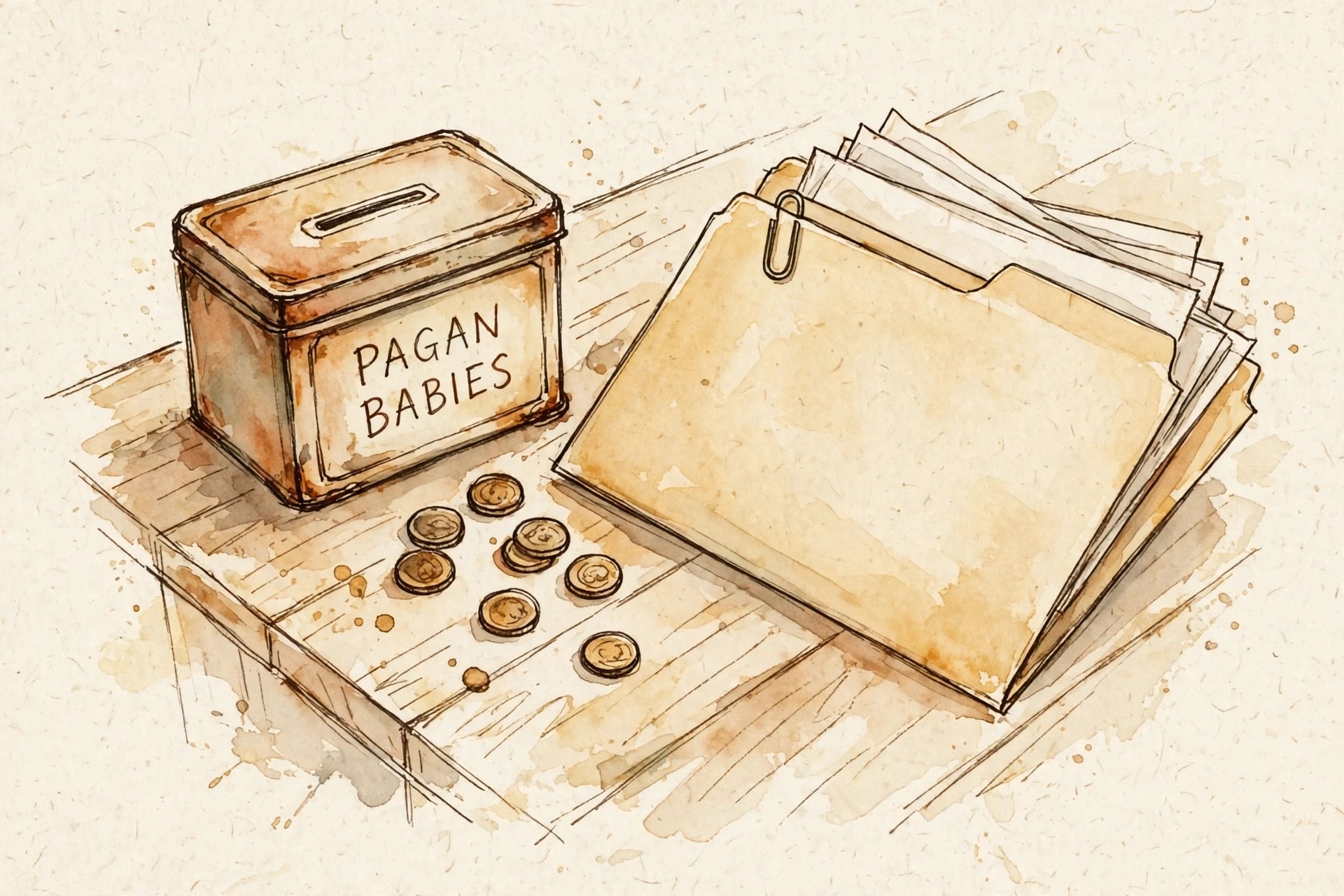
The impulse did not die with the conquistadors. It got smaller and cuter and it lived in my mother's parish. The Holy Childhood Association put collection boxes out for pagan babies—in her Catholic girls' school, in the cathedral, in the local church, even in the fishing club—labeled for saving pagan babies, saving the souls of pagan babies. Five dollars could ransom one, and the child who paid got to name it. My mother, a young girl in the 1940s and 50s, put her money in those boxes.
Hold the line in your head, because it is unbroken: a royal demand read to people who could not understand it, a tin box on a school desk collecting coins to buy souls, and a grant folder. The box is the middle of the line. My mother's coins are in the middle of the line.
The modern second wave arrives after the Marines, and it has letterhead. The State Department, USAID, and the rest of the agency alphabet, trailed by an army of NGOs, move in to run the conversion phase: elections to organize, gender programs to fund, civil society to build, rights curricula to teach, all of it under the auspices of social justice, civil rights, feminism, and anti-homophobia. Samantha Power ran USAID from 2021 to 2025, and she came to the agency as the framework's framer. In the Obama years she was the National Security Council's Senior Director for Multilateral Affairs and Human Rights, then Ambassador to the United Nations from 2013 to 2017; she wrote A Problem from Hell, helped stand up the Atrocities Prevention Board, and stood with Clinton and Rice among the leading internal advocates for the 2011 intervention in Libya. She did not run field counterinsurgency programs. She framed and justified the use of force—she authored the moral cover, which makes her the one who drafts the modern Requerimiento, not the one who staffs the mission. The second wave has an agency, a budget line, and a personnel pipeline. The friars had to improvise. We bureaucratized it.
And the conversion is as shallow now as it was then. In Afghanistan it photographed beautifully: a choice number of generals' daughters in school for the cameras, real gains for women in Kabul and the cities. The traditional rural country, where most Afghans lived, was barely touched—its men killed, its women left alone in the ruins, the promised schooling never arriving. Then the second wave went home, and the whole layer came off within months of the 2021 withdrawal. Colonial Catholicism sat the same way over Indigenous belief: a coat of paint on a house full of somebody else's gods, and the old gods outlasted the paint.
The tell is the inconsistency. America backs the Saudis and a shelf of other autocrats whenever the interests line up, and the creed never says a word about it. A cause does not take days off. A costume does. The values are the costume, not the cause—which is the conquistador model exactly, gold in the hold and salvation on the flag. Ask the gay Iraqis how the liberation treated them: worse after the invasion than under Saddam, hunted by militias in killing campaigns in the late 2000s. The cover story's supposed beneficiaries were never the point of the cover story. Every war arrives sold as a liberation. We're liberating the French, we're liberating the Polish, we're liberating, we're liberating. And as long as the pursuit can be called liberation, you can kill a thousand times more people than you liberate and still be the liberator.
The genealogy is documented, not decorative. John Gray's Black Mass argues that modern utopian politics is Christian apocalyptic thinking with the theology swapped out, and he aims it straight at Iraq. Tom Holland's Dominion argues the other side of the same coin: human rights, equality, and concern for the victim are Christian ethics with the God sanded off. If both men are right, the missionary DNA in the secular creed is a straight inheritance—proselytizing gene and all.
Act 3: Collapse
The third act is the biggest, and it is the one nobody photographs. The swords and the bombs are the smallest killers in the story. In the 1500s the mass death came after the conquest, on little wings: smallpox and the epidemics, emptying whole peoples out of country the soldiers had barely seen. Nobody understood germs. The killing was mostly unintended, a collapse nobody planned and nobody could have pictured.
The modern collapse is chosen with the picture in front of us. The Spanish killed millions without knowing what a germ was. The modern planner knows exactly what a bombed power grid and a wrecked water system do to the people inside the city, and the breadwinners still die, the logistics still die, the black and gray markets that feed people when the official economy dies still get strangled, and the dying runs on for years at industrial scale. Foreseeable is worse than unintended. There is no honest way to make it better.
Brown University's Costs of War project keeps the ledger. Its accounting of the post-9/11 wars counts roughly 940,000 people killed by direct violence. Against that, the project estimates 3.6 to 3.8 million more dead indirectly—of disease, malnutrition, wrecked health systems, and collapsed infrastructure. That indirect figure is the project's own modeled estimate, built on the standard reckoning of about four dying of a war's collapse for every one killed by its weapons. Four to one. The epidemic is still the main event. It has accountants now.
The Americas show the end state. Native America, and then Central and South America, went through all three acts: the taking, the cover, and the collapse. What followed the collapse was a caste order—decimated, then subordinated, in that order, for centuries. Argentina and Uruguay came out heavily European. Mexico came out mostly mestizo. Bolivia, Guatemala, and Peru kept large Indigenous populations. Everywhere the same staircase survived: the Spanish and their descendants on top, the mixed in the middle, the Indigenous on the bottom, and the staircase is still standing today, five centuries after the friars packed up.
Simón Bolívar did not take South America back for the conquered. He was a criollo aristocrat, a descendant of the conquerors, and he liberated Spanish America from Spain on Enlightenment terms, with a French and American revolutionary creed in his saddlebag. The Indigenous stayed on the bottom of his staircase too. That is the deepest turn in the whole pattern: the export gets learned by the exported-to and turned around. The liberator stands as the enterprise's most talented graduate.
The cases the critics reach for are Germany and Japan, and they prove the delivery rule instead of breaking it. Those were total defeats followed by a generation of occupation and rebuilding—conquest that stayed, paid, and finished the job on the ground. Nobody airdropped values into Berlin and flew home. When the second act worked, it worked as an occupation, because that is what it was.
Here is what the second wave is, stated plain. It is like raping someone and then marrying them to make it legitimate. The ceremony does not undo the taking. It reclassifies it. Seizure becomes union. Occupation becomes uplift. And anyone still objecting afterward is no longer a victim of anything. He is an ingrate at his own wedding.
The creeds will keep rotating. Salvation, civilization, rights—the wardrobe is deep. The sentence underneath never changes, and it was already old when a Spanish notary first read it aloud to people who could not understand the language it was written in. We are saving you from yourselves. The saved are still waiting to be asked.
Never trust anybody who wants to change the world. In all their hubris and pride, they never reckon with the fact that the unintended consequences and the blowback run generally seventy-seven times worse than anything they envisioned when they set out to make the world a better place. Every wave in this story arrived certain it was the exception. None of them were.
Added November 19, 2026: a closing passage.
Share: X · Facebook · LinkedIn · Reddit · Bluesky · Threads · Email