
Shoulding All Over Yourself
This article, read aloud:
Share: X · Facebook · LinkedIn · Reddit · Bluesky · Threads · Email
A meme making the rounds carries a quote from the actor Simon Pegg: "Of course it's not all men, that's not the point. The point is, it's a lot of men and we need to educate our sons as to what is right and what is fucking wrong." The quote argues safety from the world as it should be, and the world as it should be is the worst map a person can carry into the world as it is. Every father in America already teaches his son the lesson the meme demands. The men who rape and assault anyway form a small repeating minority that no curriculum was ever going to reach. Safety in the actual world comes from other materials entirely: guardians who are present, herds that intervene, prudence practiced as navigation, and the honest reconstruction of every bad night so the next person can read the chain in time. The distance between the should and the is is where the injuries happen.
The Lesson Was Never Missing
The meme relocates the crime into the nursery. Its premise: somewhere in America there are fathers who skipped the talk, households where a son grew up uneducated in the difference between right and wrong, and a national curriculum for boys would close the gap. The premise fails on contact with any actual household. Fathers teach the lesson at kitchen tables, in truck cabs, on the way to practice, in the doorway the first time a son comes home smelling of beer. Mothers teach it. Grandfathers teach it. The lesson is the wallpaper of American childhood.
The offenders heard it too. That is the finding the meme cannot afford to look at. The research on serious sexual violence keeps landing on the same shape: a small population of men offending repeatedly, responsible for a large share of the total harm. Studies of undetected rapists—men who admitted in anonymous surveys to acts meeting the legal definition of rape and were never caught—find repeat offenders again and again, men who heard every lesson the culture offers and filed it under somebody else's name. A curriculum addresses a population that lacks information. This population lacks nothing except a conscience and a cage, and a curriculum supplies neither.
So the meme aims at the wrong unit of analysis. A category can be managed, lectured, and administered. A category cannot be prosecuted. Only a person can be prosecuted, and the persons doing this are few, known to the data, and unreachable by poster. Educating "our sons" as a sex means delivering the lesson at maximum volume to the overwhelming majority who never needed it, in the hope that some of it splashes onto the minority who will never take it in. That is herd management wearing the clothes of justice.
Probably Friendly
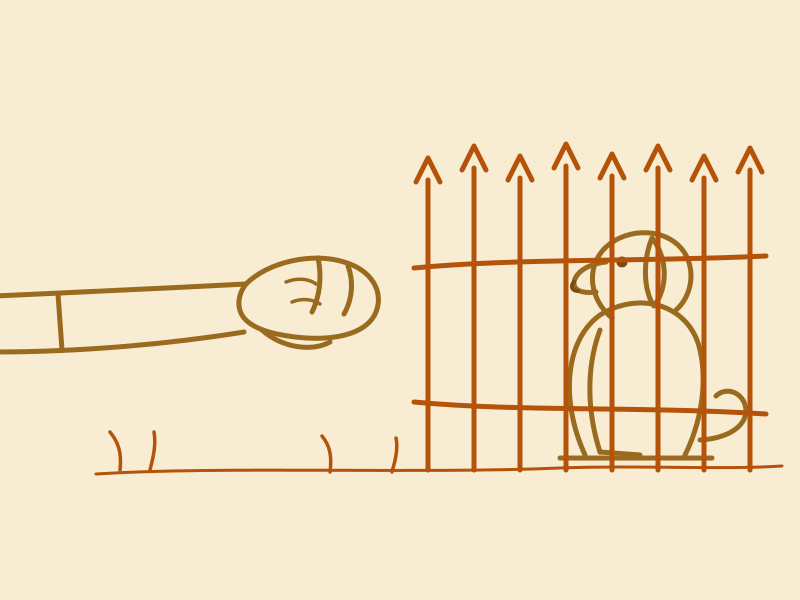
There is an older technology for moving through a world that contains large animals of unknown disposition, and it predates every curriculum. My rule for a strange dog on a walk covers it. The dog is probably friendly. The base rate comes first, because the base rate is true and panic is a liar. The approach runs slow: no rushing, the back of the hand offered, the dog closing the distance. Check with the owner and with the people standing around, the ones who know this animal. A dog you know nothing about stays untouched no matter how beautiful it is. Breed proves nothing. Breeding proves nothing. A clean coat and a healthy shine prove nothing. Those are unreliable indicators, every one of them.
The same approach governs any stranger with a size advantage, on any sidewalk, in any parking lot at night. Prudence of this kind is navigation. A sailor who reads weather is practicing seamanship; a woman who reads an unknown man as an unknown quantity is practicing the identical craft in a different medium. The reading accuses nobody. It simply refuses to confuse a hope about the world with a fact about the animal in front of you.
The limit case is the exotic animal in the living room. People keep chimpanzees and big cats and constrictors, animals that outweigh them and outmuscle them and run on carnivore software, and they explain the arrangement the same way every time: we have a special relationship. The special relationship is the should wearing fur. It holds that the species rules are real and suspended here, in this house, for this animal, because of love. Then the chimp takes a face, or the snake does what snakes do, and the surprise is total because the belief was total. The snake charmers keep better books than the pet owners do. Indian charmers are bitten and die of it in numbers nobody headlines. The evangelical handlers in the Appalachian churches take up serpents on the authority of Mark's Gospel, and the ones the Holy Spirit does not save do not testify. The survivors preach. The bitten are quiet. A whole theology of immunity gets built from the testimony of the people still standing, and it runs on the suburb's arithmetic: nobody in my environment has ever been bitten. The animal was never inside the argument. The animal is the is.
And here the meme's arithmetic inverts itself. The meme holds that safety arrives when men, as a class, complete their education. The dog rule holds that safety is a practice carried by the person moving through the world, tuned to the individual animal, refreshed at every encounter. One of those accounts describes how anyone has ever actually stayed safe.
What Did You Do
Every victim gets asked the forbidden question twice: once out loud by the culture, in the form of a scandalized silence, and once silently by every single person who hears the story. What did you do. The words arrive in every head, uninvited and instant. The public script then performs a great show of not having thought them. The performance helps no one, because the question itself is the first instrument of every safety discipline that has ever worked.
Aviation asks it without embarrassment. A plane goes down and investigators reconstruct the chain link by link: the weather, the maintenance log, the fatigue, the decision at 2,000 feet. Medicine asks it in morbidity and mortality conferences, where surgeons present their own worst outcomes to a room of peers and take the chain apart in public. Nobody in those rooms imagines the reconstruction acquits a negligent pilot or a careless surgeon. The guilt ledger and the chain ledger are separate books. The offender's guilt—total, unshrinking, his alone—sits in one. The sequence of events sits in the other, and the sequence is the only part of the story the next traveler gets any say over.
Criminology disgraced itself once by confusing the two books, and the disgrace has a name. Marvin Wolfgang coined "victim precipitation" in 1958, studying homicide. Menachem Amir picked the term up in 1971 and applied it to rape, and the field tore the work apart, correctly, because it ran the chain backward into an acquittal: it studied the victim's conduct in order to move guilt off the man who committed the crime. That move is refused here, in advance and by name. Reconstruction moves knowledge forward to the next person. It moves guilt nowhere. The question "what did you do" asked the investigator's way is how a daughter learns the world her father actually lives in. Asked the defense attorney's way, it is an acquittal machine. The words are identical. The ledger is different.
The Guardian Was the Variable
The strongest finding in the field is almost embarrassingly plain, once the sociology is stripped down. In 1979 Lawrence Cohen and Marcus Felson published routine activity theory: a crime requires a motivated offender, a suitable target, and the absence of a capable guardian, all in the same place at the same time. Two of the three terms describe people who were always going to exist. The third term—the guardian—is the variable. Where a capable guardian stands, the equation fails to complete.
The footage backs it. In 2020, Philpot and colleagues published an analysis of 219 real public conflicts captured on CCTV cameras in Britain, the Netherlands, and South Africa. At least one bystander intervened in 91 percent of them. Larger crowds helped rather than hindered: more bystanders raised the probability that somebody stepped in. Robert Sampson's collective efficacy research in Chicago found the same force at neighborhood scale—blocks where residents trust each other and will intervene for the common good run measurably less violence than blocks where everyone keeps their head down. The herd is the guardian. Safety is a property of rooms and streets, it is regional as weather, and it is maintained by people or it lapses.
I have been the guardian in the equation, and I know the borrowing from the inside. I am six foot three, and I have weighed between 220 and 280 pounds for my entire adult life. My small friends—Napoleonic little men, some of them—grew ten feet tall standing next to me in bars. My girlfriends grew bolder in my shadow by exactly the same mechanism and in exactly the same measure. The borrowing never checked gender. It checked proximity. People stood inside my field and mistook it for their own courage, and the mistake was invisible to them until the field moved.
My first fight taught me the guardian's other duty, the one nobody puts in the theory. I was a kid in Hawaii, five or six boys in front of me announcing they were going to kick my ass, and my mother and father watched the whole thing from our apartment a hundred yards away. They did not come out. In that herd, a boy rescued by his mommy and daddy wore the rescue forever; the mama's boy tag would have cost me more fights than the one standing in front of me. So they stayed at the window and let me stand. I stood, I did not back down, and in the end nobody closed and nobody swung. My father had already done his guarding in advance. He was a Marine, and he taught me to fight like a Marine, to punch with my elbows, to fall like a Marine. Then he and my mother wanted to see what I was made of. A guardian's hardest work is sometimes to be fully present and refuse to arrive.
So I learned the ethics of the large. A man built like a vehicle of last resort keeps the vehicle holstered. He lets height and size and confidence do the quiet work. He refuses to be sicced on strangers to settle somebody else's argument, because a guard dog on a leash held by a bolder friend is a weapon pointed by another person's judgment. The presence is real and it protects. It also corrupts the borrower's calibration, and a decent guardian knows both halves of that.
The field has borders, and travel proves it. A person raised inside total herd immunity carries its manners into places that never bought them. The force field that covered a quiet suburb does not extend to a strange city at 2 a.m., or to a country where the police answer a different master, or to a bar where the last guardian just left the room. The manners travel. The field does not. A map of the should says the field is everywhere. A map of the is says the field ends where the herd ends, and the traveler who cannot tell the difference has mistaken her neighborhood for the world.
Preventative Medicine and Its Paradox
The peace is real, and it is an achievement. Whole neighborhoods, whole regions, whole generations now grow up inside herd immunity against violence: friends of mine have never heard genuine malice in a locker room, never seen a fistfight that a referee did not govern. Civilization bought that with law, norms, cameras, and the boring daily labor of millions of guardians. Preventative medicine is the honest name for it.
The epidemiologist Geoffrey Rose named the trap built into every successful prevention: the better it works, the less evidence remains that it was ever needed. A generation raised after the vaccine doubts the disease. A generation raised inside the field doubts the fist. Violence goes abstract, cinematic, something that happens in films and in other zip codes. Into that vacuum the should rushes, wearing the costume of an argument. Nobody would punch somebody for saying that. Nobody would stab somebody over that. Nobody would do that here. Every one of those sentences translates, word for word, into a smaller and more honest one: nobody in my environment has ever done that. The first version claims a law of nature. The second version reports a local fact, and local facts expire at the county line, at the airport, at the moment the guardian steps out of the room.
Shoulding All Over Yourself
Albert Ellis, the psychologist who built rational emotive therapy, diagnosed the whole pattern half a century ago and gave it the name this piece borrows. He called it musterbation: the human habit of converting preferences into demands and then raging at a universe that declines to comply. His patients, he said, were shoulding all over themselves. Ellis aimed the diagnosis at private misery. It scales to public argument without modification. The meme is musterbation at national scale—a demand that reality file the paperwork, that the world run on the should, that safety be a property of the curriculum rather than of guardians and herds and practiced prudence.
Ellis never prescribed lower standards. He prescribed accurate description in place of demand. Applied at national scale, the description runs like this. A man who rapes bears the whole guilt of it, in every case, with no percentage shaved off by any chain anyone reconstructs. And the work of safety goes on in the world as it is: guardians present and willing, herds that step in, strangers read as strangers, every bad night taken apart link by link so the knowledge reaches the next person before the night does. Civilization is the project of making the should true more often. Navigation is how a person lives until it is.
The whole argument fits in one breath. The Pegg meme proposes to educate a category; the offenders are a few repeat men no lesson reaches, and their guilt is total and untouchable by analysis. Safety comes from guardians who are present, herds that intervene nine times out of ten, prudence that reads each stranger as an individual, and reconstruction that studies every chain while moving no guilt anywhere. The should describes the world we are building. The is describes the one we walk through tonight, and a person deserves a map of the second one.
Share: X · Facebook · LinkedIn · Reddit · Bluesky · Threads · Email