
The Actuarial War Crime
This article, read aloud:
Share: X · Facebook · LinkedIn · Reddit · Bluesky · Threads · Email
Every Crowd Arrives With a Death Count
Every large crowd in America carries an expected death count. Put enough aging, overweight, hypertensive, diabetic, sleep-deprived Americans in one place for one day and some of them will have heart attacks. Some will stroke out. Some will collapse from heat, dehydration, exertion, or a blood vessel giving way inside the head. Gather enough people and the medical tents fill on schedule.
Take the names of the dead and injured out of their causes. Remove the size of the crowd. Remove the number who were expected to die on an ordinary day. Call every collapse a casualty and every death an event death. The arithmetic can make a marathon look like an atrocity, a parade look like a riot, and a prayer meeting look like a war crime.
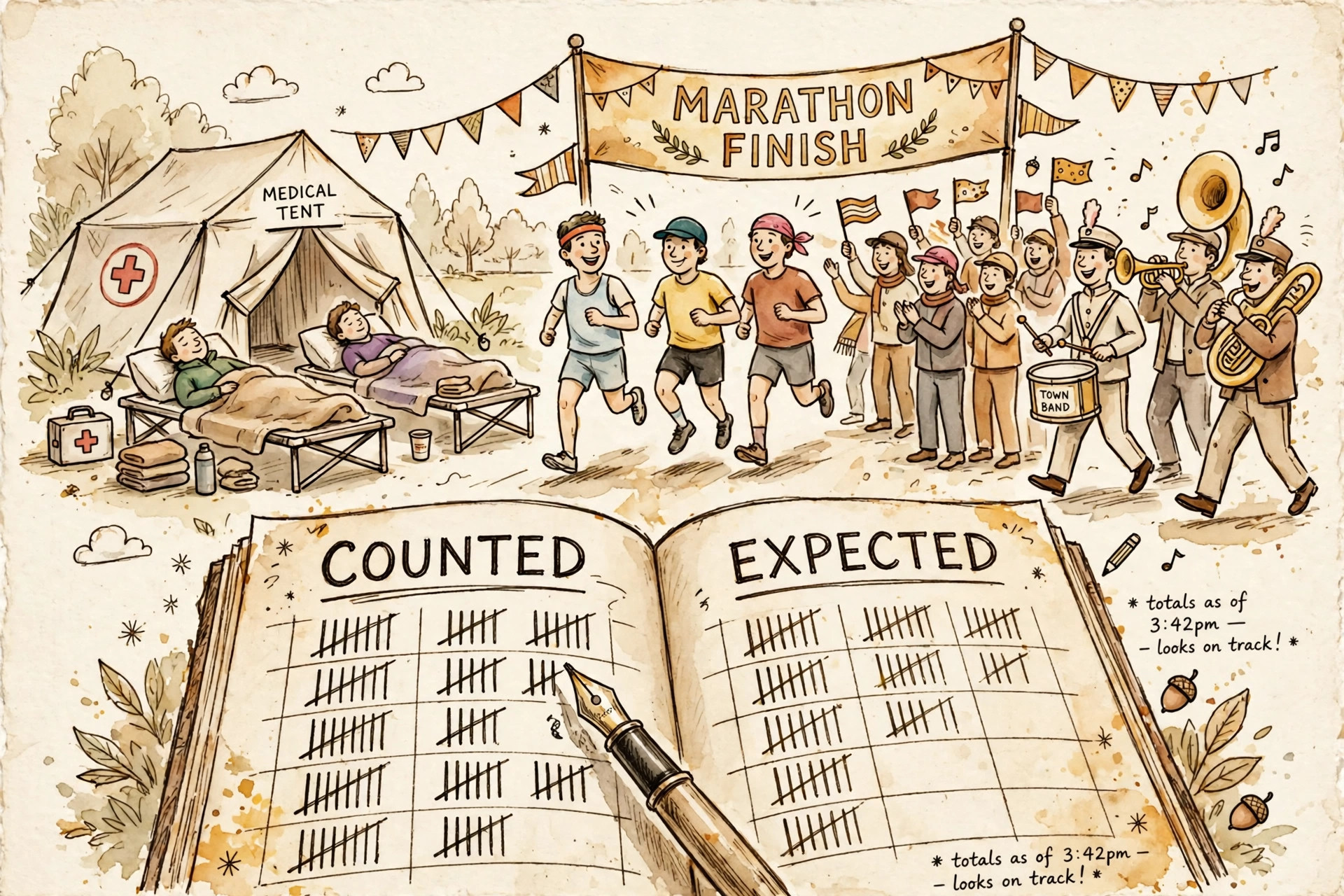
This essay performs that trick in the open. The labels matter. COUNTED means a death documented in a record. EXPECTED means a statistical expectation for a crowd of a stated size and age. Expected deaths are real arithmetic. They are not identified people, and they are not a body count.
The Baseline Under Every Gathering
The United States recorded 3,090,964 deaths in 2023. The crude rate works out to about 2.53 deaths per 100,000 people per day. A one-day crowd of 100,000 average Americans therefore contains about 2.5 expected deaths. A crowd of 500,000 contains about 12.6. A crowd of one million contains about 25.3.
Age changes the machine. Americans aged 25 to 34 die at about 0.41 per 100,000 per day. Americans aged 65 to 74 die at about 4.96 per 100,000 per day. The older crowd produces twelve times the expected deaths at the same size. A veterans' parade, a retirement-heavy march, and a college protest are different actuarial objects before the first speaker reaches the microphone.
The baseline is a first approximation. People healthy enough to attend an event lower the expectation. Heat, exertion, alcohol, and hours on their feet push it upward. The honest comparison therefore requires a baseline matched to the crowd and the day, a requirement the closing test states in full.
The injury count is just as automatic. Mass-gathering medicine measures patient presentations per 10,000 attendees. Documented rates run from 0.66 per 10,000 at a FIFA World Cup venue in Durban to 41.6 per 10,000 at the Toronto Rocks concert in 2003. At the 2019 Rugby World Cup, presentations rose from 2.04 to 4.27 per 10,000 when the wet-bulb globe temperature passed 25 degrees Celsius. Heat roughly doubled the medical load.
A casualty count begins with population, age, weather, exertion, and time. Malice enters later, if the evidence puts it there.
The Marathons Confess in Public
Marathons print their deaths with the causes attached. The RACER study followed 10.9 million American marathon and half-marathon participants from 2000 through 2010. It counted 59 cardiac arrests and 42 deaths. The rates were 0.54 cardiac arrests per 100,000 participants and 0.39 deaths per 100,000—about one death per 259,000 participants.
Boston has counted three participant deaths across 128 years. James Edward Brooks died of pneumonia shortly after the 1905 race. Humphrey Siesage, 61, suffered a fatal heart attack in 1996. Cynthia Lucero, 28, died of hyponatremia in 2002 after drinking too much water. The three spectators murdered by bombers in 2013 belong in a murder ledger. They do not belong in the race's medical count.
London's scholarly count records 15 deaths among 1,078,988 finishers from 1981 through 2018, about one death per 71,933 finishers. American road racing accumulated these deaths at charity events, civic festivals, and family celebrations. The events continued. The organizers published rates, studied causes, changed hydration guidance, and placed more defibrillators on the course.
Now strip the file. Remove ten million participants. Remove cardiac disease. Remove hyponatremia. Print a century of names under the headline “America's Marathons Keep Killing Their Runners.” The facts remain available. The meaning has been manufactured by omission.
Gansu shows the other column. In May 2021, 172 runners started a government-run 100-kilometer race in China's Yellow River Stone Forest. A cold front caught the lead runners exposed on a mountain course. Twenty-one died of hypothermia and eight were injured. The same-day expected deaths for 172 people round to zero. Weather, clothing rules, forecasting, course design, and rescue failures caused an enormous excess. That is an event-caused catastrophe. The excess test identifies it immediately.
The Marches Were Never Given a Body Count
The Million Man March filled the National Mall on October 16, 1995. The National Park Service estimated 400,000 people. Boston University's remote-sensing team estimated 837,000, within 20 percent either way. Organizers claimed 1.5 to 2 million.
COUNTED deaths: no count exists. The record located for this essay contains no documented death and no emergency-services tally for the day.
EXPECTED deaths: roughly 10 to 25. The crowd was overwhelmingly male and heavily middle-aged. At the Boston University crowd figure, age-band arithmetic produces about 9 expected deaths using the 45-to-54 rate and about 21 using the 55-to-64 rate. Men's mortality runs above the both-sexes rates used in that calculation. The honest range is therefore about 10 to 25 statistical deaths across the crowd that day. Those are expectations from population rates. They are not twenty identified marchers, and no honest writer can turn them into a death toll.
Here is the manufactured headline, with the machinery visible:
THE MARCH THAT LEFT TWENTY MEN DEAD
The sentence uses a public crowd estimate and public mortality tables. It hides the baseline, converts an expectation into an implication, and lets the reader supply a cause. Apply the same treatment to the marches Americans honor.
At the March on Washington on August 28, 1963, the Associated Press reported more than 1,700 people treated at first-aid tents or hospitals. The record included fractured ribs, headaches, insect bites, and hundreds of cases of heat exhaustion or fainting. COUNTED attendee deaths: zero in the record. The day already had a large casualty count. It lacked a villain willing to rename heat exhaustion as evidence of criminal violence.
The Women's March on January 21, 2017 drew an estimated 3,267,134 to 5,246,670 participants across the United States. At the general mortality rate, the crowd carried 83 to 133 EXPECTED same-day deaths. The documented record contains zero counted deaths. Print the expectation as a toll and the largest protest of its era becomes a mass-casualty event. Restore the labels and the atrocity evaporates.
No Kings drew about five million participants across more than 2,000 locations on June 14, 2025. The crowd carried about 126 EXPECTED same-day deaths. Reporters counted one death. Arthur “Afa” Folasa Ah Loo, 39, was shot in Salt Lake City by Matthew Scott Alder, a volunteer peacekeeper on the protest's own safety team. Alder fired at another man and struck Ah Loo. Prosecutors charged Alder with manslaughter. COUNTED medical deaths at the events: none reported. The one killing came from inside the event's own security apparatus, while the expected deaths remained what expected deaths are—population arithmetic, spread across millions of people and an entire country.
The summer of Black Lives Matter gives the trick its largest American denominator. Polls synthesized by the New York Times estimated that 15 to 26 million people participated at some point in 2020. Treat every participant as present for only one day, the lowest reasonable exposure assumption. The result is about 380 to 658 EXPECTED deaths across those participant-days. Published constructions of deaths associated with the unrest range from 19 to 42, depending on the builder, period, and circumstances included. The expectation is an order of magnitude larger than every published violence construction. It consists overwhelmingly of ordinary deaths that population rates assign to any group of 15 to 26 million Americans.
The other tribes produce the same ledger. About 200,000 people joined the People's Climate March in Washington on April 29, 2017, when the temperature reached 91 degrees. D.C. Fire and EMS reported more than 50 medical calls, the great majority heat-related, and four hospital transports. COUNTED deaths: none reported. EXPECTED deaths: about five. The National March on Washington for Free Palestine on November 4, 2023 drew an estimated 100,000 to 300,000 people. The record contains several minor incidents, one arrest for destruction of property, no deaths, and no medical tally. Its crowd carried 2.5 to 7.6 EXPECTED deaths. A slogan decides whether those shadows become a scandal.
Selma Stands Apart
Selma belongs in a different file.
Jimmie Lee Jackson was shot by Alabama State Trooper James Bonard Fowler during a voting-rights protest in Marion on February 18, 1965. Jackson died on February 26. The Reverend James Reeb was beaten by white men in Selma on March 9 and died on March 11. Viola Liuzzo was shot by Klansmen on March 25 while shuttling marchers after the Selma-to-Montgomery march. State troopers and a sheriff's posse injured more than 60 people on Bloody Sunday.
Those deaths were 100 percent caused and 0 percent actuarial. Each famous Selma death has a mechanism and a human hand behind it. Aggregate arithmetic cannot tell Selma from a picnic of equal size. Causes can. Manners can. Names can.
Parades Fill the Medical Tents by Design
A parade packs people along hot asphalt for hours. Spectators stand in the sun. Bands perform in wool or polyester while carrying instruments and holding formation. Teenagers cannot leave the line whenever they need water. Pride comes in late June. Independence Day explains itself.
A study of news reports from 1990 through 2020 found almost 400 marching-band students felled by heat-related illness at rehearsals, competitions, and parades. About 44 percent went to a hospital. At Minneapolis's Torchlight Parade in 1987, about 60 marchers received treatment for heat stress at the finish and four were hospitalized. The casualty list arrived with the celebration.
The June 14, 2025 military parade in Washington produced 48 patient contacts and 31 patient transports, according to D.C. Fire and EMS figures released by the District. COUNTED deaths: none reported. Reporting from the event identified heat exhaustion as the day's medical driver and found that most designated cooling tents failed.
The denominator changes the parade's rate. Forty-eight presentations equal 16.0 per 10,000 people if 30,000 attended. They equal 9.6 per 10,000 at 50,000 and 1.9 per 10,000 at the White House's claimed 250,000. The same medical ledger can look alarming or ordinary before a single fact changes. The crowd estimate does the work.
Macy's Thanksgiving Day Parade gives the honest counterexample. It runs in late November, so heat does not drive its record. Wind and machinery do. In 1997 the Cat in the Hat balloon struck a lamppost in high gusts. Four people were injured. Kathleen Caronna suffered a skull fracture and spent nearly a month in a coma. In 2005 debris from the M&M's balloon injured two sisters. COUNTED deaths in the parade's history: none documented. A commonly cited in-person crowd of 3.5 million still carries about 11 expected deaths during a three-hour parade window. The parade has no official shadow toll because nobody operates a counting regime for that purpose.
The Hajj Counts Everything and Convicts Nobody
The Hajj is the control case. Saudi authorities counted 1,301 deaths among about 1.83 million pilgrims in 2024. The temperature at the Grand Mosque in Mecca reached 51.8 degrees Celsius. Officials said 83 percent of the dead were unauthorized pilgrims who lacked permits and access to official cooling and transport.
The count exceeded its baseline. Applying American age-band rates across the six core days of the rites produces roughly 270 to 545 EXPECTED deaths, depending on the age band used. The counted toll was about 2.4 to 4.7 times that expectation. Heat and exertion imposed a real excess.
The world still filed the catastrophe under weather, logistics, permits, and public health. Officials published the count with its causes. Engineers and administrators answered for cooling, shade, water, and unauthorized routes. A four-figure death toll at a gathering of prayer produced an operational reckoning. The word “massacre” never gained custody of the number.
The Names Move Faster Than the Numbers
Attorney General Merrick Garland described January 6 in January 2025 as the day of “the five officers who lost their lives in the line of duty.” The medical examiner's record carries a different shape. Officer Brian Sicknick died on January 7 of acute brainstem and cerebellar infarcts. The examiner ruled the death natural, found no injuries, and recorded no allergic reaction to spray. Four other officers died by suicide between January 9 and July 29, 2021. The examiner recorded zero officer homicides and zero officer deaths on January 6 itself.
The attendee ledger on that same record is equally specific. Ashli Babbitt was killed by an officer's gunfire, a homicide officially cleared. Kevin Greeson and Benjamin Phillips died of hypertensive atherosclerotic cardiovascular disease, manner natural. Phillips's reported presentation was a stroke; the examiner's cause was cardiovascular disease. Rosanne Boyland's death was ruled an accident from acute amphetamine intoxication, with the circumstances disputed. Causes separate the ledger from the slogan.
ICE detention offers the same exhibit in a bare number. “Thirty-eight detainee deaths” sounds like a single mechanism. ICE's FY2026 record, broken by stated cause and manner, contains 15 medical deaths, five suicides, one disputed homicide, one enforcement-context vehicle death, and 16 deaths with no cause public. The 38 are real. The bare total tells the reader almost nothing about how they died.
Labels obey the same assignment desk as numbers. “All cops are bastards” turns police into a class with no individual faces. January 6 turned Capitol Police officers into named heroes with faces, biographies, testimony, and medals. The uniform stayed the same. The crowd facing the uniform changed, and the title changed with it.
Chris's law covers the whole shelf. One man's hero is another man's villain. One man's freedom fighter is another man's terrorist. One man's martyr is another man's suicide bomber. The act can remain fixed while the storyteller moves the label from one column to another.
The Only Honest Question
The honest test asks for excess. Take the counted deaths and subtract the deaths expected from a baseline matched for crowd size, exposure duration, age, sex, health, activity, temperature, and selection into attendance. Print the causes. Print the manners. Identify the hand where a hand exists.
Gansu fails that test catastrophically. Astroworld fails it. Selma's murders stand outside actuarial cover because named men inflicted them. The ordinary marathon passes. The Million Man March has no counted toll to test. The Women's March and No Kings show expectations towering over the counted record. The Hajj shows a real excess that still names its mechanism and produces engineers rather than prosecutors.
A death count tells America that people gathered and mortality attended. The excess tells us whether the event added death to the day. The cause tells us how. The hand tells us who.
Share: X · Facebook · LinkedIn · Reddit · Bluesky · Threads · Email