
The Duck Hunter Paradox
This article, read aloud:
Share: X · Facebook · LinkedIn · Reddit · Bluesky · Threads · Email
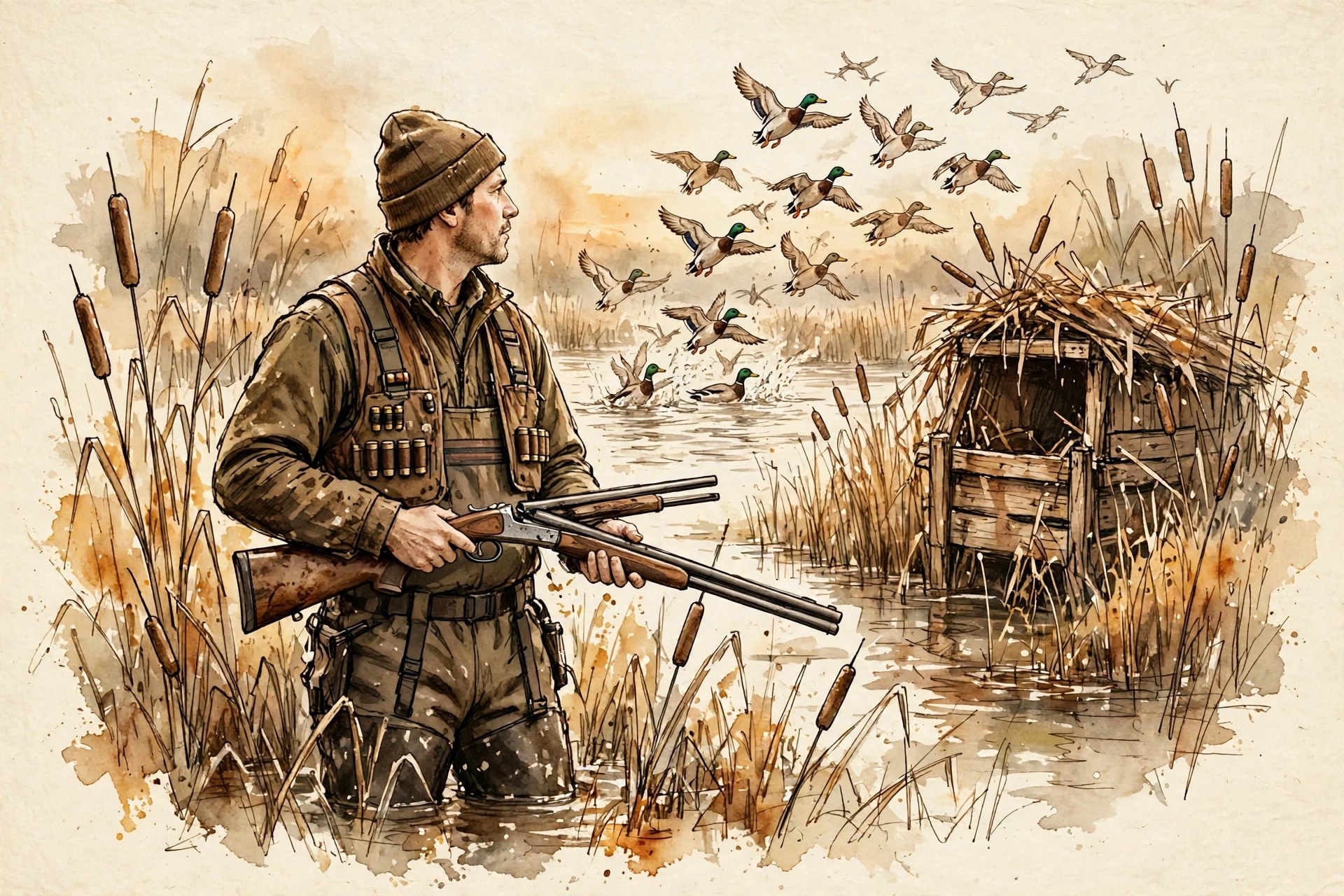
The American marsh survives because men want to kill ducks in it. Strip the sentence down and it stays true. The water is still there, the reeds are still there, the ducks are still there, because a paying constituency shows up every autumn with shotguns and a direct financial interest in the place remaining exactly what it is.
That is the duck hunter paradox. The animal's surest protection is the appetite of the man who hunts it. The habitat's surest funding stream is the desire to keep hunting it. Sentiment admires the marsh. Appetite pays its rent.
The baseline: half the marsh is gone
The Fish and Wildlife Service's reconstruction of the record puts the original estate at about 221 million acres of wetlands in the lower forty-eight states in the 1780s. By the 1980s, about 104 million acres remained. More than half the marsh in America was drained, filled, or paved, and the Service's 2024 report to Congress puts the loss at half the original estate. The drainage was a business decision repeated millions of times. A wet acre grows ducks and mosquitoes. A drained acre grows corn. A filled acre holds a subdivision. Every acre of marsh still standing has been outbid for destruction, year after year, by somebody willing to pay for it to stay wet.
The machine the hunters built
The somebody, overwhelmingly, is the duck hunter, and he organized the rescue of the marsh during the worst decade on record. The Dust Bowl years were collapsing waterfowl populations across the continent. The response came from the men with the guns.
In 1934 Congress passed the Migratory Bird Hunting and Conservation Stamp Act, and President Roosevelt signed it that March. Every waterfowl hunter sixteen and older had to buy a federal duck stamp before he could hunt. The first stamp cost one dollar, and Jay "Ding" Darling, a cartoonist and hunter who ran the Bureau of Biological Survey, drew it himself. Ninety-eight cents of every stamp dollar goes by law into the Migratory Bird Conservation Fund, to buy or lease wetland for the National Wildlife Refuge System. The Fish and Wildlife Service keeps the totals: since 1934 the stamp has raised more than $1.3 billion and protected more than 6 million acres. The tax was self-imposed. Hunters asked to be charged for the privilege of hunting, and the charge was earmarked for the habitat the hunting depended on.
In 1937 the Federal Aid in Wildlife Restoration Act—the Pittman-Robertson Act—put an excise tax on firearms and ammunition, eleven percent on long guns and shells, ten percent on handguns, and routed the money to state wildlife agencies for habitat acquisition, restoration, and research. Sportsmen and the arms industry asked for that tax too. The Service's program reports credit Pittman-Robertson grants with buying, leasing, or developing more than five million acres of state wildlife management areas. In February 2026 the Service announced nearly $1.3 billion in restoration distributions to the states in a single cycle, more than $800 million of it raised by the firearms and ammunition excise tax alone. The running total distributed since 1937 stands past $31 billion.
The same year, 1937, a small group of waterfowlers founded Ducks Unlimited, the hunters' wetlands conservation organization. It reports more than a million supporters, most of them waterfowlers by its own account, and it claims more than 20 million acres conserved across North America since its founding: marsh and grassland restored, protected, or managed in the places ducks breed, stage, and winter. In fiscal 2025 alone it delivered 1.2 million acres. The banquet circuit, the raffles, the membership dues—the money arrives because the men writing the checks intend to hunt over the ground it saves.
The symbiosis
Trace the interest and the paradox dissolves into arithmetic. The duck needs shallow water, cover, and food, in the same marsh, every year. The hunter needs the duck to have all of that, in the same marsh, every year, or his season is a walk through an empty field. The landowner needs a reason to leave the water standing while the drainage district and the developer both pay cash for the opposite. The hunter supplies the reason, in cash, through stamps, taxes, dues, leases, and the club memberships and guided hunts that make a standing marsh worth more wet than dry.
Every other claimant on that acre wants the water gone. The farmer's yield sits in the drained field. The developer's margin sits in the filled lot. The duck's only lobbyist with money on the table is the man who wants to shoot the duck. Remove him and the marsh keeps its admirers and loses its payer.
I have made a version of this argument before, about the zookeeper's logic: the keeper whose living runs through the animal becomes the animal's most dependable steward, because his interest and the animal's interest are the same interest wearing two coats. The duck marsh is that logic at continental scale. The stamp buyer, the club member, the man at the banquet bidding on a print he does not need—each man's sport is mortgaged to the health of the thing he hunts, and the mortgage gets paid every season.
Bigger animals, same arithmetic
The paradox runs anywhere an animal is worth more alive to a hunter than dead to everyone else, and the scale grows with the animal. Texas is the home exhibit. The scimitar-horned oryx, a North African antelope, was declared extinct in the wild in 2000. Texas ranchers kept it. At the herd's height, an estimated 11,000 of them lived behind Texas fences, bred and fed on the strength of trophy fees running $3,000 to $7,500 a bull on posted ranch price lists. Captive-bred oryx went back to Chad beginning in 2016, Texas stock among the bloodlines, and in 2023 the species came off the extinct-in-the-wild list. The animal exists again in Africa because it was worth money in Texas.
Africa runs the same ledger at higher prices. A mature elephant bull carries a trophy fee of $30,000 to $70,000 in the countries that still offer the hunt, and the full safari around it can run past $100,000. A lion in Tanzania carries a trophy fee of $25,000 to $60,000. An outfitter's fee schedule prints the destination of the money on the invoice: Tanzanian trophy fees are itemized to include government fees, community development fees, and anti-poaching fees. The trophy fee is the anti-poaching budget. The hunter's check pays the men with rifles who guard the herd from the men with rifles who would strip it.
Namibia built the cleanest version of the machine. Its communal conservancies—more than eighty of them, covering nearly 17 million hectares—give the people who live with the animals legal rights over the wildlife and a share of the hunting revenue, up to 20 to 40 percent of concession income by the International Wildlife Trade Fund's review. The conservancy program's own accounting, kept by NACSO, records wildlife populations inside the conservancies up 80 percent between 1998 and 2018, and the national elephant herd tripled from about 7,500 animals in the mid-1990s to nearly 23,000. The pattern holds across the region: in Zimbabwe, Zambia, and Tanzania, hunting fees fund 30 to 70 percent of the government wildlife authorities' operating budgets, and concession holders run anti-poaching patrols across their blocks as a cost of doing business.
The honest caveat belongs on the record. Namibia is the strong case. Across most of the continent, reviewers find only 3 to 7 percent of gross hunting revenue reaching the local community; the rest leaks to governments, operators, and middlemen. The paradox survives the caveat. A system that delivers a fraction of the money still delivers the guards, the fences, and the standing habitat, and the alternative revenue on most of that ground is a poacher, a charcoal burner, and a cattle fence. The animal's value to a man who wants to hunt it is the only price signal that has ever paid for its defense at scale.
The counterfactual
Run the experiment in reverse and the funding stack collapses in order. End duck hunting and the stamp loses its buyers; a conservation stamp sold to nobody raises nothing. The excise tax survives on paper and loses its political guard, because the constituency that demanded the tax and defended its earmark was the hunting public. Ducks Unlimited loses the reason its members gather. What remains is the general taxpayer and the charitable giver, and the drained half of the estate is the record of what their protection was worth across the two centuries when they were the only protection the marsh had. The marsh disappeared in the years when admiration was its only revenue.
The receipt
The duck knows none of this. The duck knows the water is there in October, the cover is thick, the food is in the shallows. Behind that water stands a long line of men who wanted to be standing in it at dawn with a shotgun, and who taxed themselves, organized themselves, and paid landowners to keep it wet. The marsh is the receipt.
The most effective conservation program in American history runs on appetite. It has run for ninety years, through drought and depression, because the men funding it get something they want out of the ground it saves. Any theory of saving wild places that refuses that engine has to replace it, dollar for dollar and acre for acre. Nobody has. The ducks are still here, and the men who shoot them are the reason.
Added November 19, 2026: the "Bigger animals, same arithmetic" section above was written after publication; it carries the paradox from the duck marsh to the Texas exotic-game ranches and the African trophy fees.
Share: X · Facebook · LinkedIn · Reddit · Bluesky · Threads · Email