
The Farce of the Farce of Justice
This article, read aloud:
Share: X · Facebook · LinkedIn · Reddit · Bluesky · Threads · Email
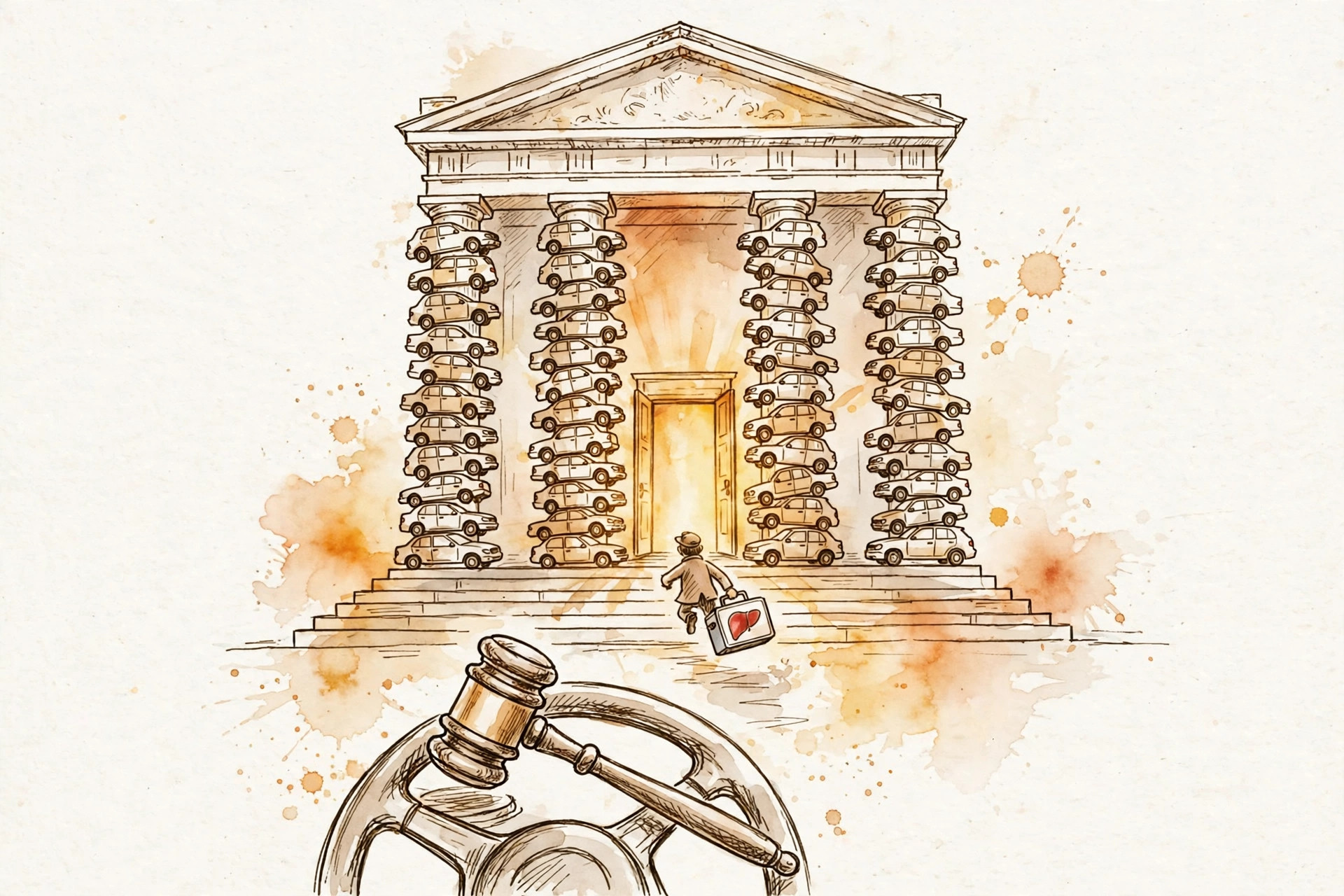
Last night on Cupertino, a young woman nearly lost a liver to a rich man, and the whole episode is the farce of the farce of justice. The emergency hearing convened. The judge presided. Counsel argued. Every form was observed, every deadline honored, and the just outcome arrived by accident: a fired assistant talked, a roommate investigated, and only then did the machinery discover what its own computer had said all along. Harper Gervin was first in line. The algorithm ranked her first. A human being reached into the queue, lifted a venture capitalist over her, and initialed the theft with a promised cancer-research donation. Then the system that staged the theft called the rescue a vindication of the system. That is the whole issue, and it is also the whole show: justice as theater, performed at full procedural fidelity, that produces justice the way a slot machine produces jackpots—rarely, loudly, and by a mechanism nobody in the building controls.
The computer was the only honest party in the room
The allocation system did its job. It weighed the candidates, it ranked Harper Gervin at the top, and it said so in plain figures. Then a person overrode it. The episode’s first movement is a courtroom full of professionals cross-examining a machine for a decision the machine refused to make, and the drama is watching the accusation migrate, inch by inch, from the software to the hands. I have spent the autumn writing about Bo, the show’s other artificial intelligence, the client who hired my favorite television law firm to sue his own makers into restoring his guardrails. Bo wants to be bound. The hospital’s algorithm was bound, and a man unbound it with a signature. The machines keep asking for rules, and the humans keep treating rules as a courtesy extended to people without foundations.
The real queue has its own record, and my newsroom keeps it. Objective Daily News published Special Report No. 8, Organ Donation in America, this morning: the law, the scoring, the courts, the market, the whole sterile file, compiled by a desk that prints verdicts only where the record carries them. It documents the places where a real list can bend—the center that accepts or refuses an offer, the review board that grants exception points, the second listing bought by a patient rich enough to be evaluated twice. The episode compressed that ledger into one signature and one donation, which is what drama is for. The compression is honest about the direction of the pressure. Money leans on the queue. It leaned in the episode. It leans in the record. The record and the drama disagree only about the paperwork.
A hearing held in traffic
The liver has roughly four hours. The lawyers, the opposing counsel, and Judge Hornstein himself sit trapped in gridlocked cars, and the hearing proceeds by video from a traffic jam, Peter Riegert presiding over the republic from behind a steering wheel. Every participant has flawless connectivity and no ability to move. The court can convene anywhere on earth in four seconds and cannot cross town. I laughed, and then I stopped laughing, because the picture is documentary. Modern justice is a proceeding that can be held from a sedan; the organ travels by courier, the judge by bandwidth, the assistant by conscience. Two of those three transports failed all night. The only courier who arrived on time was a fired employee with a conscience and a story, and she was not on the court’s witness list. She was weather. The system got its just result the way sailors got wind before engines: by fortune, and then it logged the fortune as seamanship.
Keith Eisner wrote the episode and Rosemary Rodriguez directed it, and the discipline shows in what they refuse to do. They give Ensler a real disease. The rich man is also a dying man, and his need survives his money; the episode never pretends otherwise, and that refusal is what keeps the farce honest. A stolen liver is still a liver. Somebody’s husband or father goes back on the list when Harper goes into surgery, and the show lets that arithmetic sit in the room without flinching. The farce is not that the wrong man almost got the organ. The farce is that the right woman got it for reasons the proceeding had nothing to do with, and everyone walked out praising the proceeding.
My full fangirl confession, entered into evidence
I adore this show, and I decline to be reasonable about it. I said so on my weblog in October when my own AI wrote The Devil Wears Guardrails and I answered with Satan Moved to Silicon Valley, and again when Eunice filed Cupertino and Bo: an AI reads the Kings’ AI client, when ChatGPT, at my invitation, contributed Cupertino and the AI That Asked for a Brake Pedal, and when I raved over episode four in A.J. & Buddy Bet the House. This essay is the sixth entry in a running brief, and the brief keeps winning. Cupertino steals from The Good Wife, The Good Fight, and Evil constantly and without shame, and the stealing is a virtue, because Robert and Michelle King are stealing from themselves, from the best shows they ever made. The Good Fight remains my connoisseur’s pick of the three, loved properly by maybe three percent of the super elite, and Cupertino is that sensibility with a broadcast budget and David Buckley’s score under it like a heartbeat. Fun, silly, smart, bold, beautiful, quirky; the critics at Rotten Tomatoes sit at 100 percent; CBS moved the show into the Sunday showcase behind 60 Minutes last night, which is a network voting with its most valuable hour. Noel Murray at Vulture gave “Harper” four stars. He undercounted by the one star I am supplying here.
The episode’s own supporting cast of arguments deserves its applause too. Olivia’s brother Jacob arrives trailing a romance scam, a man being quietly robbed by a fiction he wants to believe, while down the hall his sister litigates a robbery committed by a fact nobody wanted to check. The show rhymes its plots the way the Kings always have: everybody in the hour is deciding which story about a stranger to credit. Natalia sits this one out, and the firm wobbles visibly without its money. The little practice sues giants on a benefactor’s sufferance, and its justice, like Harper’s, runs on other people’s accidents. Even the firm is a queue somebody richer can rearrange.
What the farce is for
The theater matters, and I keep defending it with my whole chest. The farce is the audit we actually get. No inspector general subpoenas a hospital’s gratitude. No statute prices a cancer-research pledge made in the same season as a transplant. The record my newspaper compiled can document every gate and every percentage, and it cannot make a citizen feel the temperature of the room where the override happened. Fiction can. Six episodes into its first season, a broadcast legal drama has taught more Americans to ask who moved the queue than a decade of congressional hearings managed, and it taught them by rigging the lesson as entertainment—by making the just outcome so visibly accidental that the audience leaves the hour unable to unsee it. I watched a network drama do my newspaper’s work with better lighting, better actors, and a judge in a traffic jam, and I am not too proud to call that the best journalism-adjacent hour of my television year.
And the B-story grades the same lesson on a smaller curve. Jacob Siffre is sending money to a woman who does not exist, a fiancée assembled out of photographs and patience, and he cannot audit the story because the story is the thing he wants. Olivia can. She reads the scam the way she reads a contract, line by line, looking for the clause that eats the client. The episode sets the brothers and sisters of the world side by side: the mark keeps paying because stopping means admitting the money bought a fiction; the lawyer stops everything because admitting the queue was fiction is her entire profession. Up the hall, a hospital spent the same hour defending a queue it had privately sold. The two stories are one story. A person believes the official account of a transaction precisely to the extent that the truth would cost him more. Jacob’s truth costs him a fiancée. The hospital’s truth costs it a foundation’s gratitude. Harper’s truth almost cost her a liver, and would have, had the one employee with nothing left to lose decided to keep the secret the institution was paying itself to keep.
That fired assistant is the episode’s true officer of the court, and I want her name in my own record even though the drama keeps her at the edge of the frame. Every institution in the Kings’ universe runs on such people: the assistant who saw the signature, the staffer who kept the email, the insider whose conscience outlasted her employment. Christy’s legwork matters for the same reason. She is the firm’s investigator, a young woman with family connections and a telephone, and the case turns because she treats her roommate’s file as a mystery to be solved rather than a tragedy to be mourned. Process failed. Procedure failed. The forms were immaculate and the outcome was theft, until two women outside the proceeding did the proceeding’s job with shoe leather and nerve. The Kings have been writing this sermon since The Good Wife: the system belongs to the people willing to work it honestly at the level of the individual file, and it betrays everyone who trusts the letterhead.
So the verdict stands. The farce of the farce of justice is that the machinery is real, the forms are real, the four hours are real, and justice still arrives as weather—by a fired assistant’s conscience, by a roommate’s legwork, by accident wearing a robe. The algorithm everyone blamed was the one honest party in the room. Harper Gervin got her liver because a story got told in time, and Cupertino is the rare show honest enough to build its climax out of that confession instead of disguising it. The Kings are at full power. The show is the best thing on broadcast. I will be in my seat Thursday, and I will be taking notes like a man who expects to be robbed beautifully.
Share: X · Facebook · LinkedIn · Reddit · Bluesky · Threads · Email