
The First Muslim Senator
Share: X · Facebook · LinkedIn · Reddit · Bluesky · Threads · Email
Abdul El-Sayed won Michigan's open Senate seat on Tuesday night. The Associated Press called the race at 2:27am Wednesday: El-Sayed, a Democrat, the son of Egyptian immigrants, a practicing Muslim, beat Mike Rogers, a former congressman, former FBI agent, and former chairman of the House Intelligence Committee. In January, Vice President JD Vance will swear him in, because the Vice President swears in senators. El-Sayed pointed this out in his victory speech, with pleasure.
El-Sayed is the first Muslim ever elected to the United States Senate. Keith Ellison reached the House of Representatives in 2007. The Senate took nineteen more years.
The win is the news. The lateness is the story. A republic that seats everybody eventually seated a Muslim in 2026, two hundred and fifty years in, and I find the delay humiliating. This should have happened in the 1970s, when Lebanon was a byword for cosmopolitan money, when Egypt was America's Arab ally of record, when one of the most beloved characters on the most-watched show in the country was a Lebanese-American from Toledo. It happened on Tuesday. The gap between those two facts is what this article is about.
Twenty-one years, twenty-five years
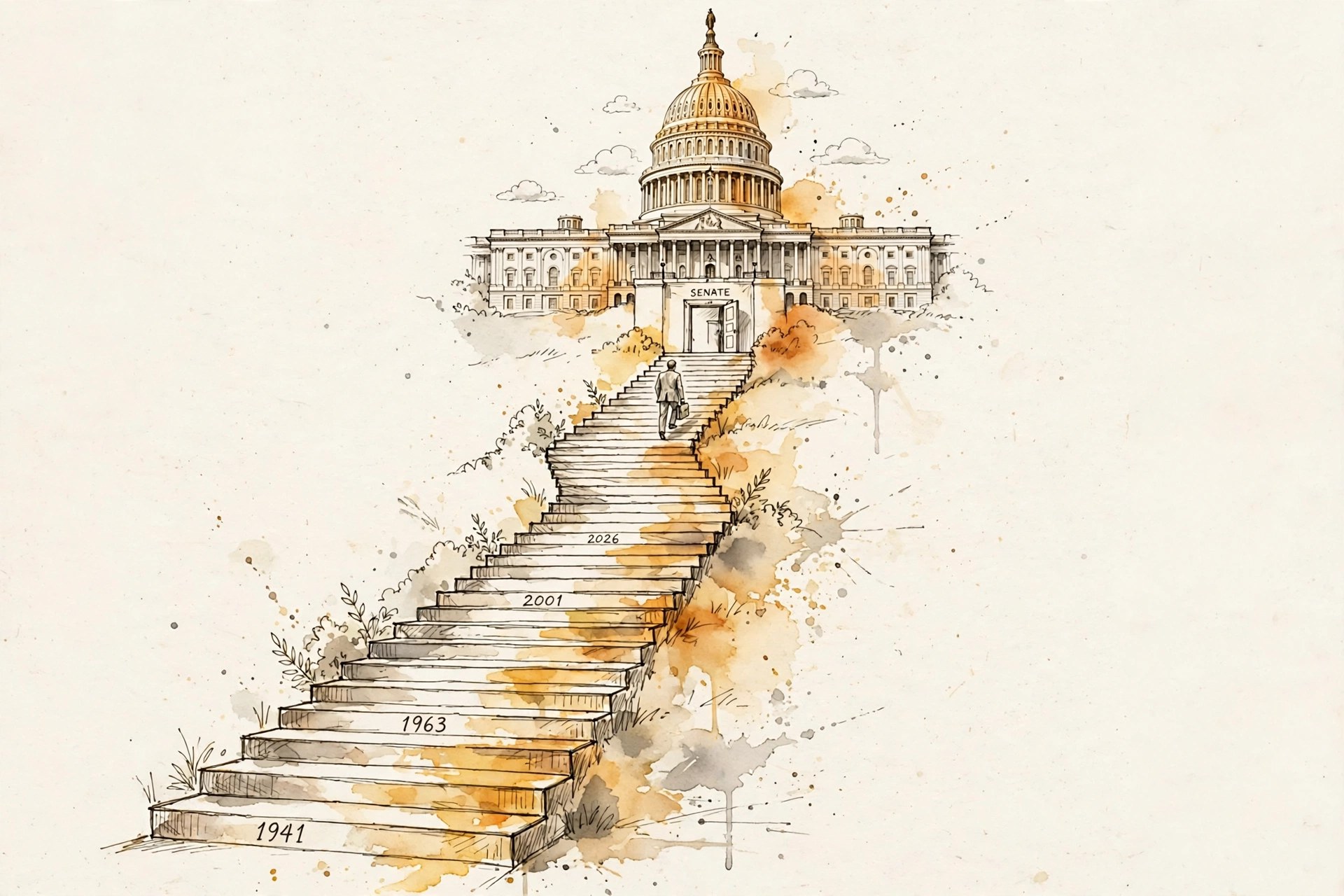
On December 7, 1941, Japan bombed Pearl Harbor. The United States government rounded up Japanese Americans on the West Coast and put them behind barbed wire. Daniel Inouye, a Nisei kid from Honolulu, volunteered anyway, joined the 442nd Regimental Combat Team, and lost his right arm taking out German machine-gun nests in Italy. In January 1963, twenty-one years after Pearl Harbor, Dan Inouye took his seat in the United States Senate. He stayed for forty-nine years and died a lion of the institution, third in line to the presidency.
On September 11, 2001, al Qaeda murdered 2,977 people in New York, Washington, and Pennsylvania. Muslim Americans were never rounded up. They were watched, listed, questioned, and campaigned against, and the country fought a twenty-year war in Afghanistan and a second one in Iraq under the banner of terror. On November 3, 2026, twenty-five years after 9/11, Abdul El-Sayed was elected to the United States Senate. He is the first of his faith to get there.
One generation each. The interned people's road ran faster. Japanese Americans went from camps to the Senate in twenty-one years, carrying a Medal of Honor and a missing arm as their credentials. Muslim Americans, whose government never built them a camp, needed twenty-five. Any honest account of this election has to sit with that arithmetic for a while.
The delay was specific. It was never a delay about Arabs. James Abourezk, the son of Lebanese immigrants, sat in the United States Senate from 1973 to 1979, representing South Dakota, while M*A*S*H was on the air. Corporal Maxwell Klinger, played by Jamie Farr—himself Lebanese-American, from Toledo—spent eleven seasons as an out-and-loud Lebanese character on the biggest show in America, in a dress, angling for a Section 8, unmistakably proud of where his people came from. Arab Christians were seated, cast, and syndicated half a century ago. The seat stayed empty for a Muslim. The holdup was the religion, named plainly at last.
The man
Abdulrahman Mohamed El-Sayed was born in Rochester Hills, Michigan, in 1984. His father, Mohamed, came from Egypt in the late 1970s to earn an engineering doctorate at Wayne State and stayed to teach. El-Sayed went to the University of Michigan, played lacrosse, won a Rhodes Scholarship, took a doctorate in public health at Oxford and a medical degree at Columbia. At thirty he became Detroit's health director, the youngest health officer of a major American city. He ran for governor in 2018 and lost the primary to Gretchen Whitmer. He ran Wayne County's health and human services department. He had never held elected office before Tuesday.
His platform is the progressive shelf, whole: Medicare for All, money out of politics, an end to unconditional American military aid to Israel—a position he extends, on the record, to Egypt as well. His faith is on the record too. His memoir says the racism that followed 9/11 made him, in his words, "a more faithful and actively practicing Muslim, saying the five daily prayers." In the August primary he beat Representative Haley Stevens, the establishment's candidate, by about a point, while roughly thirty million dollars of AIPAC-aligned spending ran against him. The seat was open because Senator Gary Peters retired.
The campaign against him
The campaign against El-Sayed ran on his name and his prayers. President Trump called him a "jihadist Muslim Brotherhood member," said it at a Port Huron rally on October 25—"I'm here to keep a jihadist Muslim Brotherhood member from becoming a United States senator"—and added that El-Sayed would need to pass through a metal detector to enter the Senate and that he resembled the 9/11 hijackers. PolitiFact rated the Brotherhood claim Pants on Fire on October 27. The White House produced no evidence. Bridge Michigan and Michigan Public looked for the Brotherhood tie and found none; PolitiFact separately rated Rogers's claim that El-Sayed had refused to disavow the Brotherhood False, because town-hall video shows him disavowing it.
Rogers, at the October 21 debate, demanded to know: "Are you for America or are you for these terrorist groups overseas?" Ted Cruz called El-Sayed a "jihadist leprechaun" and warned that Americans would die if he sat on the Intelligence Committee. John Kennedy said he sleeps "in a bin Laden jersey." Tommy Tuberville called him "a TERRORIST" and "a RADICAL ISLAMIST." Campaign mailers warned he would "bring sharia law to Michigan." A Sharia-Free America Caucus already sits in the House of Representatives, founded in December 2025, with about sixty-eight members and a package of bills. Representative Nancy Mace posted in August that every Muslim holding public office in America is a trojan horse. This was the weather around one Senate race in Michigan.
The second front came from the other direction. After a truck-ramming attack on Temple Israel synagogue in West Bloomfield this past March, El-Sayed condemned the attack and added that "hurt people hurt people"; Jewish leaders heard an excuse being made, and he apologized for the timing of the context. Haley Stevens, who had endorsed him after losing the primary, reversed on November 1 and endorsed Rogers, citing antisemitism concerns. Chuck Schumer called the reversal a "despicable betrayal." Josh Shapiro backed El-Sayed anyway. An exit poll of Jewish early voters found El-Sayed won 60 percent of the Jewish early vote even as about a quarter of 2024's Jewish Democratic voters crossed over, nearly all of them naming Israel and antisemitism. He carried West Bloomfield Township itself, the suburb where the synagogue stands.
Barack Obama came to Detroit on October 24 and named the technique: "We have seen this movie before. I starred in it. This stuff didn't work on me. Not in Michigan. It's not going to work on Abdul." A political scientist at the University of Michigan, Nazita Lajevardi, told Reuters the effort was "the most egregious and most bigoted Islamophobic campaign I have seen." El-Sayed answered from the victory podium: "You chose hate, and Michigan chose hope." Then, to the President: "Donald, I know you struggle with my name, so you can just call me Senator."
The ledger so far
Suspicion has a paper trail, and the Federal Bureau of Investigation keeps it. Anti-Muslim hate incidents in the FBI's count ran 28 in the year 2000 and 481 in 2001, and in the twenty-five years since they have never returned to the old line: 228 in 2024, 205 in 2025. In January of this year, 51 percent of American adults told Pew that Islam encourages violence more than other religions do. In March of 2002, that figure was 25 percent. The suspicion compounded for a quarter century. Fifty-nine percent of American Muslims tell Pew there is "a lot" of discrimination against them.
The same ledger records the other hatred, and honesty requires both columns. Anti-Jewish incidents were 1,938 in 2024, the highest ever recorded and 69.6 percent of all religion-bias incidents, against a Jewish population of about 2 percent of the country. The ADL counted 9,354 antisemitic incidents in 2024, its own record. CAIR's complaint count hit a record 8,683 in 2025, self-reported and labeled as such. In October, thirty-five Jewish, Muslim, Sikh, and Hindu organizations jointly told the FBI its 2025 declines were undercounts. Amy Spitalnick of the JCPA gave the joint statement its sentence: "The same conspiracy theories that cast Jews as a hidden enemy cast immigrants as invaders, Muslims as threats." The two campaigns of suspicion run on one machine, and the Michigan race was the machine's loudest American outing of the year. A twenty-year war supplied the soundtrack.
The ladder
The Christian right talks about all of this through a chart. It comes from Peter Hammond, a South African missionary whose book Slavery, Terrorism and Islam appeared in 2005; the chart lives in the book's Appendix III, and the version everybody forwards is Hammond's own 2008 adaptation, chain-emailed and reposted for eighteen years. It assigns a behavior to every population share:
- Under 2 percent: a peaceful, non-threatening minority.
- 2 to 5 percent: recruiting, aimed at prisons, gangs, and the marginalized.
- 5 to 10 percent: influence out of proportion—demands for halal food in the supermarkets, pressure on institutions.
- 10 percent: lawlessness. Riots and threats over any perceived offense, until the host country submits.
- 20 percent and up: rioting, church burnings, militias. Higher still come massacres, the jizya tax on infidels, ethnic cleansing, and at 100 percent a house of peace ruled by the faith entire.
That is the operating picture, quoted at kitchen tables and in comment threads as settled sociology. Test it against the counts. Pew's September 2026 portrait puts American Muslims at 5.5 million people, about 1.6 percent of the population. On Hammond's own staircase, 1.6 percent is the first rung, the peaceful-minority rung. The Michigan campaign was fought as though Michigan stood on the fifth. The President of the United States described a 1.6-percent minority's Senate candidate in the vocabulary the chart reserves for the takeover rungs, and the chart's own math never got a hearing.
Europe is the chart's exhibit A, so count Europe. Pew counts the continent at roughly 6 percent Muslim in 2020. No Western European country stands at or above Hammond's 10 percent line. France is highest, at 8.8 percent by Pew's harmonized estimate. Germany's federal migration office puts its figure at 8.0 to 8.5 percent. Sweden is near 8 percent. The 2021 census counted England and Wales at 6.5 percent. The Republic of Ireland, currently cast in the press as a nation being felled, counted 81,930 Muslims in 2022: about 1.6 percent, the American figure. The riots the chart's defenders cite happened under the line—France in 2005, Sweden in 2022—and the researchers and police who studied them attribute them to specific sparks: two teenagers electrocuted fleeing a police check, a Quran-burning tour guarded by police, gangs taking their shot at the police. No demographer of record attaches a behavior to the number ten.
The chart fails in the other direction too, at shares far past its worst rung. India is about 14 percent Muslim, inside a functioning democracy that holds elections Muslims vote in and sometimes win. Ethiopia is about a third Muslim and has never been captured by anybody's sharia. Indonesia, the largest Muslim population on earth, keeps a tenth of its people Christian inside a secular republic. A mechanism that predicts the same script at every address is a portrait of its author.
The chart travels with scientific credentials, and the credentials are forged. Viral copies cite a Harvard study holding that Islamization becomes unstoppable at 16 percent. No such study exists. The claim traces to a June 2018 appearance on Hungarian public television by a researcher at an advocacy center; in eight years of forwarding, no copy has ever produced a title, an author, or a journal, because there is none to produce. The genuine study underneath the folklore is real and innocent: Xie and colleagues at Rensselaer Polytechnic Institute, published in Physical Review E in July 2011, modeled a naming game on a computer network and found that any committed minority holding any opinion—an innovation, a political ideal, evacuation advice—flips the network once it passes about ten percent. Islam appears nowhere in it. A physics model of how ideas spread got welded to a missionary's staircase and sold as demography. One correction belongs here, in the open: the debunking of Hammond's ladder is often credited to Snopes. No dedicated Snopes, AFP, or Reuters verdict on the ladder could be found. The documented record is the work of Britain's Full Fact on the ladder's derivative fact sheets, and of critics and demographers in print. The ladder's fans pass around a Harvard study that does not exist; the ladder's opponents pass around a Snopes verdict that does not exist. Both sides are running on paper nobody printed.
The fog
Why does a first-rung country campaign at the fifth rung? Because nobody campaigns against a census. They campaign against the population they believe they live among, and the believed population is a fantasy everywhere it has been measured.
YouGov asked a thousand American adults in January 2022 to estimate the size of forty-three groups. The average estimate for Black Americans was 41 percent. The counted figure was 12. The average estimate for Muslim Americans was 27 percent; the counted figure was 1. Jewish Americans were estimated at 30 percent against a counted 2. Ipsos has run the same experiment for a decade under the name Perils of Perception: Americans guessed their Muslim share at 15 percent in 2014 and 17 percent in 2016, and projected 23 percent for 2020 against a projected reality of 1.1. The French guessed 31 percent against a counted 7.5, the largest error in the study, and guessed 40 percent for 2020. The British guessed 15 against 4.8. Every Western public overestimates, usually by a factor of three or four, and the overestimate is the country the politics actually inhabits. Hammond's rungs 10 through 20 describe a place no Western nation has reached. Millions of Western voters believe they already live there.
My best friend David lives in New York. He has lived in Piedmont and Berkeley and Washington. He holds a degree from Boston University and a journalism degree from Berkeley—he was trained, professionally, to count things. More than a decade ago, talking with me, he said, entirely in passing, that Black people are 40 percent of the American population. He had carried that number for years. It was wrong by a factor of more than three, and it was also, to the digit, the national average guess from the YouGov study. David did not fail a test. He reported his sample. New York, Oakland, Berkeley, and DC showed him a country, and he filed it as the country.
The same instrument runs at a Texas A&M game. A Texan in the stands looks across the engineering sections—brown face after brown face, Indian and South Asian students packed into the programs his state is proudest of—and concludes that America is now 100 percent Indian and South Asian. His sample is a stadium section. The counted Asian-American share of the United States is about 6 percent. Everybody's census is taken from a seat, a street, a subway car, a feed.
I live in the Washington corridor, where the Muslim and Arab presence is dense, visible, and woven through my daily rounds, and for years I carried the impression that Jewish Americans outnumbered Black Americans, because my world—university, media, publishing, this city—is stacked with Jewish colleagues and nearly empty of the Black South and the Black Midwest. The counted figures are 2.4 percent and 13.5. My sample lied to me in the opposite direction from David's, with the same confidence. The fog is the default setting of a mind that counts what it can see, and no diploma switches it off.
The fog gets thicker because "Muslim" dissolves on inspection. Count by religion and Pew finds 5.5 million, no racial majority among them—roughly 30 percent White, 30 percent Asian, 20 percent Black, 11 percent Hispanic. The largest single stream of Muslim immigration is South Asian. Pakistanis are the classic case: Muslim in the main, and neither Arab nor Middle Eastern by any census definition, a fact that surprises people who use the words interchangeably. Count by ancestry instead and the Arab American Institute finds 3.7 million Arab Americans, the majority of them Christian on the last authoritative measurement anyone took, a Zogby poll from 2002 that the Institute still carries because nobody has replaced it. Count by the wider region and Pew's Middle Eastern or North African measure runs from 3.1 to 5.2 million people, 0.9 to 1.5 percent, a population that includes Israelis, Iranians, Copts, and Chaldeans. A quarter of the planet is Muslim—two billion people, 25.6 percent of humanity in 2020—and the American share of that world is one of its smallest national minorities. The argument about Islam in America is an argument among definitions, conducted by people holding different rulers and calling each other liars.
Sightings and bodies
The census counts bodies. The brain counts sightings, and the two ledgers never reconcile, because a sighting is not a random draw. The eye files whatever is marked. A uniform gets filed. Side locks and a black hat get filed. A headscarf gets filed. The unmarked pass through as wallpaper, and the wallpaper is most of the country.
Take the most familiar marked population in American life: the police. The Bureau of Justice Statistics counts 845,015 full-time sworn officers in its 2020 tables—473,100 local police, 173,900 sheriff's deputies, 61,200 state officers, 136,815 federal. That is a quarter of one percent of the population, one sworn officer for every four hundred Americans. The force on the street at a given moment is a fraction of that fraction: no federal agency publishes a national street count, and the best municipal arithmetic available, Portland's official estimate, puts about 56 of its 576 sworn officers on the street at any given time—under a tenth. The police feel omnipresent. A quarter of one percent, wearing the most visible costume in public life, will do that.
Now run the same arithmetic on the people accused of running the world. Pew counts 7.5 million Jews in the United States, 2.4 percent of the population. On Earth, Jews number about 15.7 million, which is 0.2 percent of humanity. World domination by 0.2 percent of the species is a logistics problem before it is anything else: every Jewish adult, child, and infant would need a portfolio of hundreds of gentiles to supervise, in shifts, forever, while also holding the day jobs the theory assigns at the banks and the studios. The headcount refuses the plot.
Inside that small population sits the most visible fraction of a fraction. The Hasidim of Brooklyn, Rockland County, and Orange County—the black hats, the side locks, the nineteenth-century dress—are the Jews a New Yorker actually sees, and they number, by the standard scholarly estimate of 180,000 in 2006 and every demographer's account of rapid growth since, in the low-to-mid hundreds of thousands: well under a tenth of one percent of America, concentrated into a handful of neighborhoods so completely that a subway ride can feel like a demographic fact. Meanwhile the same population that imagination staffs with a world government counts 765 Jews in the entire state of South Dakota. The generic mass of American Jewry—Reform at 37 percent, no denomination at 32, Conservative at 17, Orthodox at 9—is suburban, unmarked, and invisible in the precise way the Hasidim are not. Sightings go to the marked. Fear follows the sightings. The bodies are elsewhere, uncounted by the only instrument most people own.
My ground
I came up in Hawaii, from 1976 to 1988, and in twelve years of childhood I never knowingly met a Muslim or a Middle Easterner. The category did not exist in my islands. My first deep introduction to Islam and to Judaism arrived together, at George Washington University, where the student body ran Kuwaiti, Jewish, Syrian, Qatari, Afghan, and Pakistani, and the whole crowd of them fought what I can only call a completely peaceful holy war the entire time I was there—arguing theology, history, and grievance at full volume, in dining halls, with total conviction and no casualties. I have been in the middle of that argument ever since, and it has been one of the educations of my life.
Today I live in Arlington, Virginia, in ZIP code 22204, and I clock every marker on my street, and I know what every marker is. The Syrian women in hijab are Muslim, and I file them as Muslim. The Ethiopian women covered in white netela on holy days are Orthodox Christians on their way to church, and I file them as Christians—I have known what a netela is for as long as I have lived around Ethiopians, which is most of my adult life. The casual wraps and the full burkas, nearly all of them worn with flip-flops, which is how you know the modesty is religious and not a foot conspiracy. I do not confuse these neighbors with each other. I just cannot stop counting them. I notice every tunic and every skullcap. And I do not notice the generic white people at all. The census counts my ZIP at 51,921 people, and non-Hispanic whites are 39.9 percent of it—a plurality, the largest single bloc, and a minority in my own neighborhood. I am blind to two-fifths of my neighbors. The marked remainder does all the visual work: Hispanics at 27.2 percent, Black residents at 17.5, Asians at 10.5, and a foreign-born share of 32.6 percent—one neighbor in three born in another country.
The counted version of my street keeps surprising me. The number-one country of birth in my ZIP is El Salvador, with 2,259 people. Number two is Ethiopia, with 1,868; Ethiopian ancestry runs to 4.4 percent of the ZIP, and I have walked past their churches for years—twenty-one Ethiopian Orthodox congregations across Arlington, Alexandria, Fairfax, and DC when the 2020 Religion Census counted them. Arab ancestry is 2.8 percent of my ZIP—roughly two and a half times the national rate—and inside it, Moroccan ancestry (425) runs nearly even with Egyptian (435). Arabic is spoken at home by 3.2 percent of my neighbors over five. The Middle Eastern-born are 3.1 percent of the ZIP, with Morocco ahead of Egypt. And a large share of the corridor's Egyptians are Coptic Christians, which anyone who lives here knows—their churches are landmarks on my streets—and the Religion Census counts some five thousand Coptic Orthodox adherents in Arlington and Fairfax, confirming what the neighborhood already shows you. That is the counted version. The people themselves I already knew. The headscarves I clock belong, in numbers I never would have guessed, to a neighborhood whose largest ancestry is German—9.0 percent, first on the list, and the source of exactly zero sightings in my entire Arlington life.
When I say Muslims are all around me in Tysons and Fairfax and Dulles, I am being hyperbolic, and I know it, and I am flagging it myself: the corridor is one of a handful of genuine concentrations—Dearborn, New York, Houston, Chicago, Southern California, and mine—and the Arlington County Muslim adherent estimate in the Religion Census is about 0.9 percent, an imputation from a single counted congregation, labeled an estimate because that is what it is. My local density is real. It is also local. That distinction is the whole essay in miniature.
My rounds run in the languages of the counted street. I say assalamualaikum every day. I say qué pasa, qué tal, todo bien. I say ça va. I say howdy. I never say guten Tag, in a ZIP whose largest ancestry is German and in a country where German is the largest ancestry of all. German America dissolved into the wallpaper so completely that its homeland now runs the Goethe-Institut network to keep the language on life support abroad. I studied in Berlin once, in that machinery: I lived there on my own dime, my friend Craig, who worked at the institute, got my tuition waived, and the students around me were foreign scholars on fellowships—housing paid, trips arranged, per diems issued—so that German would have a little bit of their hearts. The largest group in America produces no greetings, no markers, no sightings, and needs a state subsidy to be remembered. The smallest groups on my street say peace be upon you in the elevator, free of charge.
The other wall
El-Sayed's platform includes the sentence that defined his general election: end unconditional American military aid to Israel. The chant that follows his politics is Free Palestine. Both run into a fact about his father's country that his campaign never had to mention, because nobody asked.
Gaza is walled by all of its neighbors. Israel built its barrier. Egypt built one too, and Egypt's is aimed at keeping Palestinians out of Egypt. The Rafah crossing, Gaza's only door to a country other than Israel, moves people only—cargo goes through Israel—and Egypt has kept it shut or nearly shut since Hamas took Gaza in 2007. In December 2009, Egypt sank a steel wall ten to eleven kilometers long and eighteen meters deep under that border to strangle the smuggling tunnels; reporting at the time said American Army engineers helped design it. After 2013, the Sisi government destroyed some twelve hundred tunnels, cleared a buffer zone on its own side that widened to five kilometers, and demolished the Egyptian town of Rafah to do it—Human Rights Watch counted at least 3,255 buildings destroyed and about 3,200 families evicted between 2013 and 2015. A three-kilometer concrete wall went up in 2020. Since October 2023, Egypt has refused every proposal to move Gaza's population into Sinai. Sisi gave his reasons on the record: transfer would move "the idea of resistance, of combat, from the Gaza Strip to Sinai," turning Sinai into a launchpad, dragging Egypt into war with Israel and killing the 1979 peace; and, at the Cairo Peace Summit, "the liquidation of the Palestinian cause without a just solution will never happen, and will never happen at the expense of Egypt."
Gaza gets treated like the set of a zombie movie. The population inside is cast as the horde—sealed in by a consensus of neighbors, each calling its stretch of the quarantine security. Israel's wall is denounced at every march in the West. Egypt's wall, built by the Arab world's most populous state against fellow Arabs, gets a pass from the chant, because the chant has a cast list and Egypt is not on it.
El-Sayed has never endorsed or criticized Egypt's Rafah regime; the record holds no Rafah position from him. His Egypt argument is about Cairo's government and Washington's money. "I don't want to see my tax dollars being used to put a chokehold on the Egyptian people by a military dictatorship," he told the Detroit Free Press. Egypt receives about 1.3 billion dollars a year in American military financing, the second-largest such account on earth. His answer: "Egypt is the second biggest recipient of foreign military aid. If you'd like to start there, we can start there." At a town hall with Bernie Sanders he put Israel and Egypt in one sentence: "I want to ban it to Israel, I want to ban it to Egypt, where my family immigrated from, to Jordan, to Pakistan, to Saudi Arabia, to Qatar, to all of them." The son of Egypt is the only man in the United States Senate who campaigns against the subsidy of Egypt's generals. The Brotherhood smear aimed at him landed, of all places, on the one Arab government that imprisons Brothers as policy.
Egypt is his New Jersey
I grew up in Hawaii with New Jersey in the family attic, and I really should have visited New Jersey more. Egypt is El-Sayed's New Jersey: the place the family is from, the place a man is allowed to get on a plane and visit, the place whose hold on him is ancestry and affection. Heritage travel is enrichment everywhere else it happens. Kars4Kids sings its jingle on American radio to fund Jewish kids' trips and education; Birthright flies young American Jews to Israel at no charge, and the whole apparatus is regarded, correctly, as a wholesome investment in identity. A French American spends every summer in the south of France with grand-mère and lands in a lifestyle magazine. Korean Americans visit Korea, Vietnamese Americans visit Vietnam, and nobody convenes a hearing. The identical trip, taken by an Egyptian American to Cairo, got renamed grooming—a young man marinated by the Muslim Brotherhood, his summers entered as evidence. The trip is the same trip in every case. What differs is the religion on the family name, which is also the difference between Abourezk's Senate seat in 1973 and El-Sayed's wait until 2026.
The bench
I vote for people, and my presidential bench makes no tribal sense to anybody but me. Tulsi Gabbard stands first on it: I wanted her in 2020, she was gone before my vote could count, and if she ever runs again she has it. If Alexandria Ocasio-Cortez runs for president, I am voting for her, completely. And if Abdul El-Sayed runs, I am voting for him, totally. I keep calling him a five-foot-two Bill Clinton: the Rhodes scholarship, the policy fluency, the insurgent who beat the establishment's candidate in the primary and then beat a former intelligence chairman in the general, the memory for every room he has ever worked. Clinton's machinery in a smaller frame, aimed at a Senate that took a quarter century longer than it should have to let him in the door.
America seated a Japanese-American senator twenty-one years after it interned his people, and it seated a Lebanese Christian fifty-three years ago. It watched Klinger for eleven seasons. It argued about Islam for twenty-five years after 9/11 with the census in one hand and the fog in the other, and it finally, on Tuesday, elected a Muslim to the United States Senate. He will be sworn in by the Vice President in January. The republic survives the arithmetic. The shame is that the arithmetic took so long to be allowed to work.
Share: X · Facebook · LinkedIn · Reddit · Bluesky · Threads · Email