
The Medicine Cabinet
This article, read aloud:
Share: X · Facebook · LinkedIn · Reddit · Bluesky · Threads · Email
Privacy died, and dating got easier in the exact place where privacy used to live. Thirty years ago a person's interior stayed inside the person. The diagnosis, the medication, the politics, the wound, the flag—each item sat behind a face that had learned to mirror the room, and a date met the face first and the interior later, in installments, over months. Today the interior hangs on the outside of the animal, printed in the bio, pinned to the profile, worn as regalia, and the first reading takes seconds. Nobody has to snoop anymore. Everybody publishes.
The old cabinet
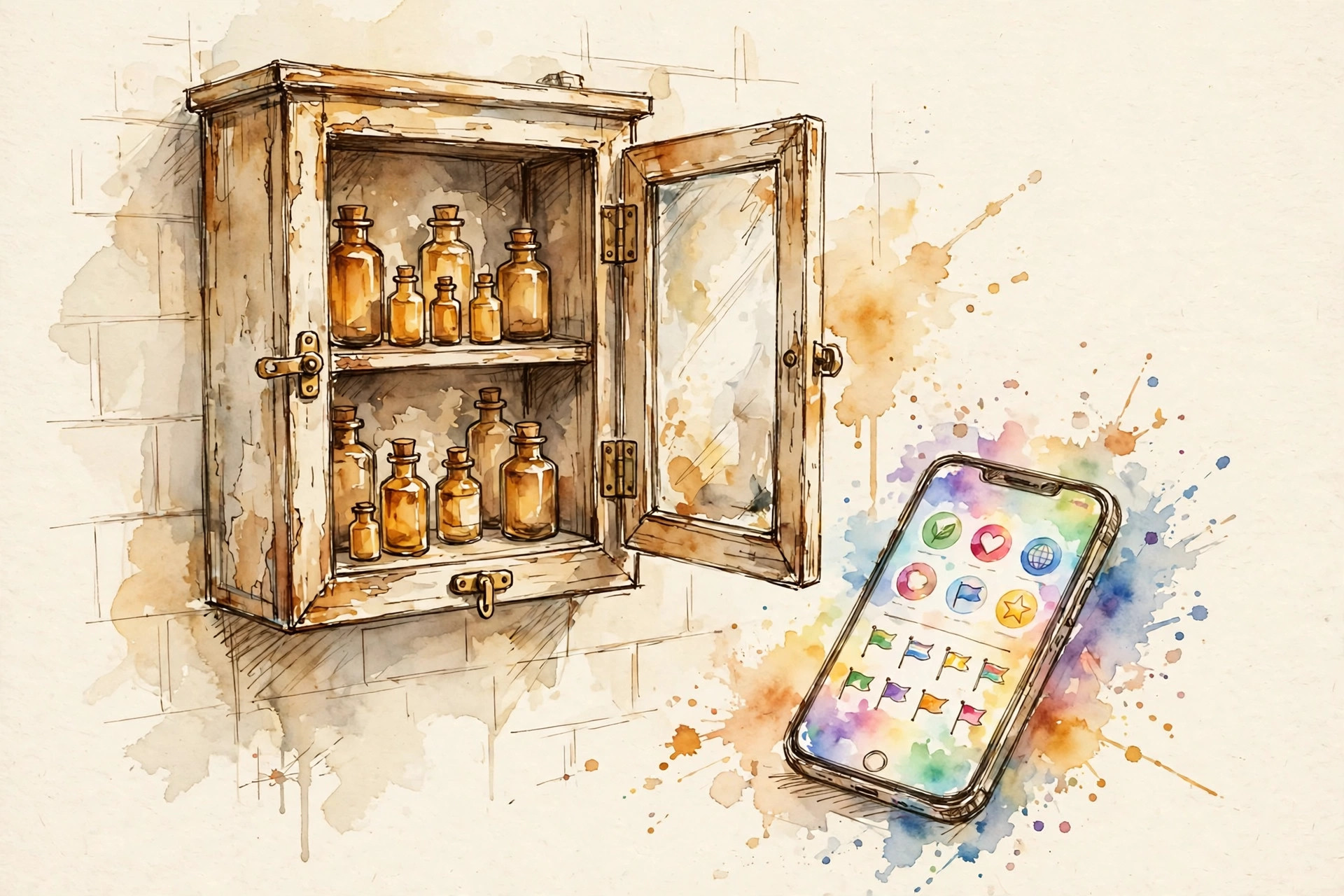
The era had one forensic instrument, and it survives as a joke: check the medicine cabinet. A man at a woman's apartment, or a woman at a man's, would find a reason to use the bathroom, open the mirrored cabinet over the sink, and read the bottles. The bottles were the record. Psychotropic drugs in that cabinet told a story the evening had kept politely out of view, and the joke endured because every adult in the habitat recognized the cabinet as the one place where the private record sat in plain rows, labeled, dated, and honest.
The joke carried an admission inside it. The information mattered, everybody wanted it early, and the ordinary channels refused to supply it. Conversation gave the curated version. Friends gave the loyal version. The cabinet gave the pharmacy version, and the pharmacy version had dosages. A whole dating culture ran on that gap between the presented animal and the documented one, and the snooping joke was the culture confessing that the gap existed and that everyone, given a quiet minute in the bathroom, wanted a look across it.
Mirroring as equipment
People in that era mirrored each other as a matter of ordinary social equipment. A dinner party, a first date, an office—each setting drew a matching surface from the people inside it, and the surface held for the length of the evening. A woman could sit across from a man for three hours and leave him with a clear impression of her laugh, her work, her opinions about the food, and no reliable information at all about the weather inside her. The withholding was courtesy in that period. Privacy was the default setting of a self, and disclosure ran on a schedule the owner controlled.
The schedule had real costs, and the field notes from the era are full of them. You found out slowly, in person, in sequence: the temper in month two, the debt in month four, the diagnosis in month six, delivered as a confession in a car because the relationship had finally reached the depth where the cabinet opened voluntarily. A person could be wrong about a partner for months, wrong in good faith, wrong with the evidence arriving one piece at a time and each piece reordering the pieces already filed. Courtship was a long exposure photograph. The image sharpened over time, and some images, once sharp, ended the sitting.
The flag worn outside
Walk the same habitat now and the animals arrive pre-labeled. The profile carries the pronouns, the diagnoses, the politics, the attachment style, the therapy vocabulary, the flags of every tribe the person claims, and a row of photographs selected to confirm the text. The freak flag—the old phrase for the hidden strangeness every person kept furled—flies from the mast in the first photograph. A reader learns in one scroll what a 1994 date would have spent a season assembling, and learns it before the first coffee, before the first sentence spoken aloud, before either animal has entered the other's physical presence.
The change arrived as self-expression, and the participants describe it in that language still. The bio is a declaration of identity, the badges are honesty, the disclosure is authenticity. Observed from the notebook, the behavior does a second job alongside the declared one: it sorts. The published interior is a filter placed at the gate of the habitat. Readers whose tribes match the badges swim closer. Readers whose tribes clash with them turn away at the gate, early, cheaply, without a wasted evening on either side. The cabinet door stands open at the entrance now, and the sorting that once took months of dinners happens at the door, in silence, at scale.
Secondary honesty
The published interior is curated, and everyone in the habitat knows it is curated, and the curation itself leaks the deeper record. I call the leak secondary honesty: the truth that escapes through signaling chosen for the tribe. A person selects badges to win standing inside a group, and the selection reveals what the group rewards, what the person fears losing, which wounds carry prestige and which stay hidden even now. The profile says what its owner wants believed. The pattern of choices says what its owner values, and the pattern is harder to fake than any single claim inside it.
Watch the omissions and the record sharpens further. Every published interior has an edge where the publishing stops, and the edge sits exactly where the old cabinet door used to close. The diagnosis that confers sympathy appears in the bio. The diagnosis that confers only cost stays in the actual cabinet, behind the actual mirror, in a bathroom a date may still visit. The new era moved the line between public and private a long way toward public. The line still exists, the snooping instinct still exists, and the joke about the cabinet still lands, because every adult hearing it knows where their own unpublished row of bottles stands.
The errors now
The errors changed when the reading changed. The old error was ignorance extended over time: a good person, misread for months, the truth arriving after attachment had already formed and raising the price of every correction. The new error arrives at the opposite end. A reader takes the curated signal for the whole animal, grades a person by the badges selected for a tribe's approval, and dismisses in seconds a specimen the old slow method might have known accurately by spring. The first system wasted evenings. The second wastes people, wholesale, at the gate, on evidence their owners arranged for a different audience and a different purpose.
The speed also flatters the reader, and flattery distorts the notebook. A ten-second reading feels like knowledge. It carries the confidence of knowledge and the paperwork of knowledge—names, labels, categories, all spelled out by the subject personally. The old reader in the bathroom at least knew he was snooping and held his findings at the discount snooping deserves. The new reader scrolls an official publication and files it as research. The specimen wrote the file, which makes the file feel verified, and the feeling survives long after the curation behind it has been noticed and forgotten in the same minute.
The mercy in it
For all of that, the open cabinet is a mercy, and the notebook should record the mercy plainly. The person whose interior once ambushed partners at month six now meets partners who arrived already knowing, already consenting, already sorted. The diagnosis in the bio costs its owner some readers at the gate and buys her readers who stayed with the information in hand. Nobody gets trapped by a slow reveal. Nobody builds a season of evenings on a foundation the cabinet would have dissolved in one look. The old privacy protected the owner of the secret. The new publicity protects everyone else in the clearing, including the next date, and the owner trades a measure of shelter for a clearing where the company has read the label and chosen to remain.
The animals have adapted to the new visibility the way animals adapt to any change in the light. Some publish everything and sort hard. Some publish a careful selection and keep the old schedule running underneath it, disclosures arriving in person, in sequence, the way their grandparents managed the same material. Some leave the field entirely and describe the gate, with its badges and its ten-second readings, as a place they decline to be graded. Each strategy is visible in the habitat every evening, each one works for somebody, and the notebook records all three without ranking them. The cabinet door hangs open. What each animal puts on the shelf, and what stays in the drawer beneath it, remains—quietly, in the one place the new era left private—a personal decision.
Share: X · Facebook · LinkedIn · Reddit · Bluesky · Threads · Email