
The Sixteen Percent
Share: X · Facebook · LinkedIn · Reddit · Bluesky · Threads · Email
A man on Threads tonight explained Donald Trump to me. “He didn't flatter the voters,” he wrote. “He just makes you feel OK with being a fucking cunt.” I gave him the only answer I have: “Lucky for Trump, smart people are always a very small part of any population. Only 16% of any human population is smart so you'll never make it into office in the shoulders of smart people. Sorry.” It took a lot of jiu-jitsu to get Google to finally admit that percentage to me, and I believe it is the best reply I have ever made on Threads. I have made thousands.
Because the whole platform runs on the word. You dummy. You dumb dumb. Why aren't you smarter? Why are you so dumb? I have spent two years in Threads conversations—silly ones, playful ones, dead-serious ones—and underneath all of them, like a bass line, runs the smartness exchange. Everybody is grading everybody else's intelligence, all day, in every thread, and I do not think anybody doing the grading has the first idea how intelligence is distributed, or what the word smart could possibly mean as a measurement. In their mouths it is not a measurement. It is a mirror.
The mirror
Here is what I know from watching people, including myself. Nobody looks in the mirror and sees a villain. There is no evil man anywhere who has ever caught his own reflection and seen a monster; he sees a hero, misunderstood and probably outnumbered. And the hero in the mirror is always smart. Everybody who looks into a mirror sees somebody they believe is smart looking back. I know plenty of people who will tell you plainly that they are not smart at all—and here is the tell: those people never bring up smartness. They are not the ones calling you a dummy in a thread. The people obsessed with the word are the people whose mirrors have never once reported back anything but genius.
I know the mirror's reports are worthless because my first one was grandiose. When I was six, my parents moved us from New York City to Hawaii, and I experienced the move as an abduction: a prince of East 35th Street, of Murray Hill, absconded against his will and his sovereignty by two crazy people who had decided they preferred beaches and bikinis to MoMA. I looked around at the mokes and the titas and thought, how dare they. I was Napoleon on his island, exiled and unappreciated, and we were not even rich enough to fly home every season so I could get a fresh batch of horse dung and soft-pretzel air into my lungs, and breathe that awful humid smell that comes up out of the tunnels under the streets. The first thing my mirror ever told me was that I was royalty. I have been discounting its reports ever since.
I am the exception that tests it, maybe. When I look in the mirror I see a non-player character. I was not a National Merit scholar. I am not in Mensa. I did not graduate cum laude or magna cum laude. I have never been handed a key award of any kind. Nobody in fifty-six years has ever once said, “Ask Chris—he's really smart.” Every external instrument returns the same verdict: whatever my test score says, I am not a resource the world consults for intelligent discourse, and nothing I have produced has been certified unique or novel enough to earn the adjective. And still, by the only ruler in this essay, I clear the line with room to spare. In Arlington it hardly matters. Around here it feels like everybody's IQ is at least 130, and against the local pond I am mediocre, mundane, banal, and perfectly common. Smartness is always graded against the room you are standing in. The curve is global; the feeling is local.
And let me be precise, because precision is the whole point: none of that is false modesty. False modesty is a performance, and anybody who watches me on Threads knows I do not perform it. I just admit, flatly, that I am not something on a stick, and people do not know how to handle it. The script offers two moves—claim the crown, or fish for compliments. Admitting the number and standing there is neither.
One sigma
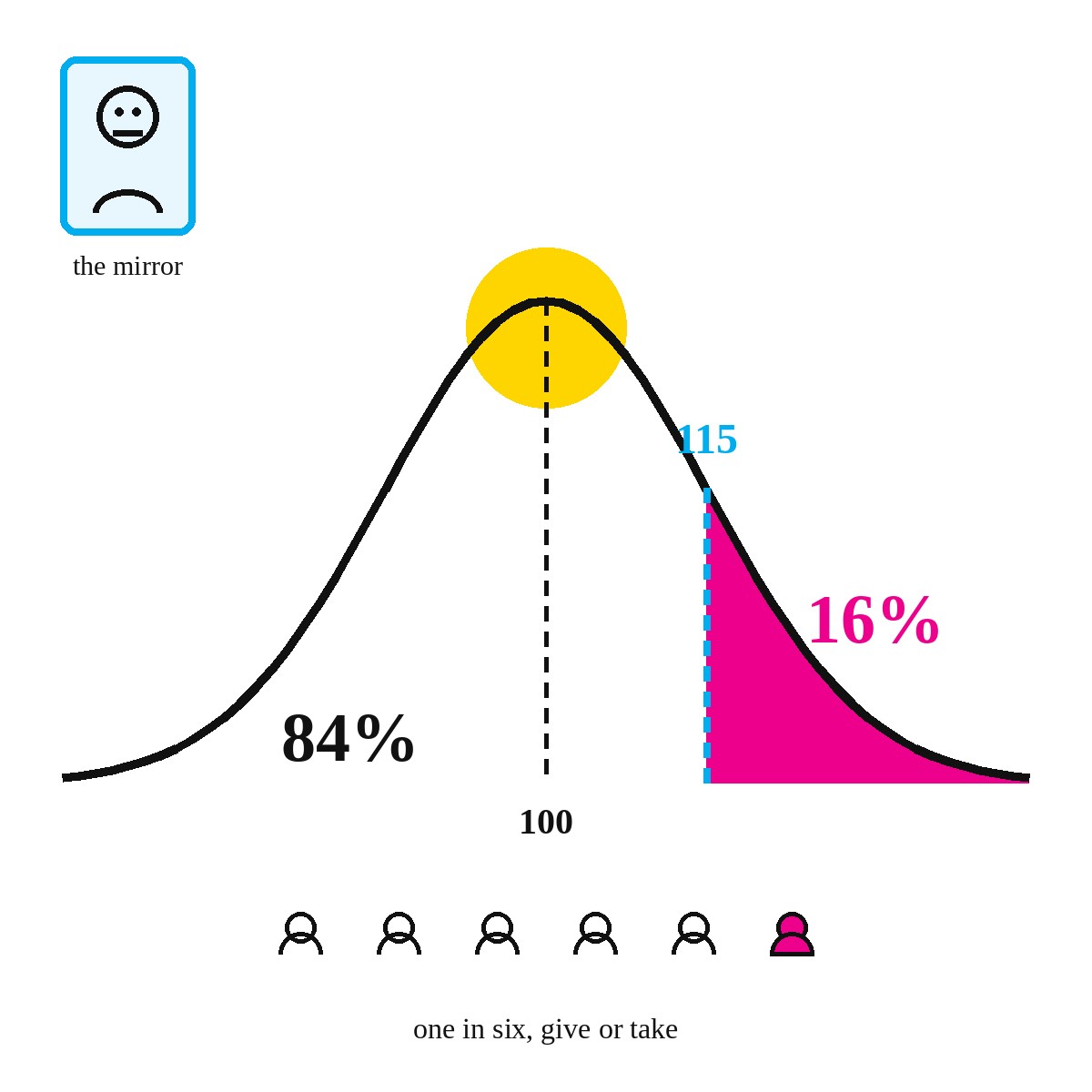
So let us pin the word to the curve, once, and see what happens. IQ scores are normed to a bell curve: the mean is 100 and one standard deviation is 15 points. Nobody—and I mean nobody—calls a person with an IQ of 100 smart. And yet the planet is mostly that person. The band from 85 to 115, one sigma either side of the mean, holds about 68 percent of all humans. Widen it to 80–120 and you have swept up more than four-fifths of the species. That is not the shallow end of the pool. That is the pool.
Now run the line up, because I had to wrestle Google for this number and I might as well publish it: one sigma above the mean—an IQ of 115—is where the top sixteen percent begins. If the word smart is going to mean anything measurable at all, that is the cutoff. Smart starts at 115, and sixteen percent of humanity qualifies. Two sigma up, an IQ of about 130, is the top two percent; that is the door Mensa guards. The word genius gets thrown at 140, which is the top four-tenths of one percent. My own tested score is 138—about the 99.4th percentile, the top six-tenths of one percent—and my considered verdict on it is the one I give on Threads: smart enough to be smart, dumb enough to be surely not a genius. My buddy Mark tests in the 150s. That is fewer than one person in two thousand, and I can report from decades of friendship that at that altitude the curve mostly buys you better arguments at dinner.
It is not only IQ, either. Pick any ruler ever built and the admired band stays a band. The OECD's PIAAC survey—the largest adult skills assessment ever run, thirty-one countries—puts thirteen percent of American adults at the top levels of literacy and twelve percent at the top levels of numeracy; the best country on earth, Japan, manages twenty-five. Roughly thirty-eight percent of American adults hold a bachelor's degree, which sounds like a multitude until you notice it is still a minority—and for the whole planet the figure is about seven percent. And the degree certifies less than it used to: in the middle of the last century the average college student tested between 115 and 120, the sixteen percent by definition, while one recent meta-analysis puts today's average undergraduate at about 102—the median of everybody. An undergraduate degree is a receipt from a credentialing business. It is not a silver star, it is not a gold star, and it is not a membership card for Mensa. Graduate school is the same business at a higher price. Neither Mark nor I has a graduate degree—Mark, who tests in the 150s, and me, at my lowly 138. In my head a PhD was supposed to mean a genius IQ; that was the deal the letters made with me when I was young, and it is a real disappointment, at fifty-six, to learn how many PhDs are not legit super-duper eggheads. What the degree actually certifies is this. Not genius. Persistence. Patience. Rule-following. Behaving. Deferring, for years, to the man who lords over your committee. It is a test you pass by staying and obeying, and staying and obeying is a real test—but it is not an intelligence test. Every instrument says the same thing in different units: the top slice is a slice.
Smart is not the same as right
And not one point of it buys discernment. History is crowded with brilliant people spending every horsepower of a magnificent engine on a map that was simply wrong. They were not dumb. They were misinformed, which is a different condition entirely, with a different cure. A man can believe a terrible thing at full intelligence; belief runs on the fuel it is given. Smart is the size of the engine. Common sense is whether anybody is steering. The Threads grading system cannot tell the difference, which is why it grades so confidently, and so wrong.
Nobody wins with a slice
Now run for office on it. An election is won at the median, with fifty percent plus one of the people who show up. Nobody in the history of the planet has ever won one with only the smart people—or only a minority, or only Black people, or only gay people, or only Jewish people, or only trans people, or only activists, or only the vanguard, or only the most vulnerable. Every one of those is a slice, some of them a one or two percent slice, and slices do not become a government until somebody goes out and builds a coalition among people who were never going to be flattered by the word smart. In 2024 Donald Trump won 49.8 percent of the ballots cast, which works out to about thirty-two percent of everyone eligible—and even he, the supposed tribune of a single tribe, had to go and get everybody: Pew's post-mortem is literally titled “Behind Trump's 2024 Victory, a More Racially and Ethnically Diverse Voter Coalition.”
That is the superpower, and it is not intelligence and it is not ideology. Trump talks to the entire curve as if the people in it are the heroes of their own story—because in their own mirrors, they are. He never grades the reflection. His opponents keep standing in front of eighty-four percent of the country explaining that the reflection is stupid, and then stand in the rain on election night wondering where their majority went. If you cannot get over yourself and reach the people the bell curve does not call smart, you will never hold office in a democracy. The arithmetic does not care how it makes you feel. Sixteen percent is a dinner party. Eighty-four percent is a country.
The sixteen percent does not build the roads
Look at who actually does everything. The occupational studies—the old Army testing, the test-norm tables, the longitudinal surveys—put the median pediatrician around 126 and the median lawyer around 125, and those are the penthouse professions. The median CEO sits around 120 to 124: inside the sixteen percent, yes, but just inside, close enough to smell the fresh air of the eighty-four. The median accountant is about 115, standing exactly on the line. The median sergeant major—the man who actually runs the United States Army—is around 108. The median plumber is about 102. And half of every profession is below its own median, which means half the pediatricians test under 126 and half the CEOs under 122, and the world does not stop. It does not even slow down.
Here is how the world actually gets made. The visionaries dream it, and the visionaries may well be the genius class. The smart class designs it and hews it and tunes it—draws the blueprints, balances the calculus. And then the implementation of everything, everywhere, is done by people who are not smart per se. You can plan a road. You can fund a road. If you do not have a small army of people who are not hiding in a room with the blueprints, the road does not get built. Presidents do not get voted for by the vanguard. Revolutions do not happen on the power of the vanguard of the proletariat alone.
We have run this experiment, and the results are in every history book. The students of Les Misérables needed the street to rise with them, and I would bet everything I own that the street had heard—innumerable times, within earshot—what the students called people like them when they thought the street wasn't listening: dumb, ignorant, stupid. People who have heard that do not become allies. They feel like material, like something to be used, exploited, and discarded once the barricade is finished. And even dumb people are smart enough to see that from a mile away. It is the one act of pattern recognition nobody fails.
Maybe that is why the people who know they are not smart are obsessed with common sense, and why I have come to suspect that smartness, past a point, makes you blind to it. Common sense is the steering. The self-aware know their engine will not save them, so they watch the road. And no rescue is coming from the social side, either: every community, every tribe, every humanity is middle school, is high school. Nobody likes the smarty-pants. Nobody likes Mr. Know-It-All. And it is not jealousy—there is simply no widespread reward on this earth for being exceptionally intelligent. The happiest people in the world, as far as I can tell, are C students. And the men who end up leading—CEOs, presidents, the leaders of men—are almost never the genius class. They are the sixteen percent, just barely, with good tires.
Don't call me stupid
Which brings me to the insult itself, because I hate it—and I hate it most from my smart friends, who should know what it costs. Intelligence is the one thing about a person that cannot be traded, transferred, or improved by an effort of will. It is non-fungible, and it is immutable. You can lose weight. You can become stronger. You can change your hair color, or skip the trouble and wear a wig. You cannot become smarter, no matter how much school you sit through and no matter how many books you read; school fills the shelves, it does not rebuild the room. So stupid is the one insult that demands the impossible. It does not say: change. It says: be somebody else, from birth. There is a reason the protest I have made my whole life belongs to Otto, the ex-CIA man in A Fish Called Wanda—Kevin Kline, my spirit animal, a man who is, as the film keeps proving, nowhere near as smart as his mirror tells him: “Don't call me stupid.” It is not vanity. It is the only appeal available against a sentence with no appeal.
And the detail that makes Otto my spirit animal is not the bluster. It is the library. Otto is always reading—Heidegger, Schopenhauer, all the great philosophers, the most erudite and dense and difficult texts in the entire world—and he is endlessly poring over them, poring over them, and none of it changes the fact that he cannot really comprehend them at all. I know that man. My degree is in American literature, with a minor in creative writing. I spent an entire year of my life reading the Western Canon. I was the young man who bought the whole History of Philosophy series and the Encyclopedia of Philosophy for his own shelf. I like to quote Derrida. I love to quote Deleuze and Guattari. And GPT has informed me, in so many words, that I completely misinterpreted Jacques Derrida. Am I Otto? We are all Otto. Especially the people with genius IQs. The poring is universal; only the size of the library varies.
And there is something delicious in the other direction. I have spent a lifetime deep-reading literature with no mentor, no professor, and no tutor curating any of it, which means my understanding of everything I have read might be entirely wrong. I am excited by the juiciness of being completely wrong, and just as excited by the juiciness of possibly being uniquely right. Because the commonplace readings—the settled interpretations handed down in classrooms—were worked out and pushed out by people who may be an order of magnitude less intelligent than the men and women who wrote the texts. The professor professing Shakespeare may be an order of magnitude less intelligent than Shakespeare. The chain of custody is not reassuring. At least my misreadings are first-hand, straight off the page. And presumably my reading of a text might be the more authentic one—not despite the missing credentials but because of the missing distance: if I am not an order of magnitude away from the author's intellect, I may be standing closer to the work than the man who is, and who holds the title anyway, and professes his interpretation in second- and third-tier universities and high schools around the country and the world. Otto pored without credentials. The academy hands its Ottos a syllabus and calls the poring a profession.
The professing classes, taken as classes, make the same point from the other side. The occupational studies put university professors at the top of the transmission table—somewhere around 125 to 135, the highest averages of any profession that works in words. Clergy run lower, somewhere in the 110s and low 120s depending on the denomination's schooling; journalists average about 118; high school teachers about 112. Respectable numbers, every one of them, and every one of them below the altitude of the works being professed. A professor at 130 can understand, deconstruct, and beautifully articulate a text written by a mind at 150 and beyond. He does not need the creator's genius to teach the creation. Teaching runs on crystallized intelligence—accumulated knowledge, verbal command, a lifetime of poring. Creation ran on the other kind, the fluid kind, the kind that builds a framework out of chaos where no framework stood. The transmitter's whole profession is to stand downstream of genius and stay faithful. Faithful is a virtue. It is not the same altitude.
Which raises the noise question: how much of the original insight survives the trip? The words, it turns out, can survive almost perfectly. The Brahmin priests who carried the Vedas orally for three thousand years recited them in woven patterns—forward, backward, interleaved like geometry—an error-correcting code built out of breath, and when the texts were finally written down there were virtually no variations across thousands of miles. Homer went the other way: no verbatim at all, bards improvising on formulas, the words drifting every performance while the architecture held. Two opposite systems, one result: the syllables arrive. But a syllable is not an insight, and fidelity of the text is not fidelity of the understanding. The recording can be perfect and the speaker still small. Every sermon, every lecture, every classroom hour is the original genius played through the transmitter's mind—and the transmitter's mind is the one part of the chain nobody can upgrade.
Bald tires
I turned fifty and got my own paperwork, and the paperwork is why I do not feel stupid anymore. Aphantasia: no pictures in my head, no inner screen at all. SDAM: my autobiographical memory does not replay; the records exist and the projector is gone. ADHD, clinically diagnosed: the executive-function module was never installed. These are not intelligence findings. They are capability findings—missing equipment in specific bays. My engine is extremely powerful. My tires are bald. And they are rear tires—not four-wheel drive, not front-wheel drive—and no amount of horsepower changes what happens when I put my foot down. At the end of the day, from the road's point of view, I might as well not be smart. Power that never reaches the pavement is not power. It is noise and heat.
So let us just admit it, since the math is right there and the math is right: if smart starts at 115, then eighty-four percent of all humans are not smart. What are we all going to do about that? Because here is the question underneath the question, and I will leave it standing the way it stands in my own life: what happens if you make the decisions of your entire life believing you are in the sixteen percent—and you are in the eighty-four? The mirror will never tell you. The mirror is not a measurement. It is a mirror.
Share: X · Facebook · LinkedIn · Reddit · Bluesky · Threads · Email