
The Trust Fall Trust Fail
Share: X · Facebook · LinkedIn · Reddit · Bluesky · Threads · Email
This is about the transaction between a protester and the law, so let us begin with the transaction itself. Every time you step in front of their car, every time you plant yourself in front of their face, every time you blow a whistle in their ear and scream at them to kill themselves, you are doing one very specific thing: you are putting your life, in full, into the hands of a man you have publicly declared a jackbooted thug, a brownshirt, an armed destroyer of the lives of undocumented immigrants.
There are only a few ways to make sense of that as a decision. Maybe you believe the law is a force field—that a right is a physical object worn on the chest, capable of stopping a vehicle, a baton, a bullet. Maybe you are betting on his restraint: that the fascist of your slogans will, at the moment of contact, turn out to be the adult in the room—trained, camera-aware, career-minded, gentle with you. Sit with that bet for a second. You are trusting the system you denounce with the only life you have. Your body is the collateral on a loan taken out against the decency of the very machinery you call Nazism.
Or maybe—this is the reading I respect, because it is the only one that is fully honest—you are neither confused nor trusting. You are a sacrificial lamb on purpose. Suicide by cop is a phrase because the phenomenon exists; its protest form is suicide by ICE. I do not care about my life. I will throw the dice with snake eyes on the table. I will spin the cylinder though one of its chambers is loaded and let the count fall where it falls. You only live once—yeehaw, motherfucker. That protester and I have no argument. He has priced the room.
My argument is with everyone else in the line, falling backward into arms they insist are attached to monsters. You do you. You might not come home. Your safety out there rests on the restraint of the very system you say you distrust.
The illustration is a boyfriend, and it is not a boast
I know the machinery from the other side of the face. Not as an agent—as something more ordinary and more damning: as the restrained man being screamed at, in a kitchen, by someone certain he would never do anything. My credential is a shame. The worst half-second of my life as a man: eleven or twelve years ago I had a girlfriend who was screaming in my face. She was five foot two, five foot four, a hundred and seventy-five pounds—a grown woman, nobody's waif—and I was six foot three and two hundred and eighty pounds, and she was in my face and in my head at full volume, the way people get when they know, down in their bones, that nothing is going to happen to them.
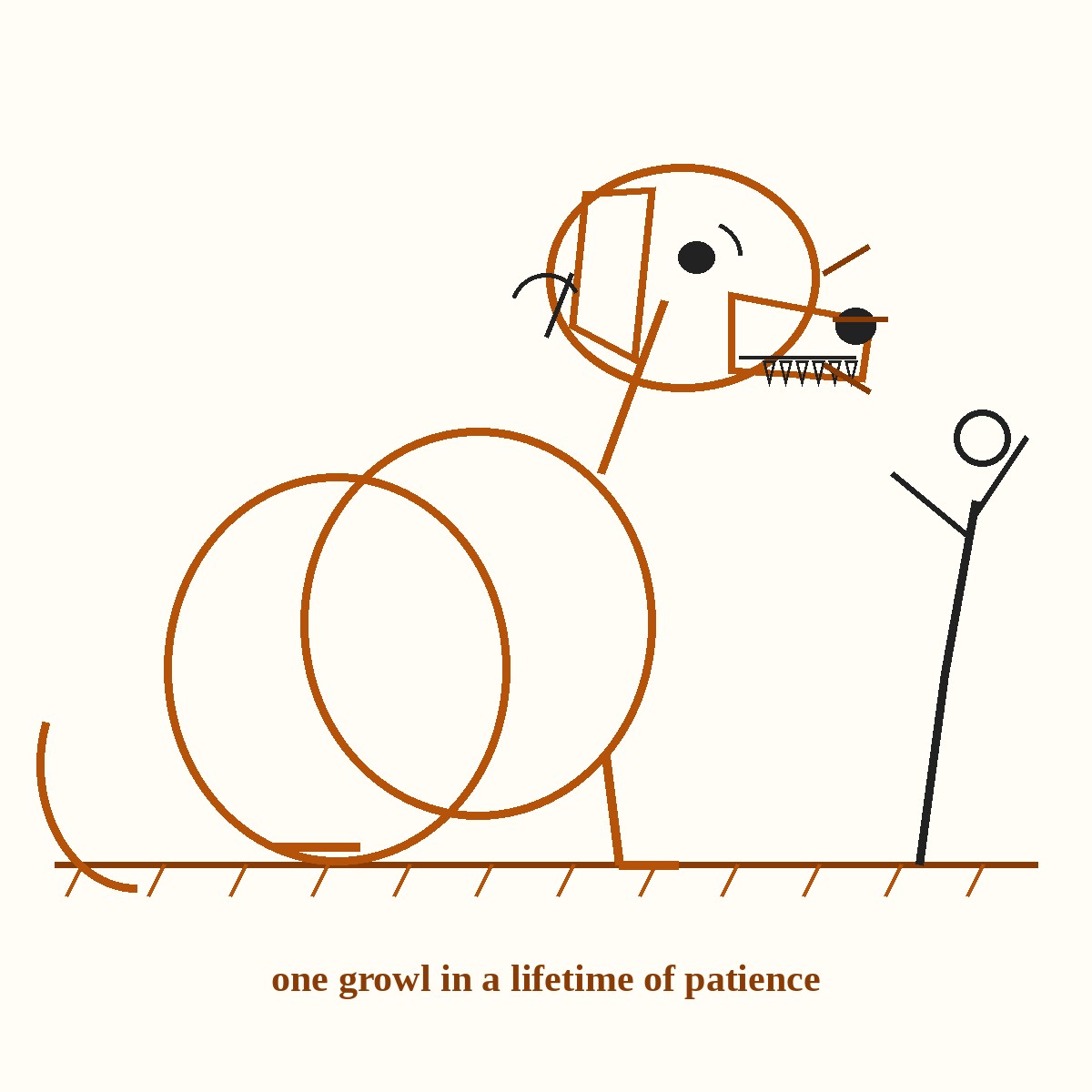
My mother raised me never to hit a woman. I have lived my whole life as the giant yellow Lab of every house I have ever been in: tail pulled, ears pulled, climbed on, leaned on, endlessly patient, because the dog is big and the dog has decided to be gentle. That night the dog growled.
I never touched her. I never took a step toward her. My feet stayed where they were and my whole body boofed—one sudden full-body feint, face growling, eyes growling, a shape expanding at her all at once—and she came apart. She freaked the fuck out. And the trust between us broke in that half-second, permanently, in a way no apology has ever repaired. Every woman I have ever told this story to has said the same sentence: you can't take that back. They are right. I knew it while it was happening. I feel shame about it to this day, and I am putting it in print because it is the most honest data I own about the thing Americans keep getting wrong in the street.
What she was banking on
Her freedom to scream at that range was built entirely out of my restraint. She could stand inside the blast radius of a man who outweighs her by a hundred pounds and scream into his face because she held a guarantee: he will never, ever do anything. The guarantee was real. I had issued it myself, over years, in ten thousand small proofs of gentleness, and my mother had cosigned it before I was old enough to spell it. Understand what the boof actually did. It added no violence to the room. It subtracted a certainty. For half a second she got to see the room without the guarantee in it: the size was suddenly just size, the man was suddenly just a man, and the whole architecture of her confidence turned out to have been a loan against my character.
She had been doing a trust fall into me every day of that relationship, arms crossed, eyes closed, certain of the catch. The boof was the moment she looked down mid-fall and saw that the catcher's arms were a decision. Decisions can change. That is what she saw, and seeing it once was enough forever.
Understand what she had actually hired, because she had hired it. The whole time we dated I was a concealed-carry man. She did not like the gun in the house—not the gun; she did not want the responsibility of it—so when I came home I locked it in a small case in the dresser by the bed. She knew the full inventory: trained, armed, six foot three, two hundred and eighty pounds. She wanted that power the way you want a bodyguard—present, capable, and aimed at the street. What she had never priced was that aim is not a property of the weapon. Aim is a decision the armed man renews.
Caesar was not killed by an army. He was killed by a direction change, by a hand inside his own perimeter; Et tu is the sound of a guard rotating. The boof was a rotation of one degree, with no contact, and it was enough, because it showed her the truth every protected person lives on and never inspects: protection is capability plus aim, and the aim was never hers. It was mine, on loan.
Anyone who has lived with a big dog knows this in miniature. You can live with a dog for its entire life—children hanging off its ears, strangers' hands in its face, a decade of provocations absorbed into a wagging tail—and then one day something crosses some interior line and the dog squares up and growls, and gives you the look. The dog has not bitten you. The dog may never bite anyone. But you will handle that dog differently for the rest of its life, because you have been shown the machinery under the temperament. Temperament is a policy. Underneath the policy there is an animal, and the animal has a vote. My girlfriend met the animal for half a second, at conversational distance, wearing my face. I have spent eleven years being sorry. Sorry does not unshow a thing.
The boof was not a decision the way a chess move is a decision. A human voice screeching at full volume from inside your personal space is not information; it is a physical event in the nervous system. The ears ring, the shoulders climb, the blood goes strange, and some ancient piece of equipment down in the stem of the brain files a single imperative: make it stop. Not win the argument. Not be right. Make the noise stop, at whatever the going rate turns out to be.
Every person alive carries that equipment. Hers fired nothing that night because she was the one making the noise; mine fired once, after years of absorbing it, and what came out was a feint instead of the thing the equipment was actually requesting—which is the policy reasserting itself at the last possible inch, and I thank God and my mother for the inch.
But do not mistake the inch for a law of physics. A policy is a dam. The reptile is the river. Men stand in the street in armor all day with the river rising behind the dam of their training while strangers work the screech at point-blank range, professionally, sometimes for hours, precisely because the screech works on the equipment. Everyone involved knows the equipment is there. The whole performance is an attempt to run a man's river up against his dam in front of cameras and charge him for the flood.
Restraint is a policy, and policies fail
Here is the warning. I know what restraint is from the inside because I have supplied it, at scale, for fifty-six years, and I know its terms: restraint is a policy a strong party maintains about a weaker one, renewed moment by moment, invisible exactly as long as it holds. You never see restraint. You see its absence, once, and then you can never unsee the space where it used to be.
Now scale the kitchen to the street. Across this country, every day, people stand in front of federal agents and police officers and scream at them exactly the way she screamed at me—an inch from the face, spittle flying, kill yourself, pig, fascist, Nazi, brownshirt, I know where you live, we will dox you, your children will be ashamed of you—and they do it inside a blast radius, in front of men carrying rifles, plate carriers, full magazines, chemical agents, and less-lethal launchers, and the entire performance runs on a guarantee the performers never signed and the agents never issued: he will never, ever do anything.
I wrote a whole essay about the arithmetic of this in Protest Russian Roulette: righteousness empties no chambers, and the cylinder does not know you are right. I said it again in FAFO: When the Speech Stops Saving You—for a long time in America, people have stood nose-to-nose with men in armor and guns, confident the bubble of restraint will hold. Bubbles are not laws of nature. Bubbles are policies, and I am a man who once watched his own policy flicker for half a second in a kitchen, against someone he loved, over nothing but screaming.
And notice what the flicker runs on, out there. Those agents are restrained by training, by cameras, by law, by career fear—and by a story. Protect and serve. Officer Friendly. The same propaganda you grew up on, they grew up on; it is the water in both tanks. A shared story is a real restraint right up until the day it stops being believed by the people it is restraining, and stories die of overuse and contempt like everything else.
Which brings me to the part nobody wants to hear from either direction: you cannot spend years calling a man a fascist, a Nazi, a brownshirt, a jackbooted thug—and then bank your physical safety on his tender commitment to proving you wrong. Names are scripts. A script repeated ten thousand times is an assignment. Some men will refuse the assignment every day of their careers; the professions are full of them, and I am counting on them too. But a movement that tells armed men they are monsters at noon and then does trust falls against them at two has not thought about what it is doing. It has confused its own slogans for a safety system.
The kit is a warning color
Biology has a word for the whole arrangement: aposematism. The poison dart frog does not hide. It advertises—bright, slow, exposed—because its defense only works if it is believed in advance. The signal is a mercy to both parties: the predator skips a poisonous meal, and the frog skips being tested by one. Law enforcement runs the same play and keeps a doctrine name for it: command presence, the projection of unassailable capability before a word is spoken. The FBI's own Law Enforcement Bulletin has said it in print for decades: the uniform is a psychological instrument, citizens cooperate more in its presence and curb themselves, and small changes in the kit change what the citizen sees. The plate carrier broadens the shoulders. The dark colors read as power. It is my holster doctrine issued by a quartermaster: let the presence do the work so the violence never has to.
The science also keeps the other set of books, and an honest warning reads both. Clothes work on the wearer. Psychologists call it enclothed cognition—Adam and Galinsky's term for the way a garment's symbolic meaning colonizes the mind inside it—and Galinsky himself has argued, in the Association for Psychological Science, that outfitting police as soldiers moves the wearer toward a battle-ready frame, quicker to read a citizen as a combatant. The kit works on the viewer too.
Since Berkowitz and LePage in 1967, the weapons effect has documented that the mere sight of weapons primes aggressive thoughts in people already aroused. And where faces disappear behind visors and names behind vests, the literature reaches for deindividuation: the loosening of the individual inside the monolith. Display deters. Display also primes. Both findings can be true in the same street at the same second, which is exactly why the street is not a seminar.
Here is what does not change across either set of books: the display is honest. Law enforcement does not hide the fact that it can kill you. It publishes the fact on its chest, in dark colors, at maximum volume, precisely so the fact will be believed before it has to be demonstrated. You are free to think the frog should be duller. You are free to think the frog is the problem. What you cannot coherently do is read the brightest warning color in the American street as an invitation to test it at point-blank range, screaming, and then call the outcome a betrayal of trust. The frog kept its side of the aposematic bargain. It told you.
The civil disobedience experience
The modern version of all this has a product category now: the experience. The permitted march with its route, its marshals, its T-shirt, its finish time. The sit-in staged where sit-ins are expected. I called it a 5K in these pages, but the fuller truth is that it has become an escape room: simulated peril, staff monitoring, a panic button by the door. It is airsoft for the conscience—a war experience engineered to send you home unhurt, with photographs.
It is the fake jail they bus difficult kids into, where an actor in a uniform yells at you inside a building designed so the yelling is the whole event. Underneath the product sits a presumption, and the presumption is the product's real feature: Portland is a safe space. Minneapolis is a safe space. New York is a safe space. A college campus is the safest space of all, a place consecrated for unlimited sit-ins, unlimited occupation, unlimited scream-in-the-face civil disobedience, with an absolute guarantee that the people inside it will never be molested. Fall backward, arms crossed. The institution will catch. The officers will catch. America will catch.
Civil disobedience was revolutionary in this country precisely because nobody in it believed that. In Birmingham in 1963 the city turned fire hoses and police dogs on schoolchildren—children, marching in their good clothes—and the marchers had trained for exactly that, rehearsed being beaten without swinging back, signed their commitment cards, and walked in with their eyes open. In Selma they were clubbed on a bridge on camera. They filled jails by the thousand. Men and women were beaten to death in that movement, dragged by their hair, savaged, disappeared into the machinery of Southern law, and the people who came after them came anyway, having read the obituaries. That is why it was revolutionary. It was not an experience. It was an act performed by people who had priced the dogs in advance and refused, as a discipline, to be surprised by them.
And the campus presumption—the one our current moment treats as a birthright—received its death certificate on May 4, 1970, when the Ohio National Guard fired sixty-some rounds in thirteen seconds into students at Kent State and killed four of them: Allison Krause, Jeffrey Miller, Sandra Scheuer, William Schroeder. The President's own commission called the shootings "unnecessary, unwarranted, and inexcusable." Kent State was the ultimate betrayal of the safe-space trust fall, and it happened on an American campus, in daylight, to the children of the suburbs, fifty-six years ago. America has been showing us since at least 1970 that the trust is misplaced.
I keep asking, in This Is Not Your Father's Protest, why people say you wouldn't dare to a country with this record. We dared at Kent State. We dared at Waco. We dare every day in the places without cameras. The historical rhyme is not subtle: the sixties are the analog of the twenty-tens, a decade that believed in the street; the seventies are the analog of the twenty-twenties, the decade the bill and the backlash arrived together.
Mouthing off is legal, and legal is a different country from safe
The police have a street name for the whole transaction: contempt of cop. A citizen mouths off—melts off at an officer, in the older phrasing—and the encounter leaves the rails: a routine stop becomes a detention, a detention becomes a charge, a charge becomes a lawsuit. Ask the data how often mouthing off is the match and the data shrugs, honestly for once: no national ledger exists, because no officer in history has written "he hurt my feelings" on a use-of-force report. What the record does show is tens of millions of police-citizen contacts a year with force appearing in a sliver of them, and body-camera research showing escalation behaving like a feedback loop whose tone is set in the opening seconds—by the officer's first words and by the citizen's answering volume.
When the loop spins up, the paperwork collects in a familiar drawer: disorderly conduct, obstruction, resisting. Criminologists call them cover charges, the statutes that arrive when the real offense was attitude. And through all of it the law is perfectly clear and perfectly useless in the moment: mouthing off is protected speech. The Supreme Court settled it in Houston v. Hill back in 1987—you have a constitutional right to verbally challenge a police officer, to argue, to swear, to tell him exactly what you think of him.
The signature taunt of the current era runs further than swearing. Kill yourself is screamed into the faces of ICE agents and cops every single day in this country, an inch away, on camera, by people having a wonderful time. It is mouthing off distilled to a death wish, and it is legal, and I will defend its legality in any room. Notice, though, what the taunt is designed to do: wound a man to the core while his restraint stands guard over the wounder. The screamer is spending the same currency my girlfriend spent. Her screaming broke no law either; there is no statute against screaming in a kitchen. The law was never the wall in that room. My restraint was the wall, and walls built out of a man's decision hold exactly as long as the man decides.
Rights are appellate creatures; they speak months later, in courtrooms, in the past tense. A right can win you a dismissed charge, a settlement check, a unanimous paragraph in an opinion with your name misspelled. A right cannot reach back into the thirteen seconds and unpick the ending. This is the distinction the trust-fall mind refuses to hold: protected and wise are different countries, and the border between them is a man's temper. Tell the agent to kill himself if the speech is in you—it's your speech, and the First Amendment covers it, and the men who wrote that amendment would have recognized the impulse. Only do it knowing whose arms you are actually falling into while you say it. His. Not the amendment's. The amendment has no arms.
Brave either way
The people out there are brave. I said it in the Russian roulette essay: everyone who goes out there is brave, genuinely, completely brave. And bravery does not require an accurate risk assessment. The kid who thinks the campus is a safe space and walks into the line anyway, singing—he is brave. The woman who stands in front of the vehicle believing her citizenship is a shield—she is brave. Uninformed courage is still courage; the universe does not grade the paperwork before it honors the act. I give full points, unconditionally, and I will argue with anyone who calls them cowards or clowns.
My quarrel is not with their hearts. My quarrel is with their trust. Courage aimed by a false map gets brave people hurt in places a true map would have told them were kill zones, and the people handing out the false maps—the ones selling the experience, booking the escape room, promising the catch—bear a share of every injury that follows. In S11E2 of this show I put it as flat as I know how: the First Amendment is not a force field against the Second Amendment, and the world does not owe you a trust fall. Rights are claims. Claims get vindicated in court, in Congress, in history—later, by other people, if you live. In the moment, in the street, in front of the car, there is only the man in front of you and the state of his policy.
So here is the whole warning. If you are going to fall, know that you are falling. Write the will. Kiss your family like it counts, because it counts. Leave the letters. Go in clear-eyed, the way the children of Birmingham went in clear-eyed, having decided that the cause was worth a body and that the body might be collected. That decision, made honestly, is the bravest thing a citizen can do, and I honor it without reservation.
What I cannot honor—what I am begging you to retire—is the trust fall performed as a lark: the scream in the armed man's face that only works if he is not really armed, the sit-in that only works if the campus is really a nursery, the whole gleaming experience economy of dissent that sells Selma and delivers an escape room. I boofed once, at a woman I loved, over nothing, and I have never forgiven myself the half-second.
Multiply me by a hundred thousand tired, taunted, spat-on men who did not choose your kitchen, who are not restrained by a mother's rule laid down in childhood, who are running on a story that your side tells them every day is a lie. One of them, on one bad afternoon, is going to show you the machinery under the temperament. Do not build your safety out of the assumption that he won't. Build it out of the truth the movement's martyrs already paid for: the catch was never guaranteed. Fall like you know it.
Share: X · Facebook · LinkedIn · Reddit · Bluesky · Threads · Email