
The Rotten Few and the Useful Many
This article, read aloud:
Share: X · Facebook · LinkedIn · Reddit · Bluesky · Threads · Email
The world you can see was made by a few. A few pages carry a website's traffic. A few clients carry a firm's revenue. A few men carry a city's violence. The rest of us live inside a record those few compiled, and we mistake the record for the world. Vilfredo Pareto found the shape in Italy's land registers in the 1890s: about 80 percent of the land sat in the hands of about 20 percent of the people, and the same curve appeared in every country's tax records he opened. The principle that took his name says outcomes concentrate—a small share of causes produces a large share of effects, and the split usually runs far steeper than 80/20. This matters because the average is a fiction wherever the curve runs. The average offender, the average customer, and the average page describe nobody who exists, and argument, policy, and marketing aimed at that fiction spend themselves on people who were never the problem and never the opportunity. Used honestly, the principle is triage: measure the real distribution, find where the curve runs steep, and put the work there. Used dishonestly, it licenses three errors—cutting the long tail that feeds the head, stopping at 80 percent quality, and forcing the pattern onto bell-curve subjects where it does not live.
The curve itself
Pareto published the land figures in his Cours d'économie politique in 1896 and 1897. He was an engineer before he was an economist, and he treated the tax records of Italy, England, France, and Switzerland the way an engineer treats load tests: the same curve, under different governments, different tax systems, and different social arrangements. The story about pea pods in his garden, 20 percent of the pods yielding 80 percent of the peas, arrived later and is probably invented. The data was tax records. Tax records are enough.
The pattern slept for half a century. In the 1940s, Joseph Juran, working on manufacturing quality, saw that a small share of defect causes produced most of the defects. He named the observation for Pareto and gave it the phrase that stuck: the vital few and the trivial many. He built the phrase for factory floors, where it did immediate work: stop inspecting everything equally, find the few causes filling the reject bin, and fix those first. Juran later renamed the trivial many. The rename is the hinge of everything after it.
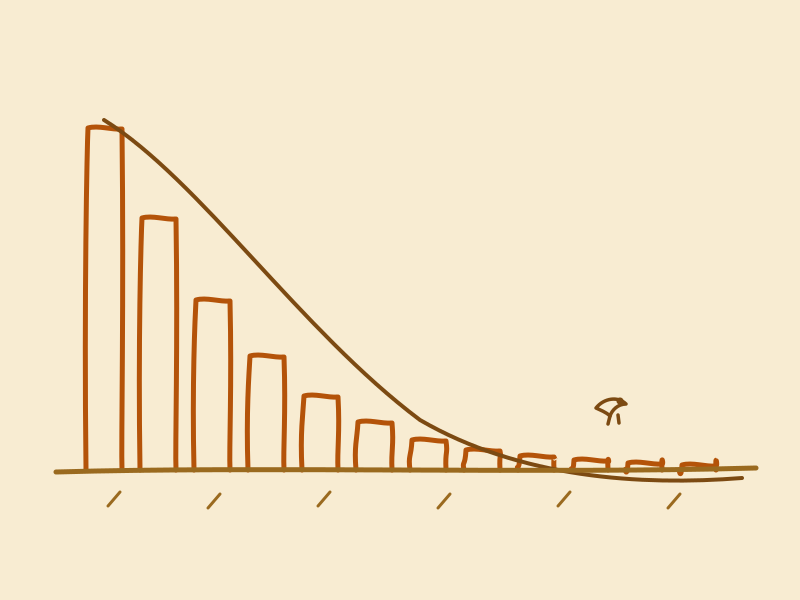
Mathematically, the principle describes a power law. Under a bell curve, values cluster around a middle and the extremes are rare and mild; human height works this way, and the average man is a fair description of most men. Under a power law, the extremes dominate and the middle thins out. The two numbers in 80/20 measure different things—one counts causes, the other counts effects—so they owe nobody a sum of 100. A distribution can run 70/30, 90/10, or 99/1 and obey the same mathematics. Venture capital returns run near the steep end. So does attention online.
The curve is fractal; it repeats inside itself. Take the top 20 percent and apply the rule again: 4 percent of causes produce about 64 percent of effects. Apply it a third time: under 1 percent of causes, 0.8 percent, produce about 51 percent of everything. Inside almost every large system sits a tiny set of levers moving half the machine.
Four mechanisms build the curve. Preferential attachment: new links, readers, and customers flow to whoever already has them. Cumulative advantage, the Matthew effect: early wins attract the resources that produce later wins. Multiplicative compounding: when several factors multiply instead of adding, small differences explode into large ones. Winner-take-most markets: when serving one more customer costs almost nothing, the best-known option absorbs the demand. Where these mechanisms run, concentration follows. Where they are absent, the curve stays flat, and Pareto has nothing to say.
Run the recursion on a roster of one hundred clients and the arithmetic gets personal. Twenty clients produce eighty of every hundred dollars. Four produce sixty-four. One client, on paper, produces half the firm. Every consultant who has sorted a client list by revenue has watched a version of that table assemble itself, and has felt the floor tilt under a business he thought he knew.
The record is the residue
Here is the part the productivity versions skip. Survivorship and Pareto are the same shape viewed from two sides. The record any of us consults—statistics, histories, bestseller lists, case studies—was compiled by whoever remained visible at the end of a skewed process. Surveys interview the living. Business books interview the companies that survived. The dead, the failed, and the never-noticed file no reports, and their absence bends every average computed from the residue.
So the concentration runs twice: once in the world, and once in the evidence about the world. Averages drawn from that evidence describe the residue, and the residue is a selected few plus a long, quiet remainder who contributed almost nothing to the outcome being measured. Anyone arguing from the average is arguing from an artifact. Even the crime figures below carry the bend twice over: they describe convictions and police contacts, the visible residue of harm. The concentration inside the visible record is steep enough. The invisible remainder never got counted at all.
Open any business magazine's success issue and the bend is on the cover. The founders interviewed are the ones whose companies lived, and their habits get credited for the outcome. The dead had the same habits, plus one bad quarter, one lost customer, one loan called at the wrong hour. Survivor's arithmetic credits the visible and bills the invisible nothing, because the invisible cannot object. The bend is also why the same names recur in every account of an era: a few firms, a few authors, and a few laboratories wrote the record, because they were the ones still standing when the record was taken.
Harm concentrates
A Swedish study tracked more than 2.3 million people across three decades of conviction records, 1973 to 2004, and found that 1 percent of the population accounted for 63.2 percent of all violent crime convictions. Marvin Wolfgang's Philadelphia birth cohort—nearly 10,000 boys followed from birth—found the chronic 6 percent, the boys with five or more police contacts, responsible for 52 percent of all recorded offenses, 71 percent of homicides, and 69 percent of aggravated assaults. David Lisak's research on men who had committed rape and were never prosecuted found that 63 percent of them were repeat offenders, averaging 5.8 rapes each, and that repeat offenders accounted for over 90 percent of the rapes in those samples.
Two countries, two methods, two generations apart; the shape did not move. Read the three studies together and the conclusion writes itself. The modal man commits no violent crime at all. The average offender is a statistical ghost, assembled by dividing real harm, done by a repeat few, across millions of men who did none of it. Argument and policy aimed at that ghost—aimed at men in general, at the average man—spend their force on the innocent majority and address almost nobody who produces the harm. The harm has addresses. They are few, they repeat, and a distribution this steep means enforcement, prevention, and argument all gain by aiming at the repeat few instead of spraying the population.
The concentration carries one hopeful piece of arithmetic inside an ugly subject. Harm this steep was never spread across the population in the first place, so a small number of well-aimed interventions can move a whole city's numbers. Policy built for the average man cannot find those interventions. It is calibrated to a person who does not exist, and it manages the men who commit nothing as though they were the problem.
The same skew appears in harmless registers, which is how you know it belongs to the mathematics rather than the subject. Lifetime partner counts run on it: the median adult reports somewhere between four and seven partners, while roughly 1.5 percent of men report 150 or more, dragging the mean into a country the median never visits.
My trade runs on the same curve
I earn my living inside this distribution. Search is power-law country end to end; every ledger I open sorts itself into a steep head and a long flat tail. In any Search Console account, a handful of URLs carry most of the clicks, and improving those pages—sharper titles, stronger internal links, content that answers the query completely—returns more than publishing fifty new posts into the tail. A few referring domains carry most of a site's authority; losing one of them costs more than losing a hundred directory listings. In a technical audit, two or three template-level faults—a canonical pointing the wrong way, an indexation directive left over from staging, a broken pagination pattern—generate most of the errors in the crawl. The amateur fixes four thousand URLs one at a time. The professional fixes the template once.
Sort a crawl by cause instead of by URL and the work changes scale: eight hundred errors collapse into one retired pattern and a short list of exceptions. The list was never eight hundred problems. It was one problem with eight hundred addresses.
Software learned the same lesson at scale. Microsoft reported in 2002 that fixing the top 20 percent of reported bugs eliminated about 80 percent of crashes and errors. Client rosters obey the curve too: a few retainers produce most of a consultancy's revenue, and a different few produce most of its headaches. Laying those two lists side by side is one of the most clarifying exercises a practice can run, because the names rarely match. The metric decides the ranking, and the ranking decides the work. Sort clients by revenue and the loudest account wins; sort by revenue after the cost of serving them—the calls, the revisions, the weekend emergencies—and a quiet account half the size can come out on top. Pareto analysis run on the wrong metric produces a confident answer to a question nobody asked.
The kin are everywhere once the shape is familiar. Zipf's law governs language: the most common word in English appears about twice as often as the second, three times as often as the third, and so on down the ranks. Price's law governs output: in any field, roughly the square root of the number of contributors produces half the work. Different centuries, different subjects, one curve.
The honest use: triage
The method fits in a paragraph, and nearly every misuse comes from skipping its first step. Measure; do not assume. Pull the real numbers—revenue by client, clicks by page, defects by cause, hours by task—and sort them largest first, with a running cumulative share. The point where the cumulative line flattens marks the end of the vital few. Protect what sits above that line: give it the best hours, the first maintenance, and the fastest repair when it breaks. The middle of the list gets a watch rather than a budget: some of it is next year's vital few in training, and the re-measurement exists to catch them climbing. Then re-measure on a schedule, because the vital few move. Last year's top client churns; last quarter's winning page decays; a ranking treated as permanent hardens into superstition.
That is the entire discipline. The audit is cheap: an afternoon, a spreadsheet, and the willingness to sort a list you would rather admire unsorted. The principle earns its keep as a triage instrument: it tells a busy person where the next hour does the most work.
The three dishonest uses
The first dishonest use is amputation. Juran renamed the trivial many the useful many late in his career, because he had watched managers cut the 80 percent and then watched the 20 percent wither; cut the whole tail and the foundation under the head goes with it. The tail feeds the head, usually on a delay. Small accounts become large ones. Low-traffic pages pass their link equity upward and answer the precise question a buyer asks the night before he telephones. Cut the tail pages and the head pages lose their internal links, their topical depth, and the exact answers that made the site worth ranking at all. In search, the long tail is my living. Each obscure query is trivial alone; in aggregate, those queries are the business—thousands of exact questions asked by people who knew precisely what they wanted. A practice that cut them would be cutting its own roots and calling the wound efficiency.
The second dishonest use is the quality excuse: the claim that 80 percent is good enough because the principle says so. Pareto ranks causes; it sets no ceiling on craft. Some systems are leverage-limited and reward focus. Others are failure-limited and punish neglect—surgery, aviation, security, any work where the last defect is the one that kills somebody. In those systems, the final 20 percent is the product. A pilot's checklist is the anti-Pareto document: every line on it exists because its absence once killed somebody, and nobody proposes flying on the vital few of the checklist. The principle tells you where to start. It is silent on where to stop.
The third dishonest use is forgery: forcing the pattern onto subjects that run on bell curves. Height clusters. So does the time most tasks take, and so does most measurement of undisturbed human variation. Where values cluster around a middle, the average is real, the extremes are mild, and a manager hunting for a vital few is hunting a mirage. He will find a top 20 percent anyway; any list can be sorted. On bell-curve ground, that top slice beats the average by a whisker, and the manager walks away carrying a Pareto chart of a pancake. The test is always the data. Where the data shows no power law, the principle does not apply, and quoting it is decoration.
Outcomes concentrate—in land, in traffic, in revenue, in violence—because advantage compounds, and the record of it all is compiled by the few who remain visible. Harm concentrates hardest, in a small repeat population, which makes the average offender a fiction and aim at the few the only aim that connects. The honest use of Pareto is triage: measure, sort, work where the curve runs steep, and re-measure when it moves. The dishonest uses amputate the useful many who feed the vital few, excuse unfinished quality, and forge the pattern onto bell-curve ground. Find the steep part of your curve. Work there. Feed the tail that feeds it.
Share: X · Facebook · LinkedIn · Reddit · Bluesky · Threads · Email