
This Isn't a Prison Planet
This article, read aloud:
Share: X · Facebook · LinkedIn · Reddit · Bluesky · Threads · Email
60 Minutes aired the segment on October 25 and called it "Destination: Nowhere." A man named Moussa Diawara, 57 years old, twenty-five years in the United States, was taken after his night shift driving for Uber, held three weeks in Texas, flown to Ghana on July 30, and within five days put on a plane to Mali—the country a judge in 2012 said he could not be sent back to. His wife Barbara and his children, Corey, 16, and Chloe, 12, were on camera. The program's arithmetic was the kind that ends arguments: of the 63 people on that flight, 19 percent had a criminal charge or conviction, and Diawara was not one of them. He had no criminal record. He overstayed a tourist visa, applied for protection, lost the deportation case, and won the right not to be returned to Mali. Then the government sent him to Ghana, and Ghana sent him the rest of the way.
I am not going to relitigate the flight. My own paper, Objective Daily News, published the whole file this morning—the segment, the interview, the omission at the center of the fight, the policy underneath, and the standards the argument runs on—with no verdict in it, because that is what that paper is for. This piece is the other half: everything the objective file cannot carry. My opinion, in my voice, on my own site.
And my opinion starts with a question nobody in the entire record asks. I have read the segment, the extended interview, the government's posts, the critics, the defenders, and the pile of coverage since. Here is the question that never appears: why doesn't the family go with him?
The family follows
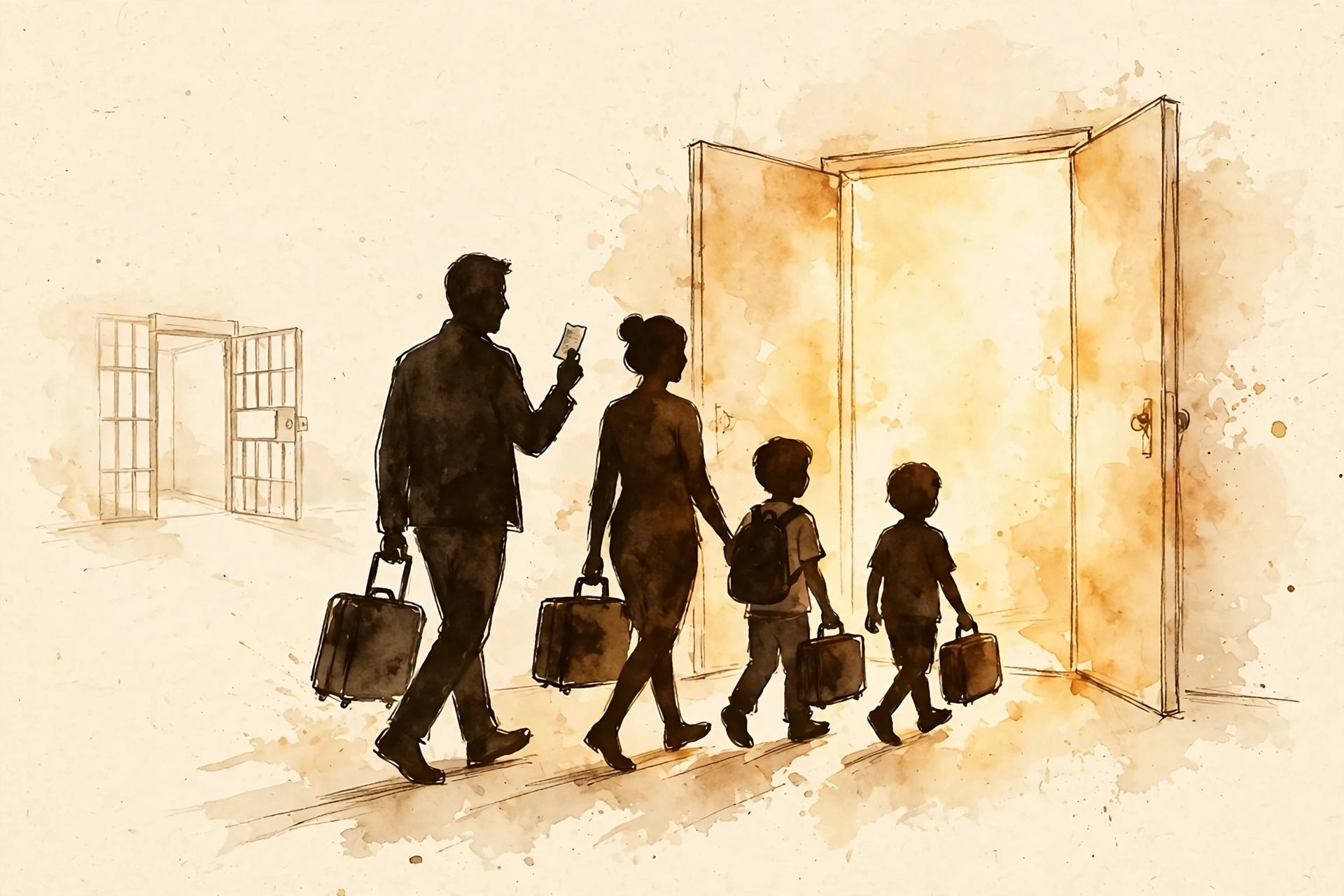
Nobody says Barbara and the children can't go to Mali. There is no law against it, no wall, no exit visa, no guard at the gate with a list. They do not lose their American citizenship. They were born in America; citizenship is theirs for life, and the passport works in both directions. If they go, they go as Americans living in West Africa while their dad deals with his immigration status, and if it stops working, they come home, because home is a right they carry in their pocket. Mali's own immigration law, as Mali reported it to the United Nations, says a residence permit must be issued automatically to the foreign spouse of a Malian national and to his minor children. The legal path is not theoretical. It is written down.
The family can sell the house. Families do it every day for smaller reasons than this. And if the citizens decide to stay, they can decide to stay—that is what citizenship buys, a choice. If the children are minors, they go where their parents go, which is the arrangement in every other department of life. We do not ask a ten-year-old to file a position paper on a move to Ohio.
This isn't a prison planet. People leave. People follow people. The segment filmed a wife and two children in Houston as if they were fixtures of the house, as if geography were a sentence. It is not a sentence. It is a plane ticket and a decision, and the decision belongs to the family, not to the audience's feelings.
Notice what the coverage needs you to believe for the tears to work: that the family has exactly two options, together in America or torn apart forever. A third option exists and it is the obvious one, the one millions of families on this earth are living right now. It goes unmentioned because it ruins the shot.
It isn't war
It's not like people going to war. Your family doesn't come with you to war—war is the one move a man makes alone, and we accept it without a documentary. But if you get a job in finance in Hong Kong, your family comes with you. Nobody makes a weeping segment about the Hong Kong transfer. The kids get an international school and a story to tell for the rest of their lives.
Deportation, for the family, is the second kind of move, not the first. A father is relocated by law to his own country, a country where he speaks the language and holds the nationality, and the question is whether his family relocates with him the way families relocate for a posting, a plant closing, a military assignment, a missionary call. Military families do this on orders, to places chosen by a bureaucracy, and we call it service. This family would be doing it by choice, to the father's own homeland, and we call it unthinkable. The difference is not in the move. The difference is in the story we have agreed to tell about the move.
The comparison nobody makes
There are nearly two million Americans in jail and in prison in this country—1,852,900 at the end of 2023, by the Bureau of Justice Statistics, and in a single surveyed year 684,500 prisoners were the parents of 1,473,700 minor children. Those children do not get to go with their parents. Not to Mali, not to a nicer facility, not anywhere. Their parents are jailed for ten, twenty, thirty years, and the children grow up visiting through glass if they visit at all. That's the sad part. That is what actual forced separation looks like in America, at a scale of a million and a half kids, and it does not get a 60 Minutes segment with a string arrangement, because the parents in those cases are unsympathetic and the audience's compassion has a casting director.
Deportation is not jail. The deported man is not in a cell. He is in his own country, free to work, free to live, free to receive his family. Diawara's situation in Mali is genuinely bad—he arrived with nothing, he is in hiding, and I am not going to pretend otherwise—but he did not stay in Mali. He left. He crossed into another African country with truckers' help, which is where 60 Minutes found him and interviewed him. A man who can leave is not a man in prison. The program's own reporting proves the point it was trying to obscure: the world outside America is not a cell block. It is the world.
And the detention centers—the other image the coverage leans on—hold people who are still fighting to stay or waiting to be moved. There is a door on that building that opens outward, and the government will pay you to walk through it. Since May 2025, the Department of Homeland Security has offered a $1,000 stipend through the CBP Home app, paid after a confirmed return, plus travel assistance; the Project Homecoming proclamation added free flights and an exit bonus. The Secretary's words were that self-deportation is "the best, safest and most cost-effective way to leave the United States to avoid arrest," and people who register are deprioritized for detention and removal. You can argue about whether the offer is generous. You cannot argue it does not exist. Detention is what happens on the road not taken.
The reverse nobody mourns
Now run the film backwards. Loads and loads of people migrate to America and leave their families behind to do it. The cook whose children are in Oaxaca. The nurse whose mother is in Manila. The driver whose wife is in Accra. They wire money home for years, for decades, sometimes forever. Migration separates families in both directions, every day, as a routine feature of the arrangement, and nobody calls the inbound version a humanitarian crisis. The man who leaves his kids in Guatemala to wash dishes in Houston is a striver. The government that sends a man back to his kids' other home is a monster. It is the same separation, the same distance, the same missed birthdays. Only one direction gets the boohoo.
If you take away the boohoo—boohoo boohoo boohoo—none of it makes any sense. What is left is a claim that movement toward America is noble and movement away from America is tragedy, which is not an argument. It is a preference dressed as one.
The premise underneath
Because underneath the whole coverage sits a premise nobody says out loud: America is the kingdom of heaven, and everywhere else is a circle of hell. To be sent to Mali is to be damned; to be kept in America is to be saved. The tears only flow if Mali is a pit and Houston is paradise.
I don't buy it. I don't think America is especially awesome, and I don't think their countries are even remotely the hellholes the coverage needs them to be. That premise is American hubris and American pride, and it is an ugly thing to watch a news program smuggle into a story as if it were a fact of weather. Mali is a real country where millions of people live full lives, raise children, bury parents, and do not consider themselves extras in an American morality play. The children would get a West African experience growing up. People pay tuition for less.
Is Mali hard right now? Yes. The State Department rates it Level 4, do not travel, and I am not going to dress that up. But the rating is a warning to American tourists, not a description of Malian life, and the family would not be tourists. They would be a Malian man's family, in his country, under his roof. The coverage cannot allow that sentence to be spoken, because the moment Mali is a place where a family can live, the segment is a story about a visa overstay and a government's workaround, and not a passion play.
Citizenship is not rent-to-own
And then there is the twenty-five years, because the segment leans on them hard—twenty-five years in the United States, as if the years themselves were an argument. American citizenship is not rent-to-own. It is not olly olly oxen free. If you get away with hiding for twenty or thirty years, if you are ordered removed and you stay anyway, if you are messaged a million times and you avoid and you hide, it does not end in a reward. Naturalization does not mean that if you wait around long enough you magically become a citizen. There is a process for that. It has forms and oaths and a test, and millions of people have done it the front way.
The longer you are in the country outside the law—twenty-five years, thirty years—the worse it is, not the better. Every year adds reliance, yes, and it also adds defiance: a removal order is not a suggestion that expires. A system where time converts violation into entitlement is not a compassionate system. It is a system that punishes everyone who waited in line abroad, everyone who left when they were told, and everyone who did it the slow legal way, in order to reward the people who simply outwaited the paperwork.
Diawara applied for protection and got his hearing. A judge ruled in 2012: deportable, but not to Mali. That ruling was the law doing exactly what the law is supposed to do, and the government's Ghana workaround is a legitimate fight to have—my paper's file lays out that fight in full, the assurances, the court cases, the injunction, all of it. But the family's story is not that fight. The family's story is a choice the coverage refused to name.
Distance isn't what it was
I will finish with the part I actually know from living. I have been the American far from home with people I loved on the other side of an ocean.
In 1990, in England, staying in touch meant a phone box and a phone card, and letters home to my parents that took a week to land. That was distance. In 2007, in Berlin, there was no iPhone yet, but there was Skype and VoIP, and if you were a little bit techy you were already not isolated. By 2011, 2012, 2013, the convenience store downstairs from my apartment had an entire wall of calling cards—$5, $10, $20 prepaid minute cards, like laundry cards, except for talking for minutes instead of cleaning clothes. A whole wall of them, because the neighborhood ran on those minutes. And now my migrant neighbors walk around without earphones, talking loudly and happily on FaceTime with relatives all over the world, spending real time together across every ocean there is.
It's not the '80s anymore. I guarantee you the average migrant is in closer touch with his mother overseas than most Americans are with the person sitting next to them on the couch—and yes, I made that up, but you know it is true in the way that matters. Distance used to be a wall. Now it is a screen you can carry. A family split between Houston and Bamako in 2026 is not a family in 1926 waving at a ship. They are one video call away, every day, for free.
None of that makes a deportation good. It makes the geography argument—the one the entire segment rests on, the one where removal equals erasure—an anachronism. The family can follow. The family can visit. The family can call every night. The family can come home whenever it wants, because the family's citizenship is the one thing in this whole story that was never at risk.
What 60 Minutes filmed was a hard thing: a man who built a life in a country that never gave him the right to build it, losing that life. That is a real loss and I am not mocking it. But the program sold it as the end of a family, and the family was standing right there, holding American passports, with every legal right to get on a plane. The saddest version of this story is the only version that was aired. The other version—the family decides, the way families have decided since there were ships—did not fit the segment. So it was left on the floor, next to everything else that got left there. My paper printed the record of what was left on the floor. This is me, saying what I think about it.
Share: X · Facebook · LinkedIn · Reddit · Bluesky · Threads · Email