
Why Does Nobody Call Them Scabs?
This article, read aloud:
Share: X · Facebook · LinkedIn · Reddit · Bluesky · Threads · Email
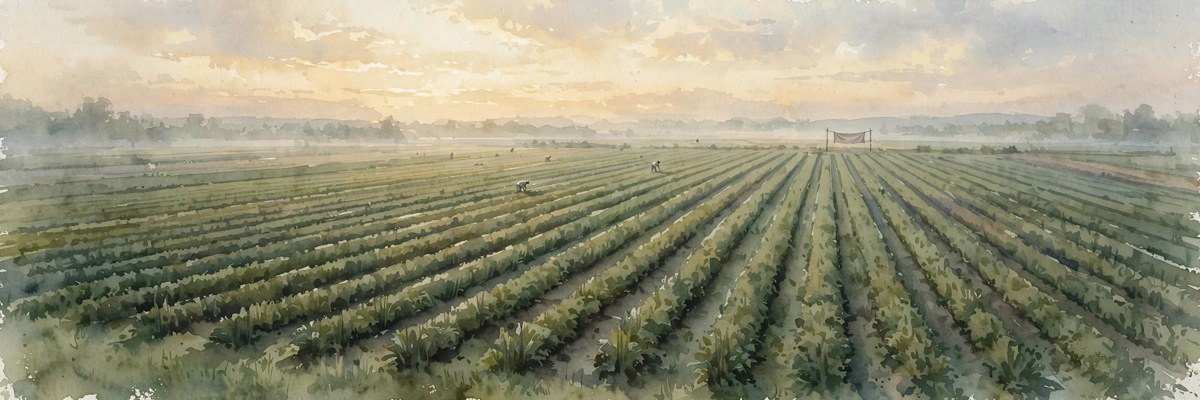
A photograph went around this week. Fieldworkers were picking vegetables on Black Friday morning, in rows, in the cold end of November. The man who posted it wrote that immigration agents had detained workers nearby not long before, and that the people in the photograph worked under that threat every day. He posted it as a conscience prompt. These are the really screwed up systems that support our economy, he wrote, and the rest of us eat because somebody else absorbs the screw.
I answered with the union record. The farmworkers' own movement, in its fighting years, treated the undocumented worker as the grower's weapon and said so in plain language. I was told to integrate my information into a barbaric racist agenda. I asked which part was barbaric: exploiting the illegals, or making farming pay while keeping prices low on the backs of exploited underpaid illegal "scabs." I put the word in quotes. Nobody picked it up. Nobody ever picks it up.
The word is scab. It is the oldest term of contempt the American labor movement owns. Merriam-Webster still prints the senses in order: a worker who refuses to join a union, a union member who works during a strike, a worker who takes a striker's job, a worker who works for less than union wages on nonunion terms. Three of the four are tied to an event, a strike in progress. The fourth is a condition. The fourth is the one the fields were about.
The rat proves the word survived. His name is Scabby. He stands six to twenty-five feet tall depending on the local, an inflatable rat with a fat belly and a snarl, and unions haul him to job sites and park him facing the work. He was born around 1990 in the Chicago suburbs; the bricklayers claim him, Local 150 of the Operating Engineers claims him, and the record honestly cannot settle who inflated him first. What the record settles is his legal standing. In July 2021 the National Labor Relations Board dismissed a complaint against a twelve-foot Scabby and the banners beside him at a neutral employer's trade show, Lippert Components, 371 NLRB No. 8, and let the constitutional question carry the day. The rat is protected speech. He is still inflated, still aimed, still named for the scab. He is aimed at the contractor who hires nonunion and the worker who crosses a picket line. He has never once been inflated in a field.
The movement that named the condition was born fighting imported labor. Ernesto Galarza spent sixteen years as an officer of the National Farm Labor Union documenting the bracero program, the federal pipeline that delivered Mexican contract workers to American growers from 1942 forward, and his Merchants of Labor made the case against it in 1964. The program expired on the last day of 1964. The Delano grape strike began the following September. The strike's enemy, from its first day, was the replacement worker the grower could always summon.
Cesar Chavez's United Farm Workers aimed that fight at the undocumented. In 1969 Chavez marched his members through the Imperial and Coachella valleys to the Mexican border to protest the growers' use of illegal strikebreakers, with the Reverend Ralph Abernathy and Senator Walter Mondale at his side. Union members were directed to report undocumented workers to the Immigration and Naturalization Service. By the mid-1970s the union ran a Campaign Against Illegals, and its petition said why, in words Frank Bardacke preserved: "these illegals are breaking farm worker strikes, displacing farm workers from the jobs in the U.S. and depressing agricultural wages." The union's newspaper, El Malcriado, ran the campaign in cartoons.
In 1973, near Yuma, the union kept a "wet line" on the border. Some three hundred members under Chavez's cousin Manuel tried to stop undocumented workers from crossing to break a lemon strike, and the union's own historians record reports of immigrants threatened, beaten, and robbed along it. In 1979 Chavez went to the National Press Club and named the contractors, the farms, and an Oxnard hotel with room numbers where thirty undocumented strikebreakers were housed. Then he testified before the Senate that the growers and the INS were in it together.
The frame held two halves at once, and both halves were the same argument. The UFW opposed employer sanctions in 1973, on the stated ground that growers would use them to bust unions. Chavez backed the amnesty in the 1986 immigration law that legalized some three million people, while that same law made it a federal offense to hire the next man without papers. Yesterday's strikebreaker, legalized, became a member. Tomorrow's stayed a weapon. The line the movement drew was not blood and it was not language. It was the wage.
The house of labor held the line for a generation, then voted to drop it. The AFL-CIO had strongly backed the employer sanctions in the 1986 law. In February 2000 its Executive Council met in New Orleans and reversed itself completely, unanimously: amnesty for some six million undocumented immigrants, repeal of the sanctions it had once demanded. The federation that had treated the undocumented worker as the employer's instrument now treated enforcement itself as the instrument. The word went out of the vocabulary in the same motion.
One man kept the old sentence and said it on camera. In July 2015 Bernie Sanders sat with Ezra Klein of Vox and was asked about open borders. "Open borders? No, that's a Koch brothers proposal," he said. "It would make everybody in America poorer—you're doing away with the concept of a nation state, and I don't think there's any country in the world that believes in that." Then the wage, stated as a wage: "What right-wing people in this country would love is an open-border policy. Bring in all kinds of people, work for $2 or $3 an hour, that would be great for them. I don't believe in that. I think we have to raise wages in this country." Sanders is not a restrictionist in the law-and-order mold. He is a socialist making the UFW's argument in the UFW's terms, and he makes it alone.
The organized left he might have led prints the opposite. The Democratic Socialists of America publish a program called Workers Deserve More. Under the heading "Abolish ICE" it reads: "End ICE detention and deportations and punish federal agents' brutality. Legalize migration, grant amnesty for all immigrants regardless of status, provide a path to citizenship for all permanent residents, and end visa caps and quotas." The same program carries the labor planks, the union drives, the wage demands. Both documents are on the same page. The contradiction the farmworkers resolved with a word is carried there without one.
An undocumented worker can be a dues-paying union member, and the machinery for it is ordinary. The National Labor Relations Act covers employees regardless of immigration status; the Board's own one-pager says undocumented workers are employees under the Act, protected when they organize, with status raised, if at all, only when a remedy is figured. Hoffman Plastic Compounds in 2002 took backpay and reinstatement off the table for a worker fired for organizing on false documents. It did not take away the coverage. The paperwork duty sits elsewhere: since 1986 the Form I-9 obligation has been the employer's, not the union's. A union does not verify status and does not cross-check Social Security numbers. A man hired at a union shop on mismatched documents is covered by the contract, joins, pays dues, and is owed representation like any other hand. The duty of fair representation obliges the union to represent every worker in the bargaining unit, member or not, and breaching it is an unfair labor practice. No statute ever assigned the union a checkpoint. In the 2023 Los Angeles hotel contracts, UNITE HERE Local 11 bargained the checkpoint out of the building: the agreements bar the hotels from using E-Verify in hiring. The false documents remain the worker's own federal exposure. Everything else about him is a member in good standing.
Now ask how many. The Bureau of Labor Statistics counted 14.7 million union members in 2025, a membership rate of 10.0 percent. Its survey asks a worker whether he belongs to a union. It does not ask whether he is in the country legally, and the Labor Board does not ask status in an election or an investigation. The count of undocumented members does not exist, and it does not exist by design on every side. The ceiling is known. The Center for Economic and Policy Research, working the same survey, counts over 2.1 million foreign-born members in the 14.7 million—and foreign-born means mostly citizens and legal residents. Run the widest arithmetic the accusers own: Pew counts some 8.3 million unauthorized workers, and if they joined at the national rate of one in ten they would make some 830,000 members, 5.6 percent of the total. The honest figure is argued lower, because unauthorized workers cluster in the least unionized industries in the economy and are shut out of the public sector where the density lives. The Center for Immigration Studies, which wants the workforce gone, estimates that some 75 percent of working-age unauthorized immigrants use fraudulent Social Security cards to obtain employment. Even CIS publishes no percentage of union members. Nobody does. Both armies stop at the same wall.
What exists instead is a ledger. When a W-2 arrives at the Social Security Administration with a name and a number that do not match, the wages cannot be credited to anyone, so they are filed in the Earnings Suspense File. The Inspector General reported in January 2026 that the file had accumulated over $2.4 trillion in wages across more than 424 million wage items, tax years 1937 through 2024. Some of that is clerical error and married names. The government's own investigators have long treated unauthorized work as a primary driver of its growth. The money is counted to the dollar. The people are not counted at all.
The right will not say the word either, and its reasons are the mirror of the left's. Scab is labor's word. To call the undocumented worker a scab is to concede that the injury is a wage injury, that a union is the injured party, and that the remedy runs through solidarity—which is why the word stays in the rat and out of the speeches. The restrictionist case is built on law and on culture: the border crossed, the statute broken, the country changed. And the hirers sit inside the restrictionist coalition, in the grower associations and the contractor lobbies, exactly where they sat in 1973. A vocabulary that indicts the man who hires the strikebreaker is no use to a coalition that contains him.
The left dropped the word when its champion became unusable. In March 2026 the New York Times published an investigation carrying allegations that Cesar Chavez raped and sexually assaulted women and girls, including girls underage, and Dolores Huerta, the movement's other founder, said in her own statement that she had been pressured in one encounter with Chavez and forced in another. The UFW announced on March 17 that it would skip the Cesar Chavez Day activities that year. In Fresno, the councilman who had co-sponsored renaming a boulevard for Chavez two years earlier introduced an ordinance to take the name down; the county moved to rename the holiday; Fresno State covered its statue while it decided whether the statue stays. I print these as allegations, dated and attributed, because that is what the record holds. What the record also holds is the effect: the man whose name carried the wage argument now arrives with an asterisk, and a movement does not revive a frame whose saint it is busy un-naming.
So the debate runs on the two registers left to it, law and pity. The right counts statutes and crossings. The left counts detentions and cruelties. The fork was named twenty years ago by Vernon Briggs, the Cornell labor economist, testifying before Congress in 2007: press restriction and enforcement, and labor alienates the immigrant workers it still has to organize; go permissive, and the growing supply undercuts the members it already has. "The fundamental issue for labor has never been a question of whether unions should organize immigrants," Briggs wrote. "Of course they must, as they have always done." Labor chose the second horn of the fork and paid for the choice with the word. The wage argument—the one argument that was once the left's own, made by its own saints, in its own fields—is now spoken by an old socialist in a 2015 interview and by nobody else.
A word does not disappear because it stops being accurate. It disappears when every army that might speak it finds the speaking too expensive. The rat still inflates over the nonunion job site, aimed at the one undercutter it is still permitted to name. The field at dawn, the rows, the bent backs, the men and women working a wage set by the threat over their heads—that picture makes its rounds every season, and every season the word that fits it sits in the dictionary, fourth sense down, waiting for somebody willing to pay what it costs to say it.
Share: X · Facebook · LinkedIn · Reddit · Bluesky · Threads · Email