
You Can't Sell Pathetic If You Allow Agency
Share: X · Facebook · LinkedIn · Reddit · Bluesky · Threads · Email
There are two immigrants in American public life and they have never met. The first one lives in the speeches. He arrives as weather: a mass, a wave, a flood of the tired and the poor, voiceless, bedraggled, incapable of a sentence in his own defense, waiting to be spoken for by the people who found him. The second one lives in the ledger. He read the rules of the richest country on earth more carefully than the people who wrote them, found the seam, crossed an ocean or a desert to stand in it, works ten prime years at wages his hometown cannot imagine, wires the surplus home, and changes his family's position for three generations. The first immigrant is the one you are allowed to see. The second one is the one who is actually there.
The casting was done early and it was done in verse. Emma Lazarus wrote the poem that sits inside the Statue of Liberty in 1883—your tired, your poor, your huddled masses, the wretched refuse of your teeming shore—and America has been casting from it ever since. Read it as what it functionally is: not a welcome but a specification. The immigrant of the poem has no skills, no plan, no past worth mentioning and no arithmetic. He is refuse that breathes. Every speech since has cast to that spec, because the spec is the product. A man with a plan cannot be marched for. A mass can.
None of which means pathetic doesn't sell. Pathetic sells beautifully; it is the best-selling product in the economy of causes. The claim is about the condition, not the market: the sale only clears while the man in the photograph has no plan of his own. Give him one and the beneficiary becomes a counterparty—and nobody marches for a counterparty. You negotiate with him. You pay him full price.
The arbitrageur
Nobody writes poems about the kid on the Alaskan king crab boat. He signs on for the season, takes the brutal wages, risks the deck, sends the money home, and gets off the boat with his stake. Everybody understands him instantly: he is doing math. The same understanding covers the offshore rig hand, the cruise-ship entertainer working a summer of other people's vacations, the private security contractor who leaves his wife at home and earns a soldier's decade of pay in a year of guarding somebody else's war. Seasonal labor arbitrage is one of the oldest and most honorable plays in the workingman's book: go where the wage is absurd, endure what the locals won't, convert the gap into a family's future.
The migrant is running the identical play, and the receipts are public. Migrants sent $685 billion home to low- and middle-income countries in 2024, by the World Bank's count—more than all foreign direct investment and all foreign aid to those countries combined. Mexico alone took in some $68 billion of it. That is the largest person-to-person transfer of wealth on earth, and it is run, wire by wire, by the population the speeches describe as too helpless to tie its shoes. Helplessness does not move $685 billion. Planning does. The man who games an asylum backlog into ten years of American wages—say the words the system taught him, file the claim the system's own lawyers would file, work the decade, remit the difference—is not a failure of the system to keep out the incapable. He is one of the system's better students, and the system's defenders cannot afford to say so, because a student has a mind, and a mind is the one thing the casting forbids.
Not everybody, and not only them
Let me say the qualifier in full, because the argument does not need it softened and I am not interested in the cheap version. I am not saying everybody came to exploit the system. I am saying exploitation happens—predictably, at the margins of any arrangement that runs on assumed good intent and no verification—and that citizens exploit the same unguarded arrangements with the same enthusiasm. When Washington opened pandemic relief on the honor system, Americans looted it wholesale, from inside, with Social Security numbers that matched. Unguarded trust pays out to whoever stands near it. That is a fact about systems, not about passports.
And notice why the guardrails never get built. To verify a claim is to admit the claimant might be lying, and to admit he might be lying is to admit he is an adult with a strategy—which is agency, the forbidden input, conceded at the level of policy. So the honor system survives every audit and every scandal, defended by the same people who would never run a lemonade stand on it. Discernment is treated as cruelty because discernment is the casting's solvent. Assume universal good intent and the mass stays a mass. Check one claim and a man steps out of it.
The practice lines
There is a recitation that answers all of this, and you have heard it so often you can mouth along. You can't say they're exploiting. You can't say they're gaming. You can't say they're reading from a script somebody coached. You can't say they're lying about being oppressed, or lying about going home, where the gangs will kill every single one of them, where they are all true refugees from countries that are—somehow, on the facing page of the same brochure—tourist destinations for everybody else. Each line is delivered as a rebuttal. Watch what it rebuts: the word everybody, which nobody at this table said. The lines survive by converting a distribution—some do, most don't, and citizens do it too—into a universal, condemning the universal, and declaring the subject closed. It is not an argument. It is a fence, and every plank in the fence is the same plank: each forbidden sentence is an agency sentence. He read from a script means he prepared, the most adult act a man can perform on his own behalf. He would survive going home means he has options. She is gaming the system means she has a plan. You can't sell pathetic if you allow agency, so agency is what the lines are there to confiscate.
The tourist-country paradox is where the fence meets arithmetic and loses. Danger is real, and it is local; it has addresses. The script requires it to be uniform, total and fatal on contact, in the same nation whose resorts run occupancy ads in February. Both brochures are printed from the same map. You are permitted to read one of them aloud.
I speak for the trees
The Lorax said it as a children's book: I speak for the trees, for the trees have no tongues. The format adopted it as an operating principle. The saving professions run on a surplus that nobody puts on a poster: there are far more people who want to help than there are people who need help, which means causes do not compete for beneficiaries. They compete for patrons. The patron is purchasing a relationship, and the relationship has terms—she is needed, they are needy, permanently, in that order—and the purchase requires the needy to hold still inside it. This is why the posture is condescending all the way down, no matter how warm the voice it arrives in. I have the power, the might, the wealth, the microphone. I will save the whales, because the whales cannot save themselves. I will save the vulnerable, because the vulnerable cannot speak. It is not cruelty. It is worse than cruelty, because it is sincere.
And it explains the fury that arrives the moment the saved person talks. He is never answered; he is reclassified. The man who says I am not your victim, I don't need saving, I have a plan gets diagnosed on the spot—internalized oppression, false consciousness, bought, unrepresentative, a man who doesn't even know he is oppressed. His denial becomes the proof. There is no sentence he can pronounce that the format cannot metabolize into a reason to keep marching on his behalf, because his testimony is inadmissible in his own case by the rule of the casting itself. One genre of speech is permitted to him: testimony. Pain, gratitude, uplift, three minutes, at the microphone the production company provided. What he may not deliver is the sentence that ends the arrangement: we're grown-ass adults, and we've got this.
Half the market wage
Now bring it home to my own zip code, where the casting does its grocery shopping. The crews who drywall and frame in Northern Virginia will do the work at half the market wage—half, not of the legal minimum, of the going rate—and the transaction is the arbitrage and the discount as a single fact read from two ends. From his end, half the American market wage remitted home beats his family's whole income; the plan clears at criminal prices, which tells you how wide the gap he is arbitraging really is. From the buyer's end, the house gets built at half price. And there is a third man at the table, the one who pays for both ends: the American drywaller whose wage just got halved, who is then lectured about compassion by the people who pocketed his half. The compassion is genuine. It was financed by somebody else's paycheck.
My liberal friends in Arlington deliver the companion monologue, and they cannot hear it. Who's going to clean my house? Rosetta loves cleaning my toilets—she's so happy, so grateful, she does it so well, no Americans want to do this work, and they just weren't around last winter, because of Trump. Listen to what the monologue requires of Rosetta. She may not merely do the work, the way the crab-boat kid does his, for the money, with a plan, counting seasons. She has to love it. The gratitude is not an observation; it is a receipt the buyer writes herself, because the alternative reading of the same kitchen is unbearable at an Arlington dinner party: I found a woman whose options are narrow enough that my toilets at half price are the best offer in her hemisphere, and I experience her necessity as devotion to me. Last winter supplied the audit. When the crews vanished, the grief in my neighborhood was not for the crews—nobody's monologue ran I hope she's safe, I hope her family ate. The grief was for the driveway. The snow sat there unshoveled, and the sorrow was a service interruption, which tells you that in the whole heartwarming arrangement Rosetta was never the person. She was the amenity.
Putting your foot in your mouth
The monologue has a public transcript. It runs for twenty years, across both parties, and it is always the same sentence with the caste rotated. Here it is in full, because this record survives by being excerpted, and excerpting ends here.
George W. Bush, State of the Union 2005 and the presidential radio address, March 25, 2006. The respectable form, from the White House archives: a temporary worker program to "match willing foreign workers with willing American employers to fill jobs that Americans will not do." A Republican president, proposing to staff the servant tier by statute, in the dialect both parties have spoken ever since.
Alex Sink, congressional candidate, forum in Clearwater, Florida, February 25, 2014. Making the case for reform to the beach employers: "We have a lot of employers over on the beaches that rely upon workers... where are you going to get people to work to clean our hotel rooms or do our landscaping?" Her opponent called it disgusting the same week. She lost the special election three weeks later.
Barack Obama, address to the nation, November 20, 2014. The dignity speech, the most elevated version ever delivered: "Are we a nation that tolerates the hypocrisy of a system where workers who pick our fruit and make our beds never have a chance to get right with the law?" Even at its most humane, the defense of the immigrant ran through the fruit and the beds. The man was defended as a pair of hands.
Kelly Osbourne, The View, August 4, 2015. "If you kick every Latino out of this country, then who is going to be cleaning your toilet, Donald Trump?" The audience gasped on live television; she apologized the same day; she remains the only speaker on this list who ever had to. Her offense was not the thought. Her offense was failing to use the dialect's euphemisms. She said in the vernacular what presidents say in policy.
Nancy Pelosi, press conference, September 30, 2022. Two weeks after the Martha's Vineyard flights, the Speaker of the House closed her case for reform by relaying the growers' complaint: "We have a shortage of workers in our country, and you see even in Florida, some of the farmers and the growers saying: 'Why are you shipping these immigrants up north? We need them to pick the crops down here.'" She attributed it to the farmers. She chose it as the note to end on.
Jerry Nadler, House Judiciary immigration subcommittee, January 11, 2024. "We need immigrants in this country. Our vegetables would rot in the ground if they weren't being picked by many immigrants—many illegal immigrants!" The United Farm Workers carried the line on its own website as a highlight, which is the detail that matters: inside that world this is not a gaffe. It is a boast.
Jasmine Crockett, Grace Baptist Church, Waterbury, Connecticut, April 7, 2025. The mirror image, and the most candid of the set: "Ain't none of y'all trying to go and farm right now... We done picking cotton. We are. You can't pay us enough to find a plantation." One caste announces its graduation from the fields and orders the next caste imported to replace it, from a pulpit, to applause.
Brooke Rollins, Secretary of Agriculture, July 8, 2025. The counter-casting, so nobody mistakes this for one party's disease. Asked who replaces the deported farmworkers, she answered: no amnesty, automation, and "there are 34 million able-bodied adults in our Medicaid program. There are plenty of workers in America." Both parties agree the crops require a designated population that cannot refuse. They campaign on which population gets designated.
Read the eight top to bottom and notice what never changes. Not the sentence. The sentence is load-bearing American infrastructure, older than anyone on the list. Only the caste rotates, and the rotation is the whole history of the country told in one line of dialogue.
The supply
It kind of makes me think that America never really got over its need for slaves. No—the correction matters, so make it: America never really got over its supply of slaves. A need is an appetite, and appetites can be shamed, sermonized, outgrown. A supply is infrastructure. For four centuries this economy has organized its fields, its kitchens, its building sites and its nurseries around a standing supply of people who cannot say no at full price, and when one supply closed, the sentence went looking for the next one. Slavery. Sharecropping. Convict leasing. Then the one era honest enough to put the arrangement in writing: the Bracero Program, 1942 to 1964, 4.6 million contracts, two governments agreeing in plain language to import prime-age men for seasons of labor and ship them home. The braceros at least had a contract that admitted what they were.
The economists saw the ledger first. Adam Smith, in The Wealth of Nations in 1776, ran the owner's own arithmetic: purchase price, food, housing, clothing, care in sickness and old age, the whole maintenance of a human asset across a whole life—and concluded that "the work done by slaves, though it appears to cost only their maintenance, is in the end the dearest of any." Smith expected the cost to kill the institution. He even named the force that would preserve it—he wrote that the pride of man makes him love to domineer—and the planters proved him right about the pride and wrong about the cost, because cotton paid.
The planters' own theorist answered Smith from the other side, and his answer is the Rosetta monologue in a frock coat. George Fitzhugh, in Cannibals All! Or, Slaves Without Masters (1857), argued that slavery was the humane system precisely because the master owned his workers and therefore maintained them, while the Northern capitalist merely rented his and discarded them at the first injury. The negro slaves of the South, Fitzhugh wrote, were "the happiest, and, in some sense, the freest people in the world"—fed, housed, and relieved of care. She loves cleaning my toilets. She is so happy. She is so grateful. It is the same testimony, 170 years apart, offered by the beneficiary of the arrangement about the feelings of the arranged. And then Fitzhugh, trying to damn the wage system, accidentally described the future with a surveyor's precision: "You, with the command over labor which your capital gives you, are a slave owner—a master, without the obligations of a master. They who work for you, who create your income, are slaves, without the rights of slaves. Slaves without a master!" He meant it as the North's indictment. It reads now as the blueprint.
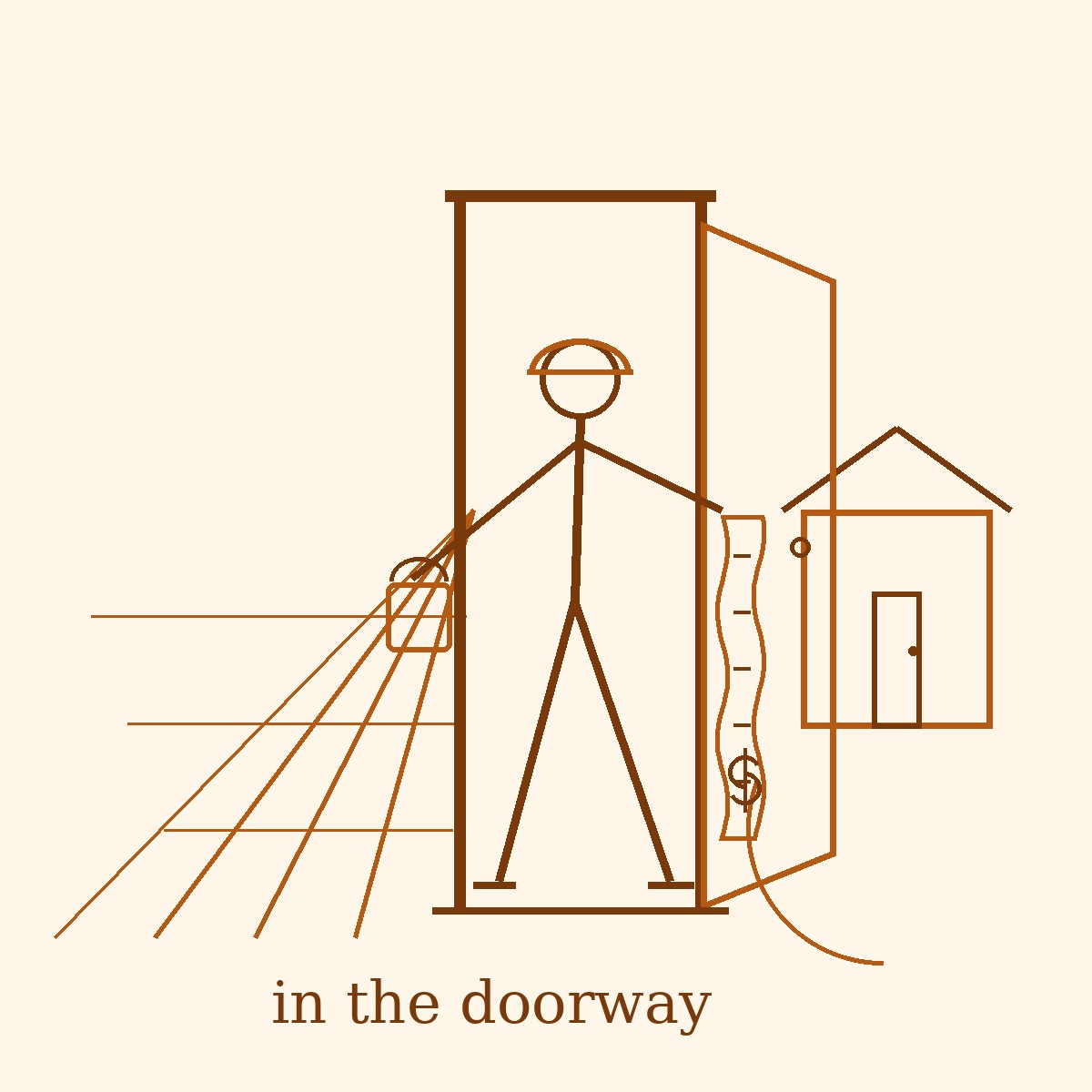
Because the liminal worker is that blueprint, built. With this supply you do not feed them, house them, care for them or discipline them, and you do not owe them rights either, because they live in a liminal space—present enough to hire, absent enough to remove. The asset is off the books. His home country paid for his childhood and his schooling; his family will absorb his injuries and his old age; America purchases the ten prime years in the middle and imports nothing before or after them. Discipline, which once required overseers and patrols, is now free and self-administered: deportability does it, carried in the worker's own head, a foreman he pays for himself. Fitzhugh's wage slave at least lived in a country whose laws acknowledged he existed. The liminal man works in the doorway between two rooms, a man fully inside the law on neither side of it, and the doorway is not an accident of the architecture. The doorway is where the discount lives.
That is the whole machine, and it runs on one fuel: a person who cannot be allowed a plan. The speeches need the mass, so the mass is what gets described. The patrons need the voiceless, so the voice gets reclassified. The prices need the liminal, so the doorway never gets a door. The ledger, meanwhile, keeps its own record—$685 billion of it, wired home by grown adults running the oldest play in the workingman's book—and the ledger does not care what the speeches call them.
You can't sell pathetic if you allow agency. And you can't keep the supply either.
Disclosure: the two book links above carry my Amazon Associates tag (gerris-20), and as an Amazon Associate I earn from qualifying purchases. Fitzhugh argued that the man who profits from labor he does not maintain is a master without obligations. My few cents per book are, on his definition, exactly that—which is more confession than most affiliate disclosures manage.
Share: X · Facebook · LinkedIn · Reddit · Bluesky · Threads · Email