
You Don't Have to Be Homeless in DC
This article, read aloud:
Share: X · Facebook · LinkedIn · Reddit · Bluesky · Threads · Email
Jacob Ward is standing under a streetlight a few blocks from the White House, doing the grief face for TikTok. Ward is not a tourist to the work: he ran Popular Science, spent five years as Al Jazeera's technology correspondent, six more at NBC News, wrote a good book about how technology strips our choices, and now runs his own outfit, The Rip Current, filming street interviews about housing and recovery under the hashtag #ripcurrent. He is also, by his own public account, a recovering drinker who calls himself a prototypical addict in the making. Which is why the pity in his voice lands wrong with me, and why I want to argue with him as one man to another rather than dismiss him. How dare this reporter pity the homeless.
Pity is the one emotion that requires its object to be helpless. You cannot pity a strategist. You cannot pity a negotiator, or a man running curfew arithmetic with his dinner still warm in him. I know those men. For ten years I worked at Miriam's Kitchen in Foggy Bottom, two blocks from the State Department, most of it cooking, and I will tell you what the dining hall taught me: agency means the choice is real, which means it can be spent badly. Shelters, kitchens, and subsidized housing are strict: curfews, sobriety, lights out, intake by a fixed hour. At Miriam's Kitchen our guests ate fast and crossed town early—not because they were rushed, but because they had a favorite shelter and meant to make its door in time. A man outside at 1 a.m. is not always a man the system failed. He is a man who declined its terms. Curfew is the price; agency is deciding not to pay it tonight.
Let me give you the numbers, because I owe you better than the one I invented in Ward's comment section, where I announced there were eighty social workers for every homeless person in DC. I made that up, and the truth is more interesting anyway. Washington has more tax-exempt nonprofits per capita than any state in America; nonprofits employ a quarter of its private workforce; and it pays its social and community-service workers more than anywhere else in the country. In the February 2026 count, 5,363 people were homeless in the District—and 87 percent of them were sheltered, against roughly 60 percent nationally. DC has the highest homelessness rate of any state, 73 people per 10,000 residents, and simultaneously the most complete apparatus in America for not sleeping outside. A third of the single adults in its system arrived from Maryland and Virginia, where the offer doesn't exist. They migrate toward the services, and then they choose, nightly, whether to use them.
I put the question to the machine itself—how many Americans live outside by choice—and it did what institutions do: first it refused the premise. There is no official data, it said; homelessness is not a choice; the causes are structural. Pressed, it produced its own table, and the table is my whole argument wearing a lab coat: theft and safety, rules and curfews, filth and disease, belongings and pets, paranoia and distrust. And two numbers that sit side by side without any embarrassment at all: up to 90 percent of the unsheltered say they want permanent housing, and 60 to 65 percent of shelter offers are declined. Both. At the same time. By the same people. Housing, yes. Terms, no. The count cannot see a choice because the count was never built to; it tallies bodies on a night in January. But a declined offer is a datum too, if you're willing to read it as one.
And here is the part my own side gets wrong, so let me correct it before Ward's side does. The classic price of the DC bed—sobriety, ID, compliance—has largely been repealed by the city itself. DC's front door is low-barrier shelter: no identification required, no sobriety demanded, open around the clock, all year, and backed by a legal right to shelter whenever the wind chill falls below freezing. The strict world survives one rung up, in the transitional programs and the faith-based houses with their curfews and their programming, and it survives in the schedule itself: breakfast is 6:30 to 8, dinner is 4:45 to 6, and a man who wants both, and a particular bed across town, has had his day organized for him as surely as any rule could do it. So the price of the bed in 2026 is not obedience. It is autonomy: the dorm, the theft, the lights, the loss of your spot, your partner, your dog, your stuff. Which makes the refusal more honest, not less. A man declining a rule is a rebel. A man declining a trade—his freedom for their mattress, eyes open, in January—is something else. He is a customer who read the contract.
The proof that the refusal is of terms and not of roofs is that when the terms come off, the refusal mostly evaporates. Pathways to Housing was founded in this city in 2004 on exactly that heresy: the rules-first agencies—curfews, mandated sobriety, medication compliance—kept the most disabled people on the street permanently, so Pathways offered the apartment first and asked for almost nothing, a share of income and two meetings a month, and it has ended chronic homelessness for hundreds of DC residents since. In Seattle, outreach workers found the most common reason a man refused a shelter bed was that he was holding out for a tiny home—a private box with a locking door—and when the tiny homes are offered, acceptance skyrockets. Understand what that means: the man's agency was so real it could be bought out for the price of a door lock. He was never refusing shelter. He was refusing to be processed. And the fraction who decline even the unlocked door, even the key with no contract behind it—that fraction is the hard core this essay is actually about, and everything the city and then the federal government threw at the problem has failed to make it zero, because it is not a housing statistic. It is a position.
I should know. Google thinks I signed it from the other side. Ask the world's largest answer engine what Chris says about homelessness and Miriam's Kitchen, and it will tell you, at length and with total confidence, about a man named Christopher Hines: unhoused in DC for twenty years after both his parents died suddenly, his days spent writing at the MLK Library, prison in his past, housed at last in 2025 in Adams Morgan with his wife, who was expecting their first child. Mr. Hines is real, and his story, told by District Bridges, deserves better than to be worn by me. I am the other Chris. I grew up in Hawaii; he says, in the line Google keeps handing me as mine, "I can't travel, I can't go to Hawaii, you know, I can't escape what I see every day." I escaped Hawaii at six and have the resentment to prove it. He cooked nothing at Miriam's Kitchen; I cooked there for a decade. The machine merged us because we share a first name and a dining hall, and then it decorated him with phrases from my own questions—social workers like bees on flowers, asset inventories—that appear in no story ever published about him. Remember that the next time an AI summarizes a man for you. But here is why Mr. Hines belongs in this essay and not just in a correction: after twenty years outside, the space he now wants to build for homeless artists runs on, in his own words, "a nice behavior contract, no drugs, no playing around, and you have to have something to do." The man who lived it longest does not dream of a fold without terms. He dreams of terms he'd sign. Everyone has a price; his is a contract he wrote himself.
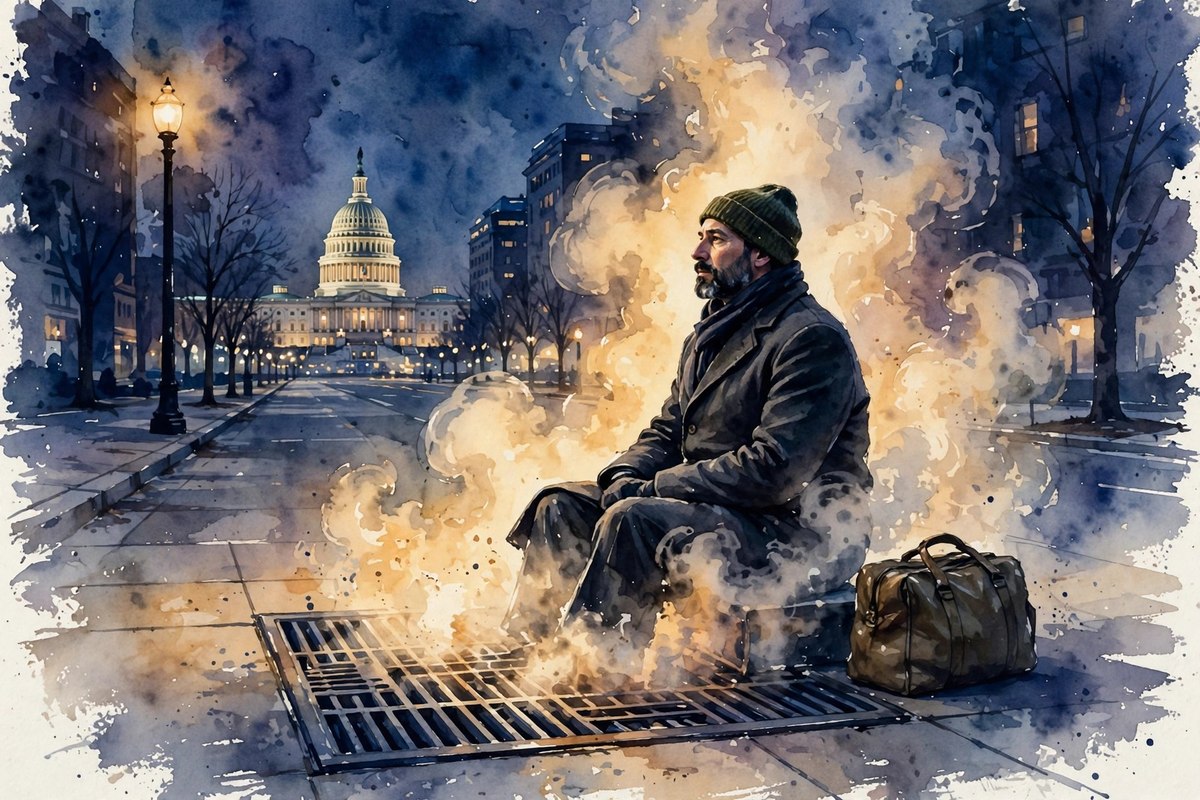
The old Washington understood the transaction and policed the optics. In the early 1980s the visible face of DC homelessness was people sleeping on the steam grates near the White House and the State Department, and Mitch Snyder of the Community for Creative Non-Violence turned those grates into a national argument: a tent city called Reaganville in Lafayette Park, fasts that ended with a president promising money, and, on November 6, 1984, Initiative 17—passed with 72 percent of the vote, the first time voters anywhere in America created a legal right to shelter. The city spent six years in court, a judge called its shelters virtual hell-holes, and in 1990 the Council gutted the right rather than fund it. Snyder died that July, in a room at the shelter he had forced into being. I will not claim the police disappeared people for the tourists in those years, because I can't prove it, and on this subject I have decided to be careful. What I can prove is the modern sequel. On March 5, 2025, the President posted that the Mayor "must clean up all of the unsightly homeless encampments," specifically the ones outside the State Department, and two days later the camp near the E Street Expressway—on the same federal-core ground as the grates—was cleared ahead of the city's own schedule. In August came the emergency declaration, the federalized police, the National Guard swelling from 800 troops to more than 4,600, bulldozers on Constitution Avenue, and a press secretary explaining that residents would be offered shelter or services and that those who refused could face fines or jail time. Roughly forty sites were cleared in the first weeks, by the District's own housing agency's records; the White House claimed more and never produced its lists. No promised federal places to stay ever materialized. Two months later the reporting found the cleared men exactly where you'd expect: still outside, minus their tents. In February 2026 the total count of DC homeless had risen 4.4 percent, and the unsheltered count had fallen by about a tenth, an estimate modeled rather than counted, because the city kept clearing camps all year—one site by the MLK Library eleven times in 2025 alone—because the camps kept coming back.
Sit with that. The full faith and credit of the United States, its Guard, its bulldozers, and its jail cells were brought to bear on the proposition that these people must come in from the cold, and the proposition lost. Not because the beds weren't there—87 percent of their neighbors took one—but because the remaining fraction ran the oldest arithmetic in the republic and declined. This is the dynamic tension I actually live in, and it is not a comfortable one: the sadness of it, genuinely; and our Puritan inheritance that says structure is a form of love; and the fact that the rules also keep women and children safe behind the shelter door; and the scarcity underneath, because there is not enough inventory and terms are how a short supply is rationed; and the hard observation that what a person is simply given, he often does not respect—that DC is full of kept apartments used as storage lockers by men who still sleep outside; and the veterans whose distrust of the men in charge was not paranoia but experience, earned at full price; and the women who will not enter a shelter because their things were stolen the last time, and whose stories about the street would curdle your blood, and who have decided that a known danger they control beats a promised safety they don't. You can lead a horse to water. The horse has his reasons. Some of them are receipts.
So paint them properly, Ward, or don't paint them at all: not as a grief exhibit under a streetlight, but with freedom and liberty and power and choice and agency and control and responsibility, and with addiction and the pursuit of pleasure and plain libertinism and the decisions they remake every single day, while an army of the best-paid social workers in America stands at the gate of the fold, desperate to bring them in. Because being homeless in Washington, DC, where persistence genuinely would get you fed, bedded, case-managed, and halfway housed, where the government of the most powerful nation on Earth eventually sent soldiers to insist—is the ultimate fuck you. Not a man who failed to reach the ladder. A man who read the terms, all of them, including the ones written by men with guns, and chose the bridge. He pays for it in cold and hunger, nightly, in full. That is not a man without a price. That is a man who knows his.
Share: X · Facebook · LinkedIn · Reddit · Bluesky · Threads · Email