
You Have to Want the Ground
This article, read aloud:
Share: X · Facebook · LinkedIn · Reddit · Bluesky · Threads · Email
Bartleby cannot die in 2026.
Melville published "Bartleby, the Scrivener" in 1853. A Wall Street copyist stops working, declines all help, and starves against a prison yard wall. Run the same man through America today and the story jams. Caseworkers arrive. Courts convene. A shelter bed waits by right. A hospital hold interrupts the fast. The country the world calls heartless has built a machine against exactly this death. A man can still reach the ground in 2026. He has to refuse each net on the way down, one by one. Wanting the ground is now the only road left to it.
The story, as Melville left it
The narrator is a lawyer with chambers on Wall Street, doing a safe business in bonds and title deeds. His copying clerks are Turkey and Nippers. Turkey, near sixty, works beautifully in the morning and returns from his noon beer flushed and blotting documents. Nippers, twenty-five and ambitious, works the opposite shift: sour before noon, steady by afternoon. A boy called Ginger Nut runs errands and fetches the cakes that give him his name.
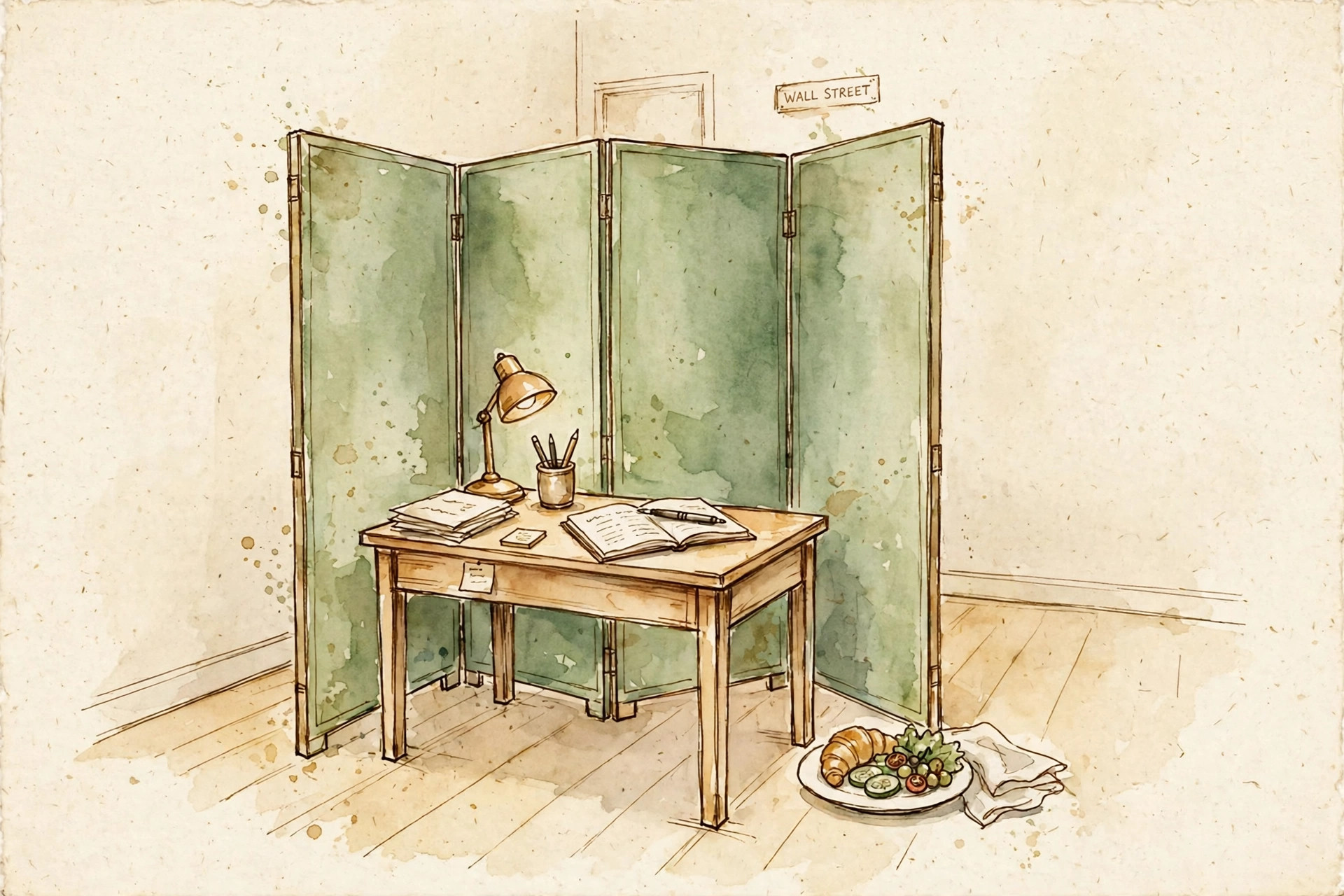
Business grows; a third copyist arrives. Bartleby: pale, neat, forlorn, copying day and night at first, silent and mechanical. On the third day the lawyer asks him to help examine copies against the original. Bartleby answers, "I would prefer not to." He says it mildly, and he says it to everything after. He will examine nothing. He will carry nothing to the post office. In time he stops copying altogether and stands at his window facing the dead brick wall a few feet outside. His desk sits behind a green folding screen, so his stillness can have privacy.
On a Sunday morning, on his way to church, the lawyer finds his key resisted in the lock. Bartleby opens the door in his shirtsleeves and asks him to walk around the block. The lawyer walks, returns, and reads the room. A blanket. A basin. Crumbs of ginger-nuts and cheese. A knotted handkerchief holding the man's savings. Bartleby has been living in the office, sleeping at his desk, eating almost nothing. The lawyer presses money on him and begs him to leave, then offers a place in his own house. Bartleby prefers not to. He prefers, he says, to be stationary.
The lawyer endures the haunting for a season, then moves his chambers and leaves Bartleby in possession of the empty rooms. The new tenant complains. The landlord demands. Strangers lay the only hands Bartleby ever receives: the police take him as a vagrant to the Tombs. The lawyer follows, finds him standing in the yard with his face to the wall, and pays the grub-man for the best dinners available. Bartleby tells the man, "I prefer not to dine today," and turns back to the wall. Days later the lawyer returns and finds him huddled at the base of that wall, knees drawn up, his head against the cold stones, dead of his own refusal. Afterward comes the rumor: Bartleby had clerked in the Dead Letter Office in Washington, handling letters that never reached the living, until an administration change removed him and the letters burned by the cartload. The story ends on the lawyer's cry: "Ah Bartleby! Ah humanity!"
The audit: every beat, intercepted
Begin with the copying strike. A clerk who stops working in 2026 enters a process built to diagnose him first. Human resources opens a file. The employee assistance program calls. The lawyer's bewildered kindness has become a sequence that runs whether the supervisor feels kind or not.
The sleeping in the office fails next. Building security finds the blanket within a week, and the find triggers a referral as reliably as a trespass warning. A man discovered living at his desk meets outreach workers whose job is that man, and he meets them again the next week. The file stays open.
The arrest fails hardest. The vagrancy charge that carried Bartleby to the Tombs has been dead law for half a century. New York carries the Callahan consent decree of 1981: the city owes a shelter bed to any man who asks. The state mental hygiene law adds the medical door. A man who cannot feed himself, whose self-neglect has become dangerous, can be taken to a hospital on a physician's certification, held, treated, and brought before a judge, with a lawyer provided by the state that holds him. Kendra's Law adds court-ordered treatment in the community for men whose refusals keep landing them in crisis.
The death itself fails last. Custody in 2026 carries a duty of care enforced by courts, cameras, and lawsuits. Intake means medical screening. A prisoner who refuses food becomes a medical case: checks, psychiatric review, a judge informed. The state that locks a man up owns his survival while it holds him. Bartleby died in a prison where feeding a man was a courtesy his friend could purchase. The modern jail feeds him as a legal obligation it cannot decline.
The net I used to measure
In my teens and twenties I argued against the safety net on a measurement. The net hung too low, I said, strung so close above the concrete that a falling man hit it at killing speed and died anyway, with net marks on him. Thirty years on, the measurement has changed. The net hangs high now, above the concrete, and a falling man is caught at a height where the fall has spent its force. He lands alive, annoyed, entangled, alive. My whole argument was about a distance, and the distance closed while I repeated it.
I spent ten years as a sous chef at Miriam's Kitchen in Washington, feeding men and women who had fallen every distance. The kitchen's house rule states the modern settlement in one line: everyone is allowed to leave the meal and sleep in the rough. The food is unconditional. The leaving is permitted. Between those two facts stands the whole architecture: nets strung by law above, a door left open below, and the man's preference deciding which one he meets.
Why the net stays up
The net cannot be taken down in a season, and the reason is architecture. A federal agency can be zeroed by one budget and one signature; the country watched an administration dismantle USAID in months. The Bartleby nets live elsewhere. They are written into fifty state mental hygiene laws, a New York consent decree from 1981, thousands of county budget lines and court orders, each with its defenders, its funding stream, its judge. No red pen reaches all of them at once. The growth happened the same way, one protection at a time, each raise of the net too small to fight, until the cumulative height stood unmeasured by the people professionally opposed to it. The small-government right never saw its central defeat arrive, because the defeat arrived in installments beneath notice.
Writers on that right describe growths like this in the vocabulary of disease: a social cancer, in their phrase, past the reach of any single surgery. Their phrase, their diagnosis. In plainer terms, the protections have wired themselves into the functioning of the body politic, into how cities shelter, how hospitals hold, how courts process, how counties pay. Removing them wholesale and keeping the patient alive through the removal are the same problem stated twice.
You have to want the ground
What remains, after every interception, is the preference itself. Bartleby's sentence is the whole engine of the man: "I would prefer not to." He raises no banner. He files no demands. He recruits nobody, protests nothing, and asks for no reform of anything. Readings that draft him into a movement, labor's martyr or capital's saboteur, invent a program the text never gives him. His disobedience serves one thing only: his own agency, held to the end. Sovereignty, exercised quietly, at the full price sovereignty usually protects against.
Anyone who has lived beside addiction knows the shape. Help can be offered, funded, scheduled, and carried to the door. Until he reaches for it himself, the help becomes wreckage in the household, and the helper who refuses every boundary joins the wreckage. He never lays a hand on Bartleby and never orders him removed. He offers money, he offers his own roof, he follows the man to prison and buys him dinners. At the edge of his own ruin he does the one thing that saves him: he removes himself, moves his office, and leaves Bartleby in possession. From inside the habitat, the boundary is the condition that kept one death from becoming two.
Two dignities stand in the story, and the notebook records both without ranking them. Bartleby keeps his freedom entire and pays its full price. The lawyer spends money, comfort, and reputation on a man who was not his kin, not his friend, barely his employee, and keeps spending after the spending has plainly failed. Neither man fights the other. Neither man betrays the other. Each goes to the edge of the same oblivion, and one pulls up in time.
The taxonomy fits here in one line: the hole, in 2026, is entered by refusal, its upkeep declined at every landing. The nets hold. The shelters hold. The holds, the hearings, the dinners in custody hold. A man reaches the yard wall of the modern city only by preferring not to, at every door, in sequence. The ground has been padded by a century of law. You have to want the ground now. Bartleby wanted it, and the wanting, observed plainly and without contempt, was his.
Share: X · Facebook · LinkedIn · Reddit · Bluesky · Threads · Email