
Don't Let the Last Through the Door Hit You in the Ass
This article, read aloud:
Share: X · Facebook · LinkedIn · Reddit · Bluesky · Threads · Email
A woman I know has lived in Portugal for about ten years.
Before Portugal she lived in England. For years she posted about the United States from outside it. The United States sucked. She knew because she no longer lived there.
Her posts have changed. She writes now about the awful people buying farms in Portugal. They are destroying her quality of life.
Ten years ago she arrived in Portugal with money from somewhere else. She bought her place there. She stayed.
A woman on TikTok has been saying that rich people who travel the world fetishize the cultures they travel to.
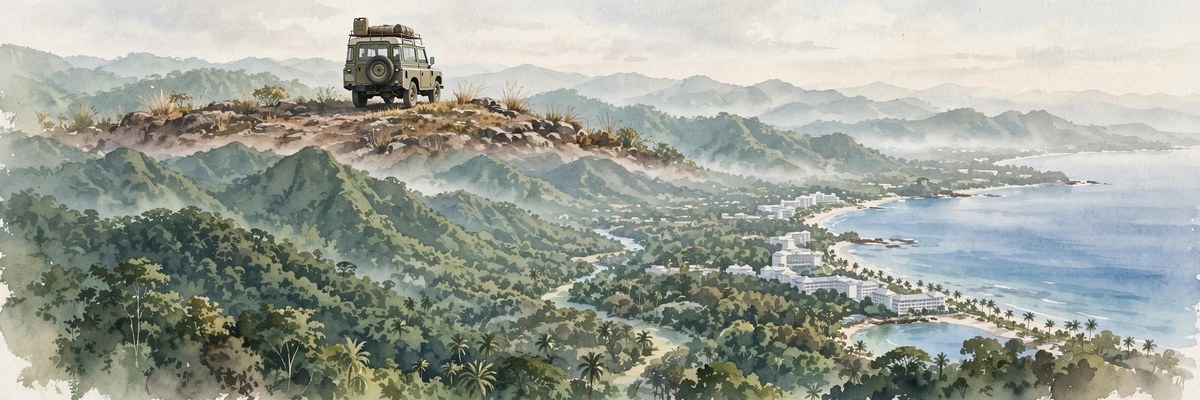
She says other people's lives get treated as a zoological park. A reserve. You ride through in the back of a repurposed Land Rover and look. On an African safari the animals were animals. On this safari the animals are human beings, in their own homes.
She says travelers go to Hawaii and get angry when Hawaiians tell them they are not wanted there. The Hawaiians tell them the visit depletes the place. The travelers call the trip self-betterment. She calls it a safari.
Michael Knowles and Matt Walsh have been mocking her for it. Mocking her is easy work.
I have done the thing she is describing. I did it in Nepal, before I had words for it.
I Did It in Nepal
In the fall of 1990 I walked the Kathmandu Valley for a week. I was twenty years old. A Sherpa guide, Tsan-Boo, led the walk.
I ate what was put in front of me. I slept where the trail put me. I looked at people's whole lives in terraced fields and stone houses and I called the looking education.
I was the colonist guy getting sherpas to carry my shit around as I toured their charming country.
The people in the valley had their lives there. The walk was arranged for visitors like me. I paid money that was real money there. I went home. They stayed.
That arrangement runs all over the world. Americans do it. Europeans do it. I did it at twenty.
Hawaii Kept the Tourists in Waikiki
I grew up in Honolulu.
In the Hawaii of my childhood the tourists stayed in the resorts. Waikiki. Hilo and Kona on the Big Island. Maui. A little bit of Kauai.
The rest of us got on with living there.
Nobody went up into the interior. Tourists did not go. Locals did not go. Local haoles did not go. Kids did not go.
We believed the interior was full of pakalolo. Marijuana. Men grew it up there and protected it with shotguns and booby traps.
I cannot tell you how much of that was true acre by acre. We believed it the way you believe weather. We stayed ocean-side.
Behind that belief the interior sat alone. The rarest plants and birds on earth live in Hawaii. They went untrampled because nobody went in there.
My Hawaii was green and blue first. Green of the island. Blue of the ocean. White sand under it. Black rock where the lava met the water. Some of the sand is green. Some of it is black.
The red dirt was local. Red Hill, Kapūkakī, the ridge over Salt Lake by the airport, named for its red ochre soil. The red-dirt plateau up at Wahiawā. That was red dirt. The whole island was not red dirt.
Moanalua was a bicycle ride from my school. Āliamanu and Salt Lake were right there. My parents took me to Moanalua Park. The creeks had little frogs and pollywogs in them.
The worst thing that ever happened to Hawaii is ecotourism.
Ecotourism told visitors to leave the resorts. Put on your Tevas. Go into the interior. Tramp through the dense vegetation. Feel good about it.
Entrepreneurial locals sold the trips. There is always a local with a truck and a price. The money is real. I do not blame him.
The trip into the interior used to be rare. One Englishman did it in the deepest part of Africa. A postdoc saved for years to do it once. Now hundreds of thousands of people a year do it as a product with a departure time.
They walk through vegetation that exists nowhere else on the planet. They go home and say they are bettered.
Then Nobody Came
In 2019 Hawaii took 10.4 million visitors.
In 2020 Hawaii took 2.7 million visitors.
The beaches emptied. The water cleared. The interior belonged to itself for a year.
The money stopped with the visitors. Hotels emptied. Restaurants emptied. Tour work, cleaning work, kitchen work, driving work—whole islands run on visitor money. When the visitors stopped coming, the paychecks stopped too.
If every Westerner stayed home tomorrow, Hawaii would lose the income the islands are built on. So would a hundred other places built the same way.
There is no USAID to catch them now. The agency was shuttered in 2025. What was left of it was folded into the State Department.
Airbnb Invented Nothing
Airbnb invented nothing.
Boarding houses are older than the republic. Subletting is older than the lease. People have always rented spare rooms to strangers.
Airbnb built the machinery around it. Global payments. Reputation scores. Insurance. Search.
With that machinery a spare room changed. An investor could buy a whole building and run it as lodging. The building sat on a street zoned for families. It never called itself a hotel.
Cities ban the app and the demand stays. The rentals move.
On Oahu the fight was over ninety days. The enforceable line is thirty days. So a unit comes back as a thirty-one-day furnished rental on Furnished Finder or Blueground. It stays out of the housing stock. It stays out of the hotel tax.
A guest arrives once through the platform. He leaves with a WhatsApp number for the next stay. Expat Facebook groups handle more of it, in cash, off the books.
An Expat Is an Immigrant with Money
A digital nomad who stays in Mexico City for a year has moved to Mexico City.
Moving to a country is immigration. A booking platform calls it an extended stay. The words on the app do not change where the man lives.
We use two words for a person who settles in another country. A poor mover is an immigrant. A rich mover is an expat.
The paycheck matters here. A man earns a San Francisco salary and spends it in Lisbon or in Roma Norte in Mexico City. Local wages are set by local work. His wage comes from outside. He bids for apartments with that outside money. Rents rise. Local people move out.
He has broken no law by doing the arithmetic. At scale the arithmetic moves a neighborhood.
Mexico City has started saying so in the street. In July 2025 marches began in Roma and Condesa. Signs said "gringo go home." One sign said, "You're a colonizer, not an expat."
Rents in the affected neighborhoods are up something like 45 percent in five years. Most of the foreigners arrived during the pandemic. The laptop class found it could wait out lockdown somewhere cheaper and prettier and work straight through it.
Down in Tulum the building outran the water and the sewers years ago.
Portugal Sent the Invitations
Portugal did this part on purpose, in writing.
The D7 visa, for people with passive income.
The D8 digital nomad visa, from 2022. The income floor is four times the Portuguese minimum wage. That is €3,680 a month this year.
The Golden Visa, which for a decade sold residency for real estate.
The Non-Habitual Resident regime, a ten-year tax break for new arrivals.
Portugal had a treasury to fill and villages emptying out. It wrote laws to bring in foreign money.
The laws worked. Portugal's foreign residents now number about 1.6 million. That is some 14 percent of the country. The share has more than doubled in four years.
Outside money arrived in volume. Houses in Lisbon cost more. Farms in the Alentejo cost more.
Then Portugal changed the laws, also in writing. The real-estate route to the Golden Visa closed in 2023. The Non-Habitual Resident regime shut to new applicants in 2024. This year the road to citizenship doubled, from five years of residence to ten years.
The invitations went out. People came. Prices moved. The state started rolling the invitations back.
The Ninth Island
More Native Hawaiians live on the mainland than in Hawaii. Some 370,000 live out there. Some 309,000 live at home.
The county outside Hawaii with the most Native Hawaiians is Clark County, Nevada. Las Vegas.
They call Las Vegas the Ninth Island. The downtown casinos were built for them. The plate-lunch places are theirs. Families live there. The community is real.
Every single Hawaiian I know thinks that Las Vegas is heaven and Disneyland is Eden.
If you grow up in Paradise, Las Vegas is your paradise. If you grow up on an island in the middle of the Pacific, infinite desert is the exotic thing. It is so nice not to see green all the time.
The mainlander flies five hours to Hawaii for the green. The islander flies to Las Vegas for the desert. Each man travels toward what his home does not have.
My friend Mohammed is from Egypt. He gave me the papyrus painting. He was born about a hundred yards from the pyramids.
His house had the Mena House golf course beside it. Golf has been played at the foot of the Great Pyramid since 1899. The greens were sand until they were grassed in 1917. The course is still there.
Mohammed grew up with the pyramids in his daily view. I grew up with Hawaii and Āliamanu. Another man's baseline is Murray Hill, East 35th Street in Manhattan. The wonder on a bucket list is the weather somebody else grew up in.
Spring Lake Had the Same Sticker
When I left Hawaii for college, my mother moved back in with her parents in Spring Lake, New Jersey.
Spring Lake turned out to be exactly like Hawaii.
In Hawaii the bumper stickers said Locals Only. No haoles. No tourists.
In Spring Lake the bumper stickers said Locals Only. No Bennys.
A Benny is the Shore's name for the summer visitor from up north. The acronym people give for it is folklore with competing authors.
The name for the outsider changes from place to place. The sticker stays the same.
She is the same figure I was in Hawaii.
My parents moved me to Honolulu when I was six. I lived there until I was eighteen. I grew up there. I think I am local.
I was never ever "Portuguese" or "Hawaiian" or Local.
She writes as a local in Portugal. She is not Portuguese.
When the revolution happens, my friend will have her Portuguese farm seized. She is a colonizer.
The same thing happened in Rhodesia.
By the third generation, white Rhodesians did not think they were invaders or conquerors. They had been born there. Their grandparents were the ones who came. They had never lived anywhere else. They called themselves Rhodesians and meant it.
In 1965 the white government declared independence on exactly that claim: this is our country, and we are its people.
After 2000 the farms were seized anyway. The ground given was that the people holding them were settlers. Three generations of being born there did not change the ground.
The Afrikaners went further. They named themselves after the continent itself. Afrikaner means African. The name did not make them of the land in the eyes of the people who were there before them.
The woman in Portugal has paper of the same kind. She bought her farm about ten years ago, when Britain was still a member of the European Union. On paper she did not move to a foreign country. She moved inside her own union, one European among Europeans.
Portugal knows its place in that union. The country lived under a dictatorship and stayed cut off from the rest of Europe until 1974. It joined the European club only in 1986. For decades it was the poorest country in Western Europe, and Portuguese workers emigrated north to find wages.
A Portuguese family does not meet a farm buyer from England as one equal European meeting another. They meet the side of Europe their own people left home to work for.
For thirty years the whole world ran the same pitch for Portugal.
All through the nineties, the two thousands, the twenty-tens, people from around the world said it the same way. Portugal is cheap as fuck. Poor as fuck. You can move there and rent there for Eastern Europe cheap. Everything is cheap as fuck.
The only downside anybody named was the food. Portugal sucks for vegetarians, or for people who don't eat pork.
She did not discover Portugal. She answered an advertisement the whole world had been running for three decades.
Mexico City got the same advertisement in the same decades.
CDMX is a perfect twin of this. Cheap as fuck. Poor as fuck. Everything cheap. Rent a big apartment for almost nothing. Eat for pennies.
The only downside anybody named was the same one in another form. The pork. In Portugal the pork was on the plate. In Mexico City it was cooked into everything, as lard.
Portugal was not a special case. The pitch had a twin. The twin's hosts are paying the same bill.
The farm was cheap for a reason. Portugal was cheap as fuck, poor as fuck, they're giving it away: empty, impoverished, money drained, brain drained.
She came with outside money and bought in a distressed country. That is exploitation, whatever the buyer calls it.
To the Portuguese she will always be an exploiter, not a savior.
And it is not her narrative at the end of the day. The narrative belongs to the people whose country it is.
One man's savior is another man's exploiter.
The woman in Portugal has been there ten years now. She posts about the awful people buying farms and destroying her quality of life.
To a Portuguese family three generations on the same Lisbon street, she arrived the same way the farm buyers arrive now. She came from another country. She brought money from outside Portugal. She bought in and stayed.
She wants the door closed behind her. She came through it ten years ago.
Share: X · Facebook · LinkedIn · Reddit · Bluesky · Threads · Email