Nobody Grows Up in a Postcard
This article, read aloud:
Share: X · Facebook · LinkedIn · Reddit · Bluesky · Threads · Email
Every single Hawaiian I know thinks that Las Vegas is heaven and Disneyland is Eden.
Mainland writers tell the Las Vegas story as an exile. Hawaiians priced out of paradise, washed up in the desert, homesick under the neon—the Ninth Island as a waiting room for people who lost the real eight. The name is real enough. Hawaiians in Las Vegas call the place the Ninth Island themselves, and the pipeline is old: Sam Boyd opened the California Hotel downtown in 1975 and aimed it squarely at Hawaii, and the Hawaii flights have been full ever since. But exile is a strange word for a place people fly to grinning, four times a year, on their own money, and then retire to on purpose. The mainland version needs the move to be a tragedy. The people making the move keep failing to act it out.
And the supposed exiles furnished the desert. The California Hotel—the Cal, downtown—runs Hawaiian food in its restaurants and Hawaiian names on its banquet rooms, and there are ABC Stores on Fremont Street selling the same macadamia nuts and suntan lotion as the ABC Stores in Waikiki. The Ninth Island is not a refugee camp with slot machines. It is a second home, built by the people who were allegedly banished to it, stocked with their own food and their own stores. Exiles do not usually renovate.
Here is the part the mainland version cannot hold. When you grow up in Paradise, Las Vegas is your paradise. When you grow up in Paradise, Disneyland is your Eden.
The Colors
Growing up in Hawaii, the world arrives in a small set of colors, and it arrives every day of your life. Green first. The green of the island, green climbing the fences and the telephone poles, green coming back a week after you cut it, green as the default setting of the visible world. Blue second. The blue of the ocean, which is not a view. It is the wall at the end of every street, the color under every bridge, the thing the light bounces off of all day. Then the white of the sand. Then the black of the rock where the lava went into the water. Some of the sand itself is green, and some of it is black. That is nearly the whole palette, and a boy soaks in it the way a fish soaks in water, which is to say he never once sees it.
Red dirt exists, but it is a place, not a climate. Red Hill—Kapūkakī—the ridge over Salt Lake by the airport, named for the red ochre in its soil. The red-dirt plateau up at Wahiawā, in the middle of the island. A boy in Honolulu does not live in red. He lives in green and blue, saturated past noticing, and saturation is the whole story of what a person later calls exotic.
Because then the boy grows up and gets on a plane, and the plane lands in Nevada, and he steps out into the Mojave: beige, tan, brown, gray, a sky with nothing in it, land running flat to a horizon in every direction, not a green thing in sight that wasn't trucked in and watered by somebody's decision. And it is glorious. It is so nice not to see green all the time. The mainland tourist standing next to him sees a wasteland with a casino problem. The islander sees the one landscape his childhood never issued him: dry land, infinite land, land you could drive across for a week and never reach the edge of. He grew up on a rock in the middle of the Pacific, where every road ends at the same ocean. The desert is the opposite of a rock. That is exactly its beauty.
Disneyland works the same way, from the other side of the fence. To a mainland kid, Disneyland is a copy of somewhere better. To a kid raised in the actual tropics, it is a garden with the tropics removed: paved, shaded, dry, contained, every river on a rail, every plant where a committee put it, nothing growing wild, nothing rotting, nothing biting. Eden was never the jungle. Eden was the garden somebody maintained. The boy from the jungle can tell the difference, and he prefers the garden.
The Other Green
I should confess the rest of it. I did not grow up aware that I lived in Paradise, and I was not impressed by the place. I thought it was chintzy and garish. That was the Hawaii on offer to a kid in it: the tourist version, all surface, and the real island underneath it read as ordinary because it was ours and it was every day. A boy does not admire his own weather. He complains about the rain and goes back inside.
The first time I actually saw Paradise, I was grown, and it was not in the Pacific. I went on a pilgrimage to Ireland with my mom, and we came out to the west coast, County Mayo and those western counties, where the cliffs go down into the North Atlantic and the hills roll green all the way to the water. Verdant. That is the word the place earns, and I do not spend it cheap. I stood there looking at green—green, the color I was issued at birth, the color I had soaked in for years without once seeing it—and I saw it. It took another ocean to show me my own color.
It happened again in California. San Luis Obispo, that whole stretch of coast: verdant green, ocean-fronted, rolling green hills standing over the water. That is Paradise. That is the most beautiful thing I have ever seen, and I say that having been to the Himalayas. The Himalayas are the biggest thing I have ever seen. San Luis Obispo is the beautiful one. There is a difference, and a man who grew up inside a postcard is allowed to know it: the wonder was never the size of the view. It was whether the view was his.
A Tuesday in Moanalua
My baseline was never the beach on the rack. My baseline was Āliamanu, and what we called Salt Lake, and Moanalua a bicycle ride from my school. My parents took me to Moanalua Park. The creeks there had little frogs in them, and pollywogs, and a boy with a bike and a whole afternoon could spend both on the bank watching them. A pollywog is a wonder that fits in a creek: a black comma with a tail, all appetite, turning by slow degrees into a frog. No postcard sells it. No visitor flies five thousand miles to see it. It was ours anyway, and it was enough to fill a childhood's quota of marvels, because a child does not measure his home against the world. He has not seen the world. He has seen the creek.
That is what the wonder of the world looks like from inside it: a park, a creek, a Tuesday. Nobody stands in his own childhood thinking, I live inside the postcard. He is thinking about the pollywogs.
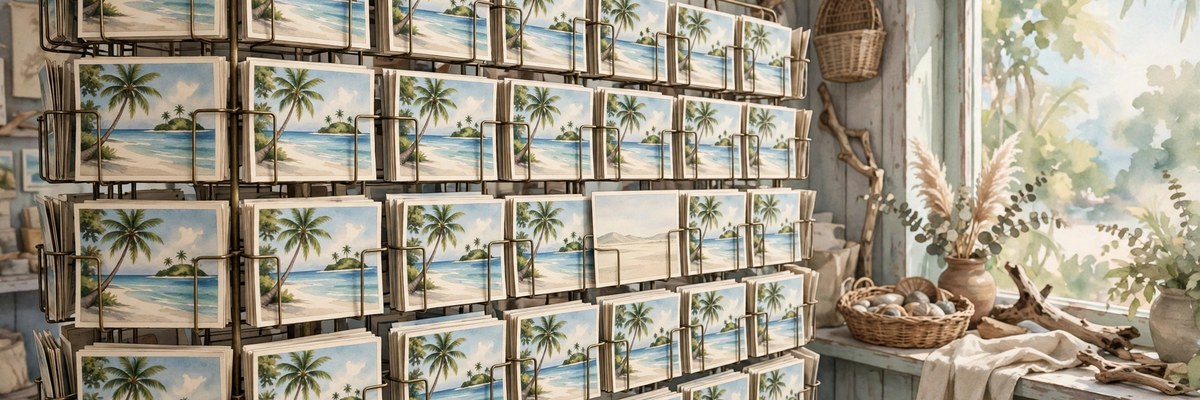
The postcards were in the ABC Store for the visitors. Row after row of the same beach, the same palm leaning the same way, the same sunset doing its shift. We walked past the rack the way you walk past a rack of anything. It never occurred to us that the rack was us. A postcard is a place with the Tuesdays taken out, and the people who live in the place are the ones who got left holding the Tuesdays.
The Man by the Pyramids
My friend Mohammed—Mohammed from Egypt, who gave me the papyrus painting at Starbucks—was born about a hundred yards from the pyramids. His house stood beside a golf course, the Mena House course, at the foot of the Great Pyramid. Golf has been played there since 1899. For the first eighteen years they played it on sand, and in 1917 they grassed it, and it is there still: tee off, and behind the flag stands a structure four and a half thousand years old. People fly across the planet and pay for the privilege of standing where Mohammed stood doing his chores. He grew up not seeing it. It was the view out the window, which is to say it was not a view at all. It was weather.
Another man's baseline is Murray Hill. East 35th Street. Brownstones, traffic, the deli that starts his sandwich when he comes through the door. His whole childhood ran in brick and asphalt and steam, and his wonder is somewhere out past the Hudson, in a color his streets never had. Maybe it is my green. Maybe it is Mohammed's desert. The address changes. The mechanism doesn't.
Everybody travels toward whatever his home is not. The mainlander flies six hours to stand in the green the islander grew up saturated in. The islander flies six hours the other way to stand in the beige and breathe out. The Egyptian flies to see snow. The Manhattan boy flies to see a horizon. Each of them lands, looks around at somebody else's Tuesday, and calls it paradise, and each of them is right, which is the part the postcard rack cannot explain.
A bucket list gives the whole game away. Read one closely and it is a catalogue of other people's Tuesdays. The pyramids are on it—Mohammed's weather. The beach at Waikiki is on it—somebody's commute, somebody's shift, somebody's bus ride home in the rain. The desert is on it, for the people raised in the green. Snow is on it, for the people raised where snow is a rumor. Every item on the list is a place where somebody is standing right now, bored, at a bus stop, inside the exact view a stranger across the ocean is saving money to die having seen. The list is not a list of wonders. It is a list of other men's baselines, printed on a card.
Nobody grows up in a postcard. Everybody grows up inside a Tuesday—Mohammed by the pyramids, the Murray Hill man over his deli counter, me on the bank of a creek in Moanalua, watching pollywogs turn into frogs. Paradise is not a place. It is the opposite of your saturation, and it is always, exactly, somewhere else.
Share: X · Facebook · LinkedIn · Reddit · Bluesky · Threads · Email