
Everybody Knew
This article, read aloud:
Share: X · Facebook · LinkedIn · Reddit · Bluesky · Threads · Email
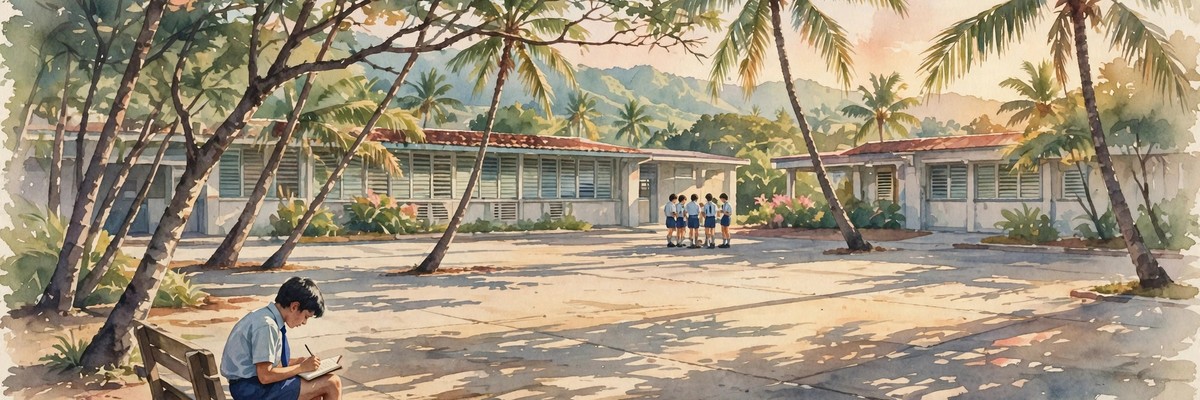
Everybody knew, and nobody said. That was the arrangement I grew up inside: Saint Louis School, Honolulu, the 1980s, an all-boys Catholic school of uniforms and Mass and wrestling mats. The rule had been handed down to us by the generation above as plain manners. The worst thing in the world was to out somebody. You outed yourself—on your own schedule, in your own words—or it did not get said at all. A whole school could hold the same fact in common for years and never speak it once, and we believed the silence was decency. Some of it was. Some of it was just the tax.
My best friend in high school swooned over the men in Duran Duran. Simon Le Bon above all. Not the band—the men, in the videos and the posters. A straight boy could love those records with his dignity intact; the swooning was something else, and everybody could read it, and nobody read it out loud. It was no big deal. He was not maintaining a second self behind the first one. He was just being himself, unhidden, in a building full of boys who had agreed without ever agreeing that what he was belonged to him to announce. We graduated. Then he came out to me—formally, deliberately, the way a man delivers news he has rehearsed. The ceremony, when it came, had a setting: a car, after a night at the Wave in Waikiki. I was at GW by then, home and catching up, and we had met Keoki that night—DJ Keoki, before the mainland finished making him Superstar DJ Keoki. It may have been a seminal night for him too. That is his to say; I only hold my side of the car. I was in the club on a fake ID my fraternity made for me at GW—a Connecticut license, the old-school manufacture, where you stood behind a cardboard cutout of the license and they photographed you inside it. It was hilarious. It also worked. And the drink was the B-52: the one sophisticated order that did not offend a baby underage palate, layered and sweet, a grown man's shot built for a kid's mouth. The information had been free for years. The saying of it was an event, and the etiquette required that the event be his. It cost him a ceremony to tell his best friend a thing his best friend had known for years.
The rule had not been invented by boys. It came down to us from the adults, and it came down hardest in the epidemic years, when a man's name attached to the wrong fact could cost him his job, his apartment, his family, and his church, in whatever order the news traveled. Nobody sat us in a classroom and taught it. We absorbed it the way you absorb weather: the grown-ups around us treated another person's private truth as property under guard, and outing somebody as the one theft that could not be taken back. You could be forgiven a fight. You could be forgiven a lie. To say out loud, about another boy, the thing he had not said himself—that was the unforgivable act, and every boy in the building knew it by the time he could shave.
The courtesy had a cruelty folded inside it: he believed he had been hiding. A man can spend his whole life crediting his mask, because the people around him are too polite to hand him the receipt. But the force field went up after the witnesses arrived. His parents had known him before he could perform. His friends had. He never butched up, never overcompensated, never rebuilt himself into something harder—he stayed slight and fine and exactly the boy we had always known, and the performance he thought was concealing him was playing to a room that held the original. That is the secret architecture of the closet in a polite place. The hider does the labor. The witnesses keep the peace. The secret survives only for strangers.
The generations still talk past each other about it. A Los Angeles podcast, Old Gay Young Gay, sits them down together—Miguel Angel Moller, a gay Mexican American millennial, interviewing the men who came up before him—and the young ask the old, in good faith and in both languages, why they did not live freer. The old answer with a world the young never had to survive. It is the same conversation in Honolulu and in Los Angeles, in English and in Spanish: the freedom was not there to be taken, and the men being asked are the ones who paid for its absence.
The same schoolyard ran a second machine, and it was not polite at all. The f-word was fired constantly—at everybody, for anything, all day. The f-word—not fuck; fuck is spelled out in this piece whenever it belongs. The other f-word, the slur for a gay man, in its short form and its long one, and I will not write it. I was a wrestler, and the wrestlers got called gay as a matter of routine, the way you would comment on the weather—two boys in singlets, grappling on a mat in front of the whole school; the joke wrote itself and somebody was always there to say it. Nobody meant it as information. It worked the way the noise cannons work at airports, the explosions they fire over the runways to keep the birds from settling: not aimed at any bird, just fired often enough that nothing could land. That was the word's real job. Not to name anybody. To keep the air itself too dangerous for anything true to come down in the open.
The one person exempt from the etiquette was always the grandmother. In the movies it is the grandmother, at the table, in front of the whole family, who asks the question nobody else will say out loud. Yiddish even kept a word in her register: faygele, little bird—a term of endearment for a child that in a grandmother's mouth could name, in public, the thing the table had agreed to carry in silence. Age had exempted her from the manners the rest of us were still paying for. The Italian version is the same woman at a different table, the nonna asking at Sunday dinner with the whole family in earshot. The culture changes. The exemption does not.
And all of this was happening in Hawaii, where the closet was never the only building on the street. Māhū had stood in the open there for centuries before my school existed—a named and placed people, of both spirits, who in the old culture kept the healing and the stories. Androgyny was common weather. There were effeminate boys who were straight, and everybody knew that too, and it was filed under the same rule: a person was what he was, and the naming of it was his. Growing up inside an imported etiquette, in a place that held an older memory of another arrangement, you could feel—even as a boy, even without the words—that the hiding was a custom. Customs can be broken. Laws of nature cannot, and this was never one.
Then the epidemic came, and the etiquette met a fact it could not process politely. In the middle 1980s AIDS was on the news every night and in the fear every day. Men were dying on the mainland in numbers nobody could make sense of, and the terror ran far ahead of the knowledge: people were afraid of toilet seats, of communion cups, of a handshake, of a shared glass of water. In Indiana a boy named Ryan White, a hemophiliac who had gotten the virus from his blood medicine, was barred from his own school by parents who believed the fear and said so in court. That was the country's arithmetic in those years: a sick child was a contamination risk first and a child second. Somewhere in those years I learned the actual arithmetic of the thing. You do not get AIDS from touching someone. Not from holding someone. Not from hugging someone, not from kissing someone. The virus traveled in blood and in sex, not in an embrace, and a dying man could be held without danger by the people who loved him. I wrote it up for the school newspaper. Understand what that meant in that building. I was a schoolboy at a Catholic school, and the one place a boy could say a true thing in public was print. I would never have stood in the courtyard and announced what everybody knew about my best friend; the etiquette forbade it, and on that point the etiquette was right, because it was his to say. But the fear was nobody's private property. The fear was just wrong, and wrong in a way that was leaving men to die untouched, and a fact that could be printed belonged in print. So I printed it: you can touch him, you can hold him, you can hug him, and it will not kill you. In a school where the deepest facts of our own lives went permanently unspoken, a boy put the epidemic in the school paper, because the terror was misplaced and somebody had to say so where it counted.
Everybody knew. Now everybody can say. The distance between those two sentences is the distance he traveled, and it is most of the distance my whole generation traveled, and it is not small.
Share: X · Facebook · LinkedIn · Reddit · Bluesky · Threads · Email