
Running Behind the Coal Cars
This article, read aloud:
Share: X · Facebook · LinkedIn · Reddit · Bluesky · Threads · Email
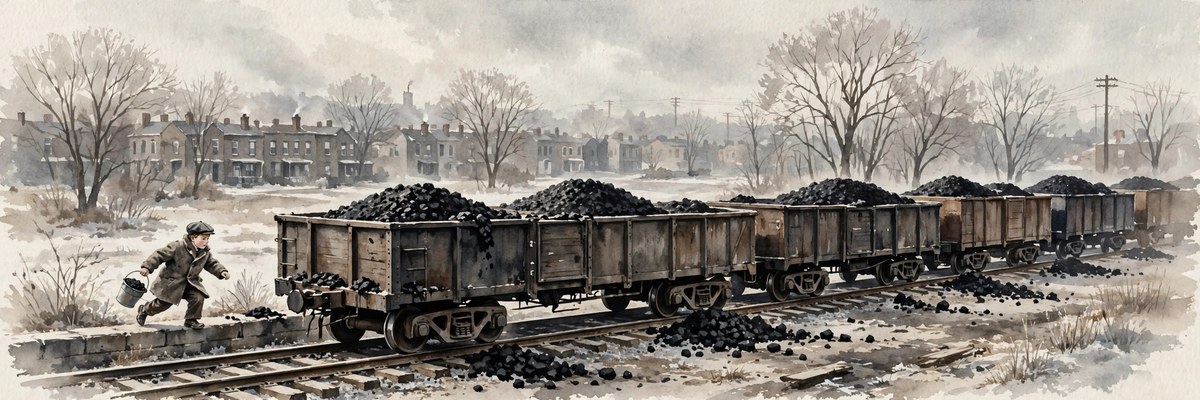
My dad told stories of running behind the coal cars. North Jersey, the early 1940s, winter coming down hard, and my dad a little kid, running in the cinders beside the tracks in a crew that ran from his grandparents' generation down to boys barely big enough to carry a bucket—his uncles, the neighborhood kids, everybody the street could field. The coal trains came through loaded and slow, and the cars shed their cargo the way a torn pocket sheds change: a lump here, a lump there, shaken loose at every joint in the rail and spilled along the right-of-way in a black trail a boy could follow like a route on a map. The kids ran behind the cars and gathered what fell. The trail ran both ways: out at a run, empty-handed, and home at a walk, buckets swinging, pockets heavy, palms black. That was the whole technology: a train, a winter, and children fast enough to keep up.
They stuffed newsprint under their shirts and jackets before they went out, newspaper layered against the skin to keep the wind from cutting straight through to the bone. Paper is what they had. Paper went between the boy and the weather, page on page, and on the coldest days the layers got thicker, so that a kid ran the coal line wearing the winter's news against his chest. Then they ran cold so the house could be warm. What they gathered came home in buckets and armloads and the deep pockets of coats—coal for the stove, coal for the furnace, coal enough that the family would not freeze in a North Jersey winter. And there was more in it than heat. A kid who ran well gathered more than his own house could burn, and the surplus moved through the neighborhood, sold and traded and owed and owing, a small economy of boys and buckets, denominated in lumps. A lump owed was a debt, and the street kept its ledger the way streets do, in memory, and a boy's credit was his word about how much he had brought home and how much of it was spoken for. The coal line was a job before any of them was old enough to be hired at one.
The house the coal came home to was a factory worker's house. My grandfather worked in a factory, and after his shift he drank a beer and a bump—a shot of whiskey riding on the beer—and he got drunk, and that was the weather in the house my dad grew up in: a factory wage, a stove that ate what the kids could gather, a drunk father at the end of the day. The wage covered the rent and the food. The heat was the children's department. A boy in that house learned early that winter is a bill that comes due whether anybody is ready or not, and that a kid with fast legs could pay part of it out of what fell off a train.
We are not that far away from any of this. Seventy years. Eighty. Ninety at the outside. People ran behind coal train cars to steal coal and stuffed newsprint into their clothing to keep warm and keep out the wind, and it happened inside my father's lifetime—and my father lived inside mine. He died in 1995. The stories still arrive in his voice. I did not read about the coal line in a book or see it in a documentary. I heard it from the boy himself, grown and gray, at the table, the way other men's sons hear about a war or a pennant race. And he told them the way he did everything the books had taught him to do: plain, in order, with the numbers right, no decoration hung on a winter that had needed none. The telling was the elocution, still working, fifty years on. The history books put a century between us and the age of coal heat and child gleaners; a family's arithmetic puts one man's life there, and no more. The boy in the cinders is my dad at the table, telling stories in his own voice, close enough to touch.
He taught himself out of that world, and the instrument was books. A dozen of them—elocution lessons, etiquette, eloquence, protocol—the matched row of hardcovers I have written about before. Elocution is the voice rebuilt on purpose: how to stand, how to breathe, how to place the sound in the mouth and round it until the street is off it. Etiquette is the room rebuilt: how a person eats, how he is introduced, how he shakes a hand and writes a letter and holds himself in company. Protocol is the order of the whole proceeding, who goes first and who sits where in the rooms where decisions get made. He bought the education the way he had gathered the coal, in pieces, by effort, because nobody was going to hand it to him whole. He studied so he would not sound like the kind of kid who ran behind coal cars. He made himself fancy on purpose, by study, the way another boy might make himself strong in a basement gym. It was a school with no teacher and no classmates and no graduation. The examinations were every room he walked into afterward, every introduction, every first sentence out of his mouth in front of people who had been born already knowing how the sentence was supposed to sound.
It worked. By the 1960s my dad was an illustrator at BBDO—Madison Avenue, the good address, account men in suits down the hall and the art department turning out boards against deadline. And here is the part that gets misread by anyone who hears the address and stops listening: illustrators in those days were blue-collar workers. The drawing table was a bench. The work was piecework and paste-up, ink under the nails, boards carried across town by hand—a trade with a tradesman's hours, wearing a better neighborhood's clothes. It never stopped being true, in the eighties or the nineties or the two thousands. Reporting never made a man white collar. Illustration never did. Say graphic designer and people pictured a fellow behind the counter at a copy shop. A man at the board was a man at a bench, whatever the letterhead said. And the benches were filled from houses like his. A boy who could draw and came from money had other doors opened for him; the art departments of Madison Avenue ran on factory workers' sons with fast hands, because the trade asked what your hand could do and the hand was the one credential a poor kid could mint for himself.
There is no straight line between the family of the factory and the coal cars and the man at the BBDO drawing table. A straight line would have needed a father in the business, a school that fed the agencies, a voice born already correct. Nobody drew that line for him. No scholarship carried him, no patron opened a door, no grandmother's syllabus waited for him at a rich table. He drew the line himself, out of the materials at hand: a voice rebuilt from elocution books, manners learned off the page the way an actor learns lines, and a hand that could draw. When people say self-made man they usually mean the money. My dad made the self first. The money was the smaller half of the project.
What the self-making was for showed up later, at a drawing table, with me on the other side of it. My dad taught me to draw people, and the first law he handed me was proportion: seven heads. A real human being stands seven heads tall, the head stacked on itself seven times down the body—one at the crown, and the measure running down through chin and chest and hips to the ground a working body actually stands on. The statues lie about it. The monuments run eight heads, stretched tall into heroes, a whole extra head of importance added at the top. Seven is the truth of the body as it is. He had picked up that canon somewhere along the road from the coal line—the trade's own elocution, the correct speech of the drawing hand—and he gave it to his son as plain fact, the way a man hands over a tool that already lives in his hands. I still run the measure on people without deciding to, the way you run a song you were taught before you could read. I run it on myself: six or seven heads, because my head is giant, and the two facts cancel into a man who reads as proportioned. The lesson outlived the teacher by thirty years and counting. It is still set to his numbers. The boy who ran cold behind the coal cars so his family would not freeze grew up to teach his son how a person is measured. Seven heads: the real size of a human being, taught by a man who had to invent his own size and then grow into it.
Share: X · Facebook · LinkedIn · Reddit · Bluesky · Threads · Email