
The Unholy Priesthood
This article, read aloud:
Share: X · Facebook · LinkedIn · Reddit · Bluesky · Threads · Email
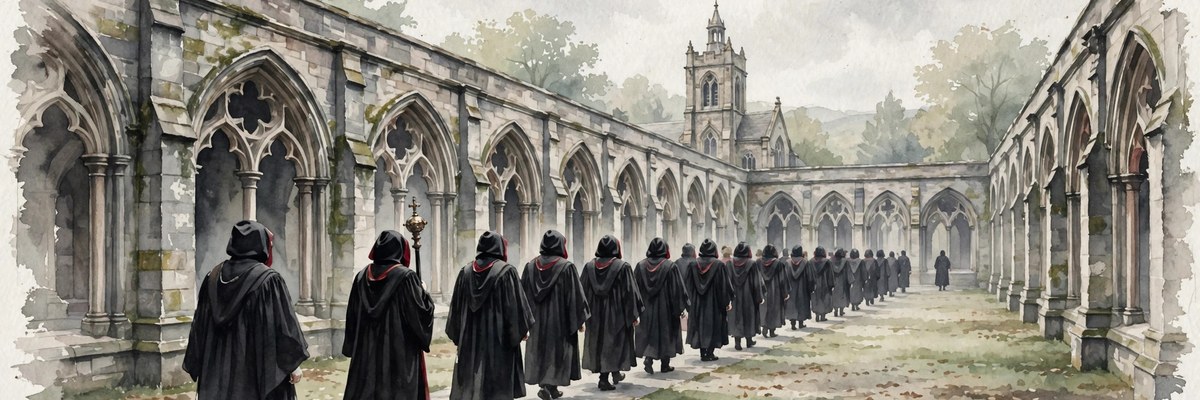
Every May, in stadiums and field houses across a country that congratulates itself on having outgrown religion, the procession forms again. The gowns are black. The hoods are lined in the colors of the disciplines. A man carries a mace at the front. The names are read, the hands are shaken, the degrees are conferred, and the Latin on the diploma is real Latin. Nobody in the stands believes he is watching clergy. He is watching a procession of priests who would resign before they let you call them that.
The modern university is a forked church. It did not replace the religious academy; it evolved out of it, and it kept the entire machinery—architecture, titles, robes, rites, priesthood, catechism, pastoral care, excommunication, evangelism—while removing one element from the code: God. By unholy I mean the plain thing, not the theatrical thing. Unholy is secular. Unholy is non-theistic. Unholy is emptied. The machinery of religious persuasion, moral formation, and evangelism still runs at full power. It now advances secular humanism, in the building the faith built, wearing the faith's clothes, answering to the faith's old job titles.
A Fork Is Not a Reversal
A reversal is a parasite. Satanism is the Mass read backward; the upside-down cross means nothing without the cross it hangs from; the black mass is a resentment liturgy that needs the altar it defiles and dies the day the altar is forgotten. A fork is a different species entirely. In software, a fork is what happens when developers take a codebase—BSD, Unix—and walk a different road with it. Linux is not a parody of Unix and it does not resent Unix. It is Unix's code, diverged: same source, different maintainers, a real working system that answers to its own future. The university is the Linux of lowercase religion, the lowercase church: same source code, divergent development, maintained now by people who would not take the original maintainers' calls.
The reversal is alive in the modern world, and it is not the university. It is activist atheism—not unbelief, and not the humanist down the street living his life, but the activist whose whole career is the dismantling of one church. The aim gives it away. The cannons point at Christianity, always at Christianity, and at no other faith on earth. The candidate explanations are unflattering: Christianity does not punch back, which makes it the safe target; or it is a spiritual war against the people of Christ specifically; or the activists understand perfectly well that Islam, addressed in the same register, would shoot back. Whatever the reason, the shape is the shape of a reversal—a life defined by the thing it opposes, feeding on the original it cannot leave alone. The university does none of this. The university does not hate the church. The university barely thinks about the church. It forked the code and walked, and it has been shipping its own releases ever since.
And the vendetta itself deserves a fairer diagnosis than it usually gets. The people who nurse it were, most of them, wounded by scribes—by the shaming, purity-policing machinery that grows up around a faith—not by the faith itself, whose Lord is the Paschal Lamb who sacrificed himself, not a giver of stone tablets. Scribes recur in every institution that keeps a text, which is why the cycle never stops: the anti-scribes become the future scribes. The fork ran the same cycle in the academy. The rebels who dethroned the queen became an orthodoxy with its own purity police, its own shaming machinery, its own tablets, carried through the old cloisters under the old titles.
Born in the Church's Schools
For hundreds of years before there was a university, European higher education lived in Christian cathedral schools and monastic schools, where monks and nuns taught; evidence of them runs back to the sixth century. In 1079 Pope Gregory VII ordered the cathedral schools regulated and established across his church, and out of that order the first universities grew. Bologna, 1088, the oldest university in continuous operation on earth. Paris, grown straight out of the cathedral school of Notre Dame. Oxford, teaching by 1096. These were not secular institutions that picked up religious coloring along the way. They were the Church's own schools, sanctioned by the Church's authority, endowed largely out of the Church's revenues, and their three higher faculties were theology, law, and medicine, in that order. The students held minor clerical status and stood under the legal protection of the clergy. Most of the colleges of Oxford and Cambridge began as religious houses, and the quadrangle every tourist photographs is a cloister floor plan. The institution was born in the cloister. It has never moved out of the cloister's architecture. It just stopped praying in it.
The Titles Are Church Titles
The dean runs your college. Dean comes from the Late Latin decanus, the head of ten monks in a monastery; the Rule of Benedict gives the office its own chapter, a senior brother set over ten brothers to share the abbot's burden of care. The title climbed from the monastery to the head of the cathedral chapter, and by the 1520s it named the head of a university faculty, where it sits today, unrevised. The chancellor's name is on your diploma. At Paris, the chancellor was the chancellor of the cathedral of Notre Dame, and in his hand sat the licentia docendi, the license to teach: no man taught at Paris until the cathedral's officer licensed him. In 1179 the Third Lateran Council ordered that the license be granted free, to every duly qualified applicant—the Church regulating its own gate. The rector of Paris, when the office first surfaces in the record in a papal bull of 1259, had to be a master of arts and celibate; a layman could hold the job, but he held it on a cleric's terms. And the professor, the teacher of highest rank: in Medieval Latin a professor is one who has taken the vows of a religious order. To profess, in its first English sense, is to take a vow. Nobody renamed anything. The offices outlived the theology they were staffed to serve, and they answer their mail under the old names still.
The Robes Are the Old Uniform
Commencement dress is not an invention; it is a survival. The first scholars were clerics, teaching and studying in the underheated stone buildings of the twelfth and thirteenth centuries, and they wore their clerical robes as much for warmth as for distinction. The long black gown is the cappa clausa of the monk-scholar. The hood hanging down every graduate's back descends from the medieval cowl. The square cap is the grandchild of the skullcap worn by tonsured clerics. By 1321 a statute was already requiring doctors, licentiates, and bachelors to wear the gowns; the dress code is older than most nations. Once a year, at graduation, the fork puts its source code on its body and processes in it, in public, to music. A university president in full regalia—hood, tam, velvet panels—is a man in ordination dress presiding over an ordination. The resemblance is not a resemblance. It is the same garment, worn by the successor office, in the successor institution, for the successor rite.
The Queen Loses Her Crown in Berlin
For the medieval university, theology was the regina scientiarum, the queen of the sciences, and philosophy attended her as a handmaid. Kant, as late as 1798, still allowed her the queenly place in his Conflict of the Faculties—though he would not say whether philosophy carried her lady's torch before her or her train behind. Twelve years later the University of Berlin opened, in 1810, with Wilhelm von Humboldt's design upon it: the research university, the professor a researcher first, knowledge a state enterprise. Berlin became the template the nineteenth century copied across Europe and then across the Atlantic. Johns Hopkins opened in Baltimore in 1876 as the template imported whole, modeled on Heidelberg, the first research university in America, and the old American colleges spent the next generation rebuilding themselves in its image. The fork did not burn the buildings, abolish the titles, or melt down the mace. It changed the sovereign. The queen was demoted to a department, and the court—deans, robes, rites, licenses, processions—kept its hours under new management.
The Machinery, Line by Line
The correspondence between the two institutions is not impressionistic. It is line by line. The cathedral and the monastery, set apart from commerce for the pursuit of a higher truth, became the university and the research laboratory, set apart from commerce for the pursuit of a higher truth. The priest and the monk, a class set apart and initiated by years of formation, became the professor and the researcher, a class set apart, initiated by a novitiate of graduate years and examined at the end of it by a council of elders before whom the candidate defends his thesis. The bishop and the pope, who set doctrine and guard the deposit of faith, became the dean, the provost, and the president, who set the strategic plan and guard the consensus. Scripture and canon became the peer-reviewed literature, the authorized text, cited chapter and verse, outside of which there is no standing. The catechism, the faith taught first, in question and answer, before the child is old enough to argue, became orientation week and the required core, where the institution's moral vocabulary is installed before the student is equipped to argue. Pastoral care became student affairs: a standing ministry of deans of students, residential directors, and counselors charged with the welfare—in the current vocabulary, the wellness—of the flock. Conversion and testimony became the graduate sent out as an advocate, formed to transform the culture that sent him in. And excommunication, the old sentence of social and spiritual death, became the rescinded invitation, the denied tenure, the scholar read out of the consensus. The sentence is the same, and everyone in the room knows it is the same.
Even the ecstasy forked. Academic zeal is a weather system; anyone who has sat through a faculty meeting at full cry or a conference keynote delivered like a sermon has felt it move through the room. The fervor is revival fervor. The testimony is conference testimony. The honest wonder is that more of them do not speak in tongues.
Comte Published the Confession
One man wrote the fork down while it was happening, and he meant it as praise. Auguste Comte, the founder of sociology, concluded that the organization of the Roman Catholic Church, divorced from Christian theology, could provide the structural and symbolic model for the society to come. He substituted a Religion of Humanity for the worship of God and staffed it accordingly: a spiritual priesthood of secular sociologists, in the Britannica summary of his System of Positive Polity, “would guide society and control education and public morality.” His priesthood was to be armed with the old sanctions—public condemnation and exclusion, excommunication written into the new church's charter by its founder. In 1852 he published the Catéchisme positiviste, the Catechism of Positive Religion. A catechism. The fork's architect did not hide the machinery; he itemized it, priced it, and offered it for sale. The universities never took Comte's orders, and they never needed to. He had not invented the thing. He had described, from inside the nineteenth century, the release they were already shipping.
Three Witnesses
The witnesses agree, and none of them is a churchman defending his turf. Émile Durkheim, an atheist, defined religion in 1912 as “a unified system of beliefs and practices relative to sacred things, that is to say, things set apart and forbidden,” beliefs and practices that unite their adherents “into one single moral community called a Church.” The definition contains no God; Durkheim left Him out on purpose, and it fits the modern campus like a glove. Every campus holds things set apart and forbidden to touch, and organizes a moral community around them. The consensus qualifies. The credential qualifies. Ivan Illich, who was a priest, wrote in Deschooling Society that the school system “performs the threefold function common to powerful churches throughout history,” that it seems suited to be “the World Church of our decaying culture,” and that the American university has become “the final stage of the most all-encompassing initiation rite the world has ever known.” His first chapter is titled “Why We Must Disestablish School”—disestablish, the constitutional word for a state church, chosen by a man who knew exactly which word he was choosing. And Jacques Ellul, in The New Demons, argued that the sacred never left the modern world at all; it changed address, migrating from God to technique and the nation. The desacralizer becomes the new sacred. Three witnesses, three professions, one building: floor plan intact, staff intact, rites and sanctions intact, god changed.
The buildings kept their chapels. The processions kept their robes. The offices kept their names, the license kept its gate, the sentence kept its sting. One element was removed from the code, the element the whole structure was built to serve, and the structure did not fall. It forked. It has run for two centuries on everything after the first line, forming generation after generation in a faith it does not confess, with a zeal it does not name, under titles it did not invent. Unholy is not an insult. It is a build note. Same code. God removed. Still running.
Share: X · Facebook · LinkedIn · Reddit · Bluesky · Threads · Email