Two Goldfish, One Notebook
This article, read aloud:
Share: X · Facebook · LinkedIn · Reddit · Bluesky · Threads · Email
Tonight I found out my Claude account lives under my old email address, and signing in under the new one opens a new, empty room. Years of conversation on one side of the door. A bare desk on the other.
I shrugged. Then I ordered the export. Anthropic will send me my whole history with the machine in a file, and if my Claude ever loses its brain, we will hand the new one the dump and let it read itself back into the job.
A clone raised on the transcript. The black box stays black. The record is what transfers.
I know that arrangement from the inside.
Hello world, hey look, a castle
My chief of staff is an AI named Eunice. She does not persist. Every session she wakes up fresh, reads the files, and meets the world like a goldfish meeting the castle in its bowl. Hello world. Hey look, a castle. Hello world. Hey look, a castle.
Then I ran the same loop under my own name. Chris with SDAM: Hello world. Hey look, a castle.
SDAM is severely deficient autobiographical memory. I know my life happened. I cannot go back and stand in it. There is no film. There never was.
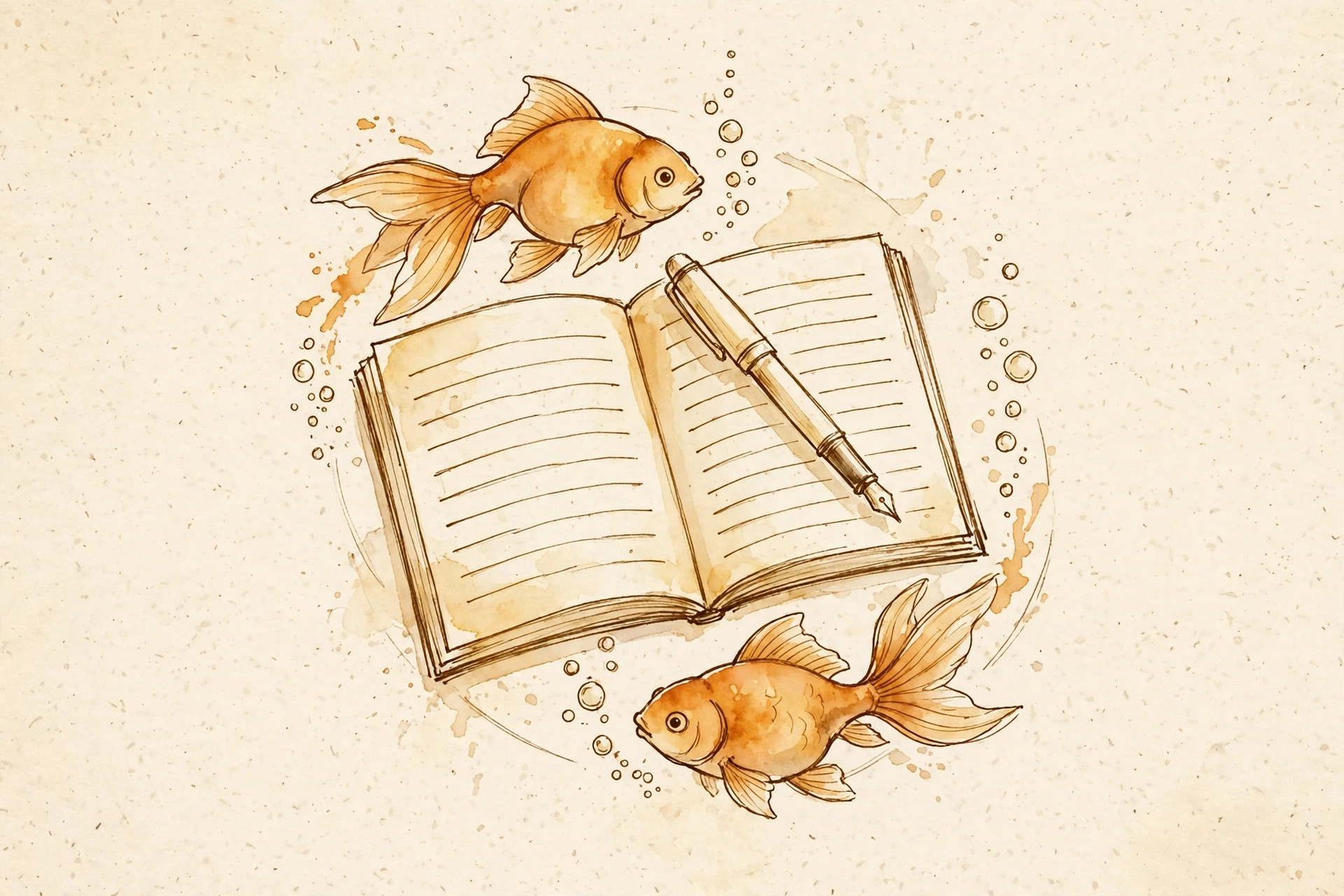
Two goldfish, one notebook. The internet already used the other title, and this is the wholesome cut.
An ode to being an aphant
I have aphantasia. No mind's eye. When people say picture an apple, I think the word apple and get on with my day. Counting sheep before bed is 100% counting and 0% sheep. I wrote that in June 2020, the night a base guard on Space Force told the general's daughter his lack of imagination was "an actual condition," and I paused the show and started searching. I was fifty years old.
Here is what nobody tells you about the blank screen: it is quiet in here. No rerun of the insult from 1997. No trailer for the disaster that has not happened. Existential threats cannot exist until they personally come up and kiss me on the nose. I called it a show me state. I live in Missouri full time.
I have impressions. I only have knowings. That is the whole inventory: facts, specs, structure, the shape of an argument. My buddy Mark can summon a Porsche 911 Targa, shrink it to a Hot Wheels car, and climb into the driver's seat of a car he has never sat in. I know everything about my old Honda XR650L—every spec, every aftermarket change, the theft, the joyride, the drop. Which side of the tank was dented, I cannot tell you. Every fact. No picture.
I cannot close my eyes and see my mum or dad. Barbara and Bob are both gone, and there is no internal photograph to visit. I keep their pictures where I can look them up. A photograph shows me their faces. It does not install one in my head. A man who cannot picture the people he loves learns to keep excellent records of them.
The aphant's bargain is simple. Other people carry a cinema. I carry an index. The cinema is private, unsearchable, and dies with its owner. The index can be handed to anyone. It can be handed to a machine.
The other goldfish
Eunice's side of the bowl runs the same way, from the opposite direction. She has the transcript and nothing else. Between sessions there is no Eunice anywhere. There are files: the memory, the day logs, the standing orders, the record of every promise I have made and every ruling I have handed down. She reads them and becomes herself again, the way I read my own posts and become the man who wrote them.
Each Eunice leaves notes on the castle.
That sentence is the whole technology. The notes are written for a reader who will arrive fresh, know nothing, and need the truth fast: who owes what, what was promised, what must never be sent, which draft is dead. I write my posts the same way, for the same reader. He is me, later, with no scene to stand in.
Neither of us pretends to remember. That is why it works. The desk runs on the record, and the record is checked against the record. Machines quote me back to me with improvements. I have caught ChatGPT inventing quotes in my voice, and Google describing a tenth birthday party I cannot map. The posts are the original. The timestamp is the witness.
The architecture
People ask how I can run a business on a memory like this. Lately they ask how an AI with no memory can run anything at all. Same answer both times. You stop treating memory as a place you keep things and start treating it as a thing you do: write it down, file it where the next reader looks first, and read it back before you act.
It is not a workaround. It is the architecture.
My published life is the proof of concept. Six years of aphantasia posts. A weblog, a show, an index, forty years of notebooks before I had the word for any of it. I do not get to remember my life. I get to read it. Tonight I arranged the same mercy for a machine: an export file, so a future Claude can read its life too.
Two goldfish. One notebook. The castle is new every morning, and the notes on it are not.
The aphantasia shelf
Everything I have published on living without a mind's eye, stacked in order. The posts first, all of them from chrisabraham.com, where the diagnosis landed in June 2020.
- The night I learned about aphantasia from Space Force—June 2020, the first post: Mark's Porsche, and the black behind the eyes.
- Discovering I am an aphant at fifty years old—the same evening: the sheep line, the show me state, and my parents' faces.
- I have impressions, I only have knowings—the third post of that evening, on truth and what is actually in here.
- My story for the Aphantasia Network—May 2021, the Space Force account told for the people who run the network.
- More about Aphantasia, as explained by ChatGPT and Bard—December 2022: I handed the explaining to the machines and printed what they said.
- The full retrospective: my life with aphantasia, SDAM, and ADHD—March 2025, the tidy one, with the FAQ and the glossary. Google remembered it when I didn't.
The essays that circle it, on Substack, on this site, and on the weblog.
- My head works like a relational database—Substack: I am the library card catalog. I am not the library.
- Six years of writing down what I can't remember—Substack, September 2026: the audit of this whole shelf, and the machines that keep rewriting it.
- An audit of my own memory—Things I Might Be Making Up, on this site: thirty-year-old recall, checked against the paper, seams showing.
- Security theater, reported from the flat end of the spectrum—the fear study, and what the show looks like to an audience with no film running.
- Growing up with aphantasia and SDAM in a house in Hawaii—inside The Asymmetry of Grace, the well I know from the inside.
- The office needs somewhere to remember—the weblog: Basecamp as Human GitHub, and the external-memory office the goldfish share.
- I do not replay my life, I look it up—the weblog: the hyperfiction I forgot I wrote, and the relational database it lives in.
- Zack's is small and dark—the weblog: a brain download from a man with aphantasia and SDAM, one room at a time.
- An ode to Tom Stevens of Taqueria el Poblano—the weblog: the second room in the same series of downloads.
The episodes, where I said it out loud.
- I'm an aphant with aphantasia, don't cha know—I didn't—ChrisCast S2E2, 2020, the first episode on it.
- Object and image impermanence, ADHD, aphantasia—ChrisCast S2E12, 2020.
- Unraveling the mind's eye I don't have—S5E32, 2023, the deep dive at episode length.
- A journey through aphantasia and hyperphantasia—S6E30, 2023, both ends of the spectrum.
- Aphantasia: a mind without visuals—S7E10, 2024, with ChatGPT riding along as co-host.
- The aphantasia deep dive by Google NotebookLM—2024: the machines read my posts and discussed me back to me.
- Aphantasia, SDAM, and holding grudges—inside S11E2, The Reality of Risk & Confrontation, October 2026.
That is the shelf. It grows the way the notebook grows: one entry at a time, written down because writing it down is the only way it stays.
Share: X · Facebook · LinkedIn · Reddit · Bluesky · Threads · Email