
Free College Ends College Football
This article, read aloud:
Share: X · Facebook · LinkedIn · Reddit · Bluesky · Threads · Email
Make college free in America and college football dies with it. The Saturday religion of a hundred thousand people in a stadium bowl runs on a college the whole state can get into. A free college admits almost nobody. Free means rationed. The ration is merit. The merit call gets made when the kid is ten years old.
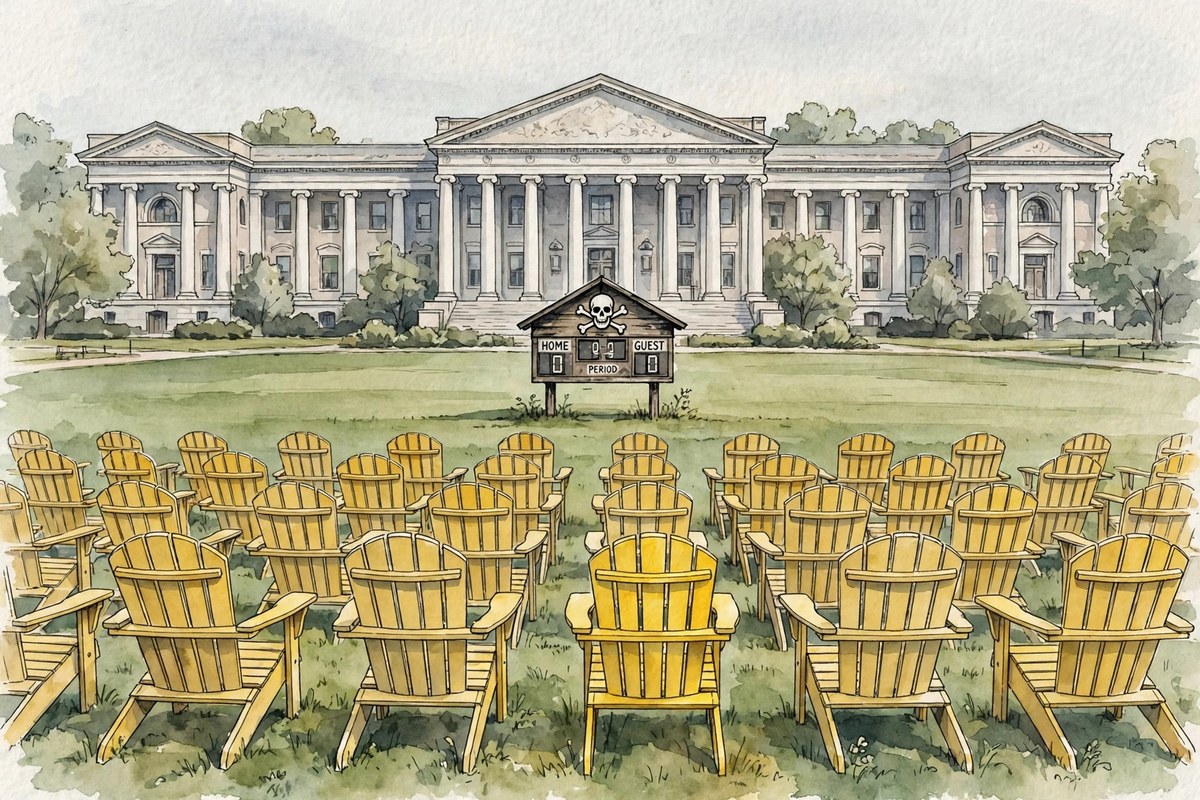
A video is going around TikTok this week, shot on a playing field at George Washington University. Yellow Adirondack chairs sit in rows on the grass where a crowd would go. The text on the screen reads: "Tuition: $72.000 per year. Stadium: ☠" The caption underneath: "$72K in tuition doesn't always get you the most for your money." The creator, who posts as Common Sense Expert, put the question to me in the comments: "I agree. However, do those European colleges charge upwards of $70K per year?"
No. They charge nothing, or next to nothing, and that is the whole story. The European seat is free the way a trophy is free. Somebody wins it. Everybody else watches.
$72,000 and No Football Team at All
Start with the number in the video, because the number is real. George Washington University publishes its own tuition, and the published figure for a new undergraduate entering in fall 2026 is $72,000 a year. Fees ride on top. The university's own estimate of the full cost of attendance, room and board and books and the rest of it, comes to $95,155 a year. The video rounded nothing.
Now the stadium. The field in that video is a soccer field on GW's Mount Vernon campus, and the skull and crossbones is generous, because GW has no football team to bury. The Colonials played their last game on Thanksgiving Day, 1966, and lost it to Villanova, 16–7. The trustees voted the sport out of existence that January. Cost, no stadium of its own, empty seats. Seventy-two thousand dollars a year, and the school dropped football before the moon landing.
GW is my school. I started there at nineteen, a kid from Hawaii by way of Saint Louis School, and the university took me on the American terms that still run the place: I could pay, so I could play. That transaction is the subject here. Europe runs the opposite one.
The Sort Happens at Ten
Germany is the clean case, the one people picture when they say free college. Public universities there charge no tuition for most students. What Germany charges instead is childhood. German children finish Grundschule, the common primary school, and at about age ten the system sorts them. A teacher recommendation, the Grundschulempfehlung, points each child at a school type: the Gymnasium, which ends in the Abitur and the university door; the Realschule, the middle road; the Hauptschule, the road to a trade. In grade eight, 37.2% of German pupils sit in a Gymnasium. The rest are already somewhere else.
The federal statistics for 2024 close the loop. In that year, 46.4% of a German age cohort earned a qualification to enter higher education of any kind, and 38.2% earned the full university entrance qualification, the allgemeine Hochschulreife. Read it from the other side: more than half of every German cohort never holds the ticket the free university asks for at the door. The free seat was decided before puberty, in a primary school classroom, by a recommendation.
So the German family that wants the free seat works the problem from age eight or nine. Tutors. The best primary school the family can reach. Schmoozing the teachers whose recommendation carries the day. A twelve-year campaign, run by the parents, aimed at a sort rendered when the child is ten. The prize at the end of the campaign is a tuition bill of zero. That is the meritocracy, and the prize is real, and the gate is a decade wide and it closes early. A kid who wakes up in his senior year and decides he wants university has decided twelve years too late. The tracks do reconnect here and there, up the side stairs, at night, the long way. The main gate is the one at ten.
Watch how the campaign runs and the meritocracy shows its seams. The recommendation is a teacher's judgment, so the family manages the teacher. Parents show up, volunteer, cultivate. Families move house to land inside the catchment of the right Grundschule, the one whose recommendations run generous toward the Gymnasium. A bad recommendation can be fought, appealed, argued around in some states, and the fighting is done by the families with the time and the confidence to fight. The sort at ten is a test of the child. It is also, quietly, a test of the parents' education, income, and nerve, administered a decade before anyone calls it that. The free university sits at the top of this ladder, gleaming, unbought. Every rung below it is a family at work.
France Charges €178 and Rations the Crown
France runs the same ration with better tailoring. A licence at a French public university costs an EU student €178 a year, set by the state. Admission runs through the national Parcoursup platform, on the strength of the school file. And then there is the track that actually runs France: the classes préparatoires, two years of grinding after the baccalauréat, feeding a competitive examination, the concours, into some 250 grandes écoles. The grandes écoles are where the ministries and the boardrooms come from. The open university is cheap. The crown is rationed by examination, and the examination is the end of a preparation that starts, again, in childhood, in the choice of lycée, in the family's whole posture toward school. The prépas themselves sit mostly in public lycées and cost next to nothing. Money is never the currency in these systems. Rank is. Rank is minted early and spent once.
One correction, because the word "Europe" does too much work in this argument. England charges. The English fee cap for a home undergraduate stands at £9,535 for 2025–26, and London plans to raise it with inflation. England is a pay system wearing a European accent. The free systems are the tracked systems, Germany and France and their cousins, and every one of them pays for the free seat with an early sort.
America Sells the Seat to the World
The American system runs on the opposite fuel. In America, a C student can pay his way into an excellent school. A family that missed every gate, started late, aimed low, and saved money can still buy the seat, senior year, on the spot market. Europeans who miss their own cut do exactly this. The kid who failed to make the merit line at home takes his parents' money to America and pays to play, or pays a private university at home, because buying your way into a free European university is the one transaction the system refuses. No free lunch. The lunch is free. The chair is earned at ten, or the chair is in Ohio, at full price.
Why is the American chair so expensive? Because the auction is global. A university has 2,000 seats, or 10,000, or 20,000, and the seats never multiply. The bidders are the whole world. The Institute of International Education's Open Doors census counted 1,177,766 international students in the United States in 2024–25, a record, about 6% of everyone enrolled in American higher education. Of the international undergraduates, 82% pay primarily out of personal and family funds. That is the bid under every American seat: the savings of families in Mumbai and Beijing and Riyadh and São Paulo, offered at full price, for schools Americans themselves call garbage. An American family paying full price is bidding against the planet. The tuition is the auction clearing, printed on a website.
The price lands on the American kid in a specific way. His competition for the seat is a family on another continent for whom the American degree is the family project, budgeted for years, paid without blinking. The seat goes at the price that family can bear, and his family is handed the same number. A school Americans rank as mediocre can still fill its entering class with full-pay internationals, because the degree's value is set in the labor market back home, where an American credential, asterisk and all, outranks the local one the kid could not reach. Mediocrity is a local judgment. The bid is global, and the bid wins.
It was not always an auction. In 1949–50, Open Doors counted 26,433 international students in the entire United States, 1% of enrollment. American college was cheaper then and the barrier was lower, and the world could not get here to bid. Sending a child across an ocean to pay full price at an American university took money, ships, visas, nerve. The postwar American campus was a local market. The expensive American college of 2026 is what a fixed number of chairs looks like after the whole world joins the line.
The Asterisk
The bought degree travels home with an asterisk on it. Everybody in the home country knows how the sorting works, knows the kid missed the cut at ten or at the concours, knows the American seat was purchased with family money. The degree is real. The knowledge is also real. So the graduate's employable niche, for the rest of his life, is the interface: the local man who can talk to the Americans, the woman who can run the German parent company's American office, the bridge between the family firm at home and the country that educated him. The purchased education buys exactly one durable asset, fluency in the place that sold it, and the market at home prices him as a translator between worlds. He pays full price for the asterisk and then works the asterisk for forty years.
The Stadium Is the Tell
Now bring it home to the stadium, because the stadium is where the two systems show their hands. Harvard has football. Yale has football. Army and Navy have football, and their game fills a stadium every December. The NCAA publishes the estimate for where college football players end up: about 1.6% of them reach the professional game. The merit-rationed schools contribute their rounding error to that figure. The pipeline runs through the pay-to-play giants, the state flagships and the football factories where the crowd and the roster are drawn from the same open door.
The crowd is the point. College football's hundred-thousand-seat bowls are filled by alumni of universities that admitted the alumni, by whole states whose kids could get in. The tailgate is a reunion of the admitted. Run the German sort on America and the reunion ends. The fans in the parking lot, grilling at dawn, painting their faces, are the people a free system would have sorted out at ten, into the Realschule of life, wished well, and sent to a trade. They love the school because the school took them. A university that takes almost nobody gathers a priesthood. A university that takes the state gathers a congregation, and the congregation builds a stadium.
So the answer to the man in the comments is no, with the machinery showing. European colleges do not charge $70,000 a year. They charge a childhood, sorted at ten, groomed from eight, and the families who lose that sort wire the $70,000 to us. GW put the whole arrangement in one frame: $72,000 on the screen, yellow chairs on a soccer field, and no football team since 1966. The price and the empty chairs are the same fact. America sells the seat, so America fills the stadium. Europe gives the seat away, so Europe holds the ceremony in a lecture hall, for the few who won it before they turned eleven.
Share: X · Facebook · LinkedIn · Reddit · Bluesky · Threads · Email