
Matt Shade Is a Christ Figure
This article, read aloud:
Share: X · Facebook · LinkedIn · Reddit · Bluesky · Threads · Email
I have a question, and I have been putting it to Google the way other men put questions to the ocean: has anybody—anybody with a PhD, anybody with a master's thesis, anybody with a paper or even a blog—ever addressed the moral teachings of Private Eyes? Has anyone mapped Matt Shade as a Christ figure? Has anyone, anywhere, written The Gospel According to Private Eyes? The answer, as far as my research can dig, is no. Academia has not touched it. The critics file the show as a breezy Canadian will-they-won't-they procedural, comfort food with a Hall & Oates theme, and move on. Nobody has claimed this territory. So I am claiming it. Consider this essay the first draft of that gospel, written by the only scholar currently working in the field, a man whose credentials are that he has watched the thing too closely for his own good.
I have earned the obsession honestly. I wrote about pride and going back, and then about partnership and perception, and somewhere across the first three seasons my entire character started being refreshed and renewed by a detective show. I am learning so much that is moral and ethical from this program that I went looking for the literature the way a man who has had a religious experience goes looking for the seminary. There is no seminary. There is just me, up to season 4 now, taking notes, and the fourth season is where the gospel gets messy enough to need writing down.
Here is the mess, and it is a beautiful one. Years ago, before the agency, before Angie, Shade blew into a woman's life for one summer and had an affair with her, and then the summer ended the way summers do. She went back to an old boyfriend. Life went on, hers and his, and nobody—not then, not in four seasons of television since—has ever gotten a paternity test. So when a young woman comes out of the woodwork saying she might be his daughter, she is working from the same evidence the rest of us are: one hot summer and a resemblance. Then her mother shows up in person, and the mother is, and I say this as a man taking notes, extremely hot, and she is kissing on Shade like the intervening decades were a commercial break. Everything is unresolved. Nobody knows whose kid anybody is. It is the messiest this breezy little show has ever allowed itself to be, and I could not look away if you paid me. I am obsessed and I love this TV show too much and I don't even know who I am anymore.
And Angie. Angie Everett has a sexy new bobbed haircut this season, and I am obsessed, and she still cannot close the deal with Shade, and I need to be honest about how much of that I don't like, because a gospel should record the heresies too. Angie is the license, the agency, the professional; her name is the one on the door. But too much of this season writes her as the one who pines—reacting to Shade, spite-dating lesser men as a coping strategy, carrying a chip on her shoulder where her plan ought to be. We don't like it when our strong women characters pine for a boy. It doesn't make her look smart or full of agency; it makes her a response monster, a reaction monster, a spite monster, and Angie Everett as written in this show's best hours is none of those things. Shade, meanwhile, sails through the same episodes unbothered, which brings me to the doctrine at the center of the gospel.
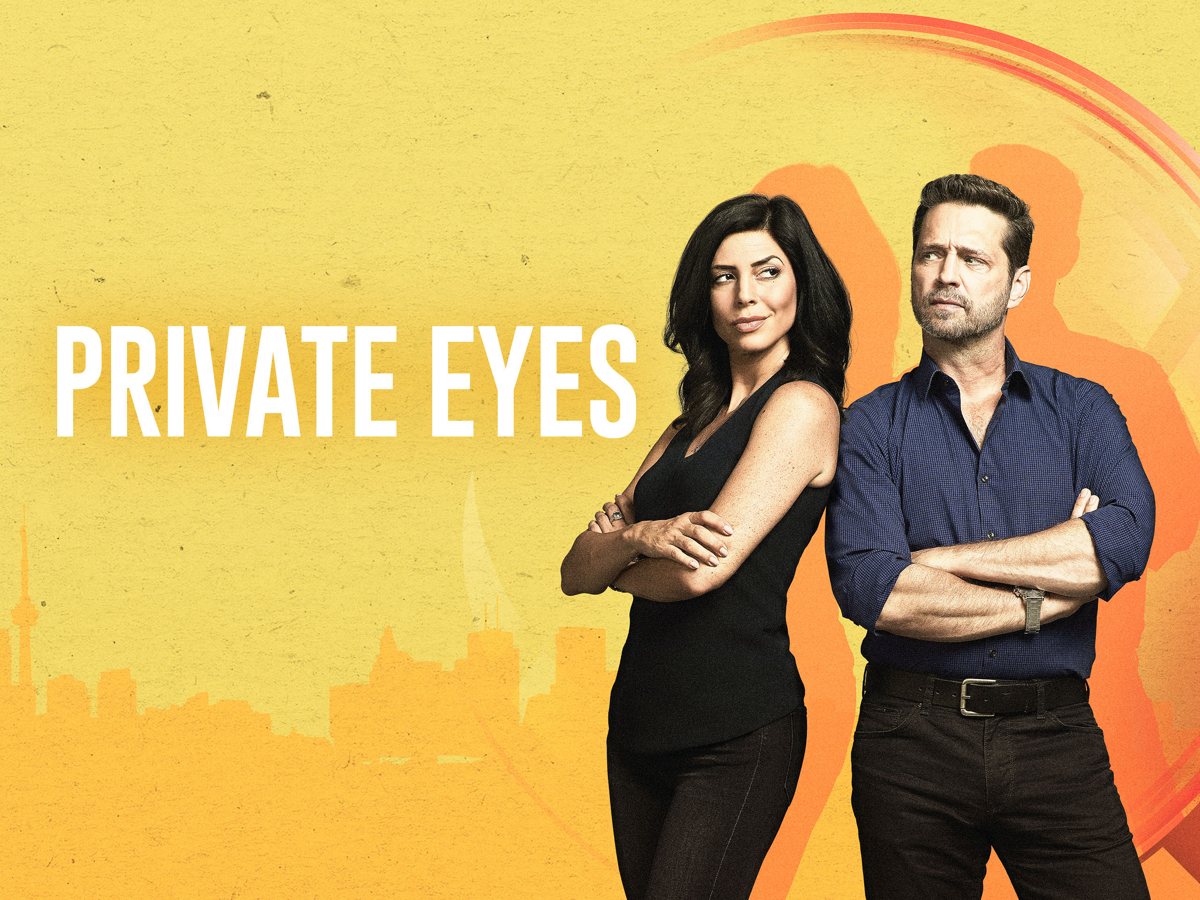
Here is my conceit, and I will defend it at parties: on Private Eyes, Jason Priestley's Matt Shade is the Christ figure. Not the suffering part—nobody's nailing Shade to anything—but the grace part, the part where people keep bringing him their worst moments and he refuses to charge them for it. Watch what happens every time somebody comes to Shade to apologize. An ex, a friend, a screw-up with a confession about some sexual or emotional mess, standing there braced for judgment, and Shade waves the apology off before it is even finished. Everybody's been a piece of shit. Everybody's blown up their life at least once. Everybody has done the thing they are confessing, or something adjacent to it, in the dark, at their worst. He who is without sin can cast the first stone, and Shade—the man with the affair, the maybe-daughter, and the wreckage of a hockey career behind him—knows exactly how many stones he's qualified to throw, which is none. Turn the other cheek is not a sermon with him. It's a reflex. And before anybody calls the casting a coincidence, we have to focus on Jason Priestley's last name, which is priestly. The most forgiving man on television is played by a man named Priestley. I did not arrange that. I am simply the first scholar to report it.
Now, a question the gospel has to ask, because I genuinely don't know the answer: is this just Canada? This is a country whose founding bargain was peace, order, and good government rather than life, liberty, and the pursuit of happiness, and its television has a whole blue-sky tradition—Murdoch Mysteries, Rookie Blue, this show—where the point of catching the bad guy is almost never the cage. It's restorative where American television is retributive. It's community healing where the American version wants a body count and a gavel. Maybe a Christ figure could only hold a series together in a country that never fully bought the punishment part of justice. Or maybe I'm a man three and a half seasons into a comfort show, building a theology out of weather. The gospel records the question. The gospel does not have to settle it.
What the gospel does settle is why the whole messy solar system of this show holds together. The daughter can come out of the woodwork because Shade won't greet the possibility with a lawyer. The mother can come back because she knows the summer won't be held against her. Ex-wives and old boyfriends and con artists and clients all orbit this man because he is the one place in their lives where the bill never arrives. Family rules, friends rule, loyalty rules, and you don't judge people for doing sexual or emotional things—not because those things don't matter, but because everybody at the table has done them and the only honest response is the one Shade gives: that's happened. It's done. What do you need?
One more entry for the record, filed under mysteries the gospel cannot explain and doesn't need to. Google tells me that Priestley himself—British, Scottish, Northern Irish, French-Canadian stock, about as layered as this country gets—has described himself as an atheist. An atheist named Priestley playing the most forgiving man on television. I have not verified this beyond my own late-night research, and I have decided I don't care to, because if it isn't true it ought to be.
It doesn't matter if anybody is an atheist. If they walk in the footsteps of Jesus, then they are christly and they are priestly. Belief is a résumé line; the footsteps are the work.
So an update on the student, who is still, somehow, enrolled, and has now apparently founded a field. I came to this show for a breezy procedural and stayed for lessons in pride, partnership, and perception, and season 4 has moved me on to graduate work: forgiveness, handed out wholesale, before it's earned, by a man who knows his own file is too thick to throw stones. I'm still behind him in the coursework. The difference is that now I know nobody else is teaching the course. Some of us get a therapist, some of us get a sponsor, and some of us get Jason Priestley playing a detective who forgives like it's his job—because on Private Eyes, it turns out, it is.
And since a gospel should end with a resurrection, here is the show's own. For five years after it ended, Private Eyes sat in exactly one obscure American streaming home, Hallmark+, written off by an industry that had decided a gentle Canadian procedural was a closed file. Then, in a single week this month, the file reopened. The sequel, Private Eyes West Coast, premiered in Canada on September 30 and on The CW on October 5, and the very next day, October 6, the original series landed on Hulu, as if the one licensor behind it all, Lionsgate, had decided to roll the whole franchise back out at once. The sequel had been renewed for a second season back in December, before a single episode had aired. In it, Shade and Angie are married, living in Victoria, raising a baby son named Declan, and Priestley himself says the new show finally gives closure to the kiss the old one ended on. A marriage, a baby, a renewal, a homecoming. The show got the Matt Shade treatment: written off, then forgiven, renewed, and resurrected. The student remains enrolled.
As an Amazon Associate I earn from qualifying purchases.
Share: X · Facebook · LinkedIn · Reddit · Bluesky · Threads · Email