
Someone Else's War
This article, read aloud:
Share: X · Facebook · LinkedIn · Reddit · Bluesky · Threads · Email
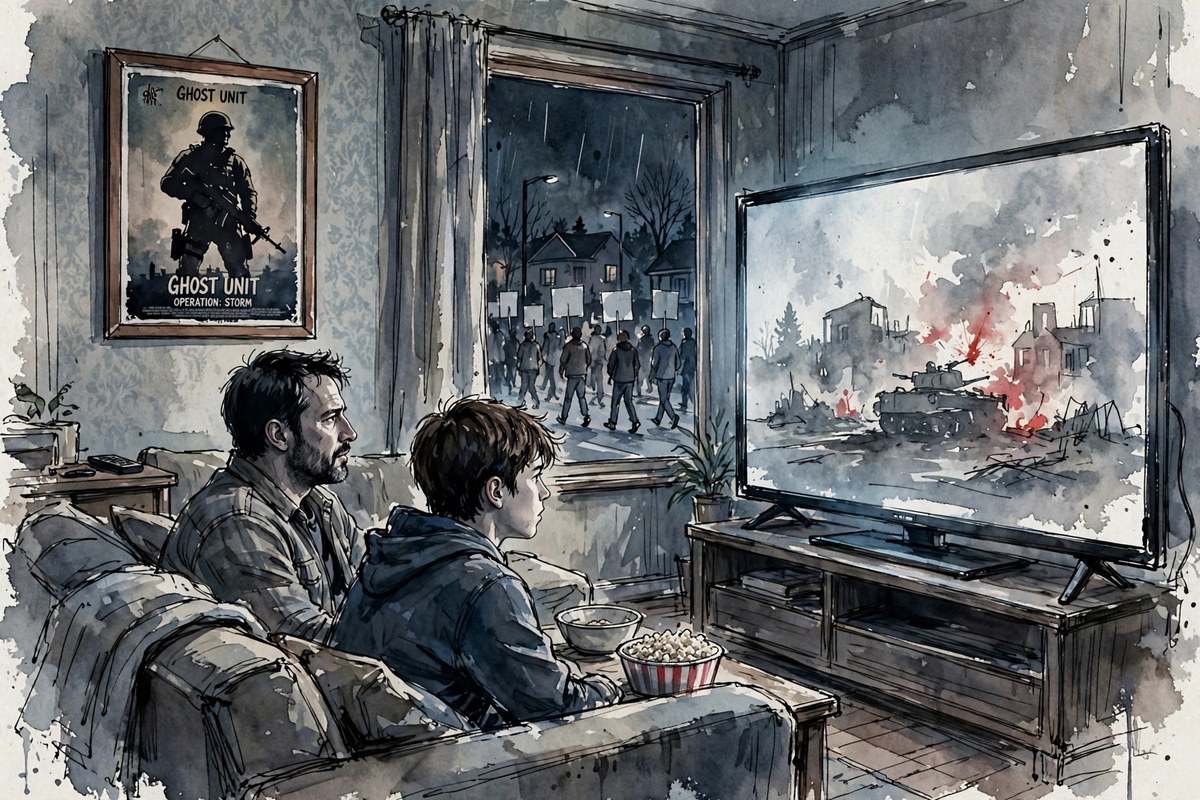
The Navy SEAL is a pin-up now. So is the Green Beret. So is the Force Recon Marine, and the long-range reconnaissance patrol—the LRRPs, two or three men and a radio living in the jungle for a week on what they could carry. MACV is a logo with a back catalog. We have turned Special Forces sexy. We have turned MACV sexy. We have turned Navy SEALs sexy and Force Recon sexy and long-range reconnaissance sexy. We have turned killing generals with suppressed Rugers sexy. We have turned just about every single thing that made people yell baby killer into entertainment, and the entertainment is very good, and nobody who makes it or watches it has to go.
The killing did not change. The contract changed. The boys who came home to baby killer were drafted—taken, at eighteen and nineteen, by a government that reached into the mailbox and pulled them out of their lives. The men on the posters now volunteered. They are professionals, and they come home to book deals and production companies and a grateful nation's streaming subscriptions. When the state takes your son, killing is obscene. When a professional signs for it and the footage comes back clean, killing is content. The obscenity was never in the act. It was in the invoice, and the invoice used to have your family's name on it.
The glamor is an industry with departments. The SEAL memoir is a shelf in the bookstore, with advances and movie deals. The operators have podcasts, coffee brands, sunglasses lines, production companies. MACV-SOG—the Studies and Observations Group, men whose missions stayed classified for a generation, whose government would not admit the countries they had been in—is a streaming genre now, its survivors telling the stories on camera to audiences eating dinner. I do not begrudge one of those men his book or his brand; they paid for the stories in the only currency that counts. I am describing the audience. The audience that once made baby killer a household phrase now buys the coffee.
War is a spectator product in this country, in both directions. The fighting is entertainment. So is the opposition to the fighting. The two audiences are the same audience, and neither of them is at risk of being called.
Someone Else's War
The entire world is talking about Palestine. Everybody is freaking out about Palestine. And here is the thing nobody says inside the freaking out: none of us is in that war. Not the students, not the celebrities, not the city councils passing resolutions about a coastline most of them could not find in an atlas in the dark. There is no draft. There are no sons. There is no tuition due. It is the perfect protest war—a Vietnam that cannot reach into anybody's mailbox.
The generation that marched against Vietnam marched with an induction notice hanging over every male head in the march. Their fervor had a price list: your body, your brother's body, Canada, prison, a life bent out of shape by the choosing. I am not romantic about them, and neither is anybody who watched them aim their contempt at the drafted boys instead of the men who drafted them. But their opposition cost them something real, and cost is what makes an act an act instead of a mood. The new fervor is free. People were hungry—hungry to fight an unjust war, hungry to stand where the photographs show their grandparents standing—and they found a war that asks nothing of them but pissing and moaning, and the supply of pissing and moaning is endless because the price is zero.
Ukraine is the same arrangement with better maps. Someone else's war, argued at full volume in American kitchens and comment threads by people whose children will never be within a thousand miles of it. The volume is not the measure of the stake. The volume is the measure of the safety. A man does not get that loud about a fire in his own house. He is too busy carrying water.
Venting Your Spleen
The ritual demand of the moment is divestment. Divest this. Divest that. Pass the resolution, read the names, move the endowment's money out of the fund that holds the stock that touches the company that sells to the army. What is it, mechanically, when you take it apart? It is venting your spleen. It is lancing a boil. The pressure is in the protester—the pressure is the whole contents of the event—and the lance relieves the protester, and the war does not notice, because nothing arrives at the war. The shares the endowment sells are bought the same afternoon by a man who does not care, at the market price. No budget shrinks. No army goes short a single bullet. It's absolutely nothing, and it is dressed as the heaviest moral machinery of the age, and the dressing is the point: the boil was never on the war. The boil is on the protester, and lancing it treats the protester, and he walks away from the encampment drained and righteous, which was the entire purpose of the procedure.
The answer comes back with a pedigree: it worked on South Africa. Men and women who actually fought apartheid—Archbishop Tutu among them—reach for the tool that was in their hands, and I do not blame a man for reaching for his own hammer. But a tool is not a spell. It worked on South Africa because of what was underneath South Africa, and what was underneath South Africa is not underneath Israel, and the distance between the two is not a nuance. South Africa was completely different.
South Africa Was Completely Different
Start with the census. In 1986 South Africa held about 34 million people, and 4.9 million of them—14 percent—were white. That 14 percent held 87 percent of the land and the whole of the state. Black South Africans were three-quarters of the population, and by 1980 they were already 64 percent of the labor force, because the economy did not merely employ the majority it ruled—it ran on them. Black hands in the gold mines. Black hands on the farms and in the factories, paid about a quarter of white wages and governed by a passbook that told a grown man where he was permitted to stand. A state that runs on the labor of the people it disenfranchises has a lever sticking out of its side, and everybody can see the lever. In 1979 the regime, desperate for industrial peace, legalized Black trade unions. The unions organized. The strikes came. The lever moved the machine, because the lever was attached to the machine's foundation.
Then look at what the country sold. Gold. Diamonds. Coal. Fruit. Things with names, things you could hold in your hand—the Krugerrand sat in coin-shop windows in Ohio. A boycott needs a surface to grip, and South Africa was all surface. In 1985 the foreign banks stopped rolling over Pretoria's short-term loans and the rand fell out of bed; an export economy lives on credit, and the credit was gone. On October 2, 1986, the Congress of the United States overrode Ronald Reagan's veto—78 to 21 in the Senate—and enacted the Comprehensive Anti-Apartheid Act: no more Krugerrands, no coal, no iron, no steel, no uranium, no textiles, no farm products, no new American loans, no new American investment. And when the Cold War ended three years later, the last shelter went with it: Pretoria's value to the West as an anti-communist address evaporated, and there was nobody left with a reason to protect it. The campus ritual got the credit for all of this, and the ritual was real, and the ritual was the smallest part of it. Underneath the ritual stood a striking majority workforce, a commodity economy a boycott could starve, a credit cutoff, and a superpower willing to sanction its own ally. The mechanics did the work.
Now run the same checklist over Israel and watch every line invert. Inside the state itself, one citizen in five is an Arab—2.1 million people—who votes, and has voted in every election since 1949, whose parties sit in the Knesset, who put Khaled Kabub on the Supreme Court in 2022, whose Islamist party, Ra'am, sat inside a governing coalition in 2021, and who in the election of October 27, 2026 won 19 of the Knesset's 120 seats, the strongest showing Arab-led parties have ever had. There is an argument to have about the territories, and it is a real one, but it does not start here. It does not begin with a 14-percent minority ruling a disenfranchised three-quarters. The analogy dies on the first line of the census.
The economy inverts the same way. More than half of everything Israel exports is high-tech—software, cybersecurity, semiconductor research, intellectual property. The Israel Innovation Authority counts high-tech at about a fifth of the whole economy and 53 percent of exports. None of it sits in a coin-shop window. It is embedded, invisibly, inside the supply chains of the very companies in the protesters' phones and pension funds; there is no Krugerrand to ban, no crate of fruit to leave on the dock. The labor line inverts too. Before October 2023, fewer than 200,000 Palestinians worked in Israel and the settlements, about half of them pouring concrete—in a workforce of more than four million, a few percent, in two industries. When the permits stopped after the October 7 attack, the building sites stalled, and Israel flew in the replacement: 65,000 foreign building workers announced from India, Sri Lanka, and Uzbekistan, and tens of thousands more behind them. A workforce that can be replaced by charter flight is a hardship. South Africa's workforce was the foundation of the state. And the politics invert last of all: the state-level weapon that finished Pretoria points the other way here—38 American states have anti-BDS laws or executive orders on the books, and a company that wants a state contract in most of this country first has to certify that it is not boycotting Israel. The superpower is not sanctioning the target. The superpower's states are sanctioning the boycott.
The fervor is real. Nobody fakes caring at that volume, and the caring is not the question. The invoice is the question. The kid who marched in 1968 got a notice in the mail, and his convictions came with a price attached, and he paid it or fled it and either way it bent the shape of his life. The marcher in someone else's war pays nothing, risks nothing, and loses nothing but an afternoon. The sexy warfighter on the screen and the righteous crowd outside the endowment office are the same audience at two showings of the same picture, and the picture is war with the cost taken out. Venting your spleen feels like surgery. It is a pressure valve. It's absolutely nothing, and it feels like everything, and that is exactly what it is for.
Share: X · Facebook · LinkedIn · Reddit · Bluesky · Threads · Email