
Yankee Doodle
This article, read aloud:
Share: X · Facebook · LinkedIn · Reddit · Bluesky · Threads · Email
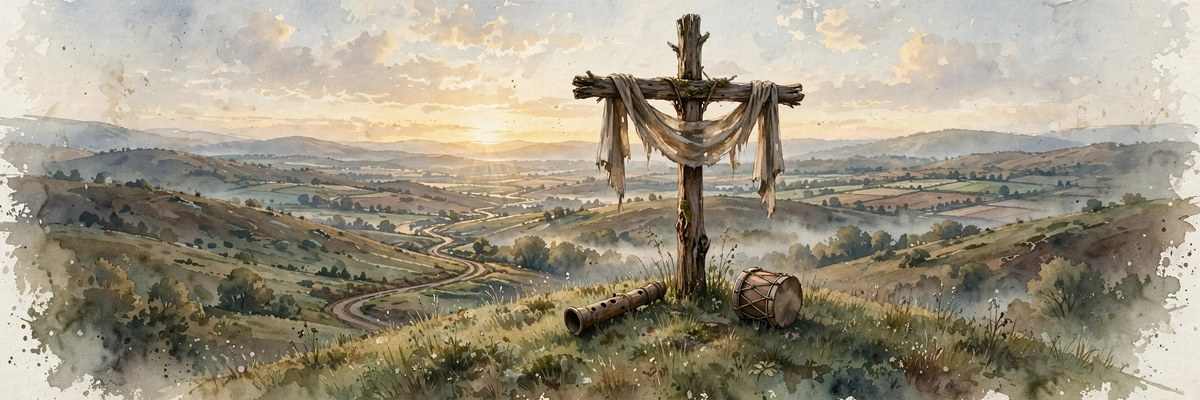
Rome had a machine for shame, and it was a cross. Crucifixion was the slaves' punishment, reserved for slaves, bandits, and rebels; citizens were exempt, and Cicero wanted the word "cross" kept from a citizen's thoughts, eyes, and ears. After Spartacus's revolt was crushed in 71 BC, six thousand slaves were crucified along the Appian Way. The death was slow and public. The instrument was engineered to say: the person on it is beneath contempt.
The followers of a crucified man took that instrument and made it their flag. Paul wrote that Christ crucified was a stumbling block to Jews and folly to Gentiles, and quoted Moses—cursed is everyone who hangs on a tree. He preached the cursed man as God anyway. By AD 200 the cross was traced on foreheads—Tertullian describes it. By the fourth century it was the faith's chief emblem; Constantine abolished crucifixion itself, reportedly out of reverence for it. Today it hangs in gold, the most recognized symbol on earth.
It worked because of what this God does with a blow. Christianity is based on a God who turns the other cheek—a poor, pathetic God by every standard of Roman honor. The real Christ does not have a glass jaw. And the founding exhibit is not a defeat, and it is not a turnaround. The Jews and the Romans did not kill Jesus; Jesus sacrificed himself for us, the Paschal Lamb. He said it in John 10:18: "No one takes it away from me, but I lay it down by myself." It was the plan all along—not a salvage, not a man announcing afterward that he meant to do that. Judas, the Jews, the Romans: facilitators, big blobs of grease toward an end none of them authored. Peter said both halves at Pentecost, Acts 2:23: delivered up "by the determined counsel and foreknowledge of God," and killed "by the hand of lawless men." The plan was God's; the hands were theirs. The Old Testament runs the same play. In Exodus, God hardens the Egyptians' hearts so they will chase Israel into the parted water and be destroyed; left alone, they might never have chased. Paul reads Exodus the same way in Romans 9:17—God to Pharaoh: "For this very purpose I caused you to stand, that I might show in you my power." The fairness objection gets the potter and the clay (Romans 9:20-21): the thing formed does not lecture the Former. God completely had root access to that entire exchange. Peter Geach's grandmaster makes the same point: he forces no move, and every legal move ends at his checkmate. The entire Bible is one man playing chess against himself. Boethius worked out the mechanics in The Consolation of Philosophy: God does not live in linear time. To God it is an Eternal Now—Big Bang, Exodus, cross, and end in one simultaneous present. Watching the charioteer from the tower does not make the driver turn the wheel. That is not fatalism. Fatalism says the destination is locked no matter what you do; this says the destination is locked because of the exact choices freely made, and metanoia—the change of heart—is the mechanism the timeline unfolds by. Open Theism gives him a turnaround to work, the salvage theory again. The Mandelbrot set is the picture of it. One short equation; every point's fate settled from the start; the whole set existing all at once, outside time. And the boundary never repeats, no matter how deep you go—chaotic beauty out of a fixed rule. The rule is fixed; the detail is free; the whole is perfect and the inside is wild. The Buddhists drew it millennia before the mathematics: Indra's net, a web of jewels, each one reflecting all the others.
Robert Jastrow ended God and the Astronomers with the scientist pulling himself over the final peak to find the theologians already seated. My version seats the Buddha among them, lotus position, smiling: "What took you so long?" Two trails, one summit—the wisdom trail and the love trail. The contemplatives were never climbing. Thich Nhat Hanh's Living Buddha, Living Christ is the same friendship in print; Thomas Merton made the same friendship from the other side.
You cannot defeat a God whose central act is voluntary: every blow lands on an offering, and the offering was his idea. Tertullian, writing to the empire's governors in AD 197, did not plead; he taunted: "We multiply whenever we are mown down by you; the blood of Christians is seed." Persecution is not the faith's emergency. It is the faith's home turf. When Christians are oppressed and subjugated, when they are despicable in the eyes of the culture, when every vote goes against them, they feel back at home. The church grew for three centuries under men trying to exterminate it.
Admiration is not the faith. Nobody gets Jesus by finding him awesome—his philosophy rocks—chosen like a shirt: I don't look good in orange, so not Buddha. The twelve steps know the order: no recovery without rock bottom. Jesus as best buddy is the partial inheritance. Jesus as Savior, needed by a man collapsing without him, is the whole: the full communion, the deliverance, the inheritance of the Paschal Lamb.
Rope-a-Dope
Muhammad Ali named the strategy in Kinshasa in 1974. In the second round Ali went to the ropes against the hardest puncher alive. His trainer begged him off them; Ali waved him away: "I know what I'm doing." For seven rounds Foreman punched himself empty on a leaning man. In the eighth round Ali came off the ropes and put him down. Rope-a-dope: absorb the round, let the other man's arms spend themselves. Jesus is really good at rope-a-dope, and Christians are really good at rope-a-dope, because the founder ran the play first.
He is not the only founder who ran it. Buddha is a rope-a-dope. A brahman named Akkosa—the word means "abuser"—reviled the Buddha. The Buddha heard him out, then asked whose a declined gift is. Mine, said the brahman. Just so: I decline your abuse; it stays with you. The insult is an offering; it has to be accepted to be delivered. Krishna is a rope-a-dope. His aunt had won him to a promise: a hundred pardons for her son Shishupala, kept through crimes—Dwaraka burned, a sacrificial horse stolen, all borne. At the great sacrifice the insults came—cowherd, nobody, fraud—and Krishna took the hundredth sitting down.
The Cheek That Turns Is Your Own
The count had an end: at the hundred-and-first offence Krishna stood up, the discus flew, and Shishupala's head came off before the assembled kings. That end is the difference between rope-a-dope and a doormat. Christianity carries the same distinction, and it is not to be taken lightly. The cheek that turns is your own cheek. A Christian absorbs every insult aimed at himself; his pride is not a protected asset. But Christianity is willing to take up swords and spears and knives and guns on behalf of his neighbor. It's a real CCW belief. A faith that can tell those two apart cannot be baited and cannot be bullied.
Brittle Gods
The glass jaw lives on the other side of the line. The modern world installed substitutes, and every one of them is brittle. Science is a very brittle God. Scientism is a very brittle God. Humanism is a very brittle God. Culturalism and tribalism is an extremely brittle God. Capitalism is a very brittle God. Communism is a very brittle God. Atheism is a very brittle God. A brittle god cannot absorb an insult or a heresy; he has no ropes and no count. Every substitute god keeps a police force of believers; the god himself cannot take the hit.
These are consensus reality based modalities. Scientism runs on universal buy-in. It is not relevant to most people's daily lives and most people do not need it; its authority exists only while everybody agrees it is the authority. A god whose power is made of agreement has to police the agreement: every heretic is a leak in the only substance he is made of. Heresy is an emergency to a consensus god. Kuhn: paradigms hold until the anomalies pile too high, then go all at once—geocentrism to heliocentrism, Newton to Einstein, the aether discarded, ulcers re-caused. Yesterday's absolute is today's museum piece. Christ's church grew fastest when the empire's consensus was organized to kill it.
Yankee Doodle
The song arrived as a joke at the colonials' expense: "Yankee" the sneer, "doodle" a simpleton, the verse a bumpkin with a feather in his cap calling it macaroni. British troops marched to it on day one. The rabble took it. The rebels claimed it and wrote dozens of verses. The Library of Congress: by Yorktown the insult had become a point of pride—the republic's unofficial anthem. Tradition adds the Lafayette ending; Smithsonian calls it possibly apocryphal. The wanting is the fact.
Contemptibles and Devil Dogs
In August 1914 an order in the BEF's routine orders, said to be the Kaiser's command of August 19, read: "exterminate first, the treacherous English and walk over General French's contemptible little army." The men adopted it. The survivors took the name: the Old Contemptibles. Their association on the name, founded 1925, stood until 1966. One defect: nobody has ever found the order. No trace exists in German archives; the Kaiser denied it; a 1925 British investigation concluded a British officer most likely fabricated the words. The insult they wore with pride for fifty years was written by one of their own side.
Four years later the Marines got theirs. "Teufel Hunden," Devil Dogs, is supposed to be the Germans' name for the Marines at Belleau Wood. The Corps' proudest nickname is almost certainly an American invention. The phrase was in American newspapers on April 14, 1918—six weeks before Belleau Wood. Mencken called it a correspondent's invention in 1921; the Marine Corps' History Division agrees the Marines likely named themselves. The spelling testifies: German writes it Teufelshunde, one word. Marines have answered for a century. An insult, once adopted, works as well as a real one. The power was never in the insult. It is in the wearing.
The Orcs
Ukrainians reached for Tolkien. "Orc" appeared in 2014, aimed first at Yanukovych's riot police, then at Russian soldiers in the Donbas; Russia became Mordor. On February 25, 2022, an official Ukrainian Armed Forces post carried it to the war. It is a total insult: subhuman. The Russians picked it up as a term of pride. Ostap Slyvynsky, a Lviv University scholar, told the BBC Russians adopt it as a badge of honour. The patch trade sells a chevron reading "the Orcs are coming"; a UNITED24 photograph shows a sleeve patch: "I am an Orc."
Russia was ready for the word. In 1999 Kirill Eskov published The Last Ringbearer, a retelling of Tolkien from Mordor's side, built on the proverb: history is written by the victors. His Mordor is a city of alchemists and poets, mechanics and astronomers, smeared by the winners' scribes. The men sewing on the patch are not ignorant of Tolkien. They have read the other edition.
Deplorables, Garbage, and a Mugshot
On September 9, 2016, at a fundraiser in New York, Hillary Clinton said: "You could put half of Trump's supporters into what I call the basket of deplorables. They're racist, sexist, homophobic, xenophobic, Islamophobic—you name it." She expressed regret for the "half" within a day. It changed nothing. By Monday supporters at a North Carolina rally were holding "Deplorable Lives Matter" signs, "Proud to be a Deplorable" T-shirts were on sale, and the campaign itself sold the word back to the people it was meant to shame. The insult was meant to mark its targets untouchable. Instead it handed several million people one name. They are wearing it.
Eight years later it ran again, faster. On October 29, 2024, on a Voto Latino call, Joe Biden said, "The only garbage I see floating out there is his supporters." The White House spent a day litigating an apostrophe in the transcript. The next day Donald Trump reached Green Bay, climbed into a garbage truck, and held the rally in the vest. "How do you like my garbage truck?" he asked. "This truck is in honor of Kamala and Joe Biden." No committee designed that. It is a reflex: hear the insult, wear the insult, hand it back with the bill attached.
The mugshot is the same move with the state's own camera. On August 24, 2023, Trump was booked at the Fulton County jail—the first former president booked. He left the jail at 7:55 p.m. By 9:22 p.m. his fundraising committee was selling the booking photograph on T-shirts at $34 under the words "NEVER SURRENDER!" The campaign reported $7.1 million raised in three days. A mugshot is the state's portrait of your disgrace. He had it on a shirt before the file was cold.
The Weapon Is Spent
The mechanism is on the table. An insult collects only while the target agrees to pay—in shame, in apology. The wearing is a refusal to pay. From that moment the arithmetic reverses: the thrower must escalate or retire the word, because a name worn with pride cannot wound. The insult is a confession: the powerful announcing what they think of the people below them—an exhibit they could not have bought. The name does work no committee can do: a patch, a shirt. "Deplorables" did more recruiting in a weekend than a year of pamphlets.
The machinery of shame has an owner, and the owner is a species, not a religion: the scribes. The purity-policing, the calling people skanky and dirty and unclean—that is scribe work, in every age, under every flag. The scribes reproduce by opposition: the anti-scribes become the future scribes, and the anti-scribes of those scribes become future scribes. The wearing is the one exit from the cycle. It declines the office instead of staffing it.
Ali's corner begged him to come off the ropes, and he waved them away, because he knew what he was doing. That is the whole posture, from the Appian Way to Green Bay. The blow lands. The man does not fall. The weapon is spent.
Share: X · Facebook · LinkedIn · Reddit · Bluesky · Threads · Email