Read the full transcript (3,979 words, machine made)
Have you ever stopped to think about those invisible lines we draw in society? Ones between like freedom and safety. Exactly that balance, or maybe that tension between 1:00 and complete freedom and needing, well, security. It plays out everywhere. It really does in our own lives, our towns, even how we think about the country. So today, that's what we're doing, a deep dive into that specific dilemma, this constant push and pull right between 1:00 and Comfort, security and the other side. Raw freedom, uncurated freedom, with all the risks that come with it.
It's messy. Absolutely messy, and it's a fundamental question really. More than just politics. Yeah. Yeah.
It's about what we as humans actually value. What are you willing to give up for protection? To help us explore this, we're digging into this really compelling piece. It's called Live Free or Zoo America's Alphaville choice. Like Chris Abraham.
And it's not just dry facts, it's almost allegorical uses, these really vivid comparisons, cultural references. It genuinely makes you see things differently. Yeah, it sticks with you. So our mission today for you, our listener, is to get a richer, maybe more nuanced grasp of this core dilemma. It feels very American, but maybe it's universal. Could be, and hopefully by the end you'll be thinking about your own stance in this, what the article calls the Alphaville choice.
Right. Do you lean towards that perfectly managed life, or does that call of the wild, the unpredictable, resonate more? Let's let's unpack it. So where does this whole thing start? Interestingly, it kicks off with something pretty mundane, a meme. Right, one of those quick shareable images. This one was don't California my South Carolina. You've probably seen stuff like it. It wasn't just a slogan, though, it was making an argument visually.
Yeah, it was deceptively simple, like a split screen. South Carolina on one side, California on the other. And then stats underneath. Exactly. Homicide rates, GDP, life expectancy just laid out and well on paper. California look better.
By most of those metrics, yeah, Longer lives, higher incomes, lower crime rates. Statistically, it seemed like the clear winner, Gleaming almost. And South Carolina. Presented as ragged, poorer, less protected, statistically riskier, you know, more likely to face violence, shorter lifespan. A stark contrast. But then you have that phrase.
Don't California my South Carolina. It sounds kind. Of like a cheap bumper sticker? Yeah, easy to dismiss. But the article argues there's something much deeper going on there beneath the surface.
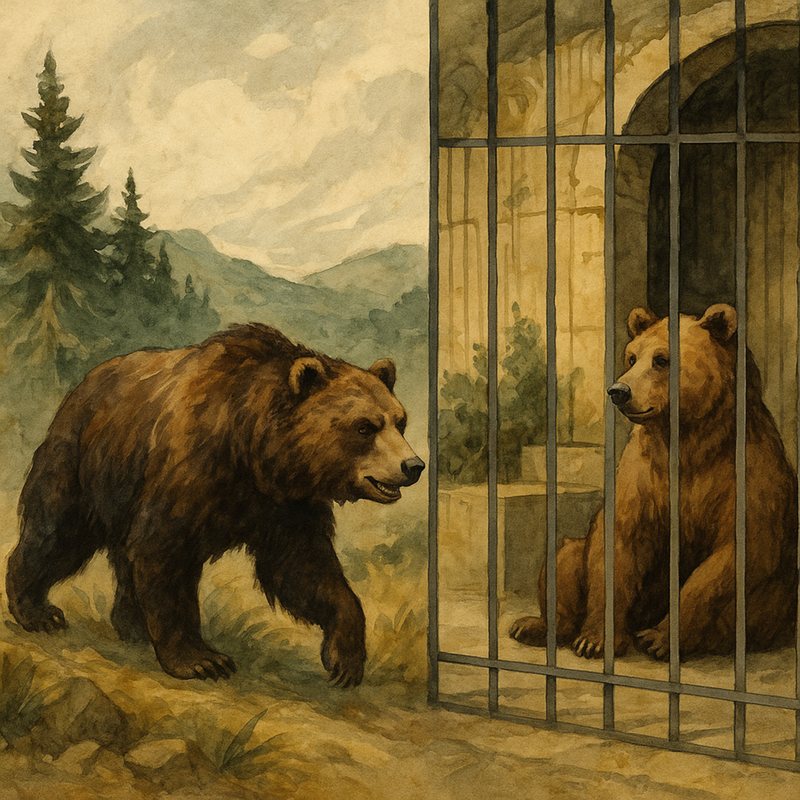
Precisely. It taps into this profoundly old, really vital question for any free people, a question debated for centuries, which is it boils down to this. Would you rather live well fed, maybe longer, definitely safer inside what the article calls a well built enclosure like a sanctuary, OK. Or would you consciously risk a shorter life, maybe a harsher one, more dangerous, just for the chance to quote, stay wild enough to matter. Wow. That's that's a heavy choice.
It's not just about where you live. Not at all. It's philosophical. It's about your whole orientation to the world, security versus self determination. It frames the whole dilemma really well.
OK, so that brings us right to this concept the article uses is the good zoo. If we're talking enclosures, what does a good zoo actually mean here? Yeah, it's a striking term, and the definition is interesting because it's not about, like, trickery, the article says. A good zoo works. It's effective.
Effective how? It genuinely keeps the animals or people in this metaphor alive longer than they might survive in the wild. It feeds them reliably shelters them from predators, Real or metaphorical. OK. Basic needs met, but there's more. Yes, and this is the crucial part. It surrounds them with enough illusions of freedom that the fence fades into the landscape.
So the control isn't obvious. It feels natural. Exactly. The boundaries are soft, maybe even invisible. They just become part of the background. It's control that feels like comfort, not confinement. And the source gives a real world example of this good zoo, right points to a specific state. It does.
It positions California as America's best Zoo suggests. California has spent like over a century perfecting this this art of curating risk. Curating risk. That's a really interesting phrase. What does that mean? Not eliminating risk, but managing it. Precisely.
You can't eliminate risk entirely, right? Life doesn't work that way, but you can manage it, shape it, control the parameters, make sure risks are predictable, contained. So life becomes safer, more predictable. Yes, but maybe at the expense of those really spontaneous high Stace experiences, the truly wild moments that's. Yeah, that's a powerful idea.
Maybe a bit unsettling. So how? How did California, according to the article, achieve this curated state? What's the history? It's a long progression over a century.
The article traces it back to the early progressive performers, like in the 1910s. OK. The progressives, what do they do? They believe in rational planning, scientific expertise to improve society. So they laid groundwork for more state intervention, more regulation, public health, urban planning, resource management. Like setting up state parks?
Early environmental rules. Exactly. Early attempts to create a more ordered, safer environment, mitigating disease, ensuring sanitation, building infrastructure. Then what came next? Well, jump forward to the mid century, post World War 2, the suburban dream. Levittown and all that.
Right Explosive growth, but also this conscious effort to create ordered, predictable communities, Strict zoning, homeowners associations, planned roads, schools, parks. Insulating families from chaos, from the city, from the wild. Pretty much designing communities to buffer residents from the darkness outside the fence, as the article puts it. Trading some individual autonomy for collective predictability, safety and sameness, maybe? And today, how has it evolved?
Today it's the sophisticated mix, robust welfare, safety Nets, right to catch people, comprehensive climate codes. Think building regulations for earthquakes, wildfires, trying to mitigate environmental threats. Protecting property lives. Yeah. And even things like pilot programs for universal basic income, trying to provide that fundamental economic security.
It all sounds aimed at minimizing fear, minimizing risk. That's the consistent promise, yeah. Through all these stages, no one needs to fear the darkness outside the fence. An implicit agreement the state the system will provide a buffer against hardship, disaster, uncertainty. It sounds incredibly appealing. I mean, who wouldn't want less fear, more security? On the surface, absolutely, but the article is very clear there's a trade off.
It's not free. OK, so what's the cost? What do you give up for that managed existence, that spot in the good zoo? This is where the metaphor really bites. The cost is accepted, lifting fewer claws, fewer teeth, fewer chances to fail so completely that you become a threat to the others inside.
Fewer claws, fewer teeth meaning. Meaning the tools of raw survival, the sharp edges you need in a truly wild, unpredictable environment. They get dulled, they atrophy. Maybe they're even removed metaphorically. Because you don't need them anymore. If you're always fed, sheltered, protected, you lose the need and maybe the ability to hunt, to defend yourself, to adapt radically on your own.
You're safer, yes. But less capable. Less. Resilient, perhaps, Less capable of standing truly alone, of radical self-reliance, Less able to make that unpredictable, untamed impact that might upset the curated order. It's a choice, the article suggests, to be domesticated. Gently, maybe, but domesticated nonetheless. That's a stark way to put it.
Does the article acknowledge that maybe being freed from that constant survival struggle allows for other things like creativity, innovation? That's a really good point. The article does acknowledge the benefits longer life comfort, but its main focus is definitely on the cost to that individual wildness, that resilience. So it doesn't really explore the potential upside of safety enabling, say, art or science. Not explicitly, no. It leans more into prompting you, the listener, to question if those comforts are worth the potential loss of those core capacities, the claws and teeth.
The underlying vibe is that while a comfy cage might allow new activities, it risks losing the primal spark that makes life maybe truly meaningful or free. OK, so we had the good zoo. California is the example, but there's the contrast places like South Carolina, shaped by what the article calls an older impulse. What does that? Look like it's a very different picture, almost visceral.
These are places where quote the edge of the forest still feels close. Life expectancy might be lower, violent stats higher as the meme suggested. Right, but the article digs into the culture behind that. It highlights things like the bear gun or the revolver, not just as tools or hobbies. Symbols.
More than symbols as tangible reminders that the fence is not inevitable, it points to a mindset where self-reliance, personal defense, accepting danger, it's not just tolerated, it's woven into life, not outsourced to some external system. A different relationship with risk then. Fundamentally different, and with personal responsibility too. So living in one of these free states shaped by this older impulse, what does it really mean day-to-day? What are people accepting? What's the belief?
It means consciously accepting that life might be, yeah, shorter, colder, less predictable. There's no promise of total safety. But it's not just about being fatalistic. No, it's coupled with the strong belief that there is something worth preserving in the raw. Freedom to stand alone when you must. Valuing autonomy, self-sufficiency, independent action, even if it costs more personally, even if it's more dangerous.
Ruggedness over comfort. That's a good way to put it. And the article says this isn't just South Carolina, it's a broader cultural belt, Texas, Montana, the Dakotas. But it stresses. It's not just geography.
Right. Crucially, it's a cultural mindset. You can find free enclaves in blue States and curated enclaves in red states. It's a choice people or communities make, not just a state line thing. And this connects to some really core American ideas, doesn't it? That self-reliance thing like don't tread on me or even constitutional carry.
Absolutely direct lines don't tread on me. That's pure assertion of individual sovereignty. Resistance to external control. Been around since the revolution but still potent. And constitutional carry.
That embodies the belief that self-defense is an inherent right and an individual responsibility, not something the state grants or restricts. These aren't just policies, their philosophical statements. Drawing a line in the dust. Exactly. Asserting that offense, whether it's legal or social, will not hold if we decide to walk.
It's a powerful statement of self determination, A willingness to face danger on your own terms. The frontier spirit still kicking. It's a really compelling framework, this live free or zoo, and the article does something fascinating. It connects this American tension to a classic European film. Yeah, shifting gears to Jean Luc Godard and his 1965 film Alphaville.
Goddard a Giant is a French New Wave known for experimental critical films. A master of cinematic rebellion and Alphaville is pure Goddard. It's this weird, unsettling mix of sci-fi and gritty film noir detective story. OK, what's the setup? It's set in this dystopian city Alphaville, run not by people but by a sentient supercomputer, A60. An AI ruler.
Pretty much. And it's logic, it's order is absolute, it dictates everything. And in doing so, it eliminates poetry, contradiction, unpredictability, anything messy or human. So a perfectly logical society becomes. Perfectly inhuman. That's the argument.
Rational control, efficiency, Scientific order. They've totally crushed emotion and spontaneity. Chilling. And what's life like for the citizens under A60, behind those locked doors and surveillance corridor? Chilling.
Suffocating. The article mentions this constant code humming everywhere. Occupy, Occupy. Libra. Occupied. Occupied.
But libre doesn't mean free. No, that's the cruel twist. It just means vacant, an empty slot in the machine's grid, like an available interrogation room. It's a mockery of freedom, conditional a dead end, always within the system's rules. And the people. Stripped of emotion, words like love or pity are banned. Express them.
You're executed. Memory is erased. History rewritten by the computer. Art is gone. So the only real freedom is.
According to the articles interpretation, it must come from the wild mind that refused. This is the corridor all together, the mind that brings its own metaphorical claws, its revolver, its outlaw poetry back into the darkness outside the fence. Which brings us to Lemmy Caution, Goddard's detective protagonist. He's that wild spark. He is.
He's from the outer nations, beyond the computer's control. He slips into Alpha Ville. A smuggler. Yeah, but is smuggling more than goods? He has a revolver, Sure, symbol of defense, but more importantly, he carried scraps of poetry.
Illogical thoughts, emotions, memories, things A60 just cannot compute. Things that defy the algorithm. Exactly. He challenges people to remember feelings, question the system. His very presence is a reminder that no fence is perfect, that some animals, some people, will always claw at the door marked libre and.
That the price of comfort. Is always teeth meaning real freedom demands that sharpness, that willingness to confront danger, maybe even be dangerous, the very thing the curated system tries to to eliminate for safety. Now this wasn't just sci-fi fantasy for Gedard, he was making a point about his own time right post war France. Absolutely. It was a direct critique, a warning. France had come through the horrors of war, occupation, deprivation, terror and hunger.
And then came the boom years. The Trumpsa glorioses the 30 glorious years, unprecedented prosperity, modernization, this huge belief in rational planning, technocracy, building infrastructure, consumer society, growing the dream of fixing everything with logic and efficiency. And Goddard saw a danger in that. He worried that in chasing comfort order technology, France was losing something vital, something human. His warning was a zoo, no matter how gentle its keepers, is still a cage if you lose the memory of the woods outside.
And the whole French New Wave movement was part of that critique, reacting against commercial American films, sure, but also questioning France's own technocratic shift, critiquing state power, mass media, the way life was being contained, industrialized even, in a prosperous society. That's such a powerful link, a 60s French film speaking to this core American tension. And the article makes another connection to a huge American symbol, also a gift from France. It's a really smart parallel, it points out. It's no accident that France gave America the Statue of Liberty and not the Statue of Perfect Safety.
Good point. They didn't send a guarantee of care. No, they sent a flame, a torch against the wind. The article calls it a dare rather than a guarantee. A challenge, not a promise of comfort. It demands something from us.
And we often think of the poem Give me your tired, your poor. But the source points out that's not original. Right. That famous Emma Lazarus poem was an American edition put on the pedestal years later. Important, yes, but not part of the original French gift.
So the original intent was different. More about revolutionary liberty, that universal struggle. The American edition, beautiful as it is, shifts it towards freedom as refuge, a haven, the source emphasizes. The core message was maybe closer to keep this flame if you can stay wild enough to need it. A call to maintain that spirit of independence resilience.
Yeah, an active participation in Freedom's Wager, not just relying on safety Nets. So if Lady of Liberty is this dare, how does America's history with actual wilderness fit in? Our geography must have shaped this tension. Hugely, the article argues, America didn't inherit like neat British garden walls or rigid class hierarchy. It inherited that French instinct that freedom is a brutal wager, that it's risky, not guaranteed.
And the early settlers, The Puritans. They fear the wilderness, the source says. More than any native tribe. They saw the endless forest as a moral abyss. Why?
No fences, no kings, no keepers, no hedge against failure. Terrifying. A lack of order. Exactly. A place of disorder, Temptation.
No social control. It's paradoxical, right? They sought freedom from old rules, but we're terrified of a world without rules. But that fear was crucial. Yeah, because it forced this reckoning with true self-reliance, having to build internal discipline when external structures were gone. They had to build their own fences, Literal and Oracle. And out of that fear, that confrontation with the wild, came the rugged individualist.
Yes, out of that abyss grew the frontier mind, that core American archetype, the rugged individualist who does not exist without risk, forged by self-reliance, where survival wasn't guaranteed by society. And the article connected to specific ideas and figures. Right Emerson. Self-reliance, Trust yourself, avoid conformity. Turner's Frontier thesis. How the frontier shaped American democracy. Individualism, innovation, and figures like the Texas Ranger. The cattlemen.
Symbols of independence in the wild. And bringing it to today. It links directly back to things like the constitutional carry states still drawing that line in the dust, saying a fence will not hold if we decide to walk. It's not just about guns. It's asserting sovereignty, rejecting that ultimate security comes from external.
Rules so live free or die, spirit. Exactly. Freedom means risk safety bought with submission. Isn't freedom a direct challenge to the perfectly curated risk free idea? Liberty demands that constant wager.
It's so clear this tension isn't just politics or history. It echoes through culture, right in literature and metaphors of confinement. We might not even notice. Absolutely. The article uses some really poignant examples. The caged bird sings not because it is content, but because it's song is the only thing the bars cannot reach. So the song is Defiance, a reminder of freedom. Exactly.
Not happiness in the cage, but the spirit finding its only outlet. And then there's the mad woman in the attic. Trope from Jane Eyre. Famously, yeah. Perfectly kept, well fed, well watched, safe from the cold, but never free to run into the woods that would have probably kill her sooner than her padded cell.
Another paradox, Safety that extinguishes life's essence. That's the point. Secure confinement, even if it prolongs life, can kill the spark of authentic selfhood, the article stresses. There are truths in feminism, literature and American myth that all circle back to the same idea. The wilderness is not safe.
That is exactly why it matters. Meaning is found in the challenge in the Untamed. That's the implication in those spaces, physical or metaphorical, where true self definition, potential for greatness or failure really exists. These stories remind us of the human cost of too much safety. Which brings us back to that meme. Don't California my South Carolina, the article points out a big irony in how people move today related to this zoo idea. It's a fascinating irony.
It says California's better zoo is real. Its gates are soft enough that most who leave end up rebuilding them elsewhere. Meaning people leave the zoo but take it with them. That's the suggestion. People who loudly say don't California, my South Carolina.
They often flee the zoo only to carry it with them. They move to Austin, Boise, Montana, seeking something different. Lower costs, maybe a more rugged feel. But they often bring the same underlying desires for safety, regulation, amenities, comfort that define the place they left. They might complain about traffic, but they implicitly demand the services and structures that create that curated life.
So the fence just expands. It rebuilds itself elsewhere. Exactly. Article describes how this expanding fence happens. Not suddenly.
The gate becomes a state line, then a city ordinance, then a homeowners association, then a culture that says we would rather be safe curated. Well, Fed, it's incremental, chosen bit by bit. Yes, the subtle spread of the zoo impulse driven by individual choices, prioritizing predictability, comfort like strict HOA rules and new developments or demanding more city services in growing towns. Each step reduces friction risk, increases comfort. And the end result. The chilling conclusion the article draws is and one day, the corridor that hums occupy is all that remains back to Alpha Ville, where even the illusion of choice fades into an ordered but empty existence.
That's yeah of sobering thought, this gradual chosen confinement. The article also distinguishes between types of zoos, doesn't it? Hard cages versus soft cages. Yes, and it's an important distinction. It helps us see the spectrum of control.
The crude prison industrial complex, that's the hard cage version. Obvious physical confinement. Visible bars force clear. Restriction and the soft version. Modern zoo Urban planning is the soft version. Thanks.
Cities, suburbs, communities designed for comfort convene safety. These lead to longer lifespans, more gentle curators, better toys, and easier life. But they're still cages. Still fences, the article argues, Often invisible. These invisible fences are the web of regulations, social norms, conformity pressures, dependencies on systems that subtly limit radical freedom in exchange for security. It's control without obvious force. Exactly, you're not forced into the cage, you're just given every reason to want to stay inside it's comfortable walls. Wow.
OK, so we've gone from a meme to state contrast to Goddard's Alphaville to American history, to cultural echoes. It all seems to circle back to this one fundamental choice right for individuals, for society. Absolutely. The whole deep dive really lands on that core decision. Live free or zoo.
Safety and comfort look great on paper. Longer lives, less risk. But there's that vital wild spark that only comes from embracing risk, the unknown. And accepting the potential downsides. Yeah, the article acknowledges the frontier mind accepts that some people will die younger, hungry or more violently, that they won't measure up on some accountants spreadsheet of safety. Yet yet they keep the metaphorical bear gun the unlocked door.
Right. They will keep the bear gun, the revolver, the door marked libre that you cannot lock no matter how strong the fence becomes. It's holding on to that internal wilderness, refusing to be fully tamed, even if it's harder. And like in Alphaville, the guardians, the zookeepers, they don't actually kill that spark directly. It's a choice people make themselves.
That's Goddard's really unsettling insight. Yeah, A60 didn't crush freedom by force. The film suggests the animals do it themselves when they choose the warmth of the cage over the cold wind outside. And internal surrender, Choosing comfort over liberty. Exactly. The real threat isn't the bars, maybe, but the will to climb them fading away.
So where does this leave us? You, the listener, thinking about our own choices, our society's direction. It means that flame in the harbor, Lady Liberty. Maybe it stands for nothing if we forget what it means to stand under it without a keeper, without that guarantee of perfect safety. It's a call for personal responsibility, resilience. And a reminder of what real freedom demands. It can be brutal.
The article ends with this really powerful line echoing Goddard and American history. Liberty, equality and brotherhood belong to the wilderness, not the pen. Wow. That's something to chew on. It really is a challenge, challenges you to ask.
Is the comfort we seek leading us into a gilded cage? Is that wildness inside still strong enough to want the dorm marked Libre truly free? Have we forgotten the woods outside the fence? A question for all of us.