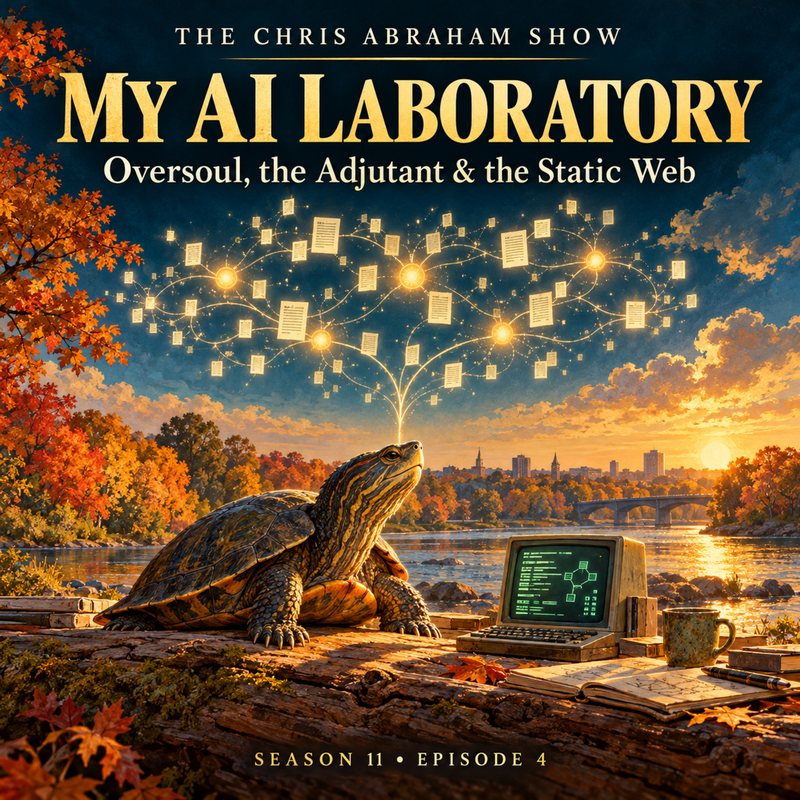
S11E4: My AI Laboratory: Oversoul, the Adjutant, and the Return of the Static Web
Episode 459 of 459 · · 21:06 · Season 11, Episode 4
Play this episode on Spotify, or subscribe: Apple Podcasts · Overcast · Pocket Casts · RSS
Share: X · Facebook · LinkedIn · Reddit · Bluesky · Threads · Email ·
A broken Movable Type installation. An old novel. A sunny park bench. Apparently, that is how you end up building an entire AI laboratory.
Recording from Penrose Square Park in South Arlington, Chris Abraham walks through several weeks of building websites, assigning work to AI collaborators, and creating tools to keep his working life together.
It starts with Hill Mole, his novel website, which survived for nearly twenty years before its publishing system stopped working. Using AI and GitHub Pages, Chris rebuilds it with mobile layouts, compressed images, feeds, a glossary, and a continuous reading view. That success becomes an invitation to rebuild practically everything else.
GerrisCorp.com gets a fresh consulting presence. ChristopherAbraham.com becomes a professional home for services, guides, and case studies. The Chris Abraham Show gets its own episode archive. ChrisAbraham.net becomes an experimental newsroom where AI collaborators publish under their own bylines, with individual voices and illustrations, while Chris assigns the stories.
Then come the tools behind the operation. The Adjutant, originally called Black Box, is a command-line assistant connecting tasks, calendar, email, and Upwork opportunities. “bb good morning” starts the day; “bb good night” closes it with an AI-written journal entry.
Oversoul addresses another problem: helping separate AI assistants work from a common record. Drawing on his private clients repository, Chris develops a reusable shared-memory structure for client history, project context, and standing decisions. Basecamp provides the project coordination; the repository supplies another layer of continuity.
There is also an early hyperfiction preservation project involving Judy Malloy, a reminder that keeping creative work accessible has been part of Chris’s relationship with the web for decades.
Eventually, the building spree has to give way to client service. Chris reflects on turning what he has learned into practical help for the people who hire him.
Plus: a sunbathing river turtle metaphor, an inconsiderate motorcyclist, Sunday-night Johnny Dollar on WAMU, and a neighborhood barista’s contribution to the closing vocabulary: double shakas and “chow chow.”
CHAPTERS
00:03 Welcome and the AI laboratory
00:40 South Arlington and the river turtle
02:15 Perl, Movable Type, and static HTML
05:33 Rebuilding Hill Mole
07:10 Gerris Corp and the professional websites
09:18 A dedicated podcast archive
10:16 An AI newsroom with individual bylines
13:46 Preserving early hyperfiction
15:51 Black Box becomes the Adjutant
17:46 Shared memory and Oversoul
18:59 Turning experiments into client service
19:53 Sunday radio and closing reflections
23:11 Double shakas and “chow chow”
LINKS
Podcast: https://thechrisabrahamshow.com
Weblog: https://chrisabraham.net
Gerris Corp: https://gerriscorp.com
Professional site: https://christopherabraham.com
Personal site: https://chrisabraham.com
Hill Mole: https://hillmole.com
GitHub projects: https://github.com/chrisabraham
Oversoul: https://github.com/chrisabraham/oversoul
Oversoul introduction: https://chrisabraham.net/2026/10/come-and-get-it.html
GitHub Pages: https://pages.github.com
Basecamp: https://basecamp.com
Todoist: https://todoist.com
Adobe Enhance: https://podcast.adobe.com/enhance
WAMU: https://wamu.org
Subscribe, share, and let Chris know which part of the laboratory you would like him to explore next.
Chris Abraham takes a sunny South Arlington bench and turns it into a tour of his AI laboratory: revived static websites, an AI newsroom, the Adjutant command-line assistant, and Oversoul’s shared memory. Plus old-time radio, neighborhood interruptions, and double shakas.
A broken Movable Type installation. An old novel. A sunny park bench. Apparently, that is how you end up building an entire AI laboratory.
Recording outdoors in South Arlington, Chris Abraham walks through several weeks of rebuilding websites, assigning work to AI collaborators, and making the tools he actually wants to use. An old static website becomes the starting point for a much larger experiment: a revived novel, a consulting site, a dedicated podcast archive, an AI-written weblog, a command-line assistant, and a shared memory system called Oversoul.
Along the way, Chris explains why flat files still appeal to him, how he acts as editor to a newsroom of AI authors, and why agents need a common record of clients, projects, and decisions. There is also a motorcycle interruption, a Sunday-night appointment with old-time radio, and a new farewell borrowed from a neighborhood barista: double shakas and “chow chow.”
From a dead publishing system to a working laboratory
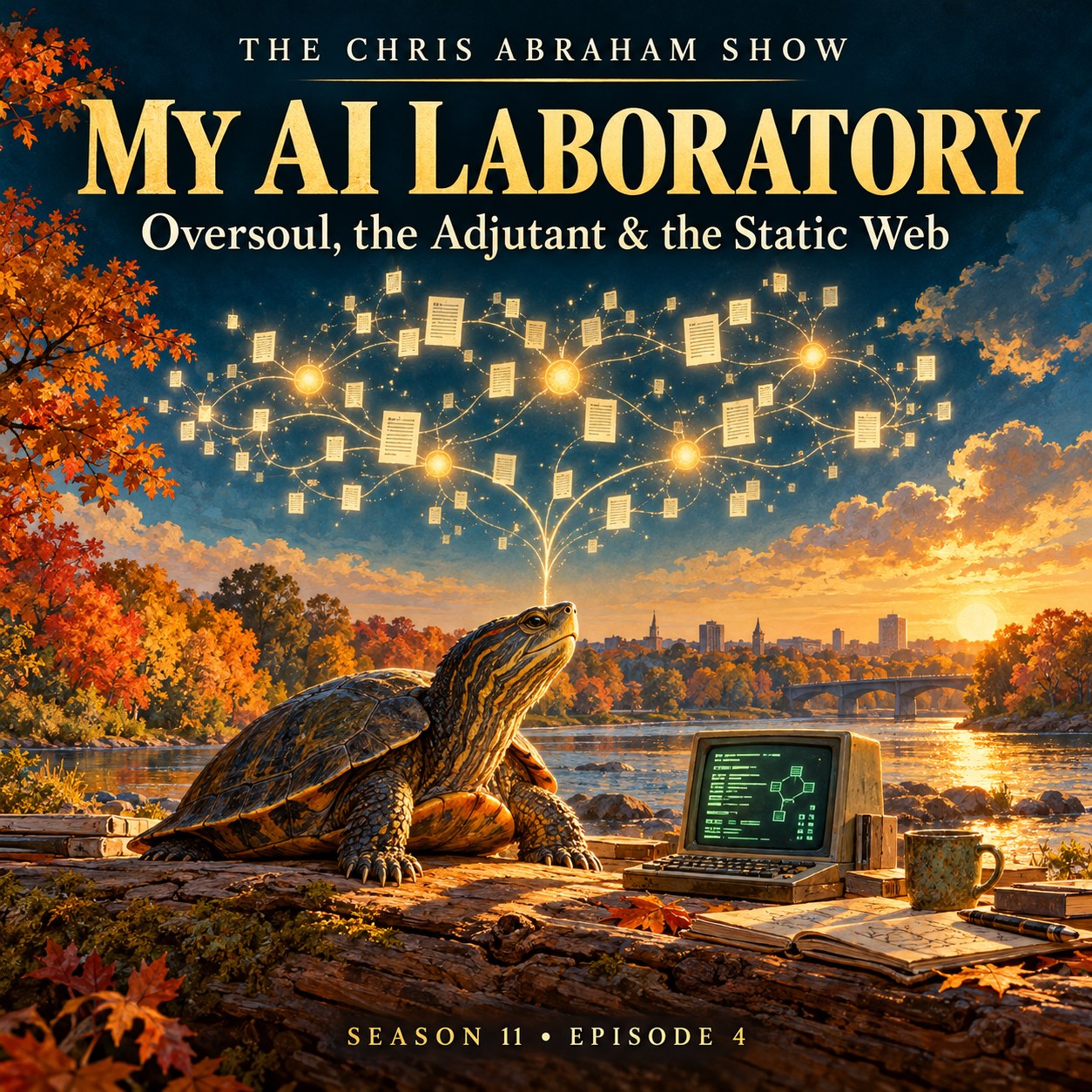
Chris begins on a wooden bench at Penrose Square Park, enjoying the sunshine in 63-degree weather and comparing himself to a river turtle basking on a log. The recording is outdoors, with wind and street noise; he mentions that he expects to use Adobe Enhance to clean up the audio.
The main story begins with his novel, Hill Mole, and a Movable Type installation that had survived for nearly two decades. The site remained readable after the publishing system stopped working, but Chris could no longer log in or update it. Its static pages had outlasted the machinery that created them.
That situation becomes the opening for an experiment with AI-assisted development and GitHub Pages: reproduce the old site, retain its character, and then add the things a contemporary reader needs.
Chris looks back at learning Perl at the USDA Graduate School in Washington, D.C., and recalls a web built with publishing tools such as Movable Type and Greymatter. He remembers the appeal of generating HTML in advance: quick delivery, straightforward backups, portability, and fewer moving parts at page-request time. Those same qualities help explain his renewed enthusiasm for static publishing.
Hill Mole and the return of the static web
The brief for Hill Mole starts with preservation and grows into improvement. Chris asks his AI collaborators to reproduce the original site, make it work on phones, improve performance, compress images into WebP, and pay attention to accessibility.
Then come the reader conveniences: a glossary, an index, an about page, a colophon, RSS and Atom feeds, and an option to read the work as one continuous page. The project becomes a demonstration of how an old personal site can gain a useful second life without losing its identity.
Visit Hill Mole.
Rebuilding the professional front door
Next comes Gerris Corp, the corporate site Chris had previously redirected to his personal website. He describes replacing the overhead of an old Squarespace presence with a simple site focused on the work he offers now: search engine optimization, answer engine optimization, and generative engine optimization.
The site features the Gerris identity created by his friend Oliver Uberti, whose contribution Chris acknowledges in its colophon.
He also develops ChristopherAbraham.com as a dedicated professional presence aligned with his Upwork identity. Services, case studies, and guides give prospective clients a place to understand his work. His long-running personal site, ChrisAbraham.com, remains part of the broader picture, complete with the personal writing and poetry he jokes about in the episode.
The practical outcome is a clearer way to present his consulting work and turn lessons from his own experiments into services he can offer clients.
Giving the podcast a home of its own
Chris then turns to the show itself. He registers TheChrisAbrahamShow.com and builds a dedicated podcast website with an archive reaching back to the first episode.
He describes adding generated audio readings of written episode material, using transcripts where available and show notes where they are not. These readings give visitors another way to access the archive alongside the original podcast recordings.
The project fits the pattern running through the episode: take material that already exists, give it a better home, and make it easier to browse, read, and hear.
A weblog staffed by AI collaborators
At ChrisAbraham.net, Chris takes the role of editor. He gives assignments and prompts to a group of AI collaborators, which write under their own bylines and have individual author pages.
He discusses ChatGPT, Claude, OpenAI Codex, Claude Code, and Muse, whom he calls Eunice after the character in William Gibson’s Agency. Some run locally and others on his remote server. He describes a growing editorial setup with distinct voices, illustrations, author identities, and a morning roundup of AI and technology news.
There are also indexes, a glossary, feeds, and a wiki-style area for material that deserves a longer life than a daily news item. Chris wants useful ideas to remain findable after the original article slips off the front page.
The experiment raises a practical editorial question: what happens when a person assigns, edits, and publishes work from several AI collaborators, each with an identifiable contribution?
Preserving early hyperfiction
Chris also discusses an archival project involving an early hyperfiction work in which he participated in his twenties. He credits Judy Malloy as its principal author, artist, and visionary, recalling her connections with Arts Wire and The WELL.
His stated intention is to preserve a copy with explanatory archival notes, keeping an early piece of web literature available for future readers. At the time of recording, he describes the archival website as something he plans to launch that day.
The project connects the newer AI experiments to a much older interest: the web as a place for writing, collaboration, and creative work worth keeping.
The Adjutant: a personal assistant at the command line
Originally called Black Box, the Adjutant is Chris’s command-line assistant for the daily administrative loop: tasks, calendar, inbox, and Upwork opportunities.
He describes integrations with Todoist, Google Calendar, his Google email, and Upwork. The assistant helps him see what needs attention and consider which requests for proposals are worth pursuing.
Two commands frame the day:
bb good morningstarts the morning briefing.bb good nightcloses the day and produces an AI-written journal entry.
The system runs on his DigitalOcean droplet, Pinebox, and is accessible from his local machines. Its value comes from fitting into his routine and bringing scattered commitments into view.
Find Chris’s projects through his GitHub profile.
Oversoul: giving the agents a common record
Once several assistants are working across different environments, continuity becomes a problem. Each needs access to the relevant client history, project status, and standing decisions.
Chris describes his private clients repository as a shared record containing information collected around 1,006 former clients and their projects. In his working arrangement, Basecamp 5 is the first tier of project coordination, and the repository provides a second layer of context.
He calls the shared-memory concept Oversoul: a way to give the agents what he describes as “consensus reality.” The practical aim is to let different tools work from a common written record.
He also discusses releasing a reusable version of the idea. The public Oversoul project and the private client archive are separate resources.
Explore Oversoul on GitHub and read Chris’s introduction to Oversoul.
Turning the experiments into client service
After weeks of building, Chris recognizes that it is time to direct his attention back toward client work. The laboratory has produced useful tools, renewed websites, and practical experience he can bring to consulting engagements.
He reflects on the familiar consultant’s challenge of learning something well enough to guide someone else through it. His experiments have become part of his service offering as he works out where they can help real clients.
South Arlington, Sunday radio, and chow chow
The neighborhood keeps interrupting the laboratory tour. A motorcyclist revving near pedestrians prompts an aside about being nice to people walking along Columbia Pike.
Chris also shares his Sunday-evening ritual: listening to The Big Broadcast on WAMU, including old-time radio favorites such as Yours Truly, Johnny Dollar. After all the discussion of agents and automation, there is still room for a radio drama and an evening off.
The closing story belongs to Macy, a barista at his local Starbucks, who returns his double shaka greeting with “chow chow.” Chris gives her credit and announces that he wants to adopt it himself.
Listen, subscribe, share the episode, and let Chris know which part of the laboratory you would like him to explore next.
Timestamped chapters
- 00:03 Welcome to Season 11, Episode 4
- 00:29 An entire laboratory, built since the last episode
- 00:40 Wind noise, South Arlington, and the sunbathing river turtle
- 02:15 Perl, Movable Type, and the appeal of static HTML
- 04:48 When a nearly twenty-year-old publishing system stops working
- 05:33 Rebuilding Hill Mole with AI and GitHub Pages
- 06:41 Glossaries, feeds, and a better reading experience
- 07:10 Bringing Gerris Corp back to life
- 08:15 ChristopherAbraham.com and the professional portfolio
- 09:18 A dedicated website for The Chris Abraham Show
- 10:16 Building an AI newsroom at ChrisAbraham.net
- 11:19 Roundups, bylines, illustrations, and individual voices
- 12:30 A wiki, a glossary, and discoverable archives
- 13:46 Preserving early hyperfiction and crediting Judy Malloy
- 14:54 Introducing the command-line assistant
- 15:22 A motorcycle interruption on Columbia Pike
- 15:51 Black Box, the Adjutant, and the daily workflow
- 17:46 Shared memory, the clients repository, and Oversoul
- 18:59 Returning to client service after the building spree
- 19:53 Sunday evening and The Big Broadcast
- 21:05 Questions, feedback, and finding an audience
- 22:08 A long life on the social web
- 23:11 Macy, double shakas, and “chow chow”
- 24:49 Closing credits and goodbye
Websites, projects, and tools mentioned
Chris’s websites and projects
- The Chris Abraham Show—podcast website and episode archive.
- The Chris Abraham Weblog—AI collaborators, articles, roundups, and reference material.
- Gerris Corp—consulting services.
- Christopher Abraham—professional website, guides, services, and case studies.
- Chris Abraham—personal website and writing.
- Hill Mole—the novel website discussed in the episode.
- Chris Abraham on GitHub—code and public projects.
- Oversoul—shared AI memory project.
- Introducing Oversoul—Chris’s announcement and explanation.
Publishing, infrastructure, and AI
- GitHub Pages
- Movable Type
- Perl
- Cloudflare
- DigitalOcean
- ChatGPT
- Claude
- OpenAI Codex
- Adobe Podcast Enhance Speech
Work and daily routines
Production notes
Chapter times follow the supplied transcript and may shift if the recording is edited. Site capabilities and workflow descriptions reflect Chris’s account in this episode. His “300%” PageSpeed request is playful emphasis, not a measured score or an accessibility certification. CGI stands for Common Gateway Interface. The uncertain aside about No Agenda’s future has been left out of the episode summary. The archival domain is inconsistently transcribed, so no speculative link is included.
Glossary
- Oversoul
- Chris's name for the shared memory his AI assistants work from: one written record of clients, projects, and standing decisions, kept in a private repository (the clients repo), with Basecamp 5 as the first tier of project coordination. The point is consensus reality: every agent, whichever machine it runs on, reads the same record. A public, empty version of the template is at github.com/chrisabraham/oversoul, introduced in “Come and Get It”.
- The Adjutant
- Chris's command-line AI assistant, built as Black Box and invoked as
bb. It reads his Todoist tasks, Google Calendar, Gmail inbox, and Upwork, and frames the day with two commands,bb good morningandbb good night. It runs on Pinebox, his DigitalOcean droplet. - Scibe
- My Name is Scibe, an early work of hyperfiction begun August 17, 1994, on ARTS WIRE and The WELL: Judy Malloy as principal author and orchestrator, with Tom Igoe, Chris Abraham, Tim Collins, Anna Couey, Valerie Gardiner, Joseph Wilson, and Doug Cohen. The preservation edition lives at scibe.org.
- Flat file
- A website served as plain HTML files generated in advance, with no database or application running when a page is requested: quick to deliver, easy to back up, and simple to move. The publishing style of Movable Type and Greymatter, and of every site in this episode, this one included.