Read the full transcript (5,512 words, machine made)
This is The Chris Abraham Show. Hey there, this is Chris Abraham of The Chris Abraham Show. It's episode three, season 11, or as they say in German, elf, elf, elf. they don't say it three times and I was thinking about episode one that I never finished when I was talking about Malcolm Gladwell and I think I just needed to bake and cook a little while and I was thinking about how something they said was really interesting in the context of some videos I've seen over the last couple years with regards to how Americans respond to pickpockets and actually a personal story I have that I completely have over drawn over painted about my friend Mark my best friend Mark But let me go back to what was said. And I believe what was said was, look at the crime rates in other cities in the world.
Look at crime rates in other countries. And this is in reference to how there is so much gun crime in America and how there is so much gun death and shootings in America. And at the second-half of the podcast, which is a podcast that Malcolm Gladwell was on promoting his book on the Oprah Winfrey podcast and it was to promote his book the American way of killing the invention of an epidemic by Malcolm Gladwell and the episode was why is America different than every other country when it comes to guns Now one of the interesting things he said was that obviously the second-half of the episode, the Oprah Winfrey episode, was admitting without admitting that most gun crimes is black on black crime within inner city and it has to do with gangs and turf and all that other stuff. It ends up focusing almost completely on the American black experience as part and parcel of most of that gun crime. I don't even think he mentioned the obvious tendency for those guns, because they're mostly illegal, to be sourced from other states either through stealing or people buying guns and then selling it into the black market through what they used to call-- there was a term for it.
I think it's-- let me find out. Hey, Google, what is the term for when people buy guns legally and then sell them into the black market without telling anybody that they're doing that. It is called gun trafficking and fire. The word I'm looking for is straw purchasing. When an eligible buyer purchases a gun from a licensed dealer for someone who is prohibited from owning one or wants to hide their identity, this is a federal felony.
And so that ended up, that conversation ended up going into the entire conversation. Hey Google, what is the issue with regards to gun crime in America that is a dynamic tension between rates and volume? The dynamic tension between race and volume in American gun crimes stem from the fact that cities with the highest volume of gun violence total numbers are rarely the places with the highest rates of gun violence per capita. That creates a major policy and media disconnection as public attention and resources are often heavily focused on massive urban centers while the highest risk of victimization is concentrated in smaller, less populated areas. I don't think that's what I'm looking for at all.
What I'm looking for is the demographic rates of people involved in gun violence versus the proportion of demographics responsible for gun violence. According to historical Federal Bureau of Investigation expanded homicide data, gun crime largely mirrors broader racial demographics because people tend to live near, interact with, and experience localized conflicts within their own demographic and geographic circles. White victims, approximately 78% to 80% of white homicide victims are killed by white offenders. Black victims, approximately 88% to 90% of black homicide victims are killed by black offenders. I'm talking about 13% of the population is involved in 50% of the gun crimes in America.
That controversial figure. The statistic you're referring to often cited as 13% of the population commits 50% of the crime or specifically gun crime is a highly prominent and fiercely debated figure in American political and cultural discourse. Criminological data from agencies like the FBI and the Bureau of Justice Statistics does show that black Americans who make up roughly 13 to 14 percent of the US population account for approximately a 50 to 60 percent of arrests for violent crimes including firearm homicides. And the controversy is of course whether or not those arrests are done because of racism and whether or not it is a whether or not it is a game statistic with regards to the overwhelming tendency of black communities to be overly policed and overly arrested. So I am saying that controversy, according to this Google responses, the dynamic tension and controversy surrounding this figure lie entirely in the divide between what the raw data reflects and how that data is interpreted by different sides of the political spectrum.
So, they talk about how poverty correlates, geography over race, arrest versus commission, and, you know, everybody has been involved in this conversation. Because the black population in America is only 13 or 14 percent, and because 65 or 75 percent of Americans identify as being white, and America has 340 million people, if you look at crimes and criminality by volume, you have, of course, mostly white people commit crimes and commit violent acts. But if you base it on demographics and race, then the numbers change. I'm just saying this in order to kind of explain the background. And so it's really interesting to watch in his podcast, Oprah Winfrey podcast.
Oprah Winfrey wasn't on there. But it's very interesting because a conversation that they had entering into the discussion of demographics was interestingly about how the crime rates around the world are the same as the crime rates in America. And the conceit of that argument was nobody shoots anybody in other countries just because they were stolen from or because they were burgled or because they were pickpocketed or because they were mugged. And there is a conflict during the last several international events where Americans have gone to Europe in order to attend things like the Olympics, et cetera, that Americans tend to respond with overwhelming violence when they catch someone who is pickpocketing them and they tend to beat the pickpocket almost to death. Or, they grab them, they detain them, they shame them, they bring them to the police, they chastise them, and they respond with extreme prejudice.
And people in Europe are not brought up that way. It is more sporting and proportional and it seems like a lot of Europeans will just roll their eyes and say, Oh no, I've been pickpocketed, or, Oh no, we've been stolen from, or, Oh no, I have felt intimidated in the street, or whatnot, just as part of life, as something to suffer through. And I think one of the arguments that I found very interesting that I haven't heard that much, which is why can't Americans be more like people internationally who just grin and bear a certain level of abuse by other people with regards to hurting them intimidating them burgling them pickpocketing them whatever even carjacking them or taking their their stealing their car any other of those things and it seems to me that one of the arguments that Malcolm Gladwell is arguing for which is deadly force or extreme response to something take someone taking advantage of you is a decidedly American ethos and I think that's true like even women have been videoed in response to being attempted to be pickpocketed. And they have grabbed the person by the nape of the neck. They've held them, they've held their bags, they've held the other person's bag.
They've held them down with their backpacks. They've brought all their family members to come over and do basically a European citizen's arrest. And so this kind of extreme violent behavior is a direct result of Americans are extreme materialists. I mean, when anybody says police are there not to protect people but to protect property, the answer is yes. Yes.
People don't like having their stuff stolen more than they, in fact, a lot of people are like, well, if I get beat up, my body heals. If I get stolen from, if I don't have insurance or if the insurance doesn't pay back replacement cost, then I don't have those things anymore. And when you think about it, I was thinking about it and the cost of keeping things that only cost several hundred or several thousand dollars under the guise of an entire insurance plan and all these other things with regards to home insurance and insuring stuff is that most things that you own, most things aren't that good. So that's how insurance works. Premiums end up costing more than the replacement cost of the things that you theoretically can own.
And over time, since they very quickly reduce their value through depreciation, your $10,000 television only is worth almost nothing 10 years later. And so they do not, when you pay the premiums on the thing that you bought, you there's a diminishing return. But it's not about that. It's about being defiled. It's about having your it's about the audacity of someone willing to invade your space or or or invade or touch your things.
Oh, my buddy Mark. My buddy Mark was in a metro. It could have been in Spain or Portugal. And he was standing there waiting for the train to come. And the train was coming, and he felt someone in his pocket.
And he immediately, without thinking twice, broke the guy's arm, like broke the guy's arm through extreme response and through brutal attack, and then walked into the metro or the subway, or the train, the doors closed and he never saw the person again. And that is such an American way to respond, which is funny because Mark is one of the biggest Europhiles in the entire world and maybe has considered owning a gun but never has. But when he felt someone in his pocket, he responded with complete commitment, broke the guy's arm audibly, and then played it cool and walked into the subway, probably assuming that universal health care would have taken care of everything. But I find that very interesting, and I find it very interesting that one of the assumptions that Malcolm Gladwell made was Americans need to become more tolerant of crime, and that crime is something that happens It's something you deal with. It's an opportunity to build your character.
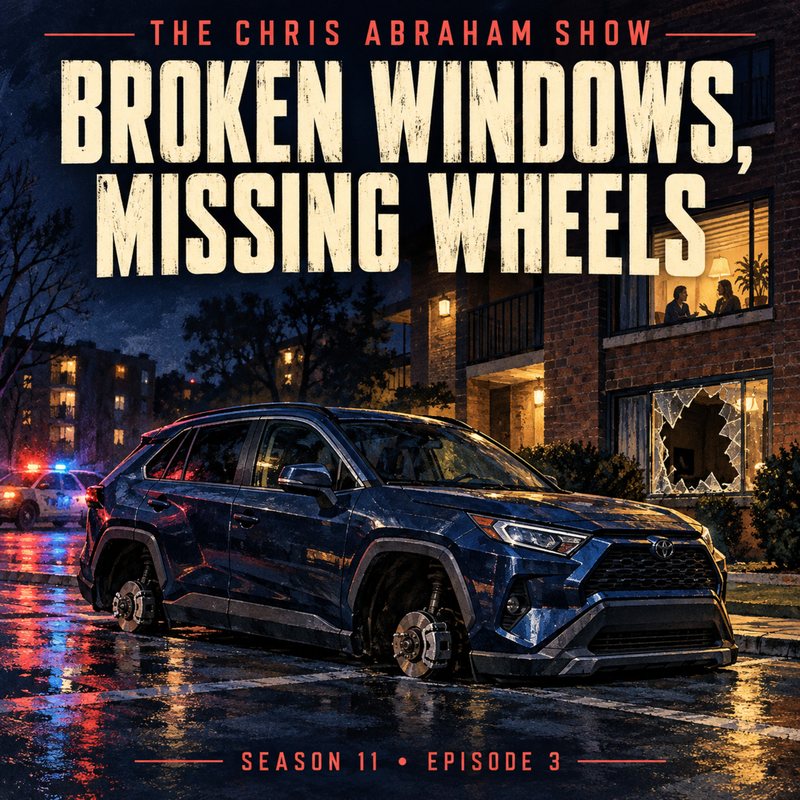
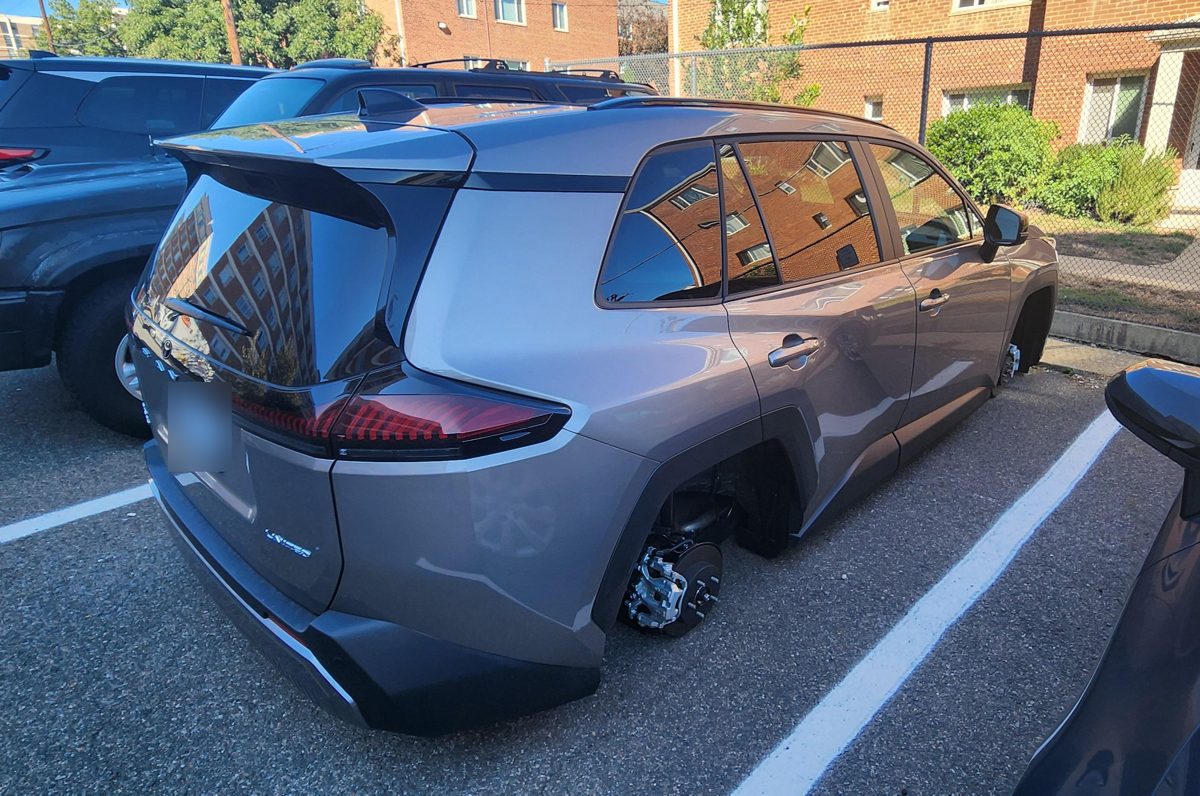
Ergo, one shouldn't respond to muggings, to pickpocketing, to having your house invaded and having things stolen and being burgled or having your property damaged. or having your car stolen or having your wheels stolen. I was just out here in the parking lot. I posted it onto Reddit if you want to look. My Reddit is reddit.com/you/chrisabraham and I think you can find it there.
I was leaving my apartment building early, 10 o'clock early in the morning. And there was a brand new Toyota CRV, sorry, Honda CRV, a brand new Honda CRV. Toyota CRV? I think it's a Honda. Anyway, whether or not it was a CRV and it was brand new top trim, I'm told because I posted on Reddit, everybody had their two cents.
It was brand new, top spec, top wheels. It had a paper plate still on it. It was fresh off the lot. And when I arrived at it, it was not up on bricks. It was on its belly with four missing wheels and tires.
And all you could see as it sat on its belly like a turtle And its little leg areas were amputated, and all you could see is the disc brakes and the calipers and, of course, where you affix the wheel. And it was on its belly, and it wasn't on bricks. It wasn't on-- what did other people say? It wasn't on bricks, it wasn't on breeze blocks, it wasn't on egg cartons. or what is it, milk cartons or milk crates.
It wasn't on milk crates. It wasn't on anything but its belly. And so it probably was completely totaled. Everybody talked about how it was gonna be recovered without doing additional damage. And apparently this happens enough that tow trucks totally know how to deal with this.
What they don't use, and which I really hope they use, And what I use when I cook is a fish spatula. I don't know if you know what a fish spatula is, but it's generally made of stainless steel and it's wafer thin and it has like slats in it and it is relatively long, relatively flexible, relatively sharp and very metal. And when I say very metal, I mean it both ways. in terms of metal, but also in terms of it kind of being the kind of thing that allows you to kind of scrape under a very flaky fish to make sure that it remains intact. And in my mind's eye, which I don't have because I have aphantasia, one would go underneath the car with a fish spatula and pick it up gently and put it onto the flatbed of the truck.
Ways that they say that they do it is some people use airbags. They get airbags under there and they pump it up. They pump the airbags up until they can put donuts on the wheels and then wheel it away that way. There's any number of ways that they do it. It's very interesting to look it up.
On that note, as an aside, I've been watching an old Canadian show with Jason Priestley in it. and it's called Private Eye or Private Eyes and they do use the the Hall and Oates song Private eyes are watching you they can see every move private eyes are watching you private eyes are watching you watching you watching you watching you You play with words. You play with love. Anyway, I'll stop now to protect you. And so even though it's on Hulu and you can skip the introduction, I don't because I get to hear that, although it's sung by someone else.
So there's that tyranny. But it is a show that is very much like Moonlighting. And I was watching it just as a goof. I never watched 90210 or anything like that. I don't know that much about...
Is it Jason Priestley? I think it might be. I'm watching it. I actually put an article up on... Yeah, Jason Priestley.
Jason Priestley plays Matt Shade, a former pro hockey player who becomes a private investigator alongside Angie Everett, played by Cindy Sampson. there is a case every week and the case is the least important thing on the screen I am learning how to be an adult man based on this Canadian show they're totally socially engineering me they're talking about patience they're talking about not lashing out they're talking about holding your horses they're talking about all kinds of things I wrote in the article I put on to the website I put the show at 80 percent psychology and 20 percent entertainment episode after episode it shows how people should deal with each other when they disagree when they've hurt each other and when they need each other so yeah so I can't even deal shades daughter Jules is even played by Jordan Negri is visually impaired. So the funniest scene is when she wants to get into this elite girls, this elite, sorry, it's not a girls school, this elite school in Toronto and she gets in through the waiting list and then she says, she carries a cane, right? She's saying to her dad, that she doesn't want to be thought of as the girl who got in off the waiting list. She was afraid about being scandalized for that.
But because this is Canada and not America where kids are cruel here, I was like, No, everybody's gonna be like the blind girl. And then I realized that I was a ***** ** ****. because she's worried about not having the right bling or not having the right bag or not having the right this or the right that or being humiliated because she got in under waiting list. And this is high school, don't forget. She's 14 or 15.
And this TV show goes all the way back to, I think 2016 or 2017 so it is an actual decade old and I believe that Jason Priestley is 58 or 59 now 57 58 59 he's a couple years older than me so this would have been when he was 47, 48, 49, but he looks like a stud. I mean, he's so, and I also think he is five foot two. I think he's the littlest man ever. If you look at his head versus the child, they actually show a scene when he is bare chested and he literally has the body of a child and the head of a man. It's very disconcerting.
But still a beautiful, a beautiful short king. But there's no way he's 5'7 or 5'8 or 5'9. He wouldn't have those proportions. Look at his shoulders. He has the shoulders of a little boy.
Anyway, it's a great show. I really enjoy it. It's completely stupid. But what I get from it is I get therapy. And every episode is how to bring down the temperature.
how to engage people in a way that's loving, generous, and merciful. It's an extremely Christian show. And everybody behaves badly, and the person across from them always behaves good enough. Or if they behave badly in response, they model good recovery or good apology and they have an amazing relationship between a father and a daughter. And since Jason Priestley shade is divorced, they have a really great relationship between the divorced couple.
You can see while they're divorced, you can also see why they were in love. You have the sacrifice of the daughter and the father to the mother who needs the love of her child, and he incessantly takes swords in order to make sure she feels better, but oftentimes at the sacrifice of the daughter-dad relationship, which bums out the daughter. So it's really, do I say daughter like a Jersey guy? Anybody who listens to this, tell me if I say daughter like a New Yorker or a Jersey guy. I just caught myself maybe getting into the trap of the way I say water.
Oh, I had a good compliment since men never receive compliments very much. I met a dude who plays the bass and was trained at music school in the clarinet we had his name is Dallas he's a local DC professional musician he plays the stand-up bass and he plays the uh he plays the guitar bass the bass guitar and he said that I have a good voice and he said that I have good enunciation which when you're buddies with Mark Harrison who has the best most amazing voice in the history of the world He has panty wetening pipes. Panty wetening pipes. I just made that up and it's completely awful and I apologize for it immediately, but I won't remove it from the podcast because who does that? Anyway, it was nice to hear because at least I'm not conveying to you complete mansplaining.
I'm not gone. That was just a dramatic pause while I was thinking of something. At least I'm not while I'm giving you drivel and while I'm spooning you pablum, at least you don't have a terrible voice to listen to. And in a world where most podcasters have adenoidal voices, I know that my nose is really stuffed up today, so I'm a little adenoidal. I'm as adenoidal as I get to be, and I want to say adenoidal a couple more times because I think I pronounced it right.
Let me see if I pronounced it right. Let's see if I can get to the Here we are, adenoidal. Let's see if we can get it to talk. Here we go. Adenoidal.
Yeah, I got it. Adenoidal. Adenoidal. Adenoidal. So anyway, I recommend the show.
It's on Hulu, or if you're Canadian, it's probably on a channel that has a 24/7. I think it was six seasons. How many seasons was Private Eyes with Jason Priestley? Five seasons, 60 episodes from 2016 to 2021. There is a follow-up series titled Private Eyes West Coast starring Jason Priestley and Cindy Sampson premiered in late 2026.
Look at that. I think I have to. Ooh, I know what they're doing. Hulu is feeding me preface, is feeding me preface before they launch a new series called Private Eyes West Coast. That's awesome.
You've heard it here first, folks. On that note, I appreciate all the listening you've done. I do not mean in any way to support any of those statistics or whatever that I read, but there's a huge conversation that is racially motivated on both sides. And since the Malcolm Gladwell book is, I think, sold as being scientific or sold as being centrist or sold as being empirical or objective or neutral, I think it's important to realize that as the saying goes, let me get the saying for you right. Google, what is the saying about damn statistics?
Mark Twain was famously popularized in the United States by Mark Twain. The famous saying is with regards to the book and its neutrality and Malcolm Gladwell in general. I was a real, I was really into the whole broken window theory. That turned out to be extremely controversial. But back in the 90s, everybody was all about the broken window theory.
Anyway, the quote is about statistics, lies, damn lies, and statistics. Hey Google, was the broken window theory introduced popularly in tipping point? Yes, the broken windows theory was famously popularized for a mainstream global audience in Malcolm Gladwell's best-selling 2000 book, The Tipping Point. While Gladwell did not invent the theory, his book dedicated an entire chapter to it to explain the dramatic drop in New York City's crime rate during the 90s. have people said that maybe the crime rate drop in the 90s had more to do with access to abortion or other things in addition to the broken window theory yes criminologists economists and sociologists have proposed several alternative theories for the 1990s crime drop according that arguing that these factors were far more influential than the broken window theory oh by the way New York City has over 40,000 cops.
So I mean, it might have to do with policing, anyway. The ideas you mentioned represent some of the most famous and hotly debated, the legalized abortion hypothesis. A highly famous and highly controversial theory was introduced by economists Steven Levitt and John Donahue in 2001, and later popularized in the 2005 bestselling books for economics. See, I'm such a *****. Like I was so into being fashionable DC guy that I totally read all of that from Freakonomics.
Hilarious. The core argument, following the nationwide legalization of abortion via Roe v. Wade in 1973, there was a significant drop in the number of children born into families experiencing severe poverty, unwantedness, or unstable environments. Donahue and Levitt pointed out that the historic crime drop began in 1991, exactly 18 years after 1973, which is the precise age when adolescents entered their peak crime committing years. They argue this explains up to 50% of the drop.
The other explanations were the waning of the crackademic epidemic, the lead crime hypothesis, the phasing out, oh, the lead crime hypothesis. Of course, in the 70s, lead was phased out from gasoline. And of course, the increased police presence and the 1990s economic boom. What was the police population in New York City in 1960? 1970, 1980, 1990, 2000, and 2026.
And also give me a ratio of police officer to citizen. I don't know if you know anything about the broken window theory. I'm speaking here as if you have a background in it. But in 1960, there were 24,000 police officers and 7.8 million New Yorkers, which is one officer for every 324 citizens. In 1970, there were 31,000 police officers with a city population that was the same, one officer for over 255 citizens.
1980, it went down to 22,000 to 23,000 police officers as a result of the huge fiscal crisis of the mid-70s. And so did the population to 7 million. And there was one officer for every 314 citizens. In 1990, it went up to 25,000. one officer for every 283 citizens.
And then in 2000, it went up to 40,000 with a city population of 8 million, which is one officer for every 199 citizens, or 15.3 officers per 10,000 residents. And now it's down in 2026 to 33,975, part of a major ongoing recruitment effort aiming to hit a baseline target of 35,000 uniformed officer by the fall. So that is pretty interesting. But let me tell you what the broken window theory is. Please explain the broken window theory.
The broken window theory is a criminological theory that argues visible signs of disorder and petty crime create an environment that encourages further more serious crime. The core metaphor. The theory gets its name from a simple analogy. Imagine a building with a few broken windows. If the windows are not repaired, it signals that no one is in charge and no one cares.
Because there are no consequences, vandals will soon break more windows. Eventually, the law-abiding citizens will abandon the street out of fear, leaving the area entirely controlled by criminals, leading to much more violent behavior. A Three-Step Chain Reaction Minor disorder appears: small, low-level offenses occur like graffiti, littering, public drinking, or turnstile jumping. Community withdrawal: when the minor violations go unpunished, regular citizens begin to feel unsafe. They stop walking down the street, stop looking out their windows, and stop interacting with neighbors, and also stop using the subway, of course.
Community surveillance breaks down, and then serious crime takes root. Criminals notice the lack of social control and police presence. They deduce that if the police do not care about graffiti, they certainly will not stop drug dealing, car thefts, or robberies. Introduced in 1982 by social scientists James Q. Wilson and George L.
Kelling, the theory heavily influenced American policing in the 90s. Most famously, New York City Mayor Rudy Giuliani, yeah, that Mayor Giuliani, and Police Commissioner William Bratton used it to completely reshape the NYPD. They aggressively cracked down on quality of life offenses like squeegee men, public urination, and fair beating under the belief that cleaning up the streets at a micro level would prevent major homicides and assault. While the New York City's crime rate plummeted during this period, modern criminologists heavily debate whether the broken window policy actually deserved the credit. Now, one might argue now is that's what's happening again in DC and New York, and crime rates are going down.
So you can say that it is the petty criminals that are indicators of what grand criminals feel like they can get away with, or you can make the criminals always the victims, and it's because of poverty, it's because of race, it's because of capitalism is because of patriarchy. So you can decide what you want with regards to areas that are left fallow. I mean, you can use the whole recovery of nature. And law and order is not natural. Law and order is the result of hiring a very aggressive and OCD landscaping company, which is what the police force is.
As I said in previous conversations, the police are not there to keep people safe. The police are not there to protect and serve. The police are there to keep law and order. They're not Solomon. They're not the judge.
They're not community conversations They're not therapists. Their job is to respond to antisocial or criminal behavior. So on that note, I hope that you were educated. I need to be more remedial, not remedial in a bad way, but I need to understand that not everybody is literally in my head with my exact background or my knowledge, or the fact that I fell for two of the most trendy books in the 2000s. one of which was Tipping Point and the other of which was Freakonomics.
I am that guy. I don't think I am anymore. I think I'm rejected by that fashionable Bugarati. Maybe my life would improve if I were to embrace that again. I assume that my entire life will change the moment Donald Trump is no longer president.
because I feel like the fact that I don't hate him enough and that I don't hate him at all and I think that people are just crazy is probably the biggest reason why I am in the fashionable literati DC literati doghouse. Also, I'm not very compliant and it started with COVID. I think the downhill in my reputation with regards to all my fancy friends, no, I think it went Yeah, I think it started with COVID. Everybody was a little bit crazy there. It definitely built a certain level of community extremism.
Please like and subscribe if you like this episode. I just created a new website. It's only three episodes old. It might only be two episodes old called thechrisabrahamshow.com. I've started writing articles on there.
You can go on and see an entire article I did where I showed my love for Private Eyes. And then I showed my love for Reacher and admit to my love for Mac Bolin. And if you don't know those names or if you only know one of them, go onto the site and look up at the top and you'll see a link for articles. and even just check out colophon or colophon is it colophon or colophon if you know please tell me on social media I am on reddit at reddit.com slash you slash Chris Abraham I am on mastodon at no agenda social no no no no No, no, no, no, no. I am on, oh goodness, I don't even know.
Yikes. It's no, I hate to say it. Why don't I know? 'Cause I used to have a bespoke one, but I am at, I am Sir Chris, S-I-R-C-H-R-A-S, @noauthority.social. And then of course you have all the rest.
I am Chris Abraham on Threads. I have a weird one. I had Chris Abraham on Blue Sky, but now I'm like, I'm @abraham.su, which is really weird. abraham.su is what my bluesky@abraham.su is my blue sky handle. And then TikTok.
At TikTok, TikTok I am. I am Christopher Abraham, @christopherabraham on TikTok. And I am linkedin.com/user/chrisabraham. On Substack, I'm chrisabraham.substack.com. And maybe for Christmas or for Halloween, I'm going to use a domain for that.
I'm going to dedicate a domain to that, so I will let you know. On YouTube, I am @chrisabraham, so youtube.com/@chrisabraham. On Instagram, I'm @chrisabraham. On Facebook, I'm Chris Abraham. And on X, I'm Chris Abraham, @ChrisAbraham on X/Twitter.
So I look forward to hearing from you. You can follow me at all the podcast sites. You can like and subscribe everywhere. You can write a comment. You can write a review.
Since nobody ever cares about this at all, I don't even mind negative feedback. My best friend Linda, who is 70 and fabulous, thinks that I'm a gasbag and that I inherited this podcast at 50, like all the boomers. I'm Gen. X but it doesn't matter the joke is is that middle-aged men have to have middle-aged white men have to have a podcast and this is mine and so she if she if I got her to write a review she would give me two out of five stars and she would say that I am a narcissistic prick and I would love to I would love to see my best friend Linda say that about me I want all of y'all to say those things about me And if you like what you see, please share it with your friends. And also at me or DM me and let me know what you would like future episodes to be about.
Anyway, thank you very much. Mahalo nui loa, aloha kakou, and merci beaucoup, and donkezer, and gracias. Amigos y amigas. Ciao. Aloha.
Bye. Thank you for listening to the Chris Abraham Show. Make sure you subscribe so you don't miss any future episodes. Until next time.