Read the full transcript (3,596 words, machine made)
Have you ever stopped and, you know, really thought about how the exact same thing, the same action done by two different people can get such wildly different reactions? I mean, we're talking about something pretty straightforward, right? Streets getting cleaned, maybe homeless encampments cleared out, bringing some order back to a city. Seems simple on the surface. Totally. But what if one cleanup gets called? I don't know, civic pride maybe?
Savvy staging while another one doing basically the same thing gets labeled a federal occupation or even even a coup. Yeah, that's a huge difference. It's a real head scratcher. It is. And that paradox, that mystery, that's exactly what we're diving into today.
So today, we're really digging into this phenomenon. It's fascinating. We're going to compare two big city cleanups, right? One actually happened San Francisco, led by Governor Gavin Newsom. And the other is, well, it's a hypothetical scenario, but one that's been talked about a lot. Washington, DC under an order from Donald Trump. And on paper, the goals sound pretty similar, don't they? Cleaner city, safer, looks better. Exactly.
Similar aims, even some similar methods, you know, clearing things out. But the public reaction, the media coverage, couldn't be more different. Like polar opposites. Yeah. And our mission today really is to try and unpack that, not just what happened or, you know, what might happen in the DC case, but why? Why are the perceptions so incredibly different? We want to explore this powerful idea that maybe, maybe it's less about the action itself, like the objective facts on the ground.
And more about who's doing it. Exactly who's doing it and what stories, what narratives we've already built up around that person. It's about the the architecture of narrative, how stories get structured. And hopefully this deep dive will help you, our listeners, start to spot these these narrative frames when you're reading the news or scrolling through social media to look past the headlines a bit. We've got some really sharp analysis to work with here today, a piece that really cuts through the noise and gets to the heart of how these stories get told, how they get framed, and how we end up receiving them. Especially now you know when everything feels so polarized. It really makes you think, makes you question those gut reactions sometimes.
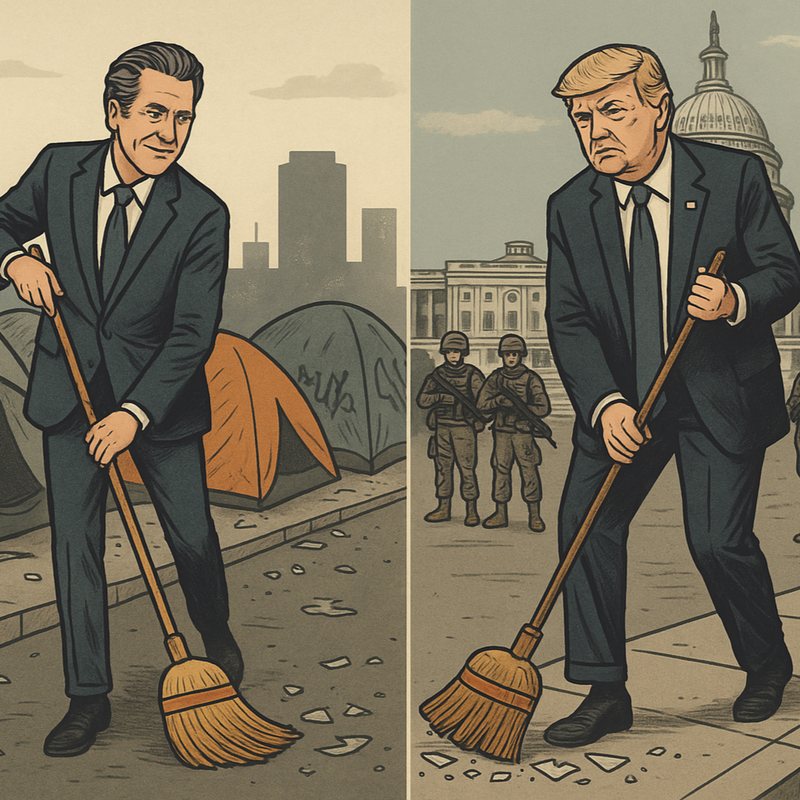
Definitely. All right, so let's get into it. Let's unpack this. OK, so this tale of two brooms, as the source material puts it, let's start in San Francisco, November 2023, right? O picture this San Francisco, a city that, let's be honest, had very visible struggles with homelessness, with street conditions for quite a while.
Yeah, a major topic of discussion. Then, almost like flipping a switch, it goes through this incredibly rapid, super visible transformation. Like almost overnight sidewalk encampments, these tent cities that had been there for ages just gone vanished. Graffiti that was, you know, everywhere. Fresh paint covering it up, Public murals getting touched up, looking bright again. Even the little things like street planters suddenly having flowers.
Right. And the bike lanes. But you're usually pretty grimy, right? They were scrubbed clean. Like really clean.
It's a huge visual shift, all done incredibly fast. And what's really interesting about the San Francisco situation was Governor Newsom himself. Yeah, he was surprisingly open about why it was happening then. Yeah, he didn't really hide it. Not at all.
He basically said, look, we're doing this big cleanup because company was coming over. Meaning the APEC summit, right? The Asia Pacific Economic Cooperation meeting, Yeah. And President Xi of China visiting. Exactly. And he had that folksy line, the one that got quoted everywhere. You know, when you have company coming over, you clean up the house, Right.
And that little quip, that analogy, it immediately framed the whole thing, didn't it? It made it sound, well, practical, relatable, like something anyone would do just. Sprucing up for guests. Yeah, not some big heavy-handed policy change, more like temporary stage setting for this important international event. Less about ideology, more about hospitality. So how did the press cover this this massive quick overhaul? Well, the coverage was, I'd say, mixed, but the overall tone was remarkably polite, almost understanding, you know, a. Little late, Yeah, that's a good. Word Major news outlets like the AP and the New York Times, they talked about it using terms like civic pride or focused on the optics.
Right, making the city look good for the cameras for the world leaders. CNN even called it savvy staging. Almost like, hey, smart move, governor. Interesting. So even the criticism wasn't wasn't condemning the ACT itself, not. Really.
No. When criticism came up, maybe from conservatives asking why only now, or from housing advocates worried about where the homeless people were moved, the debate was mostly about priorities. Like shouldn't the city always be this clean? Or was this fair to the people displaced? Exactly. But the fundamental right of the city or the governor to do the cleanup, that wasn't really the core question being argued, was sort of taken as a given that, yeah, you clean up for company. OK, so that polite reception, even though it involved, you know, moving homeless people, clearing encampments, that points to something deeper, right, about the assumed motives?
Absolutely. That's the key. The underlying assumption, the frame was that Newsome's cleanup was essentially cosmetic. Strategic, sure, but ultimately benign. Not seen as a punishment or a harsh new policy direction, no. The why was just optics put on a good show for the world leaders make a good impression for diplomacy. And the subtext was kind of like things will go back to normal afterwards.
Pretty much. Or at least the feeling was that Newsome's basic sympathies, his core political identity, was still with the vulnerable. You know, not with some kind of permanent crackdown. So it was like a temporary performance. Like setting a stage for a play.
Yeah, and this pre-existing frame of Newsome as this benevolent modernizer, a standard Liberal Democrat, allowed people, especially the media, to give him the benefit of the doubt. His actions were seen through that lens. Pragmatism, not punishment. OK, now let's shift gears. Let's Fast forward to this other scenario, the hypothetical one, but very illustrative Washington, DC, 2025, under an order from Donald Trump.
Right, a very different picture emerges. The stated goals though? Listen to this and smash and grab robberies, break up open air drug markets, clear unpermitted St. encampments, stop those illegal ATV and dirt bike takeovers. That sounds familiar, right?
Very similar goals to the San Francisco situation. Yeah, addressing disorder, public safety. And Trump's stated mission to restore order to DC, which she calls. And this phrasing is probably significant, our national living room. But here's the kicker, the visuals.
It's not just sanitation crews. The scenario describes the brooms being accompanied by, well, armored vehicles, federal agents, maybe even the National Guard. Whoa. OK, so the tools being used or potentially used are vastly different. Totally different vibe, same goal maybe, but a very different image. And that image, especially in DC, hits different. You have to remember Washington, DC's unique status. It's not a state.
Right. It has home rule, but Congress ultimately has the final say. The president, too. Exactly. So when the federal government, the president, sends in federal agents or the military for what looks like local policing, it can easily be seen as overriding the local government, the mayor, the City Council.
It becomes about federal power versus local control. Precisely. And that dynamic makes it instantly more political, more charged than a mayor cleaning up their own city, especially the federal military in the nation's capital. That carries a lot of historical weight, a lot of baggage. Yeah, You can see how that would land differently and the reaction described for this DC scenario, it's described as quote political DEFCON one basically maximum alarm. Sounds intense.
The language is incredibly strong. The Washington Post has imagined calling it a federal occupation. Occupation Well. MSNBC running Chiron's. You know, the text at the bottom warning of urban martial law?
Now the source clarifies that's rhetorical, not a legal term, but still, yeah, it shows the level of alarm. It's a pretty stark picture of fear, doesn't it? Definitely think pieces comparing it to Hungary or Turkey, places often called illiberal democracies, activist groups staging die insurance, blocking streets, holding signs saying resist the coup, the. Coup for cleaning streets. That's the framing and the ACLU warning it could be a trial run for domestic authoritarianism. It's just a completely different universe of reaction compared to San Francisco.
And if you think about why, I mean putting military or militarized federal forces onto the streets of the city, especially somewhere symbolic like Lafayette Park. Right across from the White House historic protest spot. Exactly. That just conjures up completely different images, different historical echoes than, you know, city workers painting over graffiti. It feels like seizing control of the public space, not just tidying it. So for Trump, the Y is never seen as just practical. In this framing, no.
It's immediately assumed to be ideological maximalist. It's about punishment, about erasing opposition, about imposing his will. So the frame is already set. Trump equals authoritarian. And once that frame locks in what the source calls frame lock, everything gets filtered through it. The broom isn't just a broom, it's a weapon. The street sweep isn't just cleaning. It's, you know, rhetorically escalated to something far more sinister.
Every action confirms the pre-existing narrative. The objective facts almost don't matter anymore. They struggle to get through that frame, yeah. So OK, we have this, the surface level paradox. Same basic impulse, right? Make the city look better, feel safer, more orderly if. You have the stated goal.
Yet the verdicts are just worlds apart. One gets a nod, maybe some criticism about timing, but it's fundamentally accepted. The other gets called the coup. 1 is a broom and a smile, the other is seen as a baton and a boot. It's a really stark contrast.
It really is, and it makes you ask that fundamental question. Why does the fact that both cleanups involve displacing homeless people, enforcing laws against camping, changing the streetscape? Why does that seem almost beside the point in the narrative? Yeah, the actual impact on vulnerable people seems secondary in the reaction story. Exactly what does that tell us about what really drives perception? It suggests The Who, the person doing the action, and the why, and we assume they're doing it completely overpower the what. The objective action gets lost.
It does. And this paradox, this difference, it points us towards something deeper, this idea of the architecture of narrative, how the underlying story we tell ourselves about someone shapes everything else. OK, let's unpack that more, this architecture of narrative. To really get it, maybe we need to step back from Newsome and Trump for a second and just look at the mechanics of how stories work, how they land. Right.
It's not just about the event, but the lens we use to see it. The frame, exactly the frame. That's the critical concept here. Think of it like like the settings on a camera lens, or maybe like a mental filter. It's not just what information gets through, but how that information is colored, what's brought into focus, what's left blurry in the background. And it determines how we assign motives. Absolutely.
It shapes what facts we pay attention to and what intentions we attribute to the person acting. Reminds me of that famous quote from Frank Luntz, the pollster. He said. It's not what you say, it's what they hear. The frame is what dictates what people hear, regardless of the word spoken, if the invisible structure that guides our interpretation, often before we even realize it. Like the blueprint for the story before it's even built? That's a great way to put it.
Same materials, different blueprints. You get totally doodling different feelings about them. So applying that for Gavin Newsom, the blueprint is already there, right? He's framed as the benevolent modernizer. Pretty much for a large part of the media and the public, especially those leaning progressive, he's a known entity, a Liberal Democrat.
He has the right allies, the right enemies, according to that worldview. So that pre coding shapes how his actions are seen. Definitely. It gives him that benefit of the doubt. We talked about his San Francisco cleanup.
Even the disruptive parts gets interpreted through that lens. Cosmetic, strategic, temporary, ultimately well-intentioned. The why is assumed to be optics diplomacy. Right. Not some deep seated desire to punish or displace permanently. The underlying assumption is his heart's in the right place, aligned with progressive values, even if the methods get messy for a specific temporary reason like AIPAC. So the frame allows for complexity maybe? Or forgiveness.
Or at least a left suspicious interpretation of motive. The actions are seen as consistent, or at least not fundamentally contradictory with his established political identity. OK, contrast that with Donald Trump. The frame there is, well, very different. Dangerous outsider maybe, or authoritarian? Right.
He's often described less as a politician and more as a totem, A symbol that instantly divides people, triggers really strong reactions, almost like a tribal flag. For both sides, supporters and detractors. Exactly, and because of that frame his why for doing something like a city cleanup is almost never allowed to be simple or practical. It has to be something bigger, something more sinister. In that view, it's.
Presumed to be ideological maximalist about punishing enemies, erasing dissent, imposing control. That's the immediate interpretation dictated by the frame. And that's the frame lock you mentioned. Precisely once Trump equals authoritarian becomes the locked in frame, it's incredibly resistant to contradictory information. Every action, no matter how seemingly neutral or even potentially positive, gets filtered through that negative lens. The broom becomes a baton.
The sweet becomes an ethnic cleansing, rhetorically speaking. The curfew becomes a step towards fascism. It's a powerful cognitive bias at work. Confirmation bias. People see what confirms their existing belief about him.
Which makes it almost impossible to have a conversation about the extra policy doesn't. It it really does, the policy itself gets lost. It all becomes about the perceived character and motives of the actor. You know, thinking about this, cities and public space, controlling them, cleaning them, it's always been political, hasn't it? It's not just about sanitation.
Oh, absolutely. Cities are theaters of power. Who gets to be seen? Who is made invisible? Who decides? That's always been political.
I'm thinking back to like Rudy Giuliani in New York in the 90s cleaning up Times Square. That's a classic example. He launched that huge effort, right? Broken windows, policing, going after minor offenses, clearing out the squeegee men, the sex shops. And crime did drop. Tourism boomed.
He became America's mayor, a huge success story in many ways. Undeniably. But there was another side to that story, too, wasn't there? Yeah, the criticism that his tactics were harsh, that they criminalized poverty, targeted minorities. Exactly so even Giuliani's success was framed very differently depending on who you asked. It was effective but also controversial. Newsome's clean up in SF kind of sits in that tradition, but the framing was different.
Because it was temporary tied to APEC. I think so. It was framed as pragmatic pageantry, not a permanent shift. The homeless were relocated, not erased. The frame of diplomatic necessity soften the edges.
Whereas the hypothetical Trump DC operation that's framed completely differently, not as pageantry, but. As as an existential rewrite, yeah. Who controls the Capitol? He's the president overriding local government. That feels different.
And the military visuals, that's. Huge military uniforms in somewhere like Lafayette Park that evokes completely different historical fears and memories than, say, the Department of Public Works. So cleaning Lafayette Park under armed guard isn't just cleaning. In that frame, no. It's seizing the public stage.
It's asserting dominance. It's turning a civic space into a symbol of federal power, potentially authoritarian power. The location and the tools transform the meaning entirely. This is where it gets really kind of concerning, I think. This frame lock. Once these narratives harden, they seem almost impossible to change.
Like fossils? Yeah. New facts just seem to chip away at the edges. They don't break the mold. And it leads to this crazy asymmetry you give the examples earlier.
Right. If Newsom the benevolent Modernizr clears an encampment, it's seen as a tough but necessary choice. Maybe temporary. His motives are trusted within that frame. But if Trump the authoritarian were to do something seemingly positive like fund homeless shelters?
The frame dictates suspicion. Is it a trick? A way to consolidate power? A personality cult. The positive action gets reinterpreted through the negative lens. It's not about the what anymore, it's purely about The Who. So this has huge implications for how we even talk about politics, doesn't it?
Policy gets sidelined. Completely. The focus shifts from tactics, outcomes, effectiveness, you know, the stuff we should be debating to personalities and motives. And we assign those motives with such certainty like we have a crystal ball. Clairvoyant certainty, as the source puts it.
Yeah. And we see this bias everywhere. Think about Trump's deportation talk, he says. Deport everyone undocumented. But how is it often reported or perceived? Often softened framed is just targeting violent criminals, even though that's not his full stated policy. That frame makes it sound less extreme, maybe more acceptable to some.
It twists the actual stated goal to fit a narrative. Or look at Newsome again, his usual critics on homelessness. They went quiet during APEC week. Why? Because the frames shifted.
Seems like it. The frame of diplomatic necessity hosting world leaders temporarily overrode their usual criticisms. It made the sweep seem different, less like a policy failure, more like a temporary, unavoidable measure. Shows how context can activate different frames. So what are the stakes here?
If we end up with two sets of rules for the same action, depending only on who's doing it, that sounds dangerous. It's incredibly dangerous for a healthy democracy, I think, because legitimacy stops being about process, you know, are the rules followed? Is the policy effective? Is it constitutional? And it becomes about.
About tribe Is this person on my team? If yes, their actions are legitimate, even if I wouldn't accept them from the other side. If no, their actions are illegitimate, even if they're doing something I might normally agree with. Legitimacy becomes tribal, not procedural. Exactly.
And that raises a huge question. How does that erode just basic civic trust? How can we have functional self government if we can't even agree on a common set of rules or evaluate actions based on merit rather than personality? We just end up shouting about motives instead of debating substance. Pretty much we get stuck in these endless loops arguing about character instead of consequences. So what does this all mean for us, For people trying to make sense of the world?
It feels like the next time we see a cleanup or any big government. Action. The interpretation is already baked in. Yeah, it means the next broom, no matter who's holding it, might not be seen as just cleaning anymore. It might be seen as conquering depending on which tribe you belong to. The action itself loses its meaning, overshadowed by the frame around the actor.
That's the power and the potential danger of this narrative architecture. So wrapping this up, what we've really seen today is just how incredibly powerful these frames are, these invisible lenses. They shape everything. How we see actions, how we judge leaders, whether something as heroic or tyrannical, can depend entirely on the frame, not the action itself. It's less about the objective reality and more about the story we're told or the story we already believe about the person involved.
Yeah. And hopefully this deep dive encourages you, everyone listening, to be maybe a bit more aware, to become more attuned to the frames operating in the news you read, the conversations you have. The pause before reacting. Exactly. Look beyond that immediate gut feeling the headline and ask, OK, wait, is this reaction really about the action itself, or is it more about the actor? What assumptions am I making here? What narrative is being pushed?
It's not just academic, right? It's a tool for thinking more clearly. It's a vital tool, I think, for navigating the world today, for trying to have more productive conversations. So maybe the final thought to leave everyone with is this. The next time you see a news report or get into a debate, whether it's about something small like a city cleanup or something huge like a national policy, just ask yourself that question.
Is this really about the broom, or is it actually about whose hand is holding it? What are the unspoken assumptions here, the narratives driving the reaction? And what does that mean for how we actually understand what's happening around us?