Read the full transcript (6,930 words, machine made)
Welcome, curious minds, to another deep dive. Today, we're plunging head first into a topic that sparks just incredibly strong feelings and endless debate. Yet it's often surprisingly misunderstood the true nature of a police officer. You know, there's this prevalent modern sentiment, a kind of hopeful wish, really, that law enforcement could be, well, a lot of things. We often hear the desire for them to be multifaceted community figures, almost like therapists or, you know, social workers capable of softening the world's edges when chaos inevitably erupts. And that's precisely our mission. With this deep dive, we're going to try and strip away those romanticizations, those well meaning but ultimately uncomfortable emissions to truly understand what a law enforcement officer and Elio fundamentally is, and perhaps more importantly, what they fundamentally are not. And we're basing this directly on the rich source material we've gathered.
We'll offer a well a clear eyed reminder of their core role, weaving in historical context some surprising data and some compelling analogies to illuminate this complex reality. This isn't about taking aside, not at all. It's about providing you with a nuanced, practical understanding of a role that impacts all of us, so you can be truly well informed in your own thinking. Prepare to have some assumptions challenged and hopefully gain a much clearer perspective. OK, let's unpack this then. When we talk about policing today, there's this pervasive, almost gentle wish floating around, especially visible and, you know, public discourse.
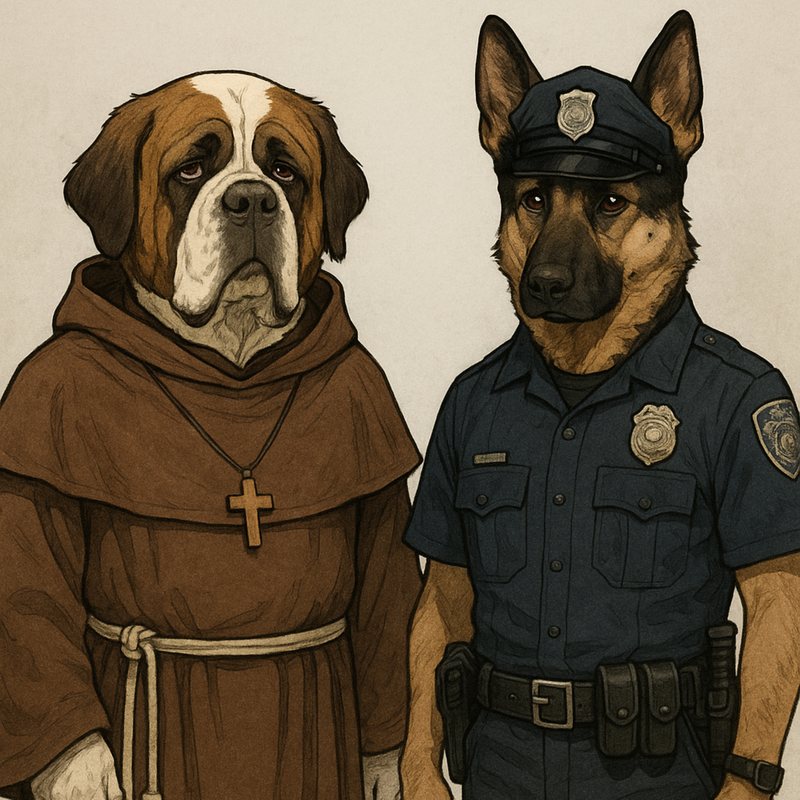
It's the idea that officers should embody this incredible blend, part community therapist, part moral guide, part social worker. The vision is that they'll be there to soften the harshness of the world, to bring a calming, almost therapeutic presence when life gets chaotic, handling complex social issues with compassion and, you know, de escalation alone. It's a very appealing image, isn't it? This idea of a police officer as a universal problem solver, a kind of civic Saint Bernard, ready to offer aid and comfort. It absolutely is, and it's a vision that's circulating with incredible velocity, almost like gospel in certain circles. There's a strong push, for instance, to suggest that before you even think about dialing 911, before you summon that uniform presence of the state, you should pause. You should wave very carefully whether police involvement might actually make the situation worse, whether it might escalate something that could otherwise be resolved with a softer touch. We've all probably encountered some version of this, perhaps packaged neatly in those shareable social media carousels or earnest public service announcements advising. Always ask the victim whether they feel safe involving the police.
Remember, to some, 911 might be violence. Wow. That's a powerful statement. 911 might be violence. It's really designed to make you stop and think, truly consider the potential ramifications of a call for help, isn't it? It truly is.
And look, to be fair, there's an undeniable kernel of wisdom in that caution. A vital historical truth embedded within it. If we look at the historical record, it is undeniably crowded with moments where the badge, despite its stated purpose of protecting and serving, did far more harm than could. Think of the era of Jim Crow policing, the enforcement of discriminatory laws, or even more recently documented instances of excessive force and racial profiling. There are countless historical instances where figures sworn to protect ended up failing spectacularly, even becoming agents of harm themselves.
Acknowledging that uncomfortable historical reality is crucial for any honest discussion about law enforcement. What often gets lost in these well meaning refrains, what is almost always omitted, is a clear, unvarnished understanding of what a police officer actually is, and, crucially, what they are not. That's the critical omission that leads to so much confusion and, frankly, public disappointment. Exactly. And Speaking of romanticized images, let's talk about the old beat cop. You know, that classic, almost nostalgic image of the local Bobby, The friendly officer walking a specific patrol area, often stereotyped as Irish and old movies, perhaps tipping his hat, breaking up a minor scuffle between kids with a fatherly word, watching over his specific patch like some kind of kind umple, an omnipresent, benevolent guardian. It's a comforting picture, isn't it? A figure of approachable, fatherly authority who knows everyone's name, all the neighborhood secrets. It's a comforting picture, yes, and very, very romanticized, but it's absolutely essential to debunk that myth for clarity. Even that seemingly benign figure, the Bobby, was never the neighborhood's roving social worker. He wasn't equipped or trained to be. His primary role from the very beginning into the very end of his shift was fundamentally that of a boundary marker. A boundary marker?
Yeah, he was a walking, visible reminder that chaos would simply not be allowed to flourish unchecked in his territory, in his specific designated area of patrol. His physical presence, the uniform, the badge, these were a constant, tangible deterrent. His job was to make it known that there were rules, a civic code, and that these rules would be enforced. He was a symbol of order, a line drawn in the sand, not a dispenser of therapy or a mediator of deeply personal family disputes. He was there to say essentially this far and no further.
So not a confessor, not a mediator, just a line in the sand, a visible demarcation of what's acceptable and what's not. And that brings us directly to the classic motto we see emblazoned on police cruisers and badges everywhere. Protect and serve. That. It sounds so straightforward, so noble, so all-encompassing. But how often do we actually stop to consider what that truly means in the context of what we've just discussed about boundaries and order?
That's a key point, and it's where a significant public misinterpretation often arises. The phrase protect and serve is widely misunderstood, or at least interpreted to a very soft, individualized lens. It most emphatically does not mean protect the 1 causing havoc at the expense of everyone else. Right. That's a common assumption though. It is, but it's a dangerous misinterpretation, as if the police are there to ensure everyone, even the lawbreaker, feels safe and unthreatened in their actions, or to make sure no one's feelings are hurt during an arrest. No, what it means, unequivocally is to protect the quiet, unremarkable majority.
Think about it, when a neighborhood is plagued by repeat car break insurance, or a corner shop owner is repeatedly targeted by shoplifters, or a family is subjected to a continuous noise nuisance from a defiant neighbor, The police aren't there to mediate the needs or expressions of the person breaking the law. They're there to enforce the boundary for the people who just want to live their lives without fear, without their property being violated, without their peace being constantly disrupted. It's about enabling a stable, peaceful environment for the many, even if that means confronting the disruptive, often forceful actions of the few. It's about upholding the social contract, not negotiating individual desires. That certainly shifts the perspective, moving away from individual comfort to societal stability as the primary goal, and that takes us directly into the fundamental identity of these officers.
Every working police officer you encounter, they use a specific shorthand to describe themselves. Leo, law enforcement officer. It's concise and it's very telling, isn't it? It is indeed telling the Leo. It encapsulates the very essence of their role.
And what's crucial here is what that shorthand isn't. It isn't law negotiation officer. It's not neighborhood mediation officer, and it is absolutely, unequivocally not community therapist. The profession itself, through this very designation, clarifies its reality. L ES are trained at their core to enforce the code that the broader society has written.
Now, that code, the law, is undeniably imperfect. It's always evolving, and sometimes, yes, it can be clumsy or blunt in its application. But it is a code nonetheless, A fundamental framework for how we are meant to coexist within a civil society. They're not there to customize that law for every household, private folklore, or every streets informal treaty about how things should be. They are certainly not sent to arbitrate competing folkways or personal grievances when those clash violently and threaten public order. Their core function, when all else fails, when dialogue breaks down, when compliance is refused, is clear. They are there to draw a line, and they are there to hold it. That's what law enforcement truly means. It's about ensuring that the agreed upon rules of society are not simply suggestions, but enforceable boundaries. To draw a line and hold it, that's a powerful image and a stark contrasts.
Some of the softer, more empathetic roles, we sometimes wish they embodied. So if we're trying to truly understand their role, this fundamental function of deterrence and maintaining boundaries, what's good metaphor for this line drawing and holding function, this fundamental, often latent force? The source material offers a pretty vivid one the guard dog metaphor. It's perhaps the most insightful metaphor for truly grasping the police role, because it captures the essence of deterrence without constant action. And to illustrate it, the source uses what it calls the parable of the trade in Glock.
Imagine for a moment handling a police trade in pistol, say a Glock 17 or 19. When you inspect it, you immediately notice the striking physical paradox. The external parts, the slide, the frame, the grip are often heavily chewed up. You see clear marks from years of holster wear, the constant friction of being drawn, reholstered, carried every single day. It's a visible testament to constant readiness, a weapon always on the hip, always ready for immediate deployment.
But then you dissemble it and you look inside the internal mechanism. It's often near pristine. It's fired few around, sometimes significantly fewer than a civilian might put through a similar gun in a single year at a shooting range. That's fascinating. So the outside tells a story of constant, relentless readiness, a tool always present, always on standby, while the inside suggests the weapon itself is rarely actually used in its ultimate capacity. What does that paradox reveal about the officers daily reality?
Precisely this physical paradox, this stark contrast between external wear and internal pristine condition, is the daily posture of the guard dog. The teeth, metaphorically speaking, remains she'sed. They aren't constantly biting or attacking. They are not deployed in every interaction. But the very existence of those teeth, the knowledge that they are there and can be deployed if necessary, that deters far more chaos and violence than they ever actually need to inflict. It's a latent possibility of force that maintains order, not its constant application.
It's the silent threat that keeps the peace. Now here's where the irony, and indeed the tragedy comes in. The same tool that Glock and underfunded departments with insufficient training budgets and often under arrested officers often turns on its own handler. We're talking about accidental self-inflicted gunshot wounds, not from a shootout, but from this handling, from insufficient practice, from fatigue. These surprisingly happen frequently enough in big cities like DC that they've earned A grim nickname. Getting bit.
It's gallows humor among Cox, a dark joke shared in the locker room to cope with the reality of an avoidable, often embarrassing injury. Getting bit? Wow, that's quite a vivid and uncomfortable phrase. What does that tell us about the broader reality of policing beyond just a specific incident? How does a specific tragic accidental discharge point to a systemic issue of inadequate preparation versus just an individual flaw?
It speaks to a significant gap, a chasm really, between the myth of elite precision, the popular, often unrealistic idea that officers are always perfectly trained, perfectly controlled, almost superhuman in their mastery of their tools, and the stark truth of an ordinary civil servant. These are real people doing an extraordinarily demanding job under immense pressure, but often with all too ordinary and sometimes inadequate preparation and resources. The getting bit phenomena highlights that the tools of deterrence require constant, rigorous and expensive training. Without that consistent investment, without the hours on the range, the repetition, the scenario based drills that build muscle memory under stress, even the tools meant to protect can become a liability. The guard dog needs to be not just present, but incredibly well trained to ensure it only barks and bites when absolutely necessary and never turns on its own handler through negligence or poor preparation.
It exposes the difficult truth that an officer is a human being with human limitations, working within a system that may not always fully equip them for the extraordinary demands placed upon them. That puts a very human face on the tools of enforcement and on the roll itself. And it ties into another point. We often discuss the desire for police to be something more, something idealized. People project these incredible, almost mythical roles onto them.
But an officer is not a paladin, nor are they a priest. That's the source of so much public confusion and subsequent disappointment. People want the police to be something they've never been, and frankly, we're never designed or trained to be. They want a paladin that incorruptible stainless night, always on call, always morally pure, dispensing mercy, grace, and rough wisdom all at once. They want a figure who can understand every nuance of a situation, make a morally perfect judgement, and resolve conflict with a word. But a police officer is not your moral champion, nor are they a figure of spiritual guidance.
They're not your pastor. They're to offer spiritual guidance or absolve sins or to provide deep counseling on personal struggles. They're certainly not your local mediator whose job is to bend the law to accommodate each household's unique tragic back story or individual circumstances saying, oh, I understand why you broke the law. You had a rough childhood. That simply isn't their function.
So they aren't there to contextualize the law based on individual circumstances or personal tragedies. Their primary role isn't about discerning the deep why of someone's actions in the moment of enforcement. Not in that sense, no. They are at their core and arm of the state, and as an arm of the state, they are fallible. They're human, and the tools they wield can be blunt.
They are trained to weigh risk quickly and to do what the law demands when negotiation fails, when voluntary compliance isn't achieved, or when an immediate threat requires intervention. Their purpose is enforcement, not empathetic arbitration of personal lows. That's a crucial distinction. Furthermore, for many officers, this isn't a sacred calling, not in the same way a soldier might feel bound by an almost transcendent oath for a significant number. This is a pension government job.
They work for 20 years if they're lucky, sometimes more, and then they retire. It's not a holy calling, nor is a patriotic in the transcendent spiritual sense some might imagine when they think of uniformed service. It is work often performed under immense pressure, with the ever present latent possibility that any mundane encounter, a routine traffic stop, a noise complaint, might instantly erupt into a moment that will define, if not tragically end a life. It's a job with unique and profound pressures, but it is, at its heart, still a job with benefits, a paycheck and a career path. That puts a very practical spin on it, moving away from any sort of spiritual or heroic idealization. It grounds the discussion in a very tangible reality. And interestingly, the source material suggests even popular culture, something as ubiquitous as Spider Man, understands this Simpler, more brutal, brutal honesty about immediate intervention and honesty that our polite discourse often conveniently forgets or actively tries to suppress. It's absolutely true, and it's a telling cultural touchstone. Think about it.
When Spider Man swings across the street and webs up a mugger who's threatening someone with a knife, what does he do? He certainly doesn't pause to ask whether the young man brandishing the weapon had a challenging upbringing or if his father was absent, or if he's suffering from systemic inequities that led him to that desperate act. He doesn't sit him down on the curb and initiate A therapeutic dialogue about early childhood stressors or the societal factors contributing to his criminal behavior. No, definitely not. No, what he does is immobilize him quickly, efficiently, decisively, without ceremony, and then he leaves him there for the police to deal with.
There's no public outcry from the audience, no calls for community accountability circles or restorative justice interventions for the person who just tried to rob someone. So the fictional hero doesn't engage in social work or therapy or deep analysis of root causes. He applies immediate, decisive force to stop the immediate threat. Exactly. And the reason we don't protest, the reason we nod along and cheer for Spider Man in that moment, is because there's this deeply ingrained, unspoken consensus within us that sometimes force must meet force.
Sometimes the problem at hand, the immediate threat to life or property, is not one that can be resolved by sympathy alone, or by dialogue, or by understanding the root causes of someone's behavior in that immediate, dangerous moment. In those instances where an immediate tangible threat exists, the primary objective, the most urgent need, is to stop the harmful action, protect the innocent and maintain the line of basic public order. Spider Man is a cultural touchstone, reflects a very primal understanding that for certain acts of violence or aggression, immediate, decisive intervention, even forceful intervention, is required. The deeper societal problems, the root causes, the therapeutic interventions, these are for others to address after the immediate threat is contained in the line is held. It highlights the crucial distinction between stopping an immediate threat and addressing complex social issues, a distinction that frequently gets blurred, sometimes dangerously so, in the broader public conversation around policing.
It's a stark reminder, isn't it, that some problems simply can't be talked away in the moment they're unfolding. That sometimes immediate action, even force, is the only option. And understanding that primal need for intervention is critical when we look at how this role, this core identity of the law enforcement officer, has actually evolved over time. Because the guard dog of today is a product of a century of shifting societal needs, technological advancements, and often public reaction to crisis. So let's dive into a century of policing, how officers are trained, the data that often gets overlooked, and the inherent dilemmas they face.
What did police training look like back in, say, the 1930s and 50s? Well, back then the picture was vastly different from today. Almost unrecognizable, really. Local patrolmen essentially learned on the job mostly by doing, by observing senior officers, and by navigating their beat. Many city police departments at the time operated heavily on political patronage systems, meaning the local war boss or precinct captain often decided who got the job, not necessarily based on meritocratic qualifications or extensive training.
It was often about who you knew or who you were connected to. Right connections over qualifications. Exactly. Formal police academies were rare or very rudimentary firearms training incredibly rare. Many beat cops went their entire careers without ever drawing a gun in anger, let alone firing it at another human being. The iconic image of The Walking beat cop, which we romanticize today, emerge from these dense, often immigrant neighborhoods. They were indeed a visible line of order, a physical presence, A deterrent, but certainly not a roving therapist. Their job was primarily to keep the peace, deal with immediate, often petty disruptions like breaking up bar brawls, directing traffic or dragging drunks to the drunk tank, not mediating complex trauma or providing social services. It was very practical on the ground. Learn as you go approach heavily influenced by local politics and the specific needs of the immediate community. So very decentralized, practical, almost reactive approach, heavily influenced by local politics. Then we move into the tumultuous 1960s and 70s, an era marked by profound social upheaval.
What fundamentally changed in policing during that period? What forced that change? Oh, the civil rights unrest and the widespread urban riots of that era. I think Watson 65 or the mass of eruptions in Detroit and Newark in 67 really forced big city departments to modernize, and often to do so rapidly and sometimes brutally. The traditional, relatively unarmed beat cop model was seen as completely insufficient to handle large scale civil disorder. As a result, riot control and officer survival training suddenly took extreme precedence. Far more than any emphasis on conflict mediation or community relations.
A big shift in priority is huge shift. This is also the period when the SWAT concept emerged. The LAPD, for instance, pioneered paramilitary units after the Watts riots specifically designed for high risk situations, barricaded suspects, large scale crowd control. Police academies became more formalized during this period, but their approach is still varied wildly. Some focused on public relations and community outreach, others almost purely on the application of force and tactical maneuvers. It was reactive modernization driven by a perceived need for a more militarized response to widespread social upheaval and rising crime rates.
And that paramilitary approach seems to have truly taken hold and expanded significantly in the 1980s and 90s, especially with the nationwide war on drugs effort. How did that specifically shape police tactics and training? Absolutely. The war on drugs, a massive federal initiative, fundamentally brought policing into a full paramilitary style, pushing it far beyond just specialized SWAT teams. Departments across the country acquired surplus military equipment.
They adopted aggressive tactics like battering Rams for forced entry, flash bang grenades for disorientation and widespread no knock warrants, which allowed officers to enter homes without warning, often based just on suspected drug activity. Which sounds inherently risky. Extremely risky. And while firearms training did improve for specialized tactical teams, becoming more rigorous and frequent, many patrol officers still only fire their weapons maybe once or twice a year, just enough to meet minimum qualification standards. This era also saw the widespread adoption of the broken windows theory proposed by criminologist James Q Wilson and George L Kelling. The core idea was that visible signs of crime, broken windows, graffiti, public drinking create an environment that encourages more serious crime.
So police were told to aggressively chase every petty infraction. Public drinking, turnstile jumping, panhandling, loitering. The idea was stopping these small things would prevent bigger ones. To restore order by cracking down on minor stuff. That was the theory to restore order.
But in practice, especially when applied broadly and without nuance, this approach often shattered Community Trust, particularly in marginalized communities. It led to more arrests for minor offenses and a widespread feeling of over policing rather than genuine community safety or partnership. It fundamentally shifted the focus from broad peacekeeping to aggressive enforcement of minor infractions. Then 911 hit in 2001. That must have fundamentally shifted things again in the 2000s and 20 tens, introducing a completely new paradigm for domestic policing. It did, fundamentally redefining everything from a federal perspective.
The immediate aftermath of 9/11 saw the channeling of massive federal grants through programs like the Department of Homeland Security. These became available to local police departments, leading to the acquisition of armored vehicles. Advanced surveillance tech, detection dogs, bomb squads, even small town police forces got this kind of equipment. The focus shifted sharply to counterterrorism and preparedness for large scale coordinated attacks. And active shooter training.
Right. Active shooter response training ramped up dramatically. It was completely revolutionized after terrific events like Columbine in 99 and Virginia Tech in 2007. Officers were now taught to immediately engage a shooter rather than waiting for SWAT. That fundamentally changed how patrol officers were taught to respond to mass casualty events. But simultaneously, during the same period, a series of high profile civilian shootings by police, incidents like Ferguson, the death of Tamir Rice, Philando Castir ignited widespread public outrage and sparked demands for greater transparency, leading to the rapid adoption of body cameras, a push for de escalation training, and increased accountability for police actions. So the era became characterized by this fascinating, often contradictory push and pull, increased militarization on one hand, and calls for significant reform on the other. And that tension seems to have continued, maybe even intensified, into the twenty 20s and beyond, with concepts like Defund the Police gaining real prominence. What's the current state of police training and the overall public conversation around it?
Yes, the Defund the Police and Abolish the Police movements became incredibly prominent, gaining significant traction in public discourse, particularly after high profile incidents of police misconduct. Some cities responding to these powerful calls did indeed slash police budgets or reallocate funds. Others pivoted, experimenting with alternative response teams for certain types of calls, like sending mental health crisis workers instead of armed officers to nonviolent mental health emergencies. However, a core, often overlooked reality of police training remains A striking point of contention and concern. The average US police Academy training still ranges from only about 600 to 900 hours nationwide.
Only 600 to 900 hours. Yeah, that's often significantly less than the hours required for a licensed Barber or a cosmetologist or even an electrician in many states, which quite surprising, even shocking when you consider the life and death stakes of the job. The balance within that training also remains remarkably consistent. It's still very heavy on firearms proficiency, tactical maneuvers, defensive tactics, and legal code. Well, de escalation techniques, crisis intervention, and mental health modules, though they exist and are growing, still constitute A relatively small slice of the overall training time.
It's a continuous, often conflicting evolution driven by reactive policy shifts in public demand rather than a cohesive long term vision. That training hour comparison is quite jarring. It really highlights a significant gap between public expectation of a highly skilled, multifaceted officer and the practical preparation they often receive. Now let's get into some crucial data points, the kind of BS check that's often overlooked or distorted in public discourse. What objective numbers should we really know about policing to cut through the noise?
The data, when presented clearly, provides some absolutely essential context that often gets lost in the emotional debates. First, regarding use of force, it's a statistic that often surprises people and directly challenges common perceptions. Only about 1% to 2%. Just one to 2% of all police public encounters involve any physical force at all. 1 to 2%. That seems incredibly low compared to the narrative. It is.
Think about the millions of interactions happening annually across the country. Traffic stops, domestic calls, noise complaints, public assistance requests. A vanishingly tiny fraction of these escalate to any physical force whatsoever. Yet these incredibly rare moments, almost always the most dramatic and often captured on video, are the ones that overwhelmingly shape the entire public narrative and perception of policing. It creates A skewed view of daily reality.
That's a huge disparity between the statistical reality and public perception, almost a statistical illusion created by media focus. What about police shootings? Those are so often at the very center of this conversation and calls for reform. Right. Police shootings, specifically civilians killed by police in the US annually, consistently hover around 1000 to 1100 individuals each year. This number is tragically consistent year after year. What's particularly notable and often surprising about this figure is that it is barely budged in decades. Despite all the public outcry, the waves of reforms, the protests, technological advancements like body cameras and less lethal options, it remains A persistent tragic statistic indicating that this particular problem is deeply entrenched and resistant to current solutions. Then there are accidental discharges, which are still significantly under reported across departments. We touched on getting bitter earlier, that grim slang for accidental self-inflicted gunshot wounds or even unintended discharges that don't cause injury but show a lapse in control.
And large urban areas like DC where high stress situations are common. It's common enough to be a source of gallows humor among officers. It's a quiet, often hidden indicator of the challenges of managing powerful tools under constant pressure, and a symptom of potential training or resource gaps. And how do these numbers, these training hours, these challenges compare internationally? Do other countries really do it better or is it a more complex comparison than that?
In many ways, yes, other countries do appear to achieve better outcomes, but with crucial caveats that are often overlooked. European countries, for instance, often require twice as many training hours for their police officers as the US does, sometimes up to 1500 hours or more. Crucially, their training tends to emphasize scenario based judgement, de escalation, conflict resolution, and social sciences much more heavily than a force first posture. They also tend to have better continuing education programs throughout an officer's career and consequently generally maintain higher levels of trust with their public. So more training, different focus, better trust sounds promising.
It does. However, it's vital to acknowledge that these countries also operate within vastly different cultural contexts. They often benefit from higher levels of social cohesion, a stronger sense of shared community, common norms, less social stratification, and, critically, significantly less personal firearm prevalence among the general population in many European nations. It's incredible. Precisely the paradox is this.
The public overwhelmingly wants less force. They want less violence from their police. They want more de escalation, more compassionate responses. Yet simultaneously, often when the worst happens, when a truly dangerous, violent or acute situation unfolds like an active shooter, a home invasion, a kidnapping, the public demands an instant, decisive, forceful response. This creates A fundamental tension, a seemingly irreconcilable demand, and it means that the guard dog, that metaphor for the police role, stays armed and ready, his teeth real and present, even when you might wish he didn't bark at all. He has to be prepared for the worst, for the extreme scenario, because the public will inevitably call for him with urgent demands when the worst arrives. It's a job designed for the worst case scenario, despite the overwhelming majority of encounters being routine. That's a powerful way to put it, and it really crystallizes the core dilemma.
Now, let's address some frequently asked questions that often arise in these discussions, synthesizing some of the points we've covered and giving them a bit more depth. First up. So if they're not social workers, should cops just be social workers, or should we replace them entirely with social workers? The answer is nuanced but clear, and it requires understanding distinct roles. Some crises absolutely do need social workers, and there's a growing and I think welcome movement to send mental health professionals or crisis intervention teams to certain calls that are clearly nonviolent mental health emergencies or low level disputes. That's a valid and necessary development in public safety. However, a law enforcement officer is not and cannot fundamentally be a social worker. Their authority flows from the state's monopoly on force. It's the credible threat that someone will, if you push far enough, if you resist lawful orders, be forcibly stopped, restrained or apprehended, leading to arrest. The authority is fundamentally different. Completely different.
A social worker operates on consent, on building trust, on therapeutic engagement, on voluntary compliance, and Leo ultimately operates on the lawful ability to compel compliance, to intervene physically when necessary, and to use force up to and including lethal force when authorized and justified. They serve different, albeit sometimes overlapping, functions. When someone is experiencing a mental health crisis but is not an immediate threat, a social worker is ideal. When someone is actively breaking into a home or assaulting another person or threatening public safety with a weapon, that's when the LE OS distinct authority and training become necessary. OK.
What about the defund the police movement? We heard about it trending, some cities trying partial versions. What were the tangible outcomes? The lessons learned from those attempts? Well, the US did indeed try partial versions of defunding in some cities, reallocating portions of police budgets to other social services or alternative response models. And in many instances it show that certain types of calls, particularly those involving mental health crises, homelessness or nonviolent neighbor disputes, were indeed better handled and with better outcomes by mental health crisis teams or non police responders.
These specialized teams could provide more appropriate resources and de escalation techniques than an armed officer. So there was some success there. Yes, definite successes in diverting certain calls. However, the reality also showed that violent crime spikes or acute emergencies involving immediate threats to life still unequivocally demand armed responders. When carjacking surged in some cities, or when organized retail theft became rampant, or when someone called 911 because an intruder was in their home, the public's immediate demand was for a rapid, armed, decisive police response.
Even in cities that reallocated funds, the guard dog was always waiting at the fence line, and society, even when it wished otherwise, still reach for that fundamental layer of protection when faced with violent chaos. The experiment revealed that while some calls can be diverted, the core need for a force backed response to violence remains. We briefly touched on international comparisons and you mentioned many countries do it better, but can you elaborate more on the key differences? Isn't it just a matter of political will to replicate their successes here? Many do perform better on certain metrics, yes, and there's much to learn. As we discussed, they often spend significantly more time on training, emphasizing judgement and de escalation far more than just tactical proficiency.
They invest in better continuing education for their officers throughout their careers, and frequently enjoy higher levels of trust for their communities, leading to more consensual policing. These are all commendable and aspirational goals for US policing, certainly, but it's critical to remember that these countries also rely on vastly different cultural contexts which cannot be simply imported. They typically benefit from higher social cohesion, a stronger sense of shared community, shared values, norms, which often leads to less individualistic and more collective problem solving. And crucially, they have much, much less personal firearm prevalence among the general population. In many European nations, it's exceptionally rare for civilians to own or carry handguns, and criminals are far less likely to be armed with firearms during routine encounters. This fundamentally changes the nature of policing encounters, dramatically reducing the immediate lethal threat officers face daily, which in turn allows for different training paradigms and response models.
So while we can certainly learn, it's not a direct copy paste solution. The societal underpinnings are just too different and. That slang phrase Getting bit for an accidental, self-inflicted gunshot wound? Is that just a sign of sloppy gun safety, or does it tell us something deeper about the challenges police face? Sometimes, yes. It can unfortunately indicate a lack of proper safety, discipline, or simply human error under pressure. No question.
But it's also a powerful illustration of a larger systemic contradiction that we as a society often overlook. Society, including the individual calling 911, wants a tool that projects deterrence. A guard dog with teeth that are truly capable of stopping a threat, a weapon that is always ready and reliable. But often that same society doesn't invest enough hours or enough resources into ensuring those officers master that tool. They are given enough range time, enough scenario training, enough continuous professional development to handle that weapon to a level of precision that minimizes such accidents, especially under fatigue or stress. It highlights the tension between desiring a capable deterring force and providing the comprehensive, ongoing training necessary to wield that force safely and effectively, both for the public and for the officers themselves. It's a symptom of a system that demands a powerful tool but may not really fund its mastery, leading to preventable incidents that erode trust and injure officers. So why then, after all this nuanced discussion, after all the data and historical context, do we keep returning to this guard dog metaphor?
Why is it so essential to understanding the police role and cutting through the layers of misperception? We keep this guard dog metaphor because it provides uncomfortable clarity, a stark, unsentimental truth. It distills the essence of their function in a way that avoids romanticization on one hand and unfair demonization on the other. You don't want that guard dog off the leash all the time, roaming freely, barking at shadows, causing issues indiscriminately. No one wants that. But you also absolutely do not want him gone, vanished, nowhere to be found, when the wolves come to your door, when true, violent chaos erupts.
What you want, ideally, is for him to be trained. You want him leashed. You want him trustworthy. But the fundamental reality is that the job, when it comes down to its core, requires teeth. It requires the latent and sometimes active ability to use force to protect the vulnerable and maintain order when all other avenues have failed.
The metaphor reminds us of this core, often unpalatable truth that underpins the entire institution of policing, regardless of our wishes or desires for a different reality. That's a truly sobering clarification pulling us back to the stark reality of the role. So let's bring this back to the core message of this deep dive. After unpacking all this, it becomes undeniably clear a police officer is not a Saint Bernard with a barrel of Brandy around its neck coming to rescue you from a snowstorm of personal lows. They are not a soft place to land when your personal code, or someone else's collides with the broader societal one.
They are not your confessor, your therapist, or your tribal elder here to mediate personal disputes with perfect empathy and endless time. That's the ultimate uncomfortable truth, the reality stripped bare. They are, in the end, the state's guard dog. They're conditioned to bark, to deter, and, yes, to bite when that fundamental line of societal order is crossed. Their training, their equipment, their tools, their legal mandates, they're very designation as law enforcement officers. Everything about the role points to this reality. It is a specific difficult job with specific difficult tools for a specific difficult purpose. And this leads us to the final provocative thought from our source material.
It presents a profound challenge, doesn't it, to all of us. If you genuinely want a world where that guard dog is needed less often, then you collectively as communities, as a society, must actively build the conditions that make him less necessary. We're talking about fostering stronger bonds between neighbors, creating fairer chances for the desperate, investing in mental health and education, and nurturing a culture that fundamentally does not glorify or enable the wolf at the door, whether that wolf is violent crime, addiction, or profound despair. That's the core societal responsibility, the aspirational goal. But, and this is the stark reality that we must confront, when you have none of those conditions, when those bonds weaken, when opportunities disappear, when societal pressures breakdown or when they simply fail under acute pressure like a sudden act of violence, or when a person simply chooses to be the wolf despite all good intentions, you will not be calling a therapist in the middle of the night.
You will not be calling a social worker. You will call the guard dog, and when he comes, when he responds to that desperate call, you must not for a second act surprised that his teeth are real and that he's prepared to use them. It's a powerful call to reflection, demanding an uncomfortable clarity from us all. You can choose to romanticize the badge, to imbue it with all these idealized qualities of perfect wisdom and boundless empathy, or you can choose to demonize it, to see it only as an instrument of oppression. But as the source material so eloquently states, if you want to live with fewer guard dogs, then you must build a society that genuinely needs fewer.
Until then, be honest with yourself. A police officer is not your therapist, your priest, or your personal Redeemer. He is the last argument the state makes, the ultimate line of defense when chaos presses at the fence. If you ignore that truth, if you sugarcoat it, you'll be stunned when the teeth come out, when force is used. But if you accept it, if you fund it wisely and constrain it justly within its proper role, you may never have to hear the bark.
It's a truth that demands clarity, not comfort. From all of us, thank you for joining us on this deep dive into understanding the true nature of law enforcement, and we encourage you to continue seeking that uncomfortable clarity in a world overflowing with complex information.