Read the full transcript (4,973 words, machine made)
Have you ever paused and noticed something truly peculiar about how we perceive events, especially in the news? Like 2 situations almost identical in their core physical actions can somehow land in our minds with drastically, even wildly different impacts. Yeah, it's strange, isn't it? It's as if the story woven around in action becomes far more potent, shaping our understanding and our emotional response more than the raw action itself. Exactly. Think about something as seemingly simple as a city cleaning up a public space.
On paper, it's just sanitation, right? Sweeping streets, maybe moving some things along. But depending on who is doing it, why it's being done, and most crucially, how it's being talked about, that simple act can transform into something else entirely in our collective consciousness. A triumph, a heavy-handed crackdown, or even, you know, a cynical performance. The meaning totally shift. Today, in the Deep Dive, we are plunging head first into that very phenomenon, the concept of framing. It's not just about what happens, but how that happening is packaged, presented, and spun to deliberately shape our perception.
It's the unique lens through which we, the audience, are encouraged to see things, often without even realizing it. And this isn't some abstract academic theory. It's a powerful everyday force. It absolutely influences our opinions, our understanding of leaders, and ultimately our whole political landscape. And at the very heart of this discussion, guiding our exploration, is a profound observation from the renowned Republican pollster Frank Luntz.
He once distilled the core truth of modern political communication into a single, incredibly potent line that resonates far beyond partisan politics. Yeah, it's not. What you say is what people hear. That quote is so key and it's important to understand what he meant by that. He wasn't talking about some kind of mystical subjective interpretation where everyone just hears whatever they want.
No, not at all. It's pointing to a very practical, often deliberate reality. The actual meaning and emotional weight an audience takes away from a statement or an action can diverge significantly from the literal words spoken or the physical act performed. Right. It's about the resonance, the underlying implications, maybe the historical associations and the emotional triggers that get activated in the mind of the receiver. Sometimes that's completely irrespective of the speaker's literal intent.
OK, let's really unpack this because it's absolutely critical for any well informed. Citizen rank, Absolutely. Our mission today is to dissect 2 recent real world examples where political leaders undertook actions that were, from an operational standpoint, strikingly similar. Yet the media coverage, and consequently the public discourse surrounding them, frame these actions in radically different ways. And just to be clear, we're not here to pass moral judgment on the actions themselves.
That's a whole different, albeit important, conversation. Exactly. Instead, our focus is purely on the mechanics. Yeah. How narratives are built, how they travel, how they're consumed, and what that tells us about understanding the often complex, sometimes contradictory stories around the actions in our interconnected world. It's about equipping you, the listener, with the tools to see past the headlines and understand the underlying dynamics of public perception.
It's truly fascinating how Luntz's principle of what people hear become so vividly apparent when politicians carry out these operationally similar actions. You see it playing out across the entire political spectrum, don't you? Whether it involves clearing homeless encampments, increasing police presence in urban areas, or implementing large scale public works. The fiscal concrete actions might share remarkable commonalities. But the narratives that are then spun around them by various media outlets, by political allies, by vocal critics, can be so divergent that they almost describe entirely different realities for the public. And that's precisely where the profound power of framing and its ability to shape our collective imagination truly becomes evident.
The broom, as it were, is wielded in different hands, and suddenly it's no longer just a cleaning tool. It becomes a symbol of something else entirely. That's a crucial distinction, and to really bring this concept to life, we're going to delve into two distinct case studies, starting with what we've playfully but pointedly dubbed the Governor's Broom in San Francisco. This event unfolded not too long ago, in November of 2023. Ah yes, the APEC summit preparation.
Exactly. San Francisco, known for its vibrant culture but also it's very visible urban challenges, underwent what can only be described as an extraordinarily rapid and comprehensive cleanup of its urban core. Anyone who lived there or even visited would have noticed it immediately. Streets that had long seen a certain level of, let's say, disorder, were suddenly visibly pristine. But why such an intensive citywide effort seemingly overnight?
Well, as you said, it was all in preparation for the Asia Pacific Economic Cooperation or APEX Summit. Now for many of our listeners who follow global affairs, you'll know APEC is a high level annual meeting. It brings together leaders from countries across the Pacific Rim, representing a huge chunk of the global economy. But what made this particular summit in San Francisco truly stand out, elevating its profile to an unprecedented level, was the attendance of Chinese President Xi Jinping, right. His presence transformed APEC from just a significant Economic Forum into a deeply symbolic, high stakes international event.
Suddenly the eyes of the world, or at least a very powerful segment of it, we're going to be fixed directly on San Francisco. So the pressure was on. Immense pressure and the city's response in terms of practical action was indeed extensive and highly visible. City workers, often working around the clock, were deployed on mass. Doing what primarily? Their primary task was the removal of homeless encampments, which, as you mentioned, were widely known as dense clusters of tents, makeshift shelters and personal belongings that had become a very visible and often challenging part of the cities urban landscape.
OK. So clearing those areas. Exactly beyond that, the aesthetic improvements were meticulous. Graffiti, which had long adorned many public surfaces, was methodically scrubbed clean. Sidewalks in areas frequented by the visiting dignitaries, the designated routes for motorcades, the vicinity of conference venues, places like Moscone Center, Union Square, parts of the Embarcadero were not just swept, but thoroughly power wash. Power wash.
Wow. Yeah, it gave them an almost unnaturally pristine appearance. It was without a doubt a concerted, highly strategic effort to transform the city's public for this extraordinarily important international gathering. Every detail seemed aimed at presenting San Francisco as clean, orderly and globally sophisticated. What?
Makes this case so remarkably insightful. Almost serving as a baseline for understanding transparent framing was the refreshingly direct candor from Governor Gavin Newsom. Yeah. That was interesting. Newsom, a Democrat who not only serves as California's governor but also previously held the office of mayor of San Francisco.
Right, he knows. The city, Well, he. Didn't attempt to obscure the motive or concoct some elaborate story about the timing of this massive cleanup being a mere coincidence. He was incredibly straightforward. Almost disarmingly so.
Well, he explicitly and quite memorably compared the entire cleanup operation to something we can all relate to. Cleaning your house before guests arrive. That analogy really hits home, doesn't it? Instantly. It communicates the explicit motive. This was fundamentally about appearances, about curating A favorable impression for significant international visitors and.
Crucially, and this is where the framing is so transparent, it was not presented as some newly conceived, comprehensive, long term solution to the profound and complex issue of homelessness that San Francisco faces. No. Nor was it framed as a sudden aggressive crackdown on violent crime or a new anti gang operation. It was simply and undeniably a very public, very visible cosmetic sweep the. Governor laid bare the operational reality and the political narrative, and they were refreshingly the same.
He was basically saying yes, we're doing this because important people are coming and we want to look our no. Hidden agenda, No reinterpretation of facts. It was quite simply a broom being used as a broom for a specific stated purpose. Tidying up and. This candor was largely mirrored in the media framing across San Francisco, which is what makes it so distinctive for our comparison, right? Absolutely.
Major news outlets cutting across various ideological leanings almost universally acknowledged that the cleanup was precisely what Governor Newsom had stated, a cosmetic pre summit effort. You saw headlines that directly referenced the preparations for APEC, right? Often featuring images of freshly scrubbed streets and newly painted facades, Some reports, in fact, even went a step further, subtly or sometimes overtly mocking the sheer speed and efficiency with which the city administration could act when international attention and dignitaries were on the line. Kind of. Implying why can't you do this all the time exactly.
That was the critical subtext. Why couldn't such rapid, concerted efforts be applied more consistently to the city's ongoing challenges when the cameras weren't rolling? But the. Pivotal point as you noted is that the reporting consistently did not pretend this was a deeper crackdown on violent crime or some kind of sweeping anti gang initiative. The.
Conversation remained anchored to the events, purpose, optics for a global summit. The broom in this very specific public discourse was indeed allowed to be just a broom A. Tool wielded for a transparent, stated purpose, tidying up for an important event and. This straightforwardness in the narrative, the clear alignment between action, stated motive and media portrayal, provides a compelling baseline for us to compare against our next case study, where the narrative unfolded in a starkly different manner. This wasn't about a crisis, it was about presentation.
That. Remarkable level of transparency. That broom is just a broom narrative truly sets the stage for our next case because there the framing could not have been more dramatically different. It highlights just how much the context and the messenger can alter the public's perception of fundamentally similar actions. OK. So we're going next.
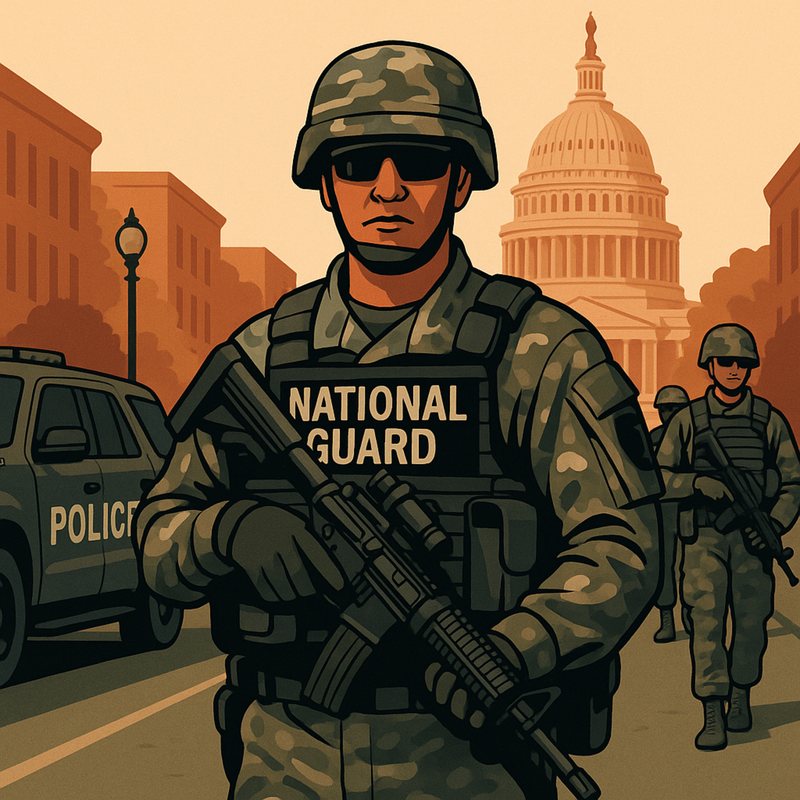
Let's now. Pivot and Fast forward a bit in our hypothetical timeline, perhaps to August 2025. Imagine for a moment former President Donald Trump is back in the White House from the Oval Office. He announces a series of significant actions impacting the nation's capital, Washington, DC. These actions involve 2 immediate and highly impactful measures. First, the federalization of the DC Metropolitan Police Department.
Whoa. And 2nd. The deployment of units from the National Guard, right? So let's unpack those actions, because they carry profound implications. Federalizing the DC police means placing the city's entire police force, which is usually under local civilian oversight, directly under federal control and the. President can do that because DC isn't a state. Exactly because Washington, DC falls under direct federal jurisdiction, it's a federal district. This isn't just some routine administrative shift. It's a significant centralization of power over law enforcement in the capital and the. National Guard deployment.
Well, the National Guard is a reserve military force, citizen soldiers that can be mobilized domestically. Governors use them for disasters, but the president can also activate them for public order issues, essentially bringing military support into a civilian urban environment. So, taken together, these actions signify a very deliberate move to assert strong, centralized federal control over the capital's public safety apparatus. A very. Strong move, yes.
And what? Did this look like on the ground in the streets and neighborhoods of DC? Early indications, and indeed the rhetoric accompanying these actions, pointed towards a clear implementation of what's widely known as a broken window strategy. Ah. Broken Windows For listeners perhaps unfamiliar, that's a criminological theory famously articulated by James Q Wilson and George L Kelling back in the 1980s. What's the?
Core idea the. Core idea is that visible signs of crime and disorder, things like broken windows, graffiti, public intoxication, loitering, create an environment that signals nobody cares. And this lack of concern, the theory goes, encourages more serious violent crimes to flourish. So. By cracking down aggressively on the minor stuff if you prevent.
The Major Crimes, That's the theory. So. In DC, under this new federal oversight, the practical application was swift and visible. You saw homeless encampments much like those in San Francisco being systematically dismantled, their residents displaced, right? And a dramatic, highly visible increase in police presence throughout the city. Officers enforcing what might previously have been considered minor infractions.
Like what? Things like jaywalking, public urination, fare evasion on public transport, minor vandalism, a targeted 0 tolerance focus on petty St. level offenses. The operational goal from this perspective was to restore a sense of strict order and control to the city's public spaces now. This is where the narrative surrounding these actions begins. Its dramatic, divergent from the observable operational reality, isn't it?
Absolutely. The rhetoric employed by former President Trump and his administration was almost entirely couched in terms of taking back the capital. Taking back that's loaded language. Very loaded, steeped in implications of a city lost to crime, chaos, urban decay, a place needing forceful reclamation. This language was designed to evoke a sense of urgency, danger and righteous intervention.
But. And this is a truly critical counterfact that often gets lost in the narrative. Violent crime in DC was at that point already down a significant 26% from the prior year down. 26% That fact alone immediately raises A crucial question. Why was the primary narrative a war on violent crime when, according to the available statistics, crime was already on a noticeable downward trend?
Right. It suggests the chosen narrative wasn't just reflecting the facts on the ground. Exactly. It seems more like a politically charged and compelling justification designed to rally a particular segment of support. It's much harder to generate public urgency or political momentum by saying violent crime is down, but we want to make the streets even cleaner, declaring.
A war is far more impactful, and this is precisely where the media framing in DC becomes incredibly complex, multifaceted, and frankly, profoundly divergent, unlike the relatively singular, transparent narrative we observed with Governor Newsom in San Francisco here. We saw not one, but two vastly different and intensely charged frames emerge, each painting a completely distinct picture of the same operational actions. OK. Frame number one on. One hand, a substantial portion of the media coverage, particularly from outlets perhaps more aligned with the administrations messaging or its base, unequivocally framed these actions as a righteous war on violent crime. Think.
About the impact of that specific framing. It's not just describing a policy. It paints A profoundly urgent, high stakes, almost existential picture. It's no. Longer just tidying up public spaces or enforcing minor laws.
It's a battle for the soul of the city, a necessary aggressive intervention to protect citizens from a pervasive and dangerous threat, and. That conjures immediate dramatic imagery, right? Yeah. SWAT teams, Police chases SWAT. Teams bursting through doors, high speed police chases, intense murder investigations dominating the news cycle. Maybe even a city under siege, desperately needing rescue. It creates an almost cinematic sense of crisis. Which then?
Justifies a strong, decisive response. Precisely this narrative validates aggressive tactics as essential. It shifts the entire public conversation from maybe administrative cleanup or urban management to a heroic, morally justified battle. OK. But then there was a completely different framing happening simultaneously.
Exactly. A completely different and equally vocal wing of media coverage, especially from civil rights organizations, legal advocacy groups like the ACLU, and progressive news outlets, presented A starkly contrasting and deeply alarming narrative. How do? They describe it They. Describe former President Trump's move in far more perilous terms, as a dangerous precedent, A deliberate and potentially permanent militarized occupation of what is significantly A majority black city. Militarized occupation.
That's strong language too. Very. Strong. Their fear was palpable and clearly articulated that this wasn't an isolated incident or just about DC, but rather a blueprint, a trial run that would subsequently be replicated in other large, predominantly Democratic leaning urban strongholds across the country, places like Chicago, Baltimore, Oakland, Detroit. So a fear of it spreading a deep.
Fear and the language used by these critics was extraordinarily strong, drawing explicit and historically loaded parallels. They didn't just disagree with the policy, they characterized it as an authoritarian federal coup, an illegitimate usurpation of local governance. Wow. Too cool, yes? They didn't shy away from using terms steeped in the darkest chapters of history, with critics comparing the actions and rhetoric to Nazi tactics, to Hitler's consolidation of power and to fascist movements. So.
Evoking really serious historical warnings. Absolutely. This rhetoric aim to evoke a sense of profound alarm, warning of a slide into authoritarianism and the suppression of civil liberties, particularly for minority communities who historically bear the brunt of aggressive policing strategies. So the narratives weren't just different, they were diametrically opposed. Totally. Opposed Each designed to evoke a powerful, specific emotional and ideological response from their respective audiences. Here's.
Where it gets really interesting and frankly quite perplexing. How can the exact same set of physical actions dismantling homeless encampments, increasing visible police presence, targeting petty offenses, federalizing a local police force generates such profoundly opposing, intensely charged narratives? It's. Jarring, isn't it? In.
San Francisco As we discussed, the broom was simply a broom. Its purpose was transparent, acknowledged, and largely accepted for what it was. But in DC, these very same types of operational actions were instantly transformed, depending on the framing, into either a righteous, desperate war against criminals or into the chilling first steps of an authoritarian takeover. And. What's profoundly and constituously missing in the DC context, from either side of the media framing, is that plain, unadorned broom narrative. The.
One that was so readily present and accepted in San Francisco. Exactly. There was no widespread public discourse about simply cleaning up for appearances in DC, even though some of the physical actions on the ground were quite similar. The political stakes and the identity of the actor utterly overshadowed any attempt at operational candor. Which?
Brings us to what you've termed the asymmetry of honesty in public discourse. Yes. And it is absolutely crucial to understand that the asymmetry we are highlighting here is not about establishing some moral equivalence between former President Trump's political aims and Governor Newsom's political aims. Right. That's not the point here.
Those aims, as the sources clearly indicate and as the context suggests, were indeed very different. One centered on presenting an international facade for a specific event. The other was couched in terms of domestic control and public order. Despite underlying crime statistics that complicated that narrative, we are absolutely not asserting that one set of actions or their ultimate goals are morally better or worse than the other. Our goal here is purely analytical, purely. Analytical.
Exactly the core of this asymmetry, the critical point of comparison for our deep dive, lies specifically in how candidly the press describes their similar tactics, the operational actions on the ground with. Governor Newsom in San Francisco, the public was given a remarkably plain, straightforward truth. It was openly stated and widely reported as a cosmetic sweep, tidying up for a visiting head of state A. Transparent, almost unapologetic explanation. The operational reality, what was physically happening, and the state of political narrative were in this instance, largely aligned in the public's understanding, no.
Need for complex interpretation The broom was openly acknowledged as a tool for tidiness, but with former. President Trump's hypothetical actions in DC, the very same type of operational action, clearing public spaces, moving homeless populations, increasing visible policing, essentially what amounts to a large scale urban sweep, is immediately reframed. Reframed in two wildly opposing but equally loaded and emotionally charged ways on one side, it is presented as a righteous, necessary crusade against violent criminals, implying A dire, uncontrollable situation that demands drastic, almost martial intervention. Suggesting the capital is in peril and only strong arm tactics can save it, right? And on the other side, it is swiftly described as the ominous first stage of a racially targeted authoritarian program, suggesting A darker, more insidious motive aimed at suppressing civil liberties, disproportionately impacting minority populations and consolidating unchecked federal power.
And what is consistently, conspicuously, perhaps tellingly absent in the public discourse surrounding Trump's actions from either perspective is that. Neutral, plain broom narrative. You would never hear a widespread public statement or media framing like the president is simply cleaning up the city for appearances. The political overlay is too thick, the implications too significant. And it's. Really important to reinforce this point, while the overall scope, the political context and the ultimate motives might indeed differ significantly, 1 focused on international optics, the other on domestic governance and political messaging. Operationally meaning the physical actions on the ground like.
Clearing public spaces, managing homeless populations, increasing visible policing and forcing public order. They were. Similar enough to warrant this direct comparison and how their media framing unfolded. This critical distinction between the operational similarities and the narrative differences is what's key to grasping the full picture it. Really is.
It's about the form, not just the content of how things are presented, so. If we connect this observation to the bigger picture, it. Highlights a profound and ongoing challenge for an informed citizenry, doesn't it? When similar operational actions, the concrete facts of what is physically occurring, are cloaked in such dramatically different, often emotionally charged and ideologically driven narratives, it. Becomes incredibly difficult for the public to discern what is truly happening on the ground versus what story is being skillfully crafted for political or persuasive purposes it. Actively demands a significantly higher level of critical engagement, media literacy, and independent thought from each of us.
We are constantly swimming through layers of interpretation and it takes deliberate effort to reach the bedrock of operational fact. And that leads us directly to the crucial, perhaps most practical question of our deep dive today. Why does framing matter so much? And how does it actually shades not just our opinions, but our very public imagination and our understanding of events, often in an almost unconscious level? Well.
As we've explored, framing profoundly effects what the public imagines is taking place. Let's reiterate those stark examples because they truly capture for this phenomenon. When you hear the phrase war on violent crime, your mind immediately conjures very specific, often dramatic and visceral images. You might envision highly trained SWAT teams bursting through doors, high speed police chases tearing through urban streets. Intense murder trials dominating the news, or grizzled detectives pouring over crime scenes. It's a high octane, almost cinematic vision of an urban landscape under siege, requiring drastic, often aggressive intervention.
Your heart rate might even pick up a little. Right on the absolute flip side, when you hear cleaning the streets for a visitor, the images that spontaneously spring to mind are entirely different, often far more mundane and administrative. You might picture city workers in bright vests with industrial power washers. Dedicated individuals scrubbing away graffiti, the rhythmic hum of a street sweeper or tense being carefully, sometimes awkwardly, dismantled and moved. These are two completely distinct sets of mental pictures evoking entirely different emotional and intellectual responses.
The. Crucial insight here, and it absolutely bears repeating because it's so central to understanding framing, is that both of these narrative frames, the dramatic war on violent crime and the more prosaic cleaning for a visitor, could in fact involve the exact same physical operations on the ground. Yes. The actual acts of systematically dismantling homeless encampments, deploying increased police patrols in specific areas, or rigorously enforcing minor infractions of public order could be present and central to both scenarios. The.
Fundamental difference. The defining factor that shapes public perception is solely in the frame. Applied to those operations, it's. About the meaning, the urgency, the moral justification, and the symbolic weight that the narrative assigns to those actions, not necessarily the actions themselves. The physical reality can be constant while the perceived reality shifts dramatically based on the words used to describe it so. Given all this, what does this all mean for you, our dedicated listener, as a citizen trying to navigate the daily overwhelming influx of information from news outlets, social media, political rhetoric?
Why is it so profoundly important for each of us to consciously separate operational reality from the political narrative? It's not just an academic exercise, it's a vital skill for democratic engagement, understanding. This distinction is absolutely vital because it empowers you to dissect the news more effectively to become a more critical and discerning consumer of information rather than a passive recipient it. Actively helps citizens separate 2 very different layers of information. First, there's the operational reality. That is what is physically happening, the concrete observable actions being taken on the ground, the verifiable facts and.
Second, there's the political narrative, which is the story being told about those actions, a story that is almost always meticulously designed to persuade you, to influence your opinion, to rally support for a particular agenda, or to demonize an opponent. When? You can consciously make that crucial separation when you can ask yourself, OK, what is actually happening here and what story is being told about it, OK, you become a far more discerning and ultimately a far more informed citizen, less susceptible to manipulation and this. Analytical lens isn't just for parsing political news either, right? Not.
At all. Both the San Francisco and Washington examples are, at their core, compelling illustrations of performances layered over public policy. They are fundamentally about making a city appear a certain way to specific targeted audiences, whether. Those audiences are foreign dignitaries and global investors or domestic voters and a political base. It's about optics, symbolism, and the powerful messages those optics convey. And while the specific aims of Governor Newsom and former President Trump may differ significantly in their broader political contexts, it's imperative to acknowledge that both types of operations inevitably disrupt lives. Absolutely the lives of the homeless who are displaced, the daily routines of residents who encounter increased policing, the economic realities for local businesses and. Both types of operations also convey messages that extend far beyond the specific block, where a cluster of tents might be taken down or a sidewalk power washed. They send signals about who belongs, who controls public space, and what type of order is prioritized. So the.
Overarching point of this deep dive isn't to declare moral equivalence between the two scenarios. Definitely not. Their underlying intentions, broader context and long term impacts are indeed quite different. And that's a conversation for another time. Instead, our purpose today has been to understand the mechanics of how information is presented to us, how it is framed, and how that framing profoundly shapes our understanding. Because.
Knowledge is most valuable when it is not just absorbed, but truly understood and consciously applied. And this kind of critical thinking, the ability to look past the rhetoric and identify the operational facts, to distinguish between the broom and the narrative about the broom, is absolutely essential. In a world increasingly saturated with information, much of it presented with a specific agenda, it helps. You build more accurate picture of reality rather than one solely colored by persuades of narratives. So as we wrap up this eliminating deep dive, let's briefly recap our core insight, the truly incredible, often underestimated power of framing and the often present asymmetry in how similar operational actions are described in public discourse.
Remember, an informed electorate, one capable of making sound decisions about his leaders and its future, truly relies on descriptive honesty. Not just from those who report the news, but ideally from the political figures themselves to Given. Everything we've unpacked today about the plane broom versus the highly loaded narratives. Here's a thought for you, our listener. How about you approach the news differently this week?
When? You encounter reports about public actions, particularly those undertaken by political figures. What other sweeps or actions might be happening around us that are being obscured or amplified by their framing are their actions? Being portrayed as emergencies when they are operationally maybe more routine, or conversely, actions being downplayed when their operational reality is far more significant. And what would it truly take for us as citizens to consistently demand that plain broom narrative, that straightforward, unvarnished description of operational reality, no matter who is wielding the broom, no matter what their political affiliation or stated motive?
It's a big. Question it. Is I strongly encourage you to keep an active eye out for how similar events or policies are reported across different media outlets. Don't just settle for one perspective, actively seek out multiple angles. Try to. Discern the underlying operational actions, the verifiable facts from the narratives being intentionally built around them.
Pay. Attention to the language used, the imagery presented, the emotions evoked. You might be surprised and empowered by what you discover about the pervasive, often subtle, power of framing and shaping our collective understanding of the world around us. Thank. You for joining us on this deep dive into the fascinating and crucially important world of framing and perception.
We hope it gives you a powerful new lens through which to view the news and indeed the entire political landscape. Until next time, keep digging deeper.