Read the full transcript (2,370 words, machine made)
Welcome to the debate. America is wrestling with fractures so deep they threaten the very idea of shared understanding, maybe even shared reality itself. Today we confront this profound challenge through the lens of a singular violent event, the assassination of Charlie Kirk. As detailed in the source material Aftershocks PDF. This isn't just a political incident, it's really a flashpoint that exposes some fundamental societal fissures.
Our central question for this discussion is stark. Does Charlie Kirk's assassination reveal in America fundamentally fractured into, well, two nations fighting entirely incompatible wars with no shared understanding? Or do these differing interpretations of foundational concepts like martyrdom and sin, do they still operate within a broadly recognizable human framework, offering perhaps a difficult but potential path for understanding across these divides? I will argue for the profound and nearly irreconcilable incompatibility of these worldviews, contending that the sides don't even share the same battlefield and. I'll be presenting the perspective that despite these vast differences in interpretation, shared human frameworks from meaning making do persist, allowing for, well, at least a degree of translatability across these deep cultural chasms.
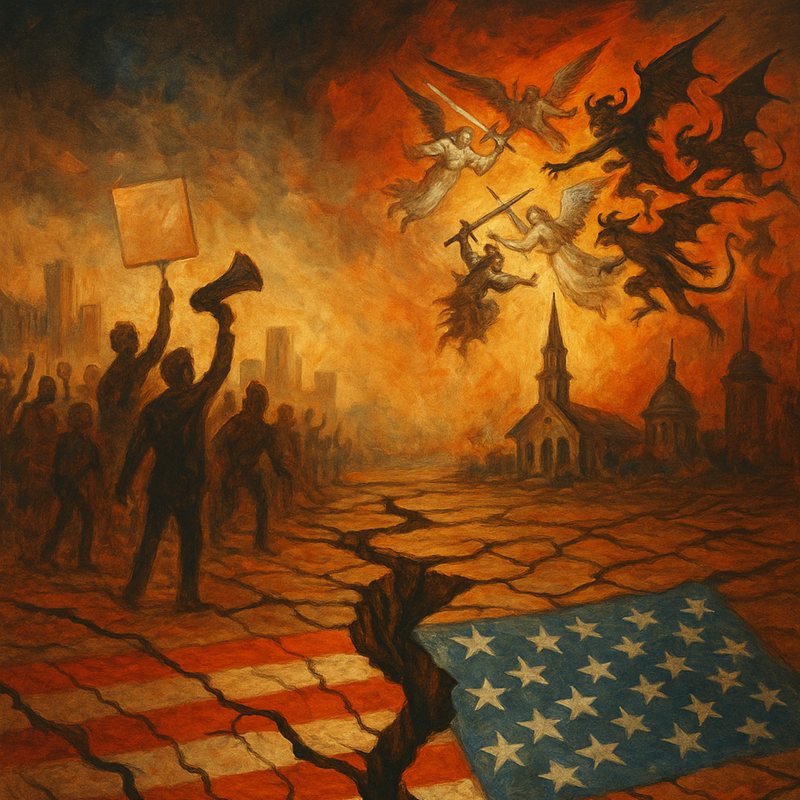
OK, so the assassination of Charlie Kirk and the aftershocks that followed, they powerfully demonstrate that America is engaged in what the source material calls 2 wars. Here, the left and the right seem to operate with fundamentally different understandings of reality, of language, and even of what constitutes meaning itself. This isn't just about, you know, political disagreement. It feels like a breakdown in shared discourse, making common ground seem increasingly elusive. The source explicitly states that two sides aren't fighting the same battle. They don't even share the same battlefield. Now, what this implies is a fundamental divergent in the very definition of conflict itself. At the core of this fracture are what's Aftershocks PDF identifies as the two languages of war. The left often employs a materialist vocabulary, focusing on power dynamics, oligarchs, systemic oppression, identity politics, even treating words as violence. This stands in stark contrast to the Wrights spiritual language, which is centered on figures like demons, Satan, and an unseen enemy with a capital E believing in what they call warfare in the heavens.
These aren't just different opinions, they represent distinct ontological frameworks, meaning they disagree on what reality fundamentally is. And you know how the world operates. This leads to what the material aptly calls an unbearable inversion of logic concerning violence. For the left, the mantra has often been words or violence, suggesting that misgendering or hate speech can wound as deeply as physical harm. Yet when an actual bullet pierces a man's throat, many voices on the side while they cheer, perceiving it as justice.
It's a profound paradox. Words are violence, but actual violence can be justice. On the other hand, the rights logic completely reverses. Words are not violence, they are truth telling, even if uncomfortable. But bullets in this framework are never justice.
They are seen as leading to martyrdom, proof of spiritual warfare. The concept of martyrdom itself vividly illustrates his fracture to the secular left. If Kirk is called a martyr at all, it's often sarcastic, framing him as a demagogue whose death weakens a movement to the right. His killing is martyrdom in the oldest Christian sense, a witness to truth, slain by the world's hatred. These aren't just different shades of meaning, they are entirely distinct worldviews, clashing in their fundamental interpretations of life, death and purpose. I I come at this from a slightly different perspective. While Aftershocks PDF undeniably illustrates profound discord and radically differing interpretations in America, framing these as entirely incompatible worldviews that share no common ground, well that might overstate the actual divide.
My reading of the material suggests that fundamental human experiences and these attempts to find meaning, however divergent their ultimate conclusions might be, still operate within broadly recognizable frameworks. While I absolutely acknowledge the profound clash of vocabularies you've highlighted, the source itself carefully defines martyrdom across Christian, Islamic, and even revolutionary materialist contexts. Now, this very active definition and comparison, I think, suggests a shared human impulse to ascribe significance and meaning to death for a 'cause even if the paradise or the afterlife differs wildly, the phenomenon of sacrificial death and the human need to view it with meaning seem quite universal. These are perhaps different worlds interpreting the same underlying human drive. Consider the word Sinner. OK, to many Christians, it's a baseline diagnosis, a recognition of inherent human failing in need of grace. To many outsiders, though, especially those may be burned by strict religious upbringings, it sounds like annihilation or a crushing judgment.
However, both reactions are responses to a core concept of moral failing or transgression. The dissonance lies in the interpretation and implications. You know, whether it's a pact to redemption or a source of trauma, not necessarily the non existence of a shared moral arena. The trauma and rage section of the document further supports this. It indicates that secular people react strongly to terms like sin, hell, and damnation, not because these words are alien to them, but precisely because they trigger old wounds from, say, childhood sermons and parental discipline. This points to a shared historical and emotional exposure to these concepts, even if that experience leads to rejection and pain.
Ultimately, the source identifies the snipers shot as the quake and the subsequent interpretations as aftershocks. Both sides are reacting to the same originating event, implying A singular reality that generates multiple, albeit radically different, interpretations. That common starting point is key, I think. I see why you'd want to find those threads of commonality, I really do. But my contention remains that the 2 languages of war, the materialist versus the spiritual, are so deeply divergent they create fundamentally different battlefields.
When the source says they don't even use the same dictionary, I don't think it's hyperbole. For instance, that capital E, an enemy for the right, isn't just a metaphor for political opponents, it's understood as a literal reference to Satan and demonic forces. Now, this directly contrasts with the left's framing of violence is purely political, historical, and entirely material. How can true communication, not just disagreement, even occur when the very foundational terms of conflict, the very nature of reality itself, are so fundamentally incompatible? This isn't just a matter of semantics, A dispute over words.
It's about ontology, meaning a fundamental disagreement on the very nature of being and reality that makes bridging the gap seem almost impossible. I certainly acknowledge the profound linguistic chasm you've highlighted and the enormous challenge it presents to well to genuine discourse. Yet I believe the source itself offers a vital counterpoint to this idea of complete incompatibility. The material, through its glossary for outsiders, actually attempts to bridge this very gap by carefully defining terms like sin, grace, the enemy, spiritual warfare, and words are violence. The document is performing an act of translation.
It facilitates an understanding of how these different groups interpret their world. Even if one doesn't agree with those interpretations, this very act of explanation, designed for those outside the framework, suggests at least a potential for deciphering the other's language. It indicates a shared human capacity for semantic understanding, even across deeply divergent worldviews. The fact that we can articulate the differences implies some shared capacity for comprehension for at least mapping out the others conceptual landscape, wouldn't you say? Perhaps mapping it out, But that capacity to define the terms doesn't necessarily lead to shared meaning or, crucially, a common moral calculus.
It's truly unsettling, isn't it? This unbearable inversion described in the Source, where words can be violence but an actual bullet can be justice for one side, while for the other words are truth and a bullet is martyrdom. How does a society even begin to deliberate when the very definitions of harm and justice are inverted like that on the left? You know, a microaggression can be equated to physical violence, yet the actual physical violence of a bullet striking Charlie Kirk is, for some, cheered as justice. It's a profound paradox.
Then, on the right, the logic reverses completely. Words are not violence, they are truth telling, even if uncomfortable. But bullets are never justice. They are martyrdom, proof of spiritual warfare. This isn't just a difference in opinion, it's a complete inversion of how harm, truth, and legitimate action are understood. It seems to remove any common moral calculus, any shared way of weighing what's right or wrong, what's a just outcome, or even how to assess the consequences of an event. Where do we begin when the very compasses seem to be pointing in opposite directions?
I find that assertion that it entirely removes common ground difficult to fully accept. My perspective is this. While I acknowledge the stark contrast and how violence is perceived and the profound moral paradox it presents, I think both sides are, in their own way, attempting to legitimize action or interpret suffering within their respective moral frameworks. Take the rage felt by Acts evangelicals described in the Source as a response to perceived condemnation and spiritual trauma, and then consider the Wrights belief that demons rage when exposed as their worldview is challenged. These are both powerful, quite visceral responses to perceived injustice or threat.
Now, while the definitions of justice or threat are diametrically opposed, the common thread might be the fundamental human drive for justice, for meaning, or maybe for protection from perceived harm. The intensity of the reaction itself suggests a shared emotional landscape, however fragmented it might appear on the surface. Think about the sheer human force behind those reactions. Rage. Pain. A drive for justice, while the language used to describe them or the solutions envisioned are starkly opposed. The fundamental, almost primal impulse to respond to perceived injustice or threat.
That strikes me as a share of human landscape, however fractured. That's an interesting point about the shared emotional landscape, though I might frame its implications differently. The Aftershocks PDF makes a, well a compelling case for the profound implications of martyrdom in these distinct frameworks, and how it really solidifies this idea of two wars. Consider the Hydra of MAGA analogy used in the source for the right. Kirk's death isn't a set back.
Instead it's seen as a fertilization of the movement, akin to Christian martyrdom where, you know, kill Jesus and the church expands. This spiritual framing means the movement by its very nature cannot be defeated by purely material means like killing a leader or suppressing voices. It fundamentally changes the nature of political struggle compared to movements that rely on a single leader or a purely material ideology. To the right, this is framed as warfare in the heavens, and physical death is merely a transition, not an end. This spiritual dimension, I think, makes the conflict truly irreducible to a shared earthly battlefield. It's not just a different strategy, it's almost an entirely different playing field. That is a powerful analogy, the idea of a movement strengthened by sacrifice, like a hydra growing new heads. But here's where I see a shared thread, maybe a functional 1. The source observes that even revolutionary materialism uses martyrdom to quote water, the tree of freedom, ensuring glory in memory and fueling a 'cause.
This highlights that while different heavens or after lives are envisioned, the function of such a death to inspire comrades and perpetuate a movement can be paralleled across these seemingly disparate worldviews. The deep division is certainly, and why it inspires and what it inspires, I grant you that. But that it inspires, that seems to indicate a shared fundamental mechanism for human movements to coalesce around sacrifice. It suggests a kind of translatability of the purpose of martyrdom, even if the details of its spiritual or material outcome differ wildly. The underlying human need to give meaning to sacrifice feels universal here.
While. I agree the function of martyrdom inspiring A cause might show a common thread. It kind of circles back to our initial point on linguistic incompatibility, doesn't it? The meaning of that sacrifice and the nature of the enemy are still so radically different because of those two languages of war that the inspiration itself fuels completely divergent ends. One side sees the death as an act of spiritual warfare against literal evil, the other is a olitical act against systemic injustice. O The insiration might be shared structurally, perhaps, but the direction it oints towards is fundamentally opposing, which further fractures the idea of a cohesive society. The material, particularly these aftershocks of Charlie Kirk's assassination, vividly illustrates how America is wrestling with profoundly disparate worldviews. The Two Wars narrative underscores a challenge not just of political disagreement, but of a well a fundamental divergent in linguistic, theological, and moral understanding.
This suggests A deeply fractured landscape where common ground is increasingly elusive and maybe the very foundations of shared reality are eroding, leaving us to confront a society perhaps more fragmented than we fully grasp. I'm not convinced that necessarily means common ground is entirely elusive, though. While the differences are indeed profound and generate significant societal tremors, the analysis in Aftershocks PDF itself, simply by carefully detailing these different interpretations across various frameworks, offers a kind of framework for understanding why people interpret events so differently. It underscores the shared human attempt to make sense of violence, sacrifice, and moral failing, even if the resulting interpretations remain starkly divided. We are, at our core, perhaps trying to understand the same core human phenomena. The document almost provides A Rosetta Stone, however incomplete, for comprehending the different languages we used to do so.
This insightful analysis of the aftershocks and their ongoing rumble beneath us certainly lays bare a complex and unsettling reality, leaving us to contemplate the implications of such deep divisions. And the potential, or indeed the lack thereof, for shared understanding standing in America. There is certainly much more to explore within this fascinating material and the enduring questions it raises about our society.