
Shepherds Aren't EDC, They're EMS
This article, read aloud:
Share: X · Facebook · LinkedIn · Reddit · Bluesky · Threads · Email
Four theories of protection circulate in the carry world, and three of them get the flock wrong. The gray man disappears into the crowd. The sheepdog stands guard over it. The rancher counts it. The shepherd in John 10 does none of those things. He stands at the gate in the morning and calls, and the sheep sort themselves by ear, and the ones who know his voice follow him out. Protection, in the oldest version of the story, is no perimeter and no balance sheet. It is a voice the flock has chosen to know.
The gray man theory is the simplest of the four: survive by being unmemorable. No logos, no patches, no tactical anything, nothing on the body or the truck that gives an observer's eye a reason to stop. Dress like the middle of the crowd and move like it. The practice has an inventory: the plain jacket with no unit patches, the truck with no stickers on the glass, the watch that tells time and nothing else, hands visible, eyes moving, face still. As a discipline of not being selected, it works, and the men who practice it are not wrong about the world they practice it in. But look at what the theory contains and what it leaves out. It contains one man. The crowd around him is not a flock; it is cover, a herd he hides inside, other people's bodies between him and the wolf. Nobody gets rescued in gray man doctrine. The best outcome the theory can imagine is that trouble picks somebody else. It is a theory of one, wearing the many as a coat.
The sheepdog theory has an author. Lt. Col. Dave Grossman laid it out in On Combat, and it has been quoted in carry classes and church security meetings ever since: most people are sheep, gentle and productive and incapable of hurting each other except by accident; a few are wolves, who feed on the sheep without mercy; and a few are sheepdogs, who have the capacity for violence and a deep love for the flock, and who live to protect the herd. The sheepdog aims outward, at wolves, and Grossman is plain that the dog's honor lies in how rarely it has to bite. It is a serious theory, held by serious people, and the men who hold it hold it as a burden, not a costume.
The flaw is in the job description. The sheepdog is on duty at all times, in all places, at the grocery store and the school play and the family cookout. Sheepdog is something he is, carried every day like the gun itself—EDC as an identity. And the flock in the theory has to stay helpless for the theory to stand. Grossman's sheep cannot tell a wolf from a dog until the teeth are already in them. They resent the sheepdog in peacetime and bleat for him in the attack, and at no point in the arrangement do they choose anything. A flock with agency breaks the model, because a flock that can choose does not need a permanent guard. It needs a voice it trusts and the freedom to answer it.
The rancher is the honest man of the four, and his honesty is the coldest. To the rancher the flock is capital. He fences it, feeds it, doctors it, breeds it, and culls it, and every one of those verbs is a line in a ledger. A sick ewe gets treated if the treatment costs less than the ewe. Predators take a percentage every year, weather takes a percentage, and the operation plans around both numbers before the season starts. One sheep: acceptable losses. That is arithmetic talking, not cruelty, and every livestock operation on earth runs on it or goes under. The rancher's failure is the counting itself: the counting is the whole relationship. His sheep are inventory that happens to be alive, and an animal that wanders off is not a soul in the dark. It is shrinkage.
The rancher marks his sheep. Brand, ear notch, a stripe of paint down the back—the mark says whose the animal is, and it says it to other men, so the ownership survives a strayed fence line and a mixed herd at market. The mark is for the record, not for the sheep; a sheep cannot read its own brand. The shepherd in John 10 keeps no mark at all. He has names. The brand answers the question of possession. The name answers the question of identity, and it runs the other direction: it is spoken to the sheep, and the sheep answers to it.
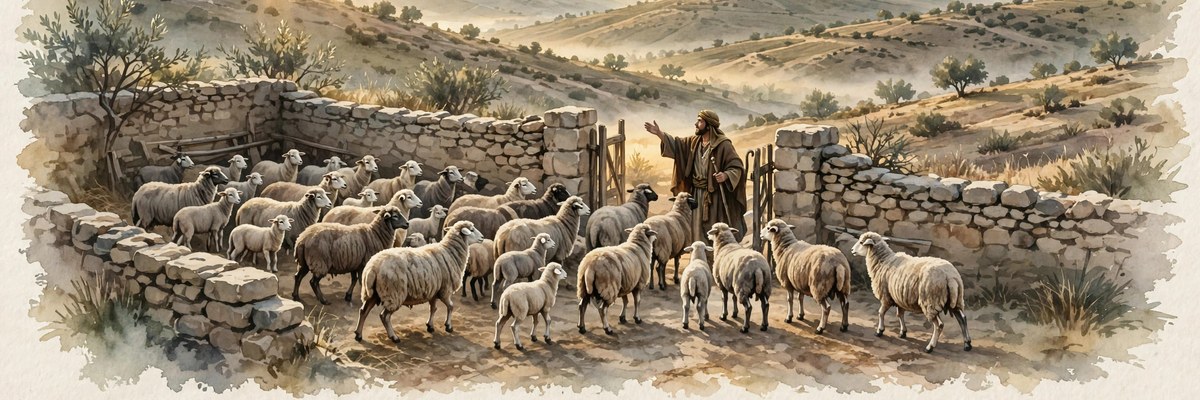
John 10 describes a different arrangement, and it describes it as a morning routine. Several flocks spend the night in one pen, mixed together behind one gate, the way flocks in that country were kept. In the morning the gatekeeper opens the gate, and each shepherd calls his own sheep by name and leads them out. The sheep follow him because they know his voice. They will never follow a stranger; in fact, they will run away from him, because they do not recognize a stranger's voice. Nothing in the scene is driven or dragged or sorted by force. Nobody walks the pen with a stick separating the flocks. The flocks unmix themselves, by ear, sheep by sheep, each animal rising and going to the voice it recognizes. The pen holds every flock in town, and the only sorting mechanism in it is recognition.
"My sheep hear my voice, and I know them, and they follow me." Read the verbs in order. Hearing is the sheep's act. Knowing runs in both directions—he knows them by name, they know him by voice—and following is what the sheep do, freely, every morning, in the presence of other voices they could follow instead and other flocks they could stay lying down with. The shepherd's authority in John 10 is a history between a voice and a flock, and the flock ratifies it daily. That is agency, and choice, and opt-in, stated in a sheep pen in the first century: the call can be refused, the stranger can be followed, the sheep can stay down. The shepherd calls anyway.
The same chapter keeps a fifth figure on the page, and he is the sheepdog's shadow. The hired hand works the flock for wages. When he sees the wolf coming, he leaves the sheep and flees, and the wolf snatches them and scatters them—and John gives the reason in one flat clause: he is a hired hand, and he doesn't care for the sheep. Paid protection has a limit, and the limit is the paycheck; when the risk outruns the wage, the arrangement ends and the flock is on its own. The shepherd in the passage works under no contract. The sheep are his—his by name, his by voice, his by the mornings—and when the wolf comes he does not consult a wage. He lays down his life for the sheep. One of those two figures can be hired. The other one can only be known.
The lost-sheep parable in Luke 15 is usually read as a story about the one, and it is; I argued the one's case in Never Spare the One for the Many. But the parable is also a story about the ninety-nine, and what it says about them is easy to miss. The shepherd leaves them in the open country and goes after the one that is lost until he finds it. Leaving them is only thinkable if they can be left. Grown sheep graze. Grown sheep keep together, keep feeding, keep being a flock for an afternoon with nobody standing over them. They are not hors d'oeuvres on a tray, helpless tidbits waiting to be served up or rescued. They are animals with a competence of their own, and the parable spends no worry on them, because they are not the emergency.
Sheep don't need a shepherd. A lost sheep totally does. That is the whole doctrine of the thing. Shepherds aren't EDC; they're EMS. Nobody wants an ambulance idling in the driveway every morning of his life, and nobody lying in a ditch wants anything else on earth. Everyday carry is the weight a man supervises himself against, all day, every day, and it never comes off. Emergency response is for the moment a life is actually out in the dark, alone, in country it cannot cross by itself. The shepherd of Luke 15 is a rescue that dispatches on loss, travels at his own risk, carries the found sheep home on his own shoulders, and then returns to a flock that was never helpless in his absence. The ninety-nine did not need him that day. The one needed nothing else.
Lay the four side by side and each one is a sentence about what the flock is. To the gray man, the flock is camouflage. To the sheepdog, the flock is helpless. To the rancher, the flock is capital, and its losses are a cost of doing business. To the shepherd, the flock is a company of agents who know his voice, who can refuse it, who can wander and be gone—and who are his, by name, one at a time, in a way no ledger records. The first three theories are arrangements a man makes with danger. The fourth is a relationship he keeps with sheep. And when one of them is out in the hills at night, it is the relationship, and only the relationship, that goes over the ridge in the dark to bring it home.
Disclosure: the Amazon link in this piece is an Associates link (tag gerris-20). As an Amazon Associate I earn from qualifying purchases.
Share: X · Facebook · LinkedIn · Reddit · Bluesky · Threads · Email