
John Was the Hype Man
This article, read aloud:
Share: X · Facebook · LinkedIn · Reddit · Bluesky · Threads · Email
Read the Gospels over and over, the way I have, and one fact keeps surfacing. Nobody in them ever says a bad word about John the Baptist. He is never dismissed, never named a false prophet, never treated as a distraction or filed under embarrassment. Jesus is in awe of him. The writers are in awe of him. The record runs from the river to the tomb and the record is love, all the way down, all the way to his beheading. If the early church could have dissed anybody as lame, the candidate was John: the forerunner with his own movement, his own disciples, his own martyrdom. The church had the pen. The church left him crowned.
Everybody else in the book takes a hit somewhere. Peter gets "Get behind me, Satan" to his face and a denial beside a charcoal fire on the worst night of his life. Thomas carries the word doubting as a surname two thousand years later. James and John send their mother in to angle for the thrones on either side and get corrected in front of the other ten. The rich young ruler walks away sorrowful and the text lets him walk. The Pharisees collect woes by the chapter. Even the men around John get handled roughly by the record: Herod is a cautionary tale with a worm-eaten namesake, and John's own preaching calls the religious delegation a brood of vipers to their faces. John alone stands uncorrected. Jesus rebukes Peter, instructs Thomas, refuses the sons of Zebedee. Jesus never corrects John once.
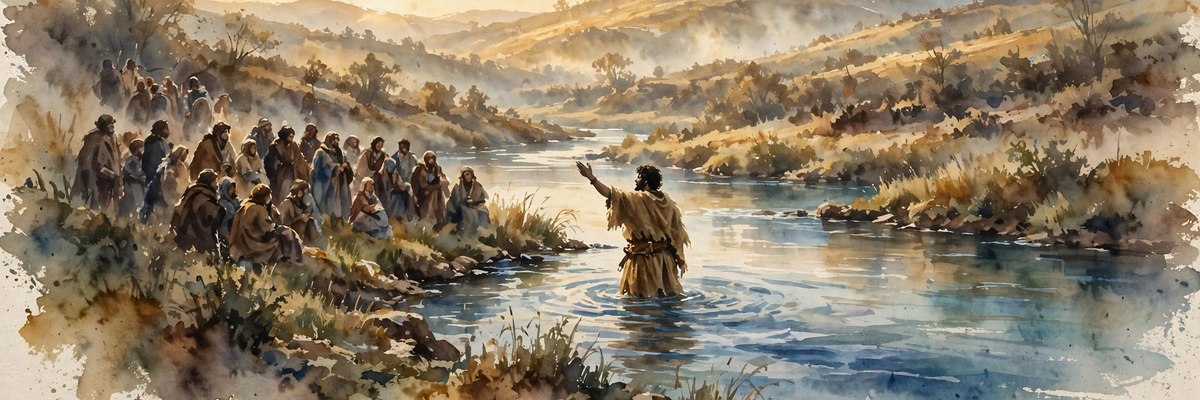
The awe is on the record in Jesus's own words. He calls John a prophet and then upgrades him: "Yes, I tell you, and more than a prophet." He calls him the messenger sent ahead to prepare the way, the Elijah the scriptures promised. In the Gospel of John he is "a burning and shining lamp," and Jesus says the crowds were willing to rejoice in his light. Jesus's public life opens by submitting to John's baptism, and his first two disciples arrive as John's gift: men John trained, whom John points onward. The headliner's opening scene is a kneel in another man's river, and his first recruits are another man's cast-offs, handed over with a blessing.
The church had every incentive to demote him, and the incentive had a name and an address for centuries. John's movement outlived John. His disciples appear inside the Gospels as a camp of their own, coming to Jesus with a complaint about fasting, reporting back to John in worry that the crowds are crossing over. Decades later, in Acts, Paul walks into Ephesus and finds twelve men who know only the baptism of John; Apollos is teaching John's baptism accurately and incompletely in Corinth at the same hour. Farther east and later still, the Mandaeans built a whole religion on John, keeping him as their prophet and counting Jesus the false one. A live competitor wore John's name long after the beheading. Movements defend themselves by shrinking the founder next door. The Gospels had the motive, the opportunity, and the editorial pen, and they spent all three on protecting him.
The first exhibit is the baptism itself. Jesus comes down to the Jordan and asks John for the thing John's whole ministry exists to give. Matthew feels the problem in his own pen and writes the discomfort into the scene instead of editing it out: John tries to stop him. "I need to be baptized by you, and do you come to me?" The seating chart is upside down and everybody in the story knows it. Matthew keeps the protest, keeps the kneel, keeps the heavens opening over a hierarchy nobody in the text will defend out loud. The greater man goes down into the water under the lesser man's hands, and the lesser man's objection is preserved in the permanent record as proof that he understood exactly what was happening.
The second exhibit is the doubt, because the doubt is where any other book buries a rival. John sits in Herod's prison, his ministry over, his head already priced, and he sends two of his disciples to Jesus with the question a founder is never supposed to ask out loud: "Are you the one who is to come, or shall we look for another?" It is as close to a crack as a prophet's faith ever shows in print. Jesus sends the messengers back with a field report instead of a rebuke: the blind receive their sight, the lame walk, lepers are cleansed, the deaf hear, the dead are raised up, the poor have good news preached to them. Then, as John's men walk away, Jesus turns to the crowds and delivers the highest praise in the book. "What did you go out into the wilderness to see? A reed shaken by the wind?" And then the verdict: "Truly, I say to you, among those born of women there has risen no one greater than John the Baptist." The doubt gets answered with a coronation, delivered in public, on the record, in front of everybody.
John refused every promotion the world offered him first. The priests and Levites come out from Jerusalem with a clipboard of titles and he hands every one back. "I am not the Christ." Not Elijah. Not the Prophet. Asked for his identity, he gives a job description out of Isaiah: a voice crying in the wilderness. He is the only man in the New Testament who is interviewed for the crown and declines it on tape, three times in a row, before breakfast. The titles he refused are the titles other men in the book reach for and get diminished for reaching. John reached for the riverbank and the locusts and the pointing, and he kept his hands on exactly those.
His own sentence explains the whole two thousand years of it. His disciples bring him the market report, worried: Rabbi, the man across the Jordan, "all are going to him." A rival founder hears that sentence as a death notice. John hears it as the sound of the job finishing. He answers with the bridegroom's friend, the man whose whole station is beside the groom at the wedding, whose joy is complete at the sound of the groom's voice. "Therefore this joy of mine is now complete. He must increase, I must decrease." Every other rival in scripture grabs at the throne and gets cut down to size for grabbing. John endorsed the successor, surrendered his crowd, and stepped down the bank on purpose, as doctrine. He never made the church spend a thing on him: no correction to print, no demotion to arrange, no footnote of shame to draft. Love was cheap because John had already paid the expensive part himself.
John was the hype man. A hype man works the room before the headliner exists in it. His whole act is the pointing: the voice out front, warming a crowd for a man who has not yet walked through the door. John's entire ministry fits in one gesture and one sentence. "Behold, the Lamb of God, who takes away the sin of the world." That is an introduction, not a sermon. The next day he says it again, standing with two of his own disciples, and the two men leave him on the spot and follow Jesus, and the text counts the loss as John's triumph. He had drawn Jerusalem and all Judea out into the wilderness, to a man in camel's hair with a leather belt, eating locusts and wild honey, and he handed the house over full. Every hype man since who grabbed the mic and tried to become the headliner got forgotten by the crowd he warmed. John did the job so purely that two thousand years of the headliner's people still cannot say a bad word about him.
Herod liked listening to him. Mark says so plainly: Herod feared John, knowing him to be a righteous and holy man, and kept him safe, and heard him gladly even when the words perplexed him. The venue owner was a fan. Then came the party, the dancing girl, the rash oath sworn in front of the dinner guests, and the guard with the platter. John was killed by a promise made over wine at a birthday, over something he had said into the mic about the king's marriage. His disciples came and took his body and laid it in a tomb. The love in the record runs all the way to the platter: the last hands on him in the text are his own people's, burying him, and the headliner's praise is already on the books ahead of the burial.
If anybody is a reincarnation of John the Baptist it's Kurt Vonnegut Jr. American letters kept him out in the wilderness for decades, filed with the science-fiction writers and beneath the serious critics' notice: the rumpled outsider in the hair shirt of the midlist. His whole ministry was the pointing. He stood outside the gates and announced a decency that had not yet walked through the door, and he compressed the entire creed to the length of an introduction, in a speech written for a christening in God Bless You, Mr. Rosewater: "Hello, babies. Welcome to Earth. There's only one rule that I know of, babies—God damn it, you've got to be kind."
The one crown he ever accepted was a functionless one: honorary president of the American Humanist Association, succeeding Isaac Asimov, in a capacity he himself called totally functionless. He announced he was done, published Timequake in 1997 as his last novel, and decreased into speeches and essays while the crowds kept coming anyway. The culture heard him gladly. It has been trying ever since to find the bad word for him, and none of them has stuck.
So the fact stands where the reading finds it. The Gospels diminish the men who reach. They correct the apostles, expose the rulers, let the sorrowful walk away sorrowful. For the one man who arrived first, drew the crowd, named the headliner, refused the crown, and decreased on schedule in public, the book keeps a clean sheet and a coronation. He is the only figure in the New Testament who exits with his reputation larger than the day he entered: baptized by nobody, corrected by nobody, praised by the man he introduced in front of everybody. John was the hype man. He pointed at the door, and the pointing is still working.
Disclosure: the Amazon link in this piece is an Associates link (tag gerris-20). As an Amazon Associate I earn from qualifying purchases.
Share: X · Facebook · LinkedIn · Reddit · Bluesky · Threads · Email