
Never Spare the One for the Many
This article, read aloud:
Share: X · Facebook · LinkedIn · Reddit · Bluesky · Threads · Email
The council had a math problem. Jesus of Nazareth was drawing crowds, and the crowds were drawing Roman attention, and Rome, when it paid attention to Judea, tended to take things away. The chief priests and the Pharisees said it in the open, in John 11: what are we doing? If we let him go on like this, everyone will believe in him, and the Romans will come and take away both our place and our nation. Caiaphas, the high priest that year, gave them the answer in one sentence, and it is the most honest sentence any committee has ever produced: it is expedient for you that one man should die for the people, and that the whole nation perish not.
That is the other side's whole doctrine, stated without decoration. One man on one side of the scale, a nation on the other, and the scale is not close. Every manager who has ever lived recognizes the arithmetic. It is the arithmetic of the house: keep the roof on, keep the many fed and calm, and if the price of the house is one man, pay the man. Caiaphas was no monster in a melodrama. He was a housekeeper with a budget, and the budget balanced.
Christianity was designed to never spare the one for the many. The design runs from the front of the book to the back of it.
Genesis 18. Abraham is standing before God over Sodom, a city with nothing to recommend it, and he starts bargaining like a man at a market stall. Will you destroy the righteous with the wicked? What if there are fifty righteous in the city? God agrees: for fifty, the city stands. Abraham pushes his luck. Forty-five. Forty. Thirty. Twenty. Ten. God agrees at every step, and the bargaining only stops because Abraham stops asking. A city guilty as charged gets carried on the books of ten righteous men. The housekeeping arithmetic runs backwards in the presence of God: the many are spared for the sake of the few, and the few have been bargained down to a minyan.
Jonah gets sent to Nineveh with one sentence of preaching, and the whole city repents in sackcloth, down to the cattle in the streets, and God spares it. Jonah is furious. He had done the arithmetic of judgment and the sum came out destruction, and he says so to God's face: I knew you would do this, gracious and merciful, slow to anger, which is why I ran the other way. The book ends on God's question, and it is a question about pity, not about totals: should not I spare Nineveh, that great city, wherein are more than sixscore thousand persons that cannot discern between their right hand and their left hand, and also much cattle? The prophet wanted the count to decide. God counted persons.
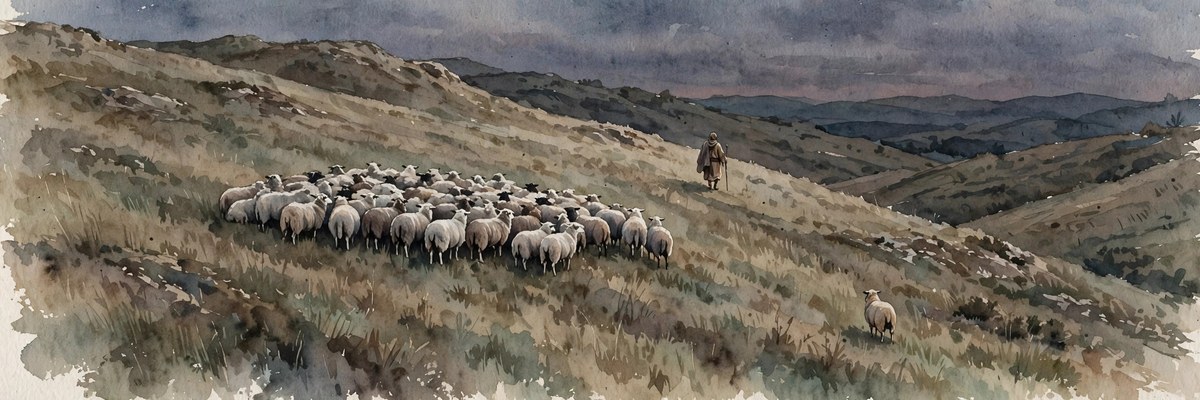
Luke 15 is three exhibits in one chapter, told to one audience: the Pharisees and scribes, who were grumbling that Jesus received sinners and ate with them. First the sheep. A shepherd has a hundred sheep and loses one of them. A competent keeper of livestock secures the ninety-nine. He counts what he has, pens the flock, writes the loss off, and keeps the operation whole, because going out into the hills after a single sheep risks the ninety-nine for the sake of the one. The shepherd in the parable leaves the ninety-nine in the open country and goes after the one that is lost until he finds it, and then he lays it on his shoulders, rejoicing, and calls his friends together for a celebration that costs more than the sheep is worth. Jesus states heaven's bookkeeping in the same breath: more joy in heaven over one sinner who repents than over ninety-nine righteous persons who need no repentance. The ninety-nine were never the point.
Then the coin. A woman has ten silver coins and loses one. She lights a lamp, sweeps the house, and searches carefully until she finds it, and then she calls her friends and neighbors to rejoice with her over a coin she could have replaced out of a week's ordinary work. Then the son. A younger son demands his share of the estate while his father is still alive, which in that world is a way of saying he wishes the old man dead, and the father divides the property and lets him go. The boy comes home ruined, rehearsing a speech, and the father sees him a long way off and runs to him. Runs. An old man, a patriarch, in public, in a culture where a patriarch's dignity was measured by how slowly he was allowed to move. The fattened calf is killed, the robe and the ring come out, and the elder son stands in the field doing arithmetic out loud: all these years I have slaved for you and never disobeyed your command, and you never gave me a young goat. The elder brother has kept the house beautifully. He cannot understand why the house is celebrating the one who spent his share of it. He is Caiaphas with cleaner hands and a better record, and the father goes out to plead with him too, because the father is after that one as well.
The pattern holds at street level. Jesus is leaving Jericho with a crowd around him, a procession with momentum, the kind of movement a manager protects, and a blind beggar named Bartimaeus starts shouting from the roadside. The crowd does what crowds do. They rebuke him and tell him to be quiet, because the procession is the point and the beggar is a delay. Jesus stops. The whole procession stops, for one blind man sitting in the dust, and the people who were shushing him a breath earlier are suddenly saying take heart, he is calling you. The Gospels are full of these stops. The schedule of the salvation of the world, interrupted by one person at a time.
The Samaritan gets the same scene from the other side. A man lies half dead in the ditch on the Jerusalem road, and the priest passes by on the other side, and the Levite passes by on the other side, and both of them have somewhere to be and duties waiting at the temple. The Samaritan stops for one wounded stranger, a man of a despised sect, nothing to him at all, and pays the innkeeper out of his own pocket on account: whatever more you spend, I will repay you when I come back. One stranger. An open account. No assembly approved the expenditure.
Genesis 22 fixes the direction of the traffic for everything after it. Abraham is told to take his son, his only son Isaac, whom he loves, and offer him on Moriah. He goes. He builds the altar, lays the wood in order, binds the boy, and takes the knife—and the angel of the Lord calls out of heaven and stops his hand, because the substitution was never Abraham's to arrange. There is a ram caught in a thicket by his horns, and Abraham offers the ram instead, provided on the mountain by God himself. Whatever else Moriah means, it settles this: when a substitute is required, God provides it. Man does not go into his own household and pick one.
And then the design completes itself, backwards. Caiaphas said that one man should die for the people, and John notes, drily, that the high priest prophesied better than he knew: one man did die for the nation, and not for the nation only. But look at who did the choosing. No committee went into the flock and selected a sheep. In John 10 the shepherd says it in terms that leave nothing standing: I am the good shepherd. The good shepherd lays down his life for the sheep. No one takes it from me, but I lay it down of my own accord. When the one is given for the many, the one is the shepherd, and he volunteers, and he pays out of his own account. Housekeeping reaches into the flock and takes a life from below to keep the structure standing. The cross gives a life from above and lets the structure shift for itself. The distance between those two transactions is the whole distance between Caiaphas and Christ.
This is why the faith cannot do global housekeeping and never could. Housekeeping asks how many people the house can hold. It asks what the budget feeds, what the planet carries, what the curve can bear, and then it adjusts the count. The ledger of Christianity is one column and the entries are one soul deep. Ask it about a murder and it asks who died. Ask it about a million murders and it asks the same question a million times. The crime is complete in a single entry; three billion of them would be the same entry written three billion times, and the horror is in the repetition, not in some threshold of scale where the sum finally becomes serious. A faith that kept aggregates could be bargained with on totals: keep the number under the line and take the policy. This one holds no total to bargain over. It holds the one.
The judgment scene at the end of Matthew keeps the same ledger. The King gathers the nations and gives his reasons one act at a time: I was hungry and you gave me food, thirsty and you gave me drink, a stranger and you took me in, naked and you clothed me, sick and in prison and you visited me. Both sides, the sheep and the goats alike, are astonished by the accounting. When did we see you hungry, Lord? The answer names the smallest unit in the whole scene: inasmuch as you have done it unto one of the least of these my brethren, you have done it unto me. One. The verdict on a life is rendered in single servings, and nobody in the scene is judged on a national total.
The modern world keeps Caiaphas's books at a scale he could not have imagined, and it keeps them with clean hands and excellent intentions. Triage charts that price one life against the lives the same money might save elsewhere. Population targets drawn up in the 1970s by sincere men who had done the carrying-capacity arithmetic and found the house too full. Aid money, medical money, mercy itself, routed to wherever the arithmetic says it multiplies fastest. And the principle has its catechism, memorized off a movie screen: the needs of the many outweigh the needs of the few, or the one. Spock says it dying behind glass, and a generation learned its ethics from a science officer. Even the film could not live with the sentence. The sequel spends a stolen starship, a crew's careers, and the Enterprise herself to go back for the one, and the audience wept with relief at the reversal. The arithmetic had been stated perfectly. It still had to be answered.
The ninety-nine are still standing in the open country where the shepherd left them, unguarded, in wolf country, at dusk. By every rule of management ever written, that is malpractice. By the design of the thing, it is the only move on the board. The flock was never the unit of account. The sheep was.
Share: X · Facebook · LinkedIn · Reddit · Bluesky · Threads · Email