
The Deer Are Coming Out of the Woods
This article, read aloud:
Share: X · Facebook · LinkedIn · Reddit · Bluesky · Threads · Email
They call it an epidemic. Mental illness, suddenly, everywhere—an epidemic of broken minds in a country that was fine before. I don't believe it. There is not more mental illness in America than there has ever been. There are more mentally ill people in the open: on the street, at the office, online, saying the names of their conditions out loud in the first person. The count went up because the hiding went down. We have been the same humans for fifty thousand years. What changed is what it costs to be seen.
For most of the century I grew up next to, the arrangement was removal. If your mind broke in a way the neighbors could see, you were taken—by petition, by a relative's signature, by a commitment hearing if you were lucky. A husband's signature could do it. A parent's could. The paperwork was not the hard part; getting out was. The state hospitals held 558,922 people in 1955, the peak year, warehoused in buildings the size of towns. The prisons of that era were comparatively empty; nobody needed them for this. The asylum was the instrument. The goal never had to be stated as cruelty: fix them, or remove them. The fixing, where it was tried, ran to lobotomies and insulin comas and tens of thousands of sterilizations carried out under law. And the ones who killed themselves were buried politely. Suicide was a shame and a sin, and the death certificate said accident often enough that the era's numbers are a floor, not a count. When the hospitals finally emptied, the people did not vanish. They changed buildings. Lionel Penrose had named the seesaw in 1939—beds down, cells up—and the county jails became the asylums' heirs: the jails of Cook County and Los Angeles County are described, accurately, as the largest mental health facilities in their states.
The emptying has a name that is a curse at Miriam's Kitchen, where I have served food for years: Ronald Reagan. The census was already falling before him, and in California he signed the law that made it hard to lock a man up for being mad, and as president he cut the money and let the doors swing. At Miriam's we remember the second half—St. Elizabeths, eight thousand souls at its peak, emptied into the streets, and the streets are where we feed them. Both halves are true, and they are the same act. A locked ward is not care. A man behind a sanitarium door has no agency at all, and whatever his reasons were—budgets, spite, conviction—the opening of those doors returned something real to people who had nothing. The people freed said so at the time. We talk about the abandonment every day. We never talk about the liberation. It was a mitzvah, performed by a man we hate, and nobody says so.
Everybody who wasn't removed did the other thing: they masked. They strained, every day, to be socially appropriate, and the strain was a second job nobody paid them for. I learned young to read the labor. You can spot a mask by the eyebrows. Eyebrows are the most adjustable signal on a face, so the person managing a presentation manages them to death—plucked, sculpted, worked—and the overworking itself becomes the tell. I wasn't reading who anybody was. I was reading how hard they were working not to be read.
The law applied to me the one time somebody else did the work. I was dating a plastic surgeon, and she preened me like a bonobo—plucking the errant hairs, clearing the strays between my brows, grooming as a public claim. I walked into Zach's, my queer-friendly, deaf-friendly pool bar, and the whole room clocked my eyebrows before I had my first drink. A man signifying straight with suddenly sculpted brows is a mixed signal, and a room fluent in the code reads it in one glance. I had spent years reading the seam on other people's faces. That night I wore it.
I am in the census myself, and I know exactly what I would have done in another decade. I have aphantasia—no pictures in my head. I have SDAM; my past does not replay. I have ADHD. In 1975, or 1985, or 1995, I would never have said any of those words out loud. I would have been intense, forgetful, difficult, and I would have strained like hell to be socially appropriate, and that strain would have been the whole story anybody got. The words themselves are younger than my career. The conditions are as old as I am. In 2026 I say the three words and keep working. The conditions did not change. The permission did.
The hiding had a vocabulary, and the vocabulary kept the receipts. Subculture—sub, under. The sex dungeons and the invite-only parties and the key parties were not called subcultures because they were edgy. They were under because they had to be: people sneaking around like thieves in the night, because daylight cost jobs and families and freedom. Underground. The closet. Every word for a hidden world is a word for a floor with something pressed beneath it.
And the ones who could not hold the mask drank. A Harvard psychiatrist named Edward Khantzian spent a career on the question and gave it a name—the self-medication hypothesis, laid out in his book Treating Addiction as a Human Process: people do not pick a drug at random; they pick the one that treats their noise. Alcohol deadens. It deadens voices. It deadens pictures. It slows the racing down to a walk. How much of the last century's alcoholism was untreated illness with a bottle for a prescription? Nobody can count it, and the reason nobody can count it is the point: it was never filed as illness. It was filed as character. The town drunk was a diagnosis the era could read. The three-martini lunch was not decadence. It was a dosing schedule, and the whole business class kept it.
Alcohol never did that work for me. It just made me feel drunk. I have no pictures to deaden—there is nothing in my head playing too loud in that frequency—so the bottle had nothing to treat, and it stayed a beverage. My drug is caffeine, and I am not casual about it: coffee, all day, titrated cup by cup, because a stimulant is what my brain was asking for and caffeine is the one whose dose answers to me. I know the other arrangement. I spent years on Adderall and Ritalin, low doses, prescribed, and for a long time they worked. Then they drifted. I started feeling crazy on them—wound up, roiding out—and I never reported it, because nobody had told me it was reportable. My psychiatrist hunted symptoms. He never issued me the field manual for the drug: what right feels like, what wrong feels like, when to call. A man on amphetamines needs a spotter. I did not know I was allowed to ask for one, so I lived in the drift until I quit. At the end of the day it is amphetamines. The coffee never needed a spotter. I am the spotter.
Now the polarity has reversed, and the count measures that too. Disclosure is not just permitted in 2026; it is rewarded. A diagnosis carries pride, belonging, a community with a vocabulary of its own—mentally spicy, the whole cheerful lexicon. Researchers have started studying the feedback loop itself: Lucy Foulkes and Jack Andrews call it the prevalence inflation hypothesis, the possibility that teaching people to name distress as disorder leads some to interpret ordinary pain as illness, and the label deepens the thing it names. A rewarded signal gets produced, not merely reported. It always ran the other way at the other exchange rate: rich enough, you were eccentric; poor enough, you were mad. And the flip has run far enough to flip the freak. It went from subculture to just alt culture, and a traditional cisgender Christian mating pair with five kids is now the spectacle. The freak is whoever the current count calls strange. The category measures the norm. It never measured the people.
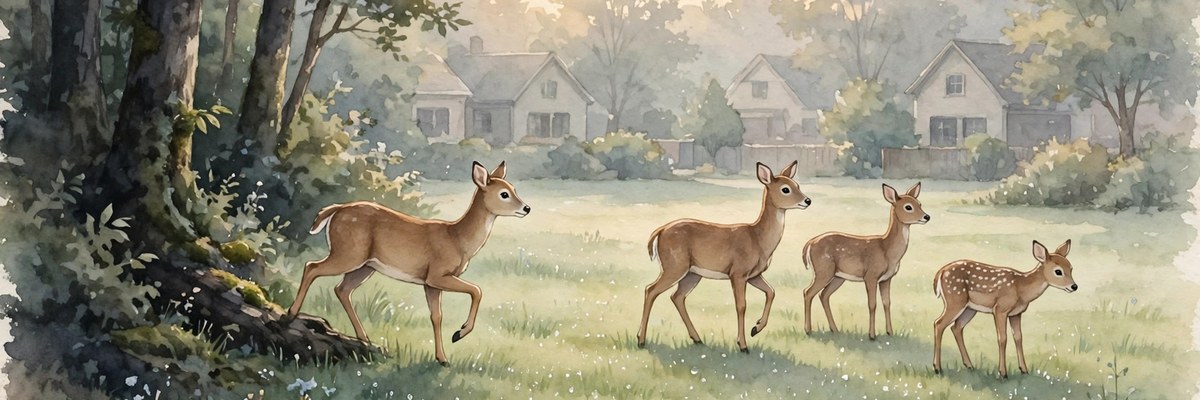
I think about the deer. Every suburb in America has them now, wandering the cul-de-sacs at dawn, eating the hostas, standing in the headlights unafraid. People conclude there is a deer epidemic. The woods were always full of deer. What the suburbs removed was the hunting—no guns, no predators, lawns laid out like a buffet. An animal hunted for ten thousand years needs about a generation to learn the lawn is safe, and then it comes out, willy-nilly, and grazes in the open. The count on the street is a reading of how dangerous the street is. It was never a reading of the deer.
I learned the same law from the other side, underwater. I had a dive spot, a reef I swam for years, and for a long time I thought it was dead—bare coral, empty water, a drowned parking lot. It was not dead. The animals were there the whole time, in the holes and under the ledges, watching me. They came out only when I shut up and got still: stopped kicking, slowed my breathing, hung in the water and let them get used to me. Then the reef arrived—fish in columns, everything feeding, a complete and verdant ecosystem that had been hiding from the loudest animal on it. My noise was the hunting pressure. My stillness was the safety signal. The reef was never empty. I was just dangerous.
The people were in the woods on the same terms. The gay son and the trans daughter were always there, in every town and every century, and the old arrangements for them were arrangements of concealment: marry them off anyway and get the babies made before the truth won out, or send the boy to the priesthood, where celibacy was not a failure but a calling and the problem was solved with honor. Gay is not an illness. Trans is not an illness. What they shared with the mentally ill was never a diagnosis. It was the woods.
The manual put them in the same building. The DSM, the book that defines mental illness in America, listed homosexuality as a disorder until 1973, and it carried cross-dressing and gender as diagnoses long after. I do not file gay or trans under illness. The book did, for most of my life, and the people of that era did not get to pick their own census. They were counted where the book counted them. That is why the woods held everybody at once.
The young cannot see the attic. There is a podcast called Old Gay Young Gay built on the two generations talking—Miguel Angel Moller, a gay Mexican American millennial in Los Angeles, sitting down with the men who came before him—and the gap in it is the gap in everything: the young map the freedoms they inherited backward onto the old and ask why the old hid, why they married, why they did not simply live free. It is not an American conversation only; it runs in Spanish and in English, in Los Angeles and in every place where the old were put away. They have never seen the madwoman in the attic—the wife, the daughter, the inconvenient mind, locked upstairs by her own family, with no hearing and no charge. The asylum was the attic with a state seal on the door. The old were not cowards. They were people who knew where the stairs went.
So the epidemic is a census of the open. More gay people, more trans people, more mentally ill people are visible than ever before—not more of them in existence, more of them out from under the carpet, on the lawn, in the daylight, unmolested. And that is why mental illness in America can finally be addressed as what it is: a problem of care, in plain sight, in numbers nobody has to estimate from the silence anymore. You cannot treat what a country has agreed not to see. The country can see it now. The deer are out of the woods.
Disclosure: the Amazon link in this piece is an Associates link (tag gerris-20). As an Amazon Associate I earn from qualifying purchases.
Share: X · Facebook · LinkedIn · Reddit · Bluesky · Threads · Email