
You Would Just Laugh
This article, read aloud:
Share: X · Facebook · LinkedIn · Reddit · Bluesky · Threads · Email
The question comes in a comment thread, on a phone screen, in the form it always takes: out of the thousands of gods men have believed in, how do you know yours is the one true God? The video that answers it runs thirty seconds, and the man in it skips the archaeology and the philosophy. He points at the questioner. My God, he says, is the only God you people are obsessed with. My Jesus is the one everybody hates the most, the one everybody freaks out about and loses their mind over, the one everybody is busy building limitations around and casting aspersions on. If my God were not God, you would treat him the way your own talk says a fairy tale gets treated. You would roll your eyes and laugh. You would just laugh.
The video is one of hundreds cut on the same pattern, and the pattern keeps working because the answer is not a doctrine. It is an observation, and anybody can check it against his own feed before the video ends.
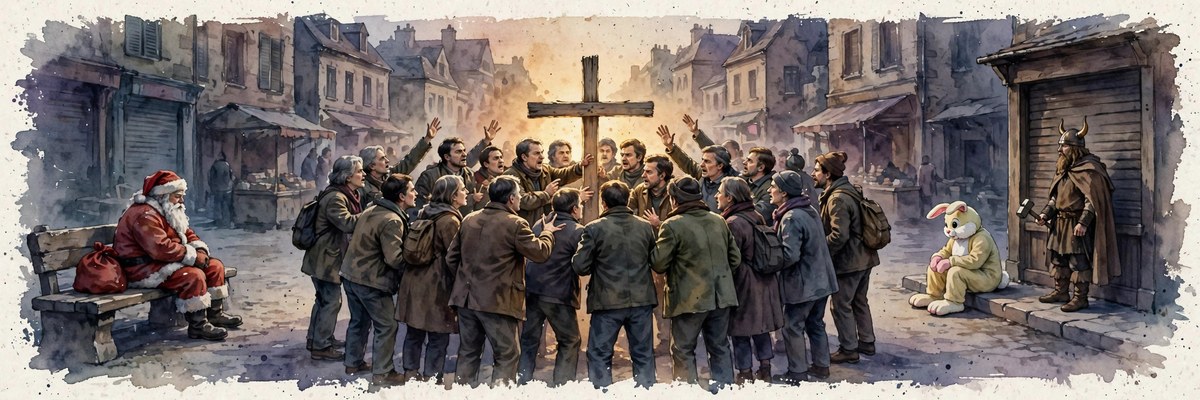
Run the inventory of the other gods and see what the world actually spends on them. Zeus gets a school subject and a cartoon lightning bolt. Odin and Thor get comic books and film franchises, and the audiences line up for tickets. The Easter Bunny gets a chair in the mall and a photograph with somebody's children. Santa Claus gets a department store, a parade, and the United States military tracking his sleigh on the evening news as a piece of seasonal charm. A Buddha sits in a thousand suburban gardens as a decoration for serenity, sold in the same aisle as the birdbath, and no neighbor has ever filed a complaint about the Buddha. Nobody sues Santa Claus. Nobody petitions to have the Bunny struck from the courthouse lawn. Nobody organizes a campaign against Thor, files briefs against Odin, or stays up until two in the morning arguing about Zeus in a comment thread. The treatment is uniform across the whole pantheon: a smile, an eye-roll, a laugh, and the subject closes. That is what settled disbelief looks like when a man honestly holds it. It looks like nothing. It costs nothing. It organizes nothing.
One name draws a different budget. One name gets the lawsuits and the limitations, the policies and the pile-ons, the aspersions cast by men who announce in the same breath that the whole thing is a fairy tale for children. His name is the swear word of people who claim he is a fiction: a man stubs his toe, drops his wrench, hears bad news, and shouts the name of Jesus Christ at the ceiling. He does not shout Santa Claus. He does not shout Odin. The profanity is a receipt—the name with power in it is the name that comes out of the mouth under pressure, and it has been coming out of unbelieving mouths for two thousand years. Watch what a man fights and you have found what he believes is real enough to matter. Men build fences around property. They litigate over things that exist. Every December the fight arrives on schedule and it is always over the same property: the creche on the courthouse lawn, the words of the greeting, whose name the holiday carries. Santa rides in the same parade the creche gets sued over, and nobody sues Santa. The energy aimed at this one name is the energy men spend on a presence, and it has never once resembled the energy men spend on Santa Claus.
The strangest part of the record is that the hatred was announced in advance, by the man himself, at a moment when his side held nothing. John 15, in the World English Bible: "If the world hates you, you know that it has hated me before it hated you. If you were of the world, the world would love its own. But because you are not of the world, since I chose you out of the world, therefore the world hates you." And again: "Remember the word that I said to you: 'A servant is not greater than his lord.' If they persecuted me, they will also persecute you." He said it in an upper room, to a handful of followers, the night before his execution. At that hour the movement's entire inventory was twelve men, a borrowed room, and a message. Christian power stood at zero: no Christian law on any book, no Christian majority anywhere on earth, nothing to push back against. The forecast named the treatment first, and the treatment arrived on schedule. Within a generation Nero was blaming the fire of Rome on the sect and, in Tacitus's account, covering Christians in animal skins for his dogs and setting them burning as torches in his gardens. Nearly two and a half centuries later Diocletian ran the last and largest imperial persecution, burning scriptures and churches across the empire. An empire mobilizes against what it takes seriously. Rome took the sect seriously from the beginning, while the sect was still small enough to fit in a courtyard.
The skeptic's answer deserves its full weight, because it explains a genuine stretch of the record. People push back hardest against the religion that holds power over their daily lives, and in the modern West that religion is Christianity. It is the largest faith on earth: Pew Research Center counts Christians at 28.8 percent of the world's population, some 2.3 billion people, more than any other religion. Its holidays set the calendar, its history sits inside the law, its members hold office and sit on school boards. A man in Ohio does not rage against Thor, the argument runs, because no Thor legislature has ever zoned his land or set his child's school day; the anger aims at institutions with their hands on real levers, at believers and their laws, not at a god in the sky. And the pattern travels: in countries where another faith holds the majority and the levers, the local pushback aims at that faith with the same heat. The skeptic can add, fairly, that Christians holding power built fences of their own across the centuries—blasphemy laws, banned books, closed theaters—and that resentment of that record is honestly part of the modern heat. Granted, and printed. On this account the temperature measures market share. Dominance explains the volume.
Dominance explains the volume in the places where Christians hold the levers. The record outruns the explanation in both directions, backward and forward. Backward: the first three centuries, when the hated held no levers at all and the hatred ran at full strength anyway, in arenas and gardens—and behind even that, the forecast itself, made from a borrowed room by a man about to be executed, naming the world's hatred as the movement's permanent weather before the movement owned a single building. Forward: the present tense in the places where Christians dominate nothing. The underground churches of China hold no office and set no policy, and they meet in secret anyway, while the state that registers their sanctioned counterparts has pulled crosses off church roofs and demolished sanctuaries. Christians in northern Nigeria bury their dead from attacks that arrive village by village, and no one accuses them of running the state. North Korea treats a smuggled Bible as a capital matter, and its Christians hold less power than any group in the country. In each case the heat is present and the dominance is absent. A theory of pushback against power keeps meeting people with no power, being pushed at the cost of their lives. The variable that survives every case is the name itself.
The opposition has been filing testimony from the first chapter of the story, and its testimony is precise. In Mark's Gospel, the first creature to identify Jesus in public is an unclean spirit in the Capernaum synagogue, and the identification is exact: "I know you who you are: the Holy One of God!" The demon had the Christology right while the disciples were still working out who they were following. At the Gerasene tombs the spirits knew his name and his rank on sight and opened negotiations for terms. James states the enemy's standing condition in one line: "You believe that God is one. You do well. The demons also believe, and shudder." Believe, and shudder. The demons' doctrine is accurate; it is their obedience that failed, and the accuracy stands in the record as testimony from the opposing camp. Nobody in the record shudders at Santa Claus. The resistance has always treated this God as a power to be named, resisted, and feared—which is why the aspersions aimed at him read as a report, filed free of charge, on which God the casters consider real enough to fight. I argued the courier side of this in As Long as the Hustler Doesn't Defile the Message: the message counts, whatever the messenger's heart holds. The heckler's side runs on the same rule. Opposition is testimony with the sign reversed, and it has been entered into evidence by the other side's own witnesses.
The skeptics' own vocabulary supplies the test, in their own words: "sky daddy." The phrase is built to end arguments. It says the thing is beneath refutation, a Santa Claus for grown men, a nursery figure with a beard. Take the phrase at face value and apply it evenly. A sky daddy gets a smirk and a changed subject. A sky daddy gets the eye-roll the TikTok man described. What a sky daddy has never gotten, in any century, is a legal strategy, an imperial persecution, a content policy, a prison term for a smuggled copy of his book, or a thousand strangers awake at two in the morning casting aspersions on him in a comment thread. The talk says fairy tale. The behavior says power. When a man's talk and his behavior file different reports, the behavior is the sworn statement. The phrase and the fence cannot both be the honest one. A man can hold either. The record shows which one got held.
So the answer to the question stands where the thirty-second video put it. If he were not God, the treatment would match the talk: an eye-roll, a laugh, a walk past the whole subject the way everybody walks past Santa Claus, and the subject would close. The subject has refused to close for two thousand years—through emperors who fed it to animals, through empires and parties that outlawed it, through every generation's fresh set of limitations and aspersions, down to a comment thread tonight. The eye-roll exists, and it gets spent daily: on horoscopes, on garden Buddhas, on Thor. At scale, in any century on record, it has simply never been spent on him. Nobody builds a fence around nothing. The fence is the confession. You would just laugh. You don't.
Disclosure: the Amazon link in this piece is an Associates link (tag gerris-20). As an Amazon Associate I earn from qualifying purchases.
Share: X · Facebook · LinkedIn · Reddit · Bluesky · Threads · Email