Read the full transcript (2,522 words, machine made)
All right, let's dive into something you might not even realize you're hearing. There's a sound this country makes if you really know how to listen for it. Not the obvious stuff. No, exactly. Not the parades, not the anthems, but something much quieter, more intimate. It's that you know that hushed click of a basement fridge door opening late at night.
Yeah, I know that sound. You know the one, right? And it's followed by those muffled footsteps, someone quietly bringing food downstairs, maybe to a relative who's supposed to stay for a week, but, well, never quite left. Happens all the time. It does. And this, see, this is like the audible pulse of America's unacknowledged social safety net. The source material we looked at actually calls it America's Black market of Democratic Socialism. That's a striking phrase, isn't it? So our mission today is a deep dive into this whole complex societal workaround.
We're using this really powerful metaphor from the sources a house, a strict father, a soft mother and this hidden basement. To sort of unpack it all. Exactly To illuminate this secret safety net and the the whole national debate that's swirling around it. OK, I'm with you. So imagine America as this House, right?
But it's like it was built without a proper permit. You can see the cracks and the beams. The walls are kind of propped up by forces you don't normally see. Got a? Bit shaky. Bit shaky, yeah, And nailed to the kitchen fridge by the strict father, he's like the embodiment of America's official story. You know, rugged individualism, free market. Right.
The Constitution in boots, the HOA president maybe? Yeah, totally. You find these rules like no free ride, sink or swim. Charity is good. Coercion is theft. Work or get out.
That's the official brand, we're told. The mythology. OK. But public face? But then, then there's the soft mother. She's the work around.
She represents the the administrative state, maybe quietly stepping in, providing for knees when those official rules are just too harsh or they just plain fail. A quiet. Fix Exactly. And here's where it gets really interesting for me in the source material, the noise of this so-called black market of democratic socialism. It's those muffled steps.
It's the mother slipping a fold in 20. It's that cousin who just stays. It's the hum of that basement fridge, a reality everyone kind of knows exists deep down, but nobody really wants to name. Yeah, it's felt more than spoken about. So what exactly is in this hidden basement? According to the sources, What does it actually hold? Good question.
What lives down there? Well, it's basically all the things we publicly say we don't need, but they're definitely down there doing the work you've got, like field church pantries, right? Quietly making sure whole blocks don't go hungry. Then there are these neighborhood nonprofits. And if you actually follow the money, the sources say they're often 80% federal money.
It's just channelled through, well, it looks like shell games sometimes. 80% Wow. Yeah, even something like the Peace Corps gets mentioned describe as our hush hush export version of the same idea. You know, a bright eyed Kennedy dream may be designed to make poverty look less like imperialism when we deal with it overseas. Never thought of it quite like that.
And think about charities we praise. So many are actually built on these hidden pipelines of grants and subsidies. We're talking about SNAP Peaks EITC credit. Earned Income Tax credit. Exactly. And even those pandemic emergency dollars, remember how much those prop things up.
Absolutely crucial stuff. But this whole work around, it's not on the blueprint as the material puts it, it never got the permit. So why? Why did it develop this way? Well, the sources suggest it's partly because there's this deep historical distrust of big government here, plus really strong beliefs and individual responsibility. The strict father rules.
Exactly. So it was politically easier, maybe the path of least resistance, to address real needs this way quietly, rather than try to vote for direct public aid out in the open. You preserve the ideal image that way. So it's not just accidental. No, it's presented more like a design feature or this other quote, a moral contradiction Americans keep on life support because maybe they don't trust each other enough to actually vote for the real thing in daylight.
A moral contradiction that really hits home and it leads right into this conflict, this mold versus roses debate you see in the sources. Yeah, tell me about that split. Well, the same hidden basement, the same workaround. It's viewed completely differently depending on who's looking for roughly, say, 30% of people. The sources link this view often with progressives like Zoran Mamdani. He's a New York legislator.
For them, that basement is a garden. It's full of roses. It's the soft blossom that keeps the house humane, keeps America's heart beating. It's seen as vital mercy, you know, making our hypocrisy a little less, right. But then you have the other side, maybe 70%. The rugged ones, the Iron Dad ones, the people who fundamentally see taxes theft.
For them, it's black mold, it's moral decay, it's termites in the joists that are sucking the value and the the moral character out of the house. Wow, completely opposite views of the exact same thing. Exactly. So what does it all mean? It just highlights this deep irony. Both sides swear they care about the house, about the people in it.
But one sees the hidden help as mercy, as a bloom, and the other sees it as well as moral theft or a dangerous rot. And connecting that to the bigger political picture, the sources explained that for that, 70%, taxes really are seen as theft. Like, fundamentally they'd, and this is a paraphrase, but they'd rather stand shivering in an empty lot than feel robbed to build a greenhouse they never agreed to. That's a powerful image. It is, and it's crucial, the source of stress.
Neither side really wants people to suffer. But one side, like Mom, Donnie argues, OK, let's bring the fridge upstairs. Let's plant the roses out front. Let's make it official. Tax, taxes, votes acknowledge it, He basically says, look, we are kind of a democratic socialist country already in some ways.
Just admit it and do it properly. Right. But the other side, the 70%, they want to tear it down because they see it as a lie, as this unpermitted addition that's dragging down the property value of their ideal America. Which leads us straight to this figure of Iron Dad and the whole tear down idea, right? How did past leaders handle this this mold?
Well, the sources have some interesting takes. Reagan, they say, kind of sniffed the mold and called it character building. Boosh Senior maybe shrugged. Clinton put up some Third Way wallpaper. Covering it up a bit. Yeah, and Obama even upgraded the mini fridge and painted it. Hope Glue, but none of them really removed it or made it official.
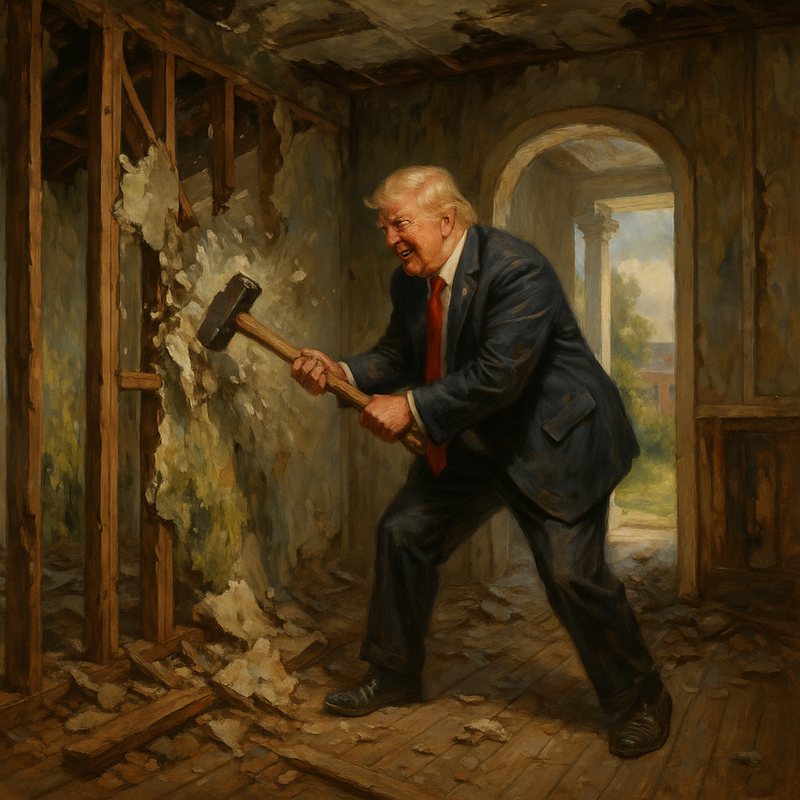
So it always stayed hidden. Always stayed moms purse, never the people's will. That's a direct quote. Then comes Donald Trump, described as Iron dad 47. He didn't invent the mold, wasn't the 1st to see it, but he came down with a flashlight, saw it clearly.
A secret wing that never had a permit full of people eating from a fridge they never paid for. And his motivation? According to this analysis, it wasn't primarily about causing pain. But he hated the lie. He hated the unpermitted nature of it all. So he called the inspector, ready to strip it to the studs. Uh huh.
Taking serious action. Serious action. And this is where it gets really pointed. You know that old saying from Audra Lord, You cannot dismantle the master's house with the master's tools. Yes, very famous quote. Well, the source material flips it. It says actually you can tear the whole thing down with them. Whoa.
OK, unpack that. Who is the master or the landlord here and what are the tools? That's the crucial question the material raises. Because it's not just one politician, right? No, the twist is the landlord isn't Trump or Reagan or Obama.
It's us the people. Or more specifically, that 70% who see taxes as theft and the basement is mold. So we are the landlord. In this metaphor, yes. And the real tool isn't even the Supreme Court, though The court acts like the inspector wearing a tool belt, finding the termites, the mildew, the undocumented cousins.
OK, so what's the real tool? The real tool is the lease, the vote. And it's short. Four years. Eight years.
Which means the next tenant, the next administration, the next voter mandate can come in and just RIP out your carpet and your moldy crawl space and your beautiful hidden rugs. Because it was never official. Exactly. The whole system is vulnerable because it was never permitted. It was never explicitly voted for in the 1st place.
It's just a workaround with no real defense when a determined inspector shows up. That makes the whole thing feel incredibly precarious. It does, and that leads to another critical point, maybe an ugly one that nobody likes to say out loud. Which is. That not all of these workaround roses are real.
They're not all genuine blossoms of mercy. What do you mean? The source is used as powerful parallel fighting a war with private contractors like Blackwater versus using budgeted official soldiers. OK, how does that connect? Well, real soldiers are under congressional oversight. They're paid less, relatively speaking. They're part of the official structure. But private mercs?
They're super expensive. 1000 bucks a day sometimes. Yeah, for work a corporal does for way less per year, and they often lack clear accountability when things go wrong. Right. That's been a huge issue.
So how does this apply to the social safety net? It applies directly to what the sources call our shadow social democracy. The material details how many independent nonprofits are 80% tax dollars funneled through shell games. Think about the effects. What kind of effects? Well, you see CEO's of these nonprofits making more than governors, maybe even generals.
Administrative costs running hotter than the engine. Big parties, endless consultancies. Wow, sounds like grift. It's framed as basically a mercenary system for social support, which raises a really important question. Is the cost of hiding our safety net that it becomes incredibly inefficient and opaque?
Because you need middle men. Exactly. When you hide it, you risk filling it with middle men who profit from Allied that it's private. They're selling plastic roses dusted with rose water. Plastic roses? That's bleak.
It is it's unpermitted mercy and it creates this whole black market economy of moral middle men. And they have an incentive to keep the mold hidden, maybe manage it, but never really get rid of it. Because they profit from the secrecy. Precisely. And that secrecy, that opacity, it can also just breed cynicism among the public, right, which makes it even harder to ever build support for a system that's truly transparent and, you know, codified.
Which brings us right back to the present dilemma, the choice facing the landlord. Yeah, the decision point. You have Zoran Mamdani's vision. OK, Bring the fridge upstairs. Put the kids in the living room where they belong.
Pass the HOA vote. Build a real greenhouse. Pay for it with taxes. Be honest about it. The open daylight approach. Contrasted sharply with Iron Dad's stance, which is not on my lease, not while I hold the crowbar back to the studs. No compromise there.
Be grateful it's not a full tear down yet. Next time maybe it will be. And meanwhile, the mother, the administrative state, is pictured rummaging through this emptying purse, just wondering if the kids will ever get their own house. Or if the mold just takes over completely. Yeah.
Or if they just keep living in her basement till the mold wins. So looking at the bigger picture, the ultimate question really boils down to do you want the roses, the real men's growing out in the daylight, or are you OK with this hidden, very vulnerable workaround? That seems to be the core choice. And if you do want the real roses, the sources are pretty clear. You're going to have to stand out front and admit they cost money. They cost taxes, votes, line items. You have to own it.
You have to own it. You have to basically say out loud that you'd rather keep your neighbors fed than cling to some illusion of rugged cowboy freedom that maybe never really existed for everyone anyway. But there is that counter argument too. Right there is you have to acknowledge the other view. Maybe the mold was always fatal.
Maybe a tear down is necessary to build something honest, something truly based on the stated principles. Starting over from scratch? Right. But, the sources warn, if that's the path you choose, don't fool yourself. The new house won't come with floaties. There won't be a hidden safety net anymore. Sink or swim for real this time.
Pretty much. And if you do decide you want some kind of safety net in that new house, well, you'd better plant them in the front yard, vote for them, tax yourself for the fence, and stand guard when the next dad calls the bulldozer 'cause it will need defending. Wow. OK, so this deep dive really has, I think, pulled back the curtain on this secret safety net we often pretend isn't there, this whole black market of democratic socialism operating like right under our feet. Yeah, it's a powerful lens and. We've navigated that core dilemma, the contrast between the mercy, however hidden from the mother's purse, and the very real potential for a tear down from Iron Dad and that 70% who just see corrosive mold.
Yeah. So ultimately, maybe the question for you, the listener, to really ponder is this. If a house is what you say it is, you know, on paper, in the building code, in your neighbor's heart. And if this mold we've been talking about is actually the price you pay for lying to yourself about needing help. Then what do you really lose when you pretend you never needed that help in the 1st place?
Just remember, in this story, the landlord is US. The vote is the lease. And the lease is short. Very short. The inspector is already on the porch, the bulldozer is warming up, and if you don't speak now, well, the next cold night is eventually going to come for you, too. A.
Sobering thought to end on. Sleep tight and maybe keep your ears on the floorboards.